
Need a solution?
This guide covers practical, effective strategies to ensure every sentence counts, keep your ideas organized, and help you communicate with confidence.
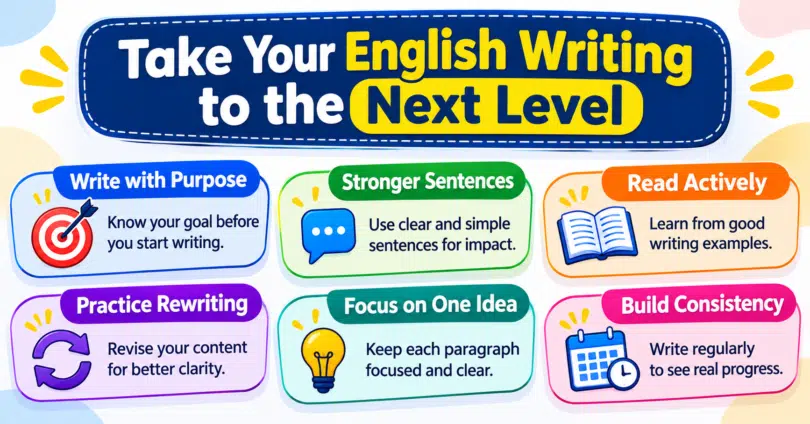
6 Tips for Writers To Improve Their English Writing Skills
Here are some professional, effective tips to help you improve your English writing skills without extra effort.
1. Write with a Clear Purpose Every Time
Remember, to improve your writing skills, you need to give your content a clear, defined purpose.
Therefore, before you dive into writing, make sure to first spare some time and decide what exactly you want to discuss and how. Decide what you want the reader to learn, feel, or do.
Trust me: when you have a clear goal from the start, every sentence you add will add value and move you toward it. It also helps you choose your tone, examples, and structure effectively.
Remember, readers trust writing that stays focused and intentional. Whether you write an essay or an article, purpose shapes quality. When each paragraph supports one clear idea, your writing feels confident, direct, and professional.
2. Strengthen Your Sentences, Not Just Your Vocabulary
If you want to write content everyone admires, you need to understand one thing: strong writing isn’t about fancy vocabulary or technical jargon.
You need to craft clear sentences and express ideas effectively so readers can easily grasp the main idea and stay engaged.
To do this, pay special attention to how you structure your content.
Write in short and clear sentences. Be comprehensive, but don’t overexplain anything.
Use strong verbs and active voice for clarity.
Moreover, discuss only one idea at a time, and move on to the next only after you’ve finished explaining it.
Add smooth transitions between sentences, and make sure each point connects coherently with the others.
Trust me, when you stick to these simple habits, your content will sound more polished and professional.
3. Read Actively to Learn How Good Writing Works
If you ask me, the best way to improve your writing skills is by sharpening your reading habits.
Believe it or not, reading sharpens writing skills faster than any shortcut.
So, if you want to improve your grip on any topic, read relevant articles, blogs, research papers, books, or journals in that niche.
Pay attention to how the author covered the topic. Analyze their sentence flow, transitions, and word choices. Notice how they introduce ideas and support them with examples.
Wondering how it helps?
Active reading means learning structure, not just content. This habit improves your intuition about tone and clarity. It also helps you avoid awkward phrasing. Over time, reading builds a natural rhythm in your writing and exposes you to new vocabulary, phrases, and expressions that can help you write like a pro.
4. Practice Rewriting to Improve Clarity and Flow
Honestly, sometimes rewriting ideas you’ve already discussed improves your writing more than writing from scratch.
Let me explain how.
When you first draft, you focus on getting ideas down. When you revise, your first focus is on content clarity. Thus, this approach ultimately helps you communicate more effectively. But here’s a catch: just rewriting isn’t enough. In fact, you need to know some rewriting basics to make sure your efforts are worth it. When refining, read the content thoroughly and closely. Look for repetition and remove it immediately. Also, break long sentences into shorter ones. If anything seems unclear or awkward, refine it and restructure it. Thoughts flow more naturally.
However, if clarity is still an issue, you can also use a free paraphrasing tool to suggest alternative sentence structures or clearer phrasing. The best part is that the tool doesn’t just refine your content; it also helps you learn different ways to describe the same idea.
This ultimately adds more diversity to your writing style without extra effort.
5. Focus on One Idea Per Paragraph
To polish your overall writing skills, keep your paragraphs focused.
Each paragraph should develop one clear idea from start to finish. Mixing multiple points weakens the impact and confuses readers. Start with a clear opening sentence. Support it with explanation or examples. End once the idea feels complete. This structure improves readability and logic.
It also makes your writing easier to revise. When each paragraph serves one purpose, your argument feels organized and convincing. Readers follow your thoughts without effort. This habit works for essays, reports, and creative writing alike.
6. Build Consistency Through Daily Writing Practice
Improvement comes from consistency, not perfection. So, if you want to improve your writing, write regularly, even in short sessions.
Daily practice improves fluency and confidence. It helps you think in English naturally instead of translating ideas. Writing often also reduces hesitation and self-doubt.
The key point is this: writing well is a skill, not a talent; you can learn and polish it only through consistent practice.
Each writing session strengthens control over grammar, tone, and structure. Over time, your progress becomes visible.
When writing becomes routine, quality improves without pressure. That consistency pushes your English writing to a higher level.
Conclusion
In conclusion, strong writing isn’t something you can achieve by memorizing a few tips. In fact, it takes awareness, intention, and steady effort.
Every improvement starts with paying attention to how you think, structure, and refine your ideas.
When writing feels deliberate instead of forced, improvement becomes visible. Therefore, if you want to write well, then keep showing up, keep refining, and let your writing reflect the clarity of your thinking.

Leave a Comment