
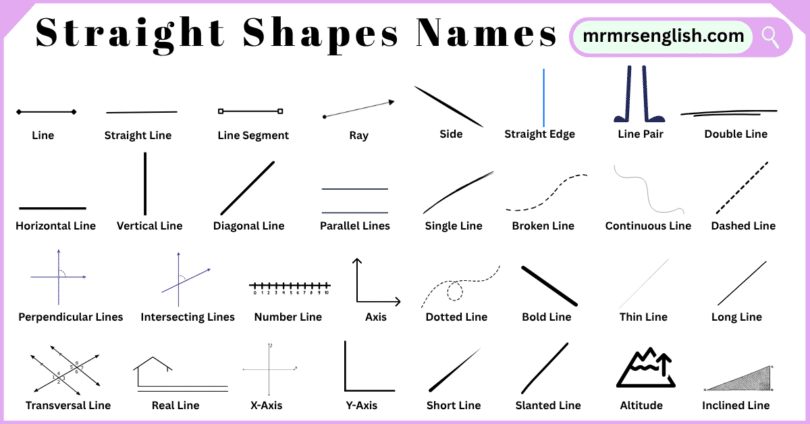
Straight shapes are geometric figures made mainly with straight lines, sides, and angles, making them easy to recognize in mathematics and everyday objects. They come in many forms, including squares, rectangles, triangles, rhombuses, trapezoids, and different polygons, each having its own number of sides and corners. Learning the names of straight shapes is a useful way to improve English vocabulary while developing a basic understanding of geometry. In this article, you will learn straight shape names in English with clear pictures, helping kids, students, teachers, beginners, and English learners easily identify, understand, compare, remember, and use these shape names with confidence.
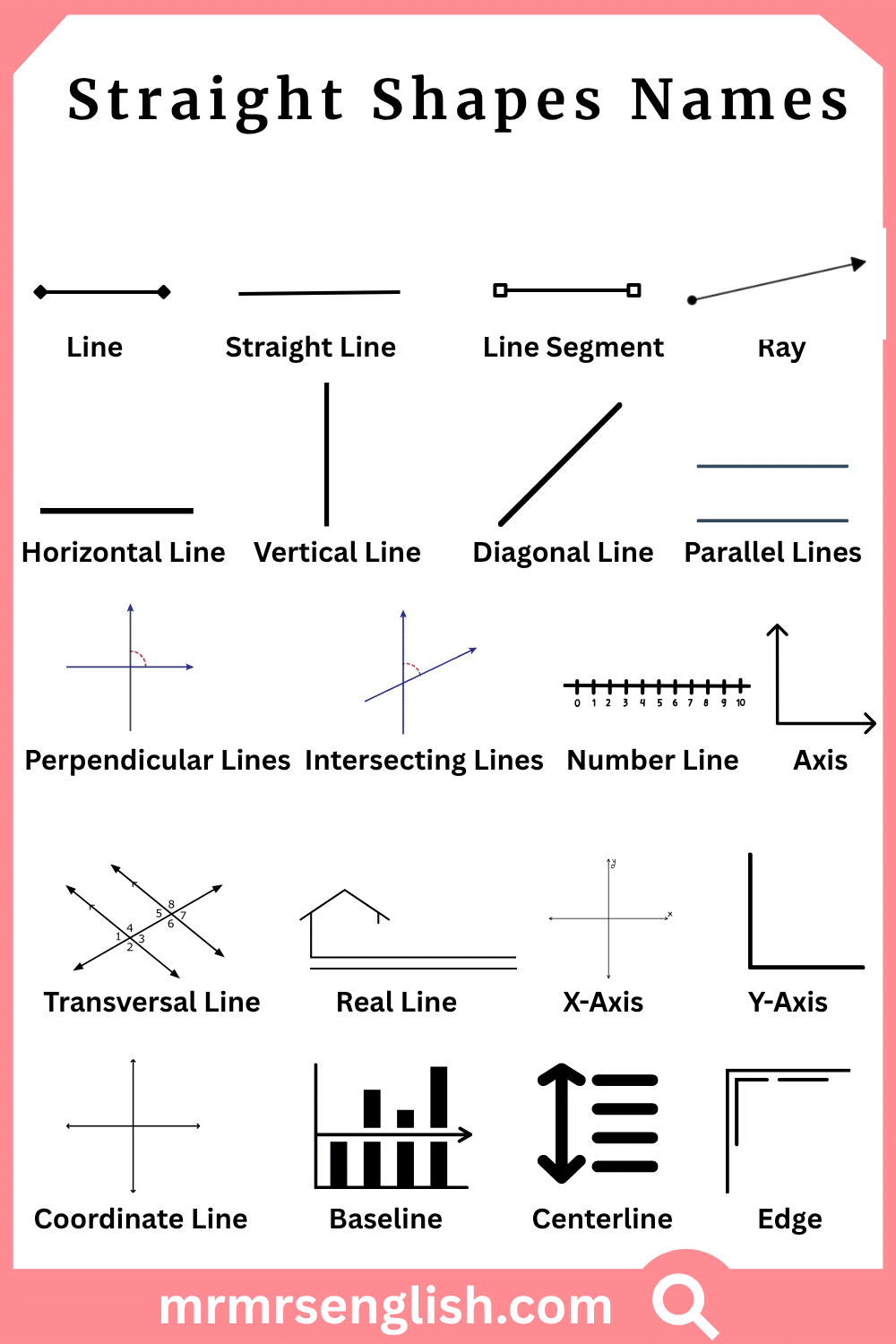
List of Straight Shapes Names in English
- Line
- Straight Line
- Line Segment
- Ray
- Horizontal Line
- Vertical Line
- Diagonal Line
- Parallel Lines
- Perpendicular Lines
- Intersecting Lines
- Transversal Line
- Number Line
- Real Line
- Coordinate Line
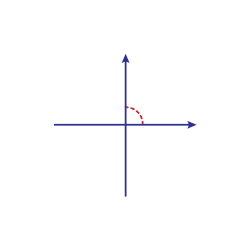
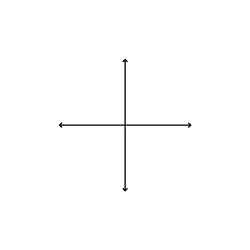
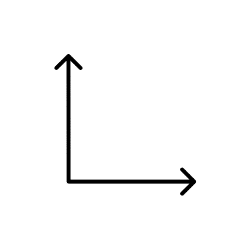
- Axis
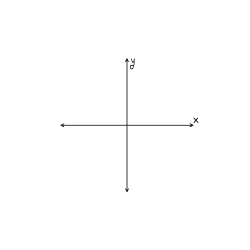
- X-Axis
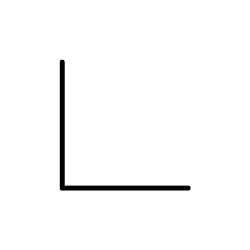
- Y-Axis
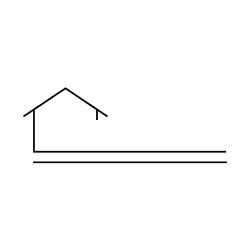
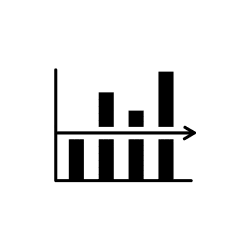
- Baseline
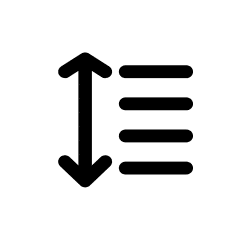
- Centerline
- Edge
Straight Shapes Names in English with Pictures
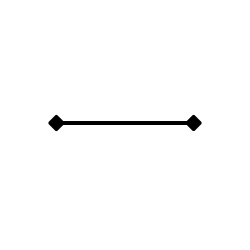
- Line
A line is a straight path extending endlessly in both directions without having any endpoints.

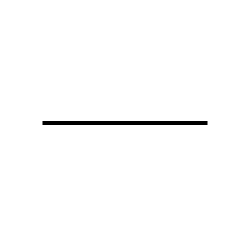
- Straight Line
A straight line is a perfectly direct path with no curves, extending infinitely in both directions.
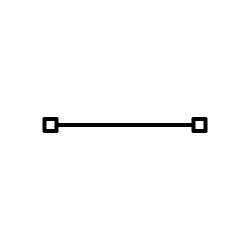
- Line Segment
A line segment is a straight part of a line with two definite endpoints.
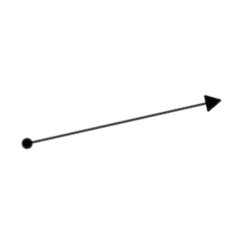
- Ray
A ray is a straight part beginning at one endpoint and extending endlessly in one direction.
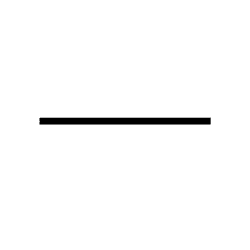
- Horizontal Line
A horizontal line runs straight from left to right, remaining at the same height throughout.
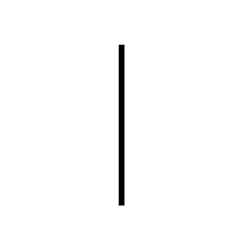
- Vertical Line
A vertical line runs straight up and down, forming a right angle with horizontal lines.
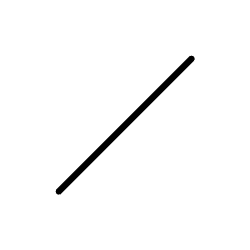
- Diagonal Line
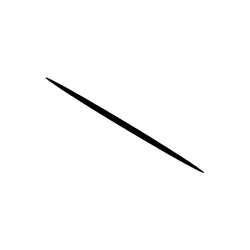
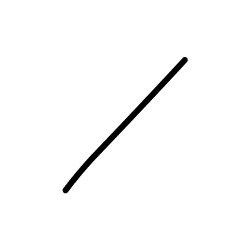
A diagonal line is a straight line that slopes between horizontal and vertical directions.
- Parallel Lines
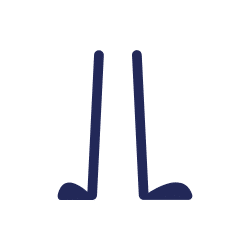
Parallel lines are straight lines that remain equally spaced and never meet, even when extended.
- Perpendicular Lines
Perpendicular lines are lines that cross each other and form four right angles at their intersection.
- Intersecting Lines
Intersecting lines are two or more lines that cross at one common point.
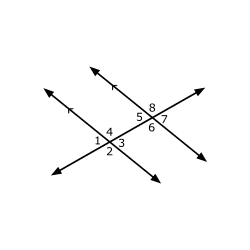
- Transversal Line
A transversal line crosses two or more lines at different points within the same plane.
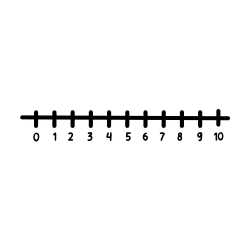
- Number Line
A number line is a straight line showing numbers arranged in order at equal intervals.
- Real Line
A real line represents all real numbers arranged continuously along a straight mathematical line.
- Coordinate Line
A coordinate line is a straight line used to locate points using numerical positions.
- Axis
An axis is a reference line used to measure positions or describe coordinates on a graph.
- X-Axis
The x-axis is the horizontal reference line in a coordinate system used to locate positions.
- Y-Axis
The y-axis is the vertical reference line in a coordinate system used to locate positions.
- Baseline
A baseline is a reference line from which measurements, positions, or other elements are commonly determined.
- Centerline
A centerline is a reference line marking the exact middle of an object, shape, or space.
- Edge
An edge is a straight boundary where two surfaces or sides of a geometric object meet.


Straight Shapes Names in English with Pictures
40 Straight Shape Name in English
- Side
- Straight Edge
- Line Pair
- Double Line
- Single Line
- Broken Line
- Continuous Line
- Dashed Line
- Dotted Line
- Bold Line
- Thin Line
- Long Line
- Short Line
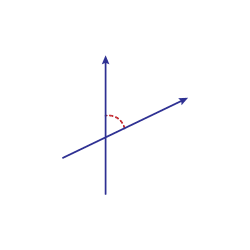
- Slanted Line
- Inclined Line
- Oblique Line
- Median
- Altitude
- Diameter
- Chord
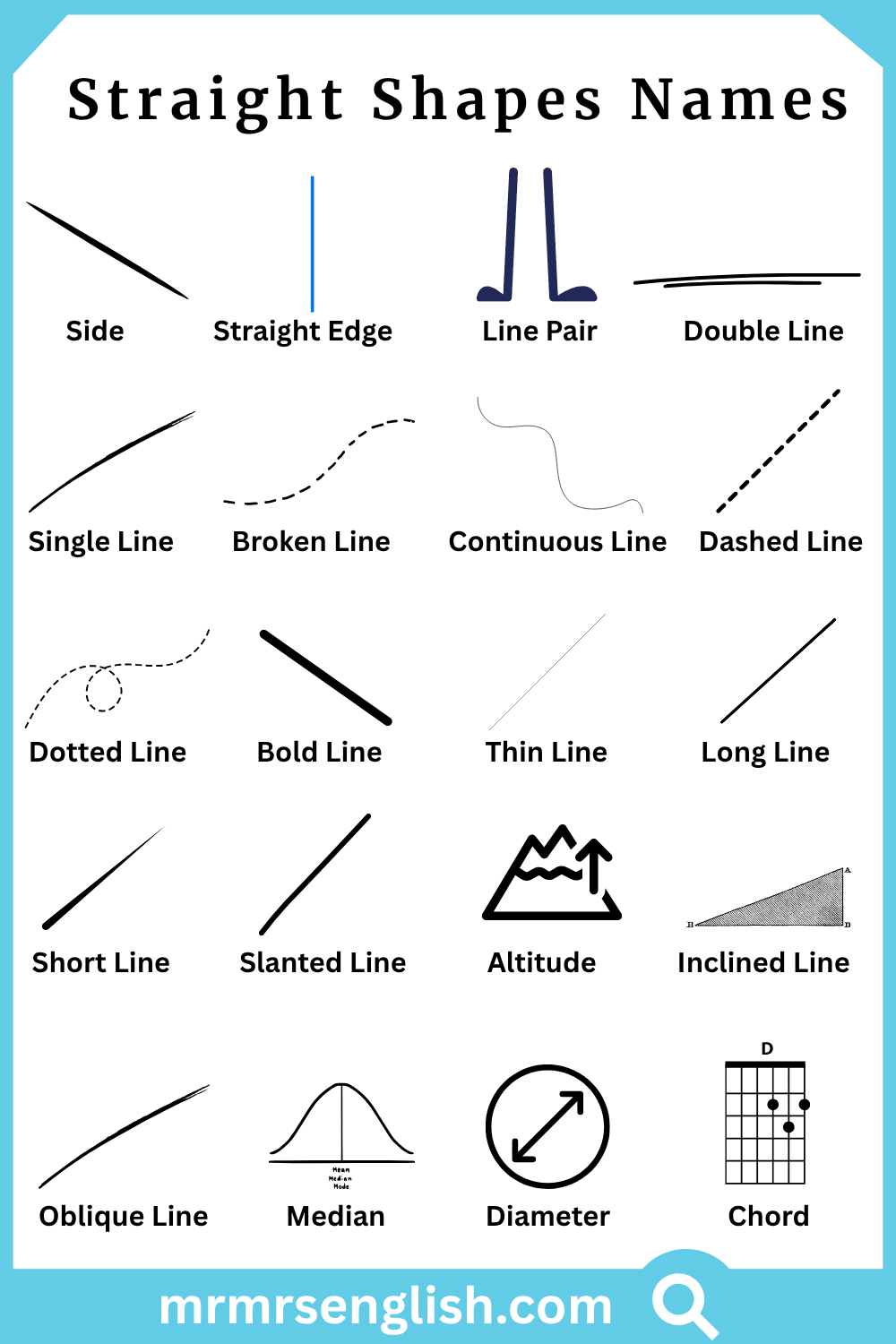
Basic Straight Shapes Names with Pictures
- Side
A side is a straight boundary of a shape connecting two points, corners, or vertices within a geometric figure.
- Straight Edge
A straight edge is a perfectly straight boundary used to form or measure the sides of geometric shapes.
- Line Pair
A line pair consists of two lines that may be parallel, intersecting, perpendicular, or related in another specific way.
- Double Line
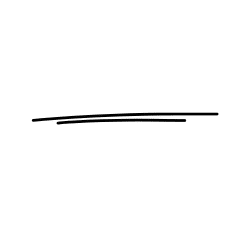
A double line consists of two straight lines drawn closely together, often used for boundaries, symbols, or emphasis.
- Single Line
A single line is one continuous straight stroke used to represent boundaries, paths, measurements, or geometric elements.
- Broken Line
A broken line consists of straight line sections joined together, creating changes in direction between connected points.
- Continuous Line
A continuous line is drawn without lifting the drawing tool, forming an unbroken path from beginning to end.
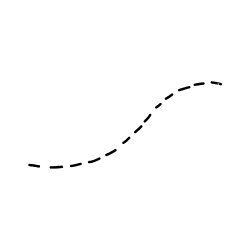
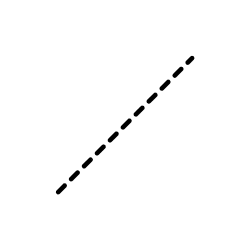
- Dashed Line
A dashed line is made from separate short strokes with regular spaces between them, often showing boundaries or hidden features.
- Dotted Line
A dotted line consists of small separate dots arranged along a straight path to indicate separation or guidance.
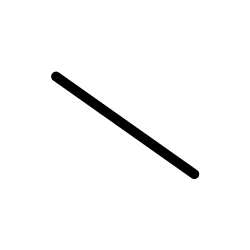
- Bold Line
A bold line is a thick, strongly visible line used to emphasize boundaries, outlines, or important drawing features.
- Thin Line
A thin line is a narrow straight stroke commonly used for details, measurements, construction, or delicate drawing elements.
- Long Line
A long line is a straight stroke extending across a considerable distance between its starting and ending points.
- Short Line
A short line is a small straight stroke with a limited length between its two endpoints.
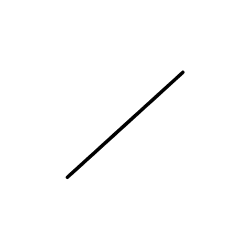
- Slanted Line
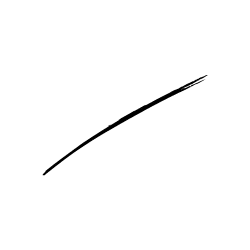
A slanted line is a straight line that leans at an angle instead of running horizontally or vertically.
- Inclined Line
An inclined line is a straight line positioned at an angle to a horizontal reference line or surface.
- Oblique Line
An oblique line is a straight line that is neither horizontal nor vertical, forming an angled direction.
- Median
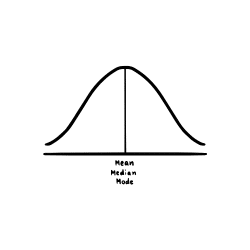
A median is a line segment joining a triangle’s vertex to the midpoint of the opposite side.
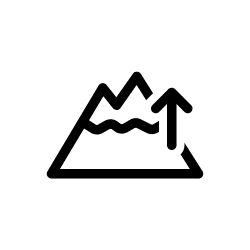
- Altitude
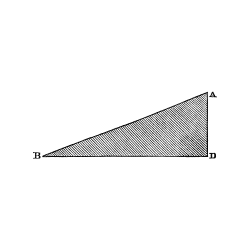
An altitude is a perpendicular line segment drawn from a triangle’s vertex to its opposite side or extension.
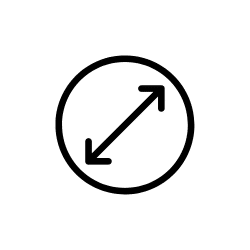
- Diameter
A diameter is a straight line segment passing through a circle’s center and connecting two points on its circumference.
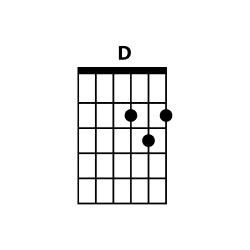
- Chord
A chord is a straight line segment connecting any two points on the circumference of a circle.
Basic Straight Shapes Names with Pictures
Learn more helpful articles




Leave a Comment