
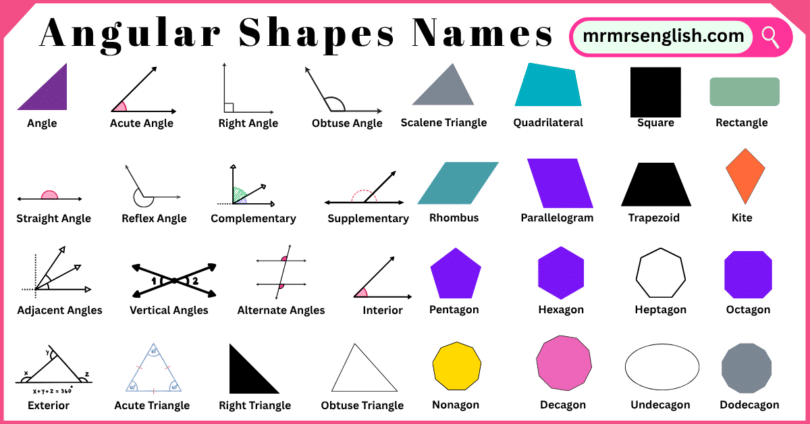
- Angle
- Acute Angle
- Right Angle
- Obtuse Angle
- Straight Angle
- Reflex Angle
- Complementary Angles
- Supplementary Angles
- Adjacent Angles
- Vertical Angles
- Alternate Angles
- Corresponding Angles
- Interior Angles
- Exterior Angles
- Triangle
- Acute Triangle
- Right Triangle
- Obtuse Triangle
- Equilateral Triangle
- Isosceles Triangle
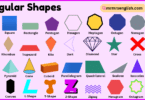
Angular Shapes Names in English with Pictures
- Angle
An angle forms when two rays meet at one common endpoint, creating a measurable opening between them.

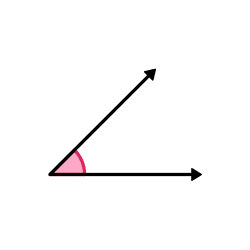
- Acute Angle
An acute angle measures less than 90 degrees, making a small and narrow opening between two rays.
- Right Angle
A right angle measures exactly 90 degrees and forms a square corner between two perpendicular lines.
- Obtuse Angle
An obtuse angle measures more than 90 degrees but less than 180 degrees, creating a wide opening.
- Straight Angle
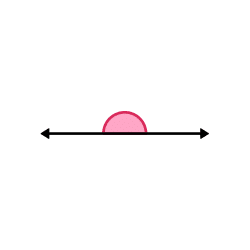
A straight angle measures exactly 180 degrees and forms a straight line with two opposite rays.
- Reflex Angle
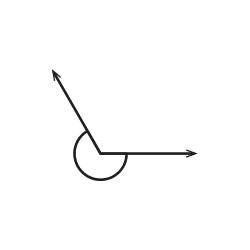
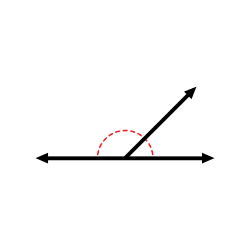
A reflex angle measures more than 180 degrees but less than 360 degrees, creating a large opening.
- Complementary Angles
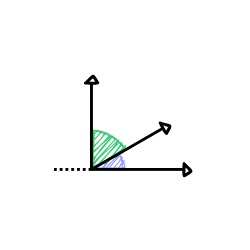
Complementary angles are two angles whose measures add together to exactly 90 degrees.
- Supplementary Angles
Supplementary angles are two angles whose measures add together to exactly 180 degrees.
- Adjacent Angles
Adjacent angles share a common vertex and one common side without overlapping each other. - Vertical Angles
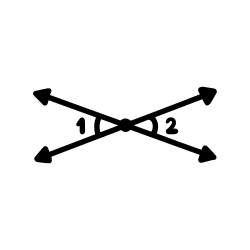
Vertical angles are opposite angles formed when two straight lines intersect and always have equal measures.
- Alternate Angles
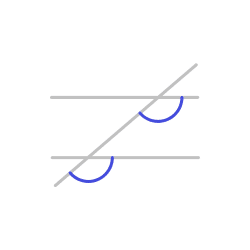
Alternate angles are angle pairs formed by a transversal crossing two lines on opposite sides.
- Corresponding Angles
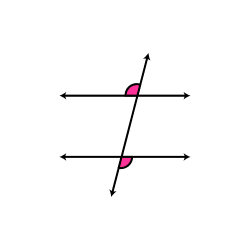
Corresponding angles occupy matching positions when a transversal crosses two lines, especially when those lines are parallel.
- Interior Angles
Interior angles are angles located inside a polygon or between two lines crossed by a transversal.
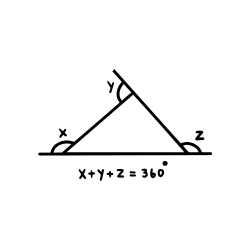
- Exterior Angles
Exterior angles are angles formed outside a polygon or outside the region between two lines.
- Triangle
A triangle is a three-sided polygon with three straight sides, three vertices, and three interior angles.
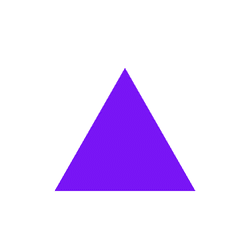
- Acute Triangle
An acute triangle has three interior angles, and each angle measures less than 90 degrees.
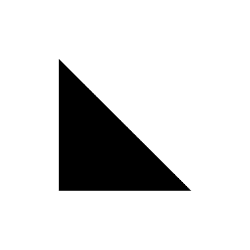
- Right Triangle
A right triangle has one right angle measuring exactly 90 degrees and two acute angles.
- Obtuse Triangle
An obtuse triangle has one angle measuring more than 90 degrees and two acute angles.
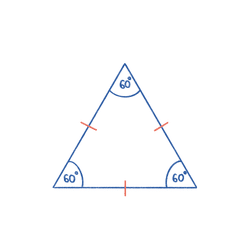
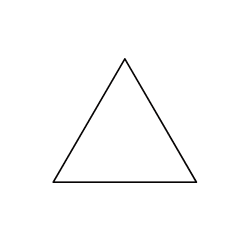
- Equilateral Triangle
An equilateral triangle has three equal sides and three equal angles, each measuring exactly 60 degrees.
- Isosceles Triangle
An isosceles triangle has at least two equal sides and two equal opposite angles.


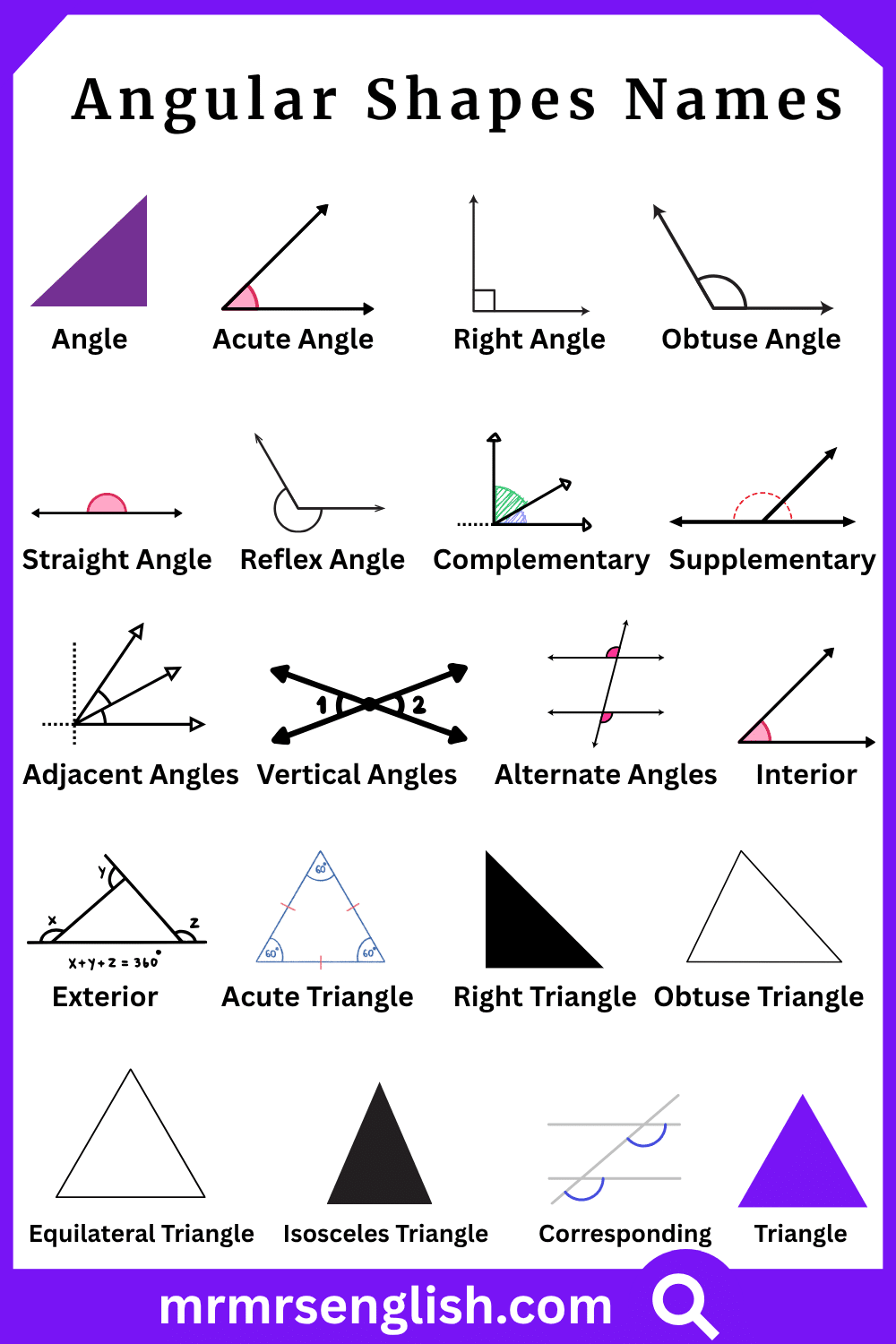
Angular Shapes Names in English with Pictures
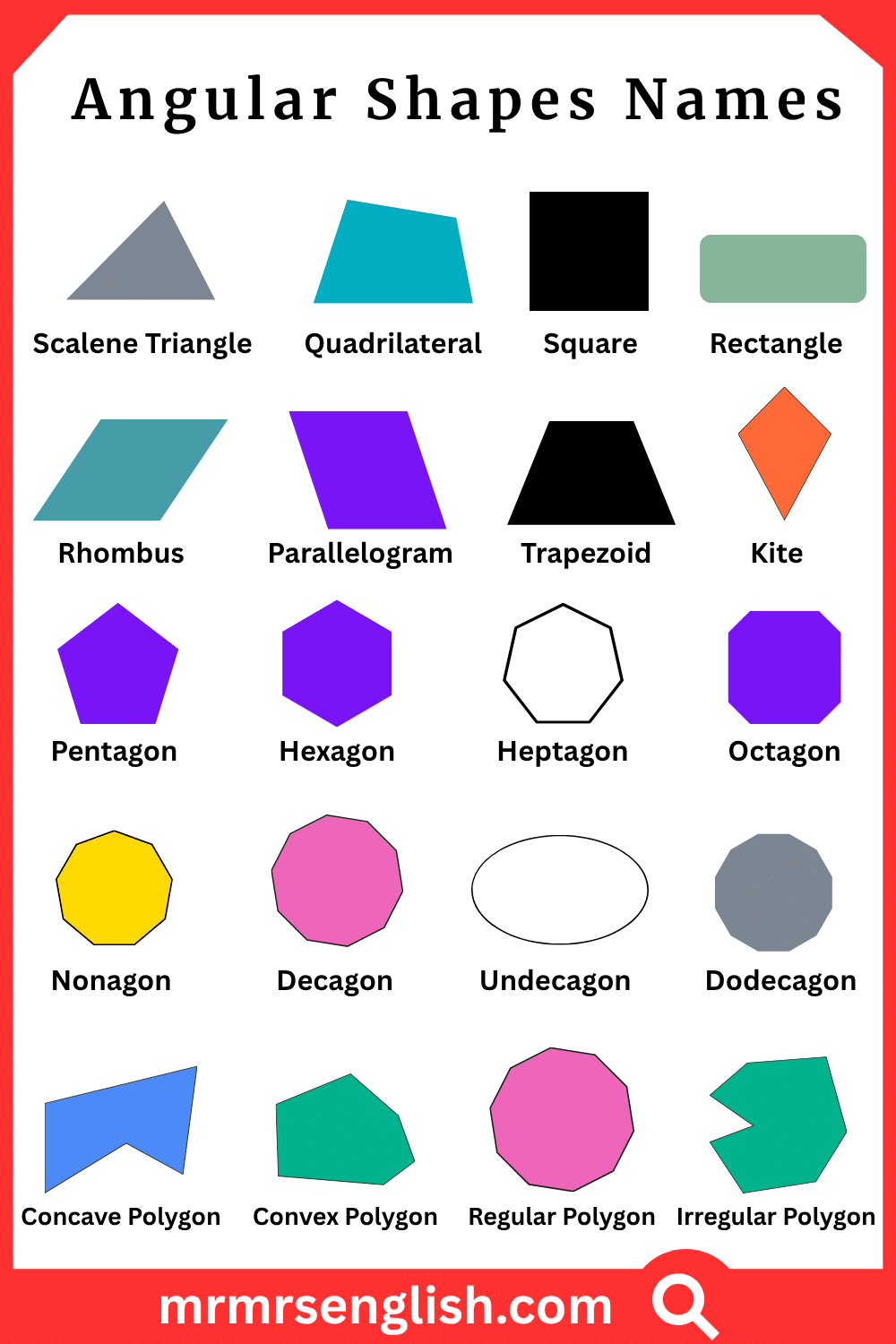
40 Angular Shape Name in English
- Scalene Triangle
- Quadrilateral
- Square
- Rectangle
- Rhombus
- Parallelogram
- Trapezoid
- Kite
- Pentagon
- Hexagon
- Heptagon
- Octagon
- Nonagon
- Decagon
- Undecagon
- Dodecagon
- Concave Polygon
- Convex Polygon
- Regular Polygon
- Irregular Polygon
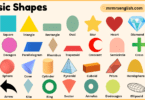
Basic Angular Shapes Names with Pictures
- Scalene Triangle
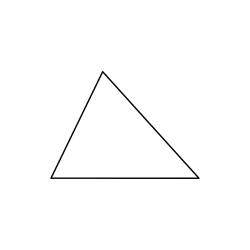
A scalene triangle has three sides of different lengths and three angles with different measures.
- Quadrilateral
A quadrilateral is a four-sided polygon with four straight sides, four vertices, and four interior angles.
- Square
A square has four equal sides and four right angles, with opposite sides parallel to each other.
- Rectangle
A rectangle has four right angles, with opposite sides equal in length and parallel.
- Rhombus
A rhombus is a quadrilateral with four equal sides and opposite sides parallel.
- Parallelogram
A parallelogram is a quadrilateral with two pairs of opposite sides parallel and equal in length.
- Trapezoid
A trapezoid is a quadrilateral with at least one pair of opposite sides parallel.
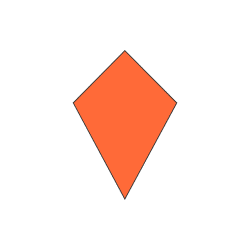
- Kite
A kite is a quadrilateral with two pairs of adjacent sides equal in length.
- Pentagon
A pentagon is a five-sided polygon with five straight sides, five vertices, and five interior angles.
- Hexagon
A hexagon is a six-sided polygon with six straight sides, six vertices, and six interior angles.
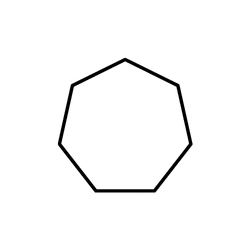
- Heptagon
A heptagon is a seven-sided polygon with seven straight sides, seven vertices, and seven interior angles.
- Octagon
An octagon is an eight-sided polygon with eight straight sides, eight vertices, and eight interior angles.
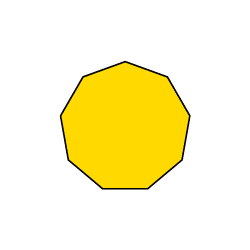
- Nonagon
A nonagon is a nine-sided polygon with nine straight sides, nine vertices, and nine interior angles.
- Decagon
A decagon is a ten-sided polygon with ten straight sides, ten vertices, and ten interior angles.
- Undecagon
An undecagon is an eleven-sided polygon with eleven straight sides, eleven vertices, and eleven interior angles.
- Dodecagon
A dodecagon is a twelve-sided polygon with twelve straight sides, twelve vertices, and twelve interior angles.
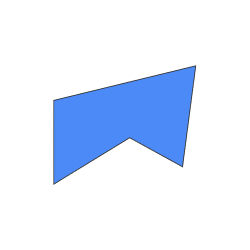
- Concave Polygon
A concave polygon has at least one interior angle greater than 180 degrees, creating an inward indentation.
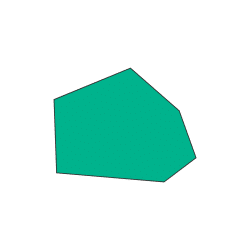
- Convex Polygon
A convex polygon has all interior angles less than 180 degrees, with no inward indentation along its boundary.
- Regular Polygon
A regular polygon has equal side lengths and equal interior angles throughout its geometric shape.
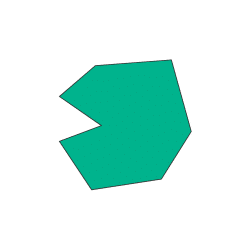
- Irregular Polygon
An irregular polygon has sides or angles that are not all equal, creating an uneven geometric shape.











Basic Angular Shapes Names with Pictures
Learn More Helpful Articles





Leave a Comment