
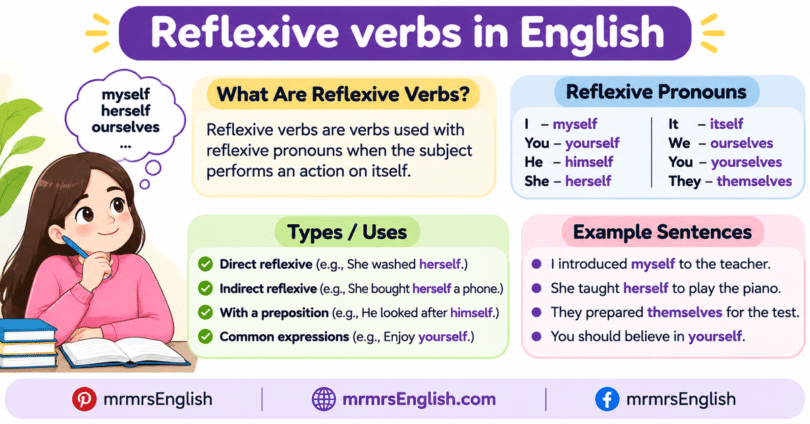
Reflexive verbs are verbs used when the subject of a sentence performs an action on itself, meaning the person or thing doing the action also receives it. They are commonly used with reflexive pronouns such as myself, yourself, himself, herself, itself, ourselves, and themselves. Examples include teach oneself, introduce oneself, blame oneself, and prepare oneself. Learning about reflexive verbs helps students understand sentence structure, use reflexive pronouns correctly, and improve their English grammar and communication skills. In this article, you will learn what reflexive verbs are, along with their meaning and examples in English, helping kids, students, teachers, beginners, and English learners understand this important grammar topic more easily.
What Are Reflexive Verbs in English?
Reflexive verbs are verbs used with reflexive pronouns when the subject and the object of an action refer to the same person or thing. In other words, the subject performs an action that affects itself.
For example:
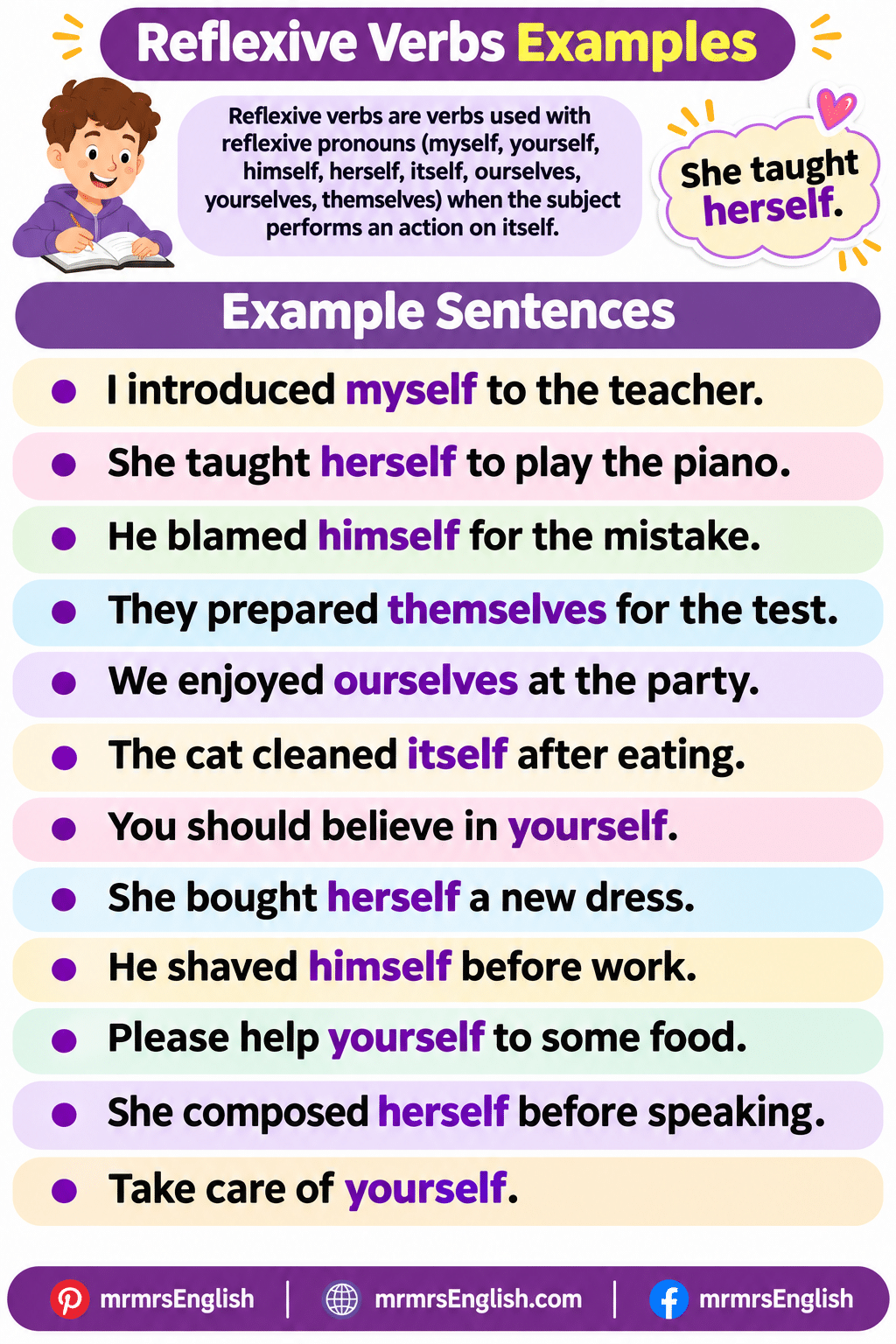
- She taught herself to play the piano.
- I introduced myself to the new teacher.
- He blamed himself for the mistake.
- They prepared themselves for the examination.
- The cat cleaned itself after eating.
What Are Reflexive Pronouns?
Reflexive pronouns are words that refer back to the subject of a sentence. They are used when the subject and the object represent the same person, animal, or thing.
There are eight commonly recognized reflexive pronouns in English:
| Subject Pronoun | Reflexive Pronoun |
|---|---|
| I | Myself |
| You (singular) | Yourself |
| He | Himself |
| She | Herself |
| It | Itself |
| We | Ourselves |
| You (plural) | Yourselves |
| They | Themselves |
The word oneself is also used as a general reflexive pronoun, particularly in formal writing and general statements.
Examples:
- I looked at myself in the mirror.
- You should believe in yourself.
- He introduced himself to everyone.
- She bought herself a new dress.
- The bird hurt itself.
- We enjoyed ourselves at the party.
- You should prepare yourselves for the test.
- The children dressed themselves.
- One should always respect oneself.
How Do Reflexive Verbs Work in English?
Reflexive verbs follow a simple grammatical structure. The subject performs an action, and the reflexive pronoun shows that the action returns to the same subject.
The basic sentence structure is:
Subject + Verb + Reflexive Pronoun
Examples:
- I hurt myself.
- She dressed herself.
- He shaved himself.
- We enjoyed ourselves.
- They introduced themselves.
However, reflexive pronouns can also appear after prepositions.
Examples:
- She was talking to herself.
- He looked after himself.
- I bought a present for myself.
- They were laughing at themselves.
Common Reflexive Verbs in English with Examples
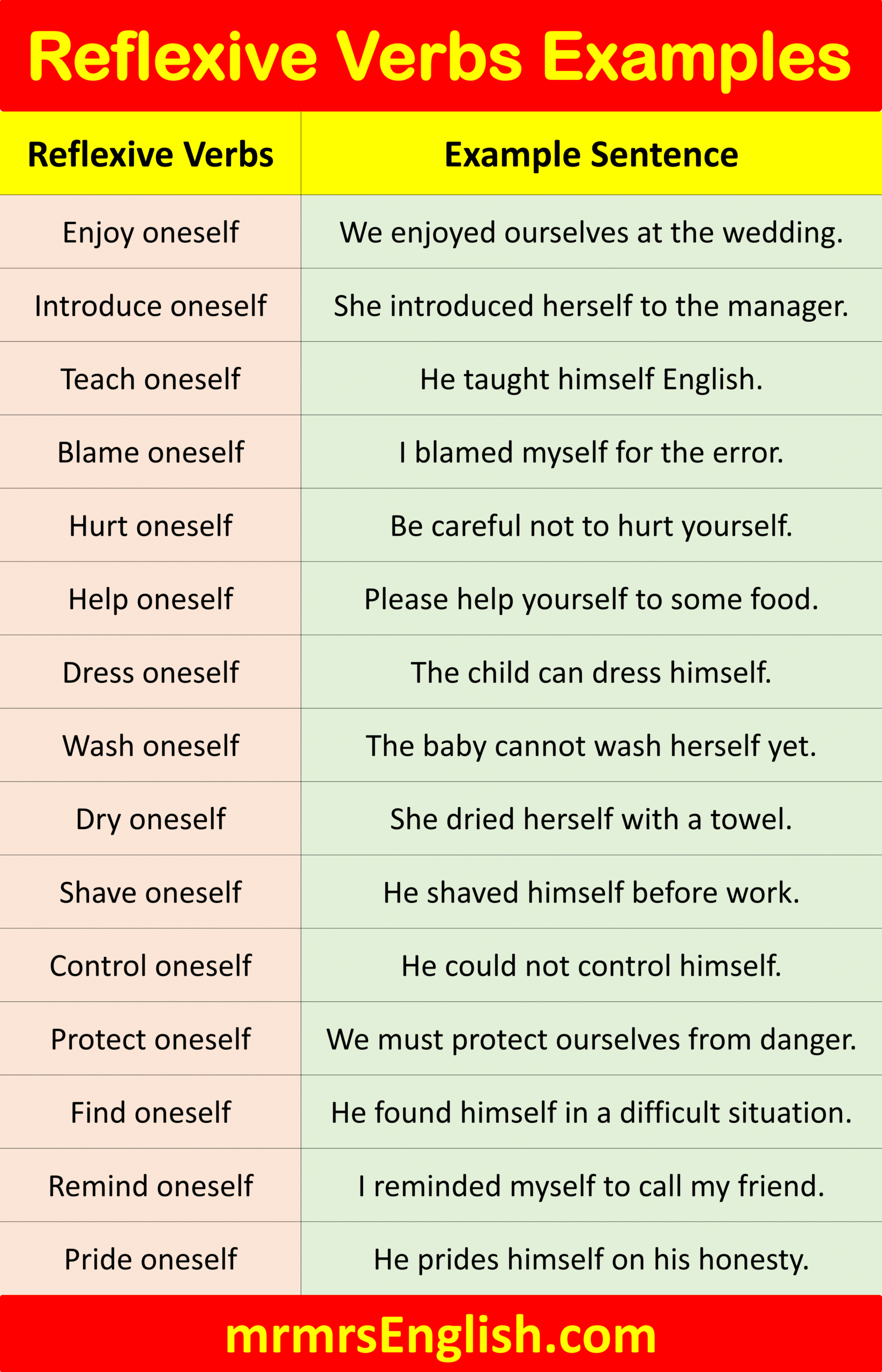
| Reflexive Verb or Expression | Example Sentence |
|---|---|
| Enjoy oneself | We enjoyed ourselves at the wedding. |
| Introduce oneself | She introduced herself to the manager. |
| Teach oneself | He taught himself English. |
| Blame oneself | I blamed myself for the error. |
| Hurt oneself | Be careful not to hurt yourself. |
| Prepare oneself | They prepared themselves for the interview. |
| Help oneself | Please help yourself to some food. |
| Dress oneself | The child can dress himself. |
| Wash oneself | The baby cannot wash herself yet. |
| Dry oneself | She dried herself with a towel. |
| Shave oneself | He shaved himself before work. |
| Behave oneself | The children behaved themselves at school. |
| Express oneself | Everyone should express themselves clearly. |
| Control oneself | He could not control himself. |
| Defend oneself | She defended herself against the accusation. |
| Protect oneself | We must protect ourselves from danger. |
| Find oneself | He found himself in a difficult situation. |
| Remind oneself | I reminded myself to call my friend. |
| Satisfy oneself | She satisfied herself that the information was correct. |
| Pride oneself | He prides himself on his honesty. |
| Apply oneself | You must apply yourself to your studies. |
| Acquaint oneself | She acquainted herself with the new rules. |
| Absent oneself | He absented himself from the meeting. |
| Commit oneself | She committed herself to the project. |
| Occupy oneself | He occupied himself with reading. |
| Devote oneself | She devoted herself to teaching. |
| Adapt oneself | We must adapt ourselves to new conditions. |
| Distance oneself | He distanced himself from the controversy. |
| Prepare oneself | I prepared myself for the challenge. |
| Reassure oneself | She reassured herself that everything was fine. |
| Convince oneself | He convinced himself that he was right. |
| Find oneself | I found myself wondering about the future. |
| Look after oneself | You should look after yourself. |
| Talk to oneself | The old man sometimes talks to himself. |
| Look at oneself | She looked at herself in the mirror. |
| Blame oneself | They blamed themselves for the failure. |
| Enjoy oneself | The children enjoyed themselves outdoors. |
| Introduce oneself | Please introduce yourself to the guests. |
| Push oneself | You should not push yourself too hard. |
| Challenge oneself | She challenged herself to learn something new. |
| Settle oneself | He settled himself comfortably in the chair. |
| Compose oneself | She composed herself before speaking. |
| Apply oneself | Students should apply themselves to learning. |
| Accommodate oneself | He accommodated himself to the new environment. |
| Keep oneself | She kept herself busy during the holidays. |
| Prove oneself | He wanted to prove himself at work. |
| Entertain oneself | The children entertained themselves with games. |
| Forgive oneself | You should learn to forgive yourself. |
| Treat oneself | I treated myself to a delicious meal. |
| Take care of oneself | Everyone should take care of themselves. |
Reflexive Verbs Examples
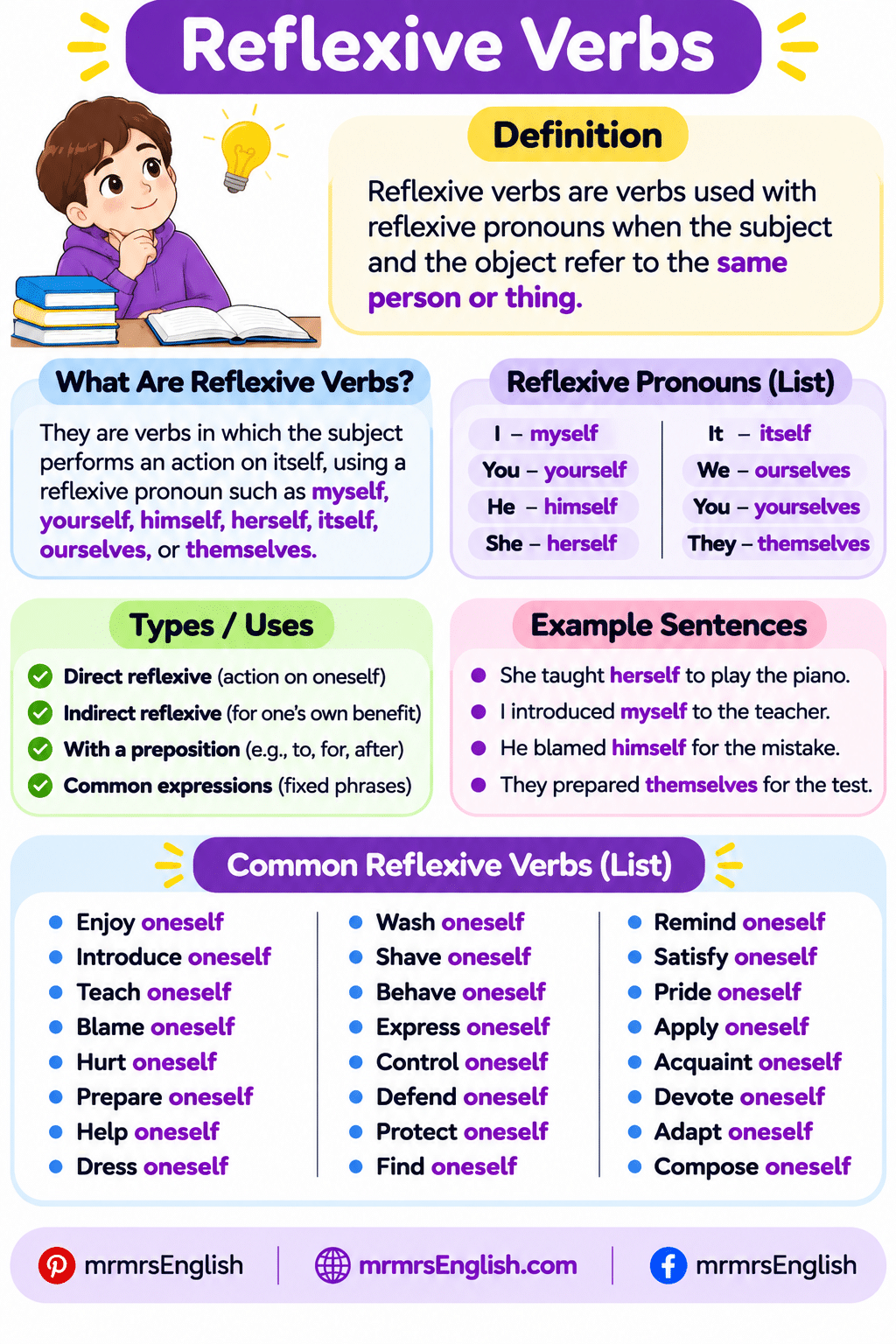
Types of Reflexive Verbs and Their Uses
Reflexive constructions can be understood through different grammatical uses. Recognizing these uses helps learners understand why reflexive pronouns appear in particular sentences.
1. Direct Reflexive Verbs
A direct reflexive construction occurs when the subject performs an action directly on itself. The reflexive pronoun functions as the direct object of the verb.
Examples:
- She washed herself.
- He cut himself while cooking.
- I blamed myself for the mistake.
- They prepared themselves for the competition.
- The dog scratched itself.
2. Indirect Reflexive Verbs
Sometimes, a reflexive pronoun functions as an indirect object. The subject performs an action for its own benefit, while another object receives the direct action.
Examples:
- She bought herself a new phone.
- I made myself a cup of tea.
- He cooked himself dinner.
- They found themselves a comfortable place.
- We gave ourselves enough time to prepare.
3. Reflexive Verbs with Prepositions
Some reflexive constructions contain a preposition between the verb and the reflexive pronoun. These expressions are common in spoken and written English.
Examples:
- He looked after himself.
- She was talking to herself.
- I am proud of myself.
- They were laughing at themselves.
- You should believe in yourself.
4. Fixed Reflexive Expressions
Some English expressions regularly use reflexive pronouns. Their meanings are often different from the literal meanings of their individual words.
Examples:
- Behave yourself during the class.
- Enjoy yourself at the party.
- Help yourself to some coffee.
- Make yourself at home.
- Pull yourself together.
- Take care of yourself.
Types of Reflexive Verbs and Their Uses
Rules for Using Reflexive Verbs in English
Understanding the rules of reflexive verbs helps avoid common grammatical mistakes. The following rules are important for school examinations, English grammar tests, and everyday communication.
Rule 1: The Reflexive Pronoun Must Agree with the Subject
A reflexive pronoun must refer to the same person or thing as the subject. You cannot randomly replace one reflexive pronoun with another.
Correct examples:
- I prepared myself for the test.
- She introduced herself to the guests.
- They enjoyed themselves at the event.
- We taught ourselves a new skill.
Incorrect examples:
- I prepared himself for the test.
- She introduced myself to the guests.
- They enjoyed ourselves at the event.
Always select the reflexive pronoun according to the subject.
Rule 2: Do Not Use Reflexive Pronouns as Ordinary Subject Pronouns
Reflexive pronouns normally cannot replace personal pronouns in the subject position.
Incorrect: Myself and Ali went to school.
Correct: Ali and I went to school.
Incorrect: Herself completed the assignment.
Correct: She completed the assignment herself.
The word “herself” in the second correct sentence adds emphasis. It does not replace the subject pronoun “she.”
Rule 3: Use Reflexive Pronouns When the Subject and Object Are the Same
When the subject performs an action on another person or object, use an ordinary object pronoun. When the subject performs the action on itself, use a reflexive pronoun.
| Sentence | Explanation |
|---|---|
| She saw him. | She saw another person. |
| She saw herself. | She saw her own reflection. |
| I blamed you. | I blamed another person. |
| I blamed myself. | I blamed my own actions. |
| He helped her. | He helped another person. |
| He helped himself. | He helped his own interests or needs. |
This distinction is one of the most important rules for understanding reflexive verbs.
Rule 4: Reflexive Pronouns Can Follow Prepositions
A reflexive pronoun can be used after a preposition when it refers to the subject.
Examples:
- She was speaking to herself.
- He completed the work by himself.
- They were proud of themselves.
- I bought a gift for myself.
- We looked after ourselves.
The preposition does not change the agreement between the subject and the reflexive pronoun.
Rule 5: Do Not Use Reflexive Pronouns Unnecessarily
Some English learners use reflexive pronouns in sentences where ordinary object pronouns are required.
Incorrect: Please send the email to myself.
Correct: Please send the email to me.
Incorrect: The teacher called myself.
Correct: The teacher called me.
Use a reflexive pronoun only when it refers back to the subject or serves another appropriate grammatical purpose, such as emphasis.
Rule 6: Use “By + Reflexive Pronoun” to Express Doing Something Alone
The expression “by myself,” “by yourself,” or “by themselves” can mean without help or without another person’s company.
Examples:
- I completed the project by myself.
- She lives by herself.
- He repaired the bicycle by himself.
- They travelled by themselves.
- We prepared the entire presentation by ourselves.
The exact meaning depends on the context. It can describe being alone or doing something without assistance.
Reflexive Verbs vs. Non-Reflexive Verbs
Not all English verbs require reflexive pronouns. Some verbs can be used both with and without them, while others normally do not need a reflexive pronoun.
For example, the verb “wash” can appear in both forms:
- She washed the clothes.
- She washed herself.
In the first sentence, the clothes receive the action. In the second sentence, the subject performs the action on herself.
Consider these additional examples:
| Reflexive Construction | Non-Reflexive Construction |
|---|---|
| He hurt himself. | He hurt his brother. |
| She introduced herself. | She introduced her friend. |
| I blamed myself. | I blamed my colleague. |
| They prepared themselves. | They prepared the food. |
| He taught himself English. | He taught his students English. |
| She dressed herself. | She dressed her daughter. |
| I reminded myself. | I reminded my friend. |
| We entertained ourselves. | We entertained our guests. |
The difference is the relationship between the subject and the object, not simply the verb itself.
Reflexive Pronouns vs. Emphatic Pronouns
Reflexive and emphatic pronouns have the same forms, but they perform different grammatical functions. A reflexive pronoun is necessary to complete the meaning of a sentence when the subject and object are the same. An emphatic pronoun is used to emphasize the person or thing that performs an action.
Compare the following examples:
| Reflexive Use | Emphatic Use |
|---|---|
| She blamed herself. | She herself completed the work. |
| I introduced myself. | I myself checked the document. |
| He hurt himself. | He himself opened the door. |
| They prepared themselves. | They themselves organized the event. |
Remember: An emphatic pronoun can often be removed without changing the basic grammatical structure of the sentence.
For example:
- She herself completed the assignment.
- She completed the assignment.
Common Mistakes When Using Reflexive Verbs
English learners sometimes make mistakes when choosing reflexive pronouns or deciding whether a verb needs one. Understanding these common errors can improve grammatical accuracy.
| Incorrect Sentence | Correct Sentence |
|---|---|
| Myself went to the market. | I went to the market. |
| She introduced myself. | She introduced herself. |
| He hurt hisself. | He hurt himself. |
| They enjoyed theirselves. | They enjoyed themselves. |
| I completed it by me. | I completed it by myself. |
| Please contact myself. | Please contact me. |
| We blamed themself. | We blamed ourselves. |
| She bought a gift for her. (meaning herself) | She bought a gift for herself. |
| He taught hisself English. | He taught himself English. |
| They prepared theirself. | They prepared themselves. |
Advanced Reflexive Verb Expressions
At an advanced level, reflexive constructions appear in formal writing, academic English, and professional communication. Some expressions are more common in formal contexts than in everyday conversation.
| Expression | Meaning | Example |
|---|---|---|
| Avail oneself of | To make use of something | Students should avail themselves of the available resources. |
| Pride oneself on | To be proud of a quality or achievement | She prides herself on her professional skills. |
| Apply oneself to | To work hard at something | He applied himself to his studies. |
| Commit oneself to | To promise or dedicate oneself to something | They committed themselves to the project. |
| Acquaint oneself with | To become familiar with something | Please acquaint yourself with the company policies. |
| Absent oneself from | To stay away from an event or place | He absented himself from the meeting. |
| Compose oneself | To become calm and regain control | She composed herself before giving the speech. |
| Reconcile oneself to | To accept an unpleasant situation | He reconciled himself to the decision. |
| Distinguish oneself | To become noticeable through achievement | She distinguished herself through excellent performance. |
| Conduct oneself | To behave in a particular way | Everyone should conduct themselves professionally. |
Examples of Reflexive Verbs in Sentences
Frequently Asked Questions About Reflexive Verbs
What are reflexive verbs in English?
Reflexive verbs are verbs used with reflexive pronouns when the subject and object refer to the same person or thing. For example, in “She taught herself English,” the subject performs the action and receives its effect.
What are the eight reflexive pronouns in English?
The eight commonly recognized reflexive pronouns are myself, yourself, himself, herself, itself, ourselves, yourselves, and themselves. Each pronoun refers back to a subject and must agree with it in person and number.
What is an example of a reflexive verb?
An example is “She introduced herself to the teacher.” In this sentence, “introduced” is the verb, and “herself” is the reflexive pronoun referring to the subject “she.”
What is the difference between reflexive and emphatic pronouns?
Reflexive pronouns act as objects that refer back to the subject, while emphatic pronouns add emphasis to the subject. For example, “He blamed himself” is reflexive, whereas “He himself completed the work” is emphatic.
Can reflexive verbs be used in all English tenses?
Yes. Reflexive constructions can be used in all English tenses. The verb changes according to the tense, but the reflexive pronoun changes according to the subject. For example, “I teach myself,” “I taught myself,” and “I will teach myself.”
Is “myself” a subject or an object pronoun?
“Myself” is a reflexive pronoun, not an ordinary subject pronoun. It usually functions as an object or an emphatic pronoun. Use “I” as the subject in sentences such as “I completed the task myself.”
What is the difference between “by myself” and “myself”?
“By myself” generally means alone or without help, depending on the context. “Myself” can refer back to the subject or add emphasis. For example, “I completed the work by myself” means I did it without assistance.
Are reflexive verbs and reflexive pronouns the same?
No. A reflexive verb is an ordinary verb used in a reflexive construction, while a reflexive pronoun is the word that refers back to the subject. For example, in “He blamed himself,” “blamed” is the verb and “himself” is the reflexive pronoun.
Learn more helpful articles


Leave a Comment