
Clauses are important parts of English sentences that contain a subject and a verb and help express complete or incomplete ideas. They come in different types, including independent, dependent, noun, adjective, and adverbial clauses, each performing a specific function in sentence structure. Learning the types of clauses in English is a useful way to improve grammar while building clearer and more accurate sentences. In this article, you will learn clauses with definitions and examples through simple explanations, helping students, teachers, beginners, and English learners identify different clauses, understand their functions, and use them correctly and confidently in speaking and writing.
What Is a Clause?
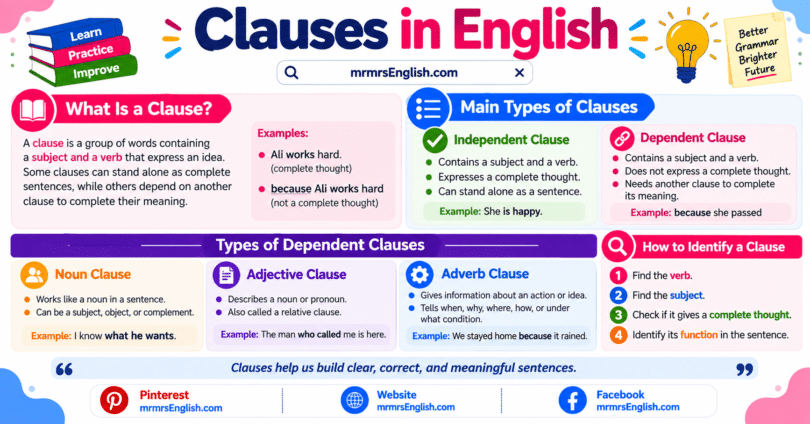
A clause is a group of words containing a subject and a verb that work together to express an idea. Some clauses can stand alone as complete sentences, while others depend on another clause to complete their meaning.
Examples:
- Ali works hard.
- because Ali works hard
- She is reading a book.
- when she is reading a book
In Ali works hard, the subject is Ali and the verb is works. The clause expresses a complete thought. In because Ali works hard, there is also a subject and a verb, but the word because makes the clause dependent on another part of the sentence.
Types of Clauses in English
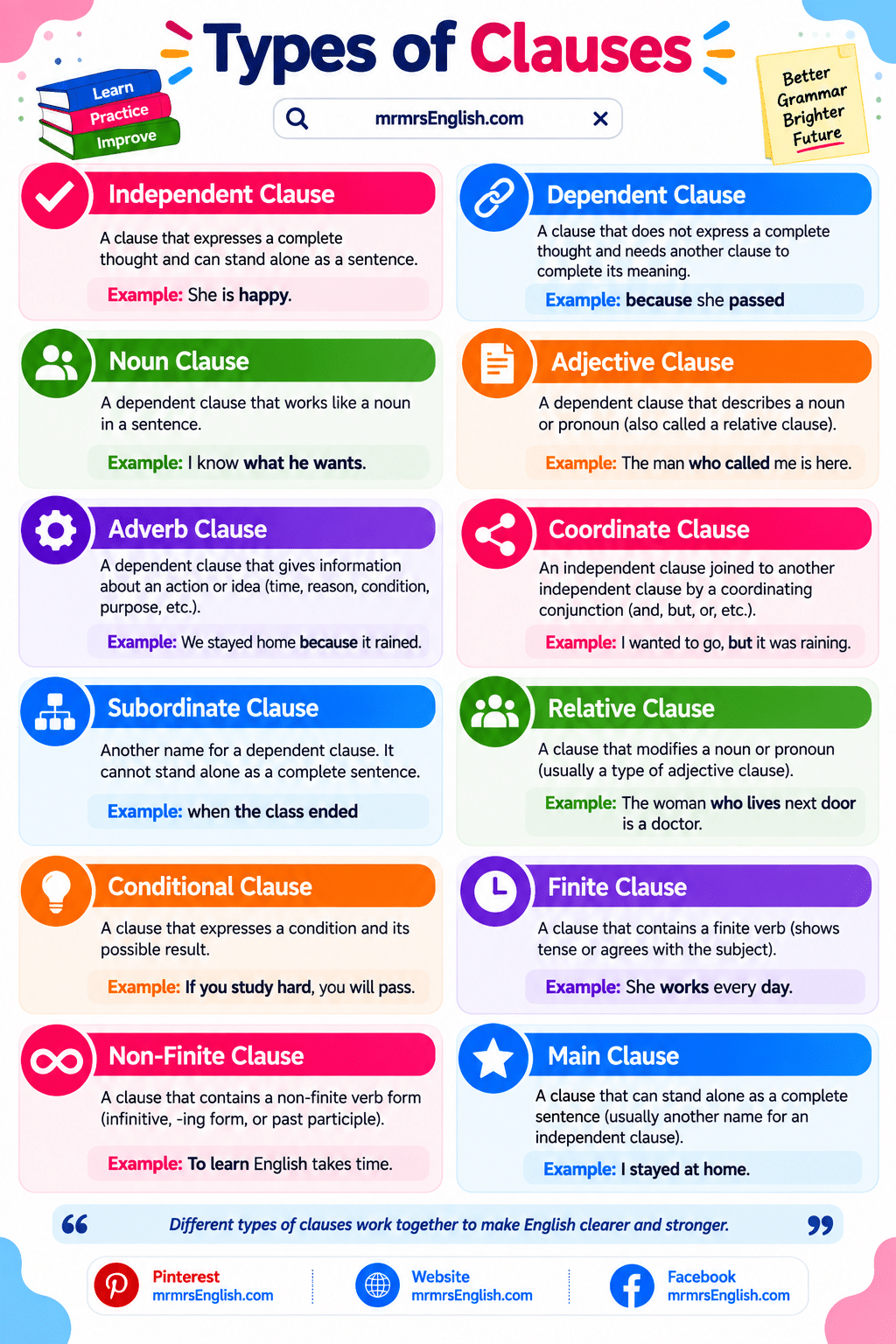
Clauses in English are mainly divided into independent and dependent clauses. An independent clause expresses a complete thought, while a dependent clause needs another clause to complete its meaning and grammatical function within a sentence.
| Type | Meaning | Example |
|---|---|---|
| Independent Clause | Expresses a complete thought | She is happy. |
| Dependent Clause | Does not express a complete thought alone | because she passed |
Dependent clauses are commonly divided into three major groups:
| Dependent Clause | Main Function | Example |
|---|---|---|
| Noun Clause | Works like a noun | I know what he wants. |
| Adjective Clause | Describes a noun or pronoun | The man who called me is here. |
| Adverb Clause | Gives information about an action or idea | We stayed home because it rained. |
Independent Clause
An independent clause is a group of words that contains a subject and a verb and expresses a complete thought. It can stand alone as a complete sentence.
Examples:
- She works in a bank.
- The children are playing.
- I finished my homework.
- They visited Lahore.
- My brother likes football.
Each example has a subject and a verb and gives a complete meaning.
Examples of Independent Clauses
| Clause | Subject | Verb |
|---|---|---|
| Ahmed plays cricket. | Ahmed | plays |
| She opened the door. | She | opened |
| They are watching TV. | They | are watching |
| We enjoyed the meal. | We | enjoyed |
| The baby is sleeping. | The baby | is sleeping |
Two independent clauses can be joined to make a compound sentence.
I wanted to go, but it was raining.
Here:
- I wanted to go = independent clause
- it was raining = independent clause
Dependent Clause
A dependent clause, also called a subordinate clause, contains a subject and a verb but does not express a complete thought by itself.
Examples:
- because I was tired
- when the teacher arrived
- if you need help
- although it was raining
- who lives next door
For example:
Because I was tired
This has a subject (I) and a verb (was), but it does not give complete meaning.
It becomes complete when connected to an independent clause:
I went to bed because I was tired.
Here, I went to bed is the independent clause, and because I was tired is the dependent clause.
Types of Dependent Clauses
Noun Clause
A noun clause is a dependent clause that performs the function of a noun in a sentence. It can work as a subject, object, or subject complement. Noun clauses are often introduced by words such as that, what, who, whoever, whom, where, when, why, whether, and how.
Examples:
- I know what she wants.
- She explained why she was late.
- What he said was true.
- Tell me where you live.
- We don’t know when they will arrive.
Noun Clause as a Subject
A noun clause can function as the subject of a sentence, performing the same role as a noun. It usually appears before the main verb and tells what the sentence is mainly about.
What she said surprised everyone.
The clause what she said is the subject.
More examples:
- What you did was helpful.
- Why he left is still unknown.
- Where they went is not clear.
- How she solved the problem amazed us.
Noun Clause as an Object
A noun clause can function as the object of a verb by receiving or completing the action or meaning of that verb. It usually follows the main verb and answers questions such as what? or whom?
Examples:
- I know what you mean.
- She understands why he is angry.
- He asked where I lived.
- We believe that she is honest.
- Tell me what you need.
Noun Clause as a Complement
A noun clause can function as a complement by completing the meaning of a subject or another part of a sentence. It often follows a linking verb and provides necessary information about the subject.
Examples:
- The truth is that he was wrong.
- The question is whether they will come.
- My concern is what will happen next.
Adjective Clause
An adjective clause is a dependent clause that describes or gives more information about a noun or pronoun. It is also called a relative clause. Adjective clauses commonly begin with who, whom, whose, which, that, where, and when.
Example:
The girl who won the race is my sister.
The clause who won the race describes the noun girl.
Examples of Adjective Clauses
- The man who lives next door is a doctor.
- I bought the book that you recommended.
- This is the house where I grew up.
- She met a teacher who helped her.
- I remember the day when we first met.
Clauses and its types
Relative Words Used in Adjective Clauses
| Word | Main Use | Example |
|---|---|---|
| Who | People | The boy who called me is my friend. |
| Whom | People as an object | The man whom we met was kind. |
| Whose | Possession | The girl whose bag was lost is crying. |
| Which | Things or animals | The car which I bought is new. |
| That | People or things | The book that I bought is useful. |
| Where | Places | This is the school where I studied. |
| When | Time | I remember the day when we met. |
Defining Adjective Clause
A defining adjective clause identifies or specifies the noun or pronoun it modifies by providing essential information. Without this clause, the sentence may lose important meaning or become unclear about the person or thing being discussed.
Example:
The students who studied passed the exam.
The clause who studied tells us which students passed.
More examples:
- The man who called you is waiting outside.
- The book that you gave me is useful.
- The house that has a red roof belongs to my uncle.
Defining relative clauses are generally written without commas.
Non Defining Adjective Clause
A non defining adjective clause gives extra information about a noun that is already clearly identified.
Example:
My brother, who lives in Karachi, is a teacher.
The clause who lives in Karachi gives additional information about my brother. It is not needed to identify him.
More examples:
- Mr. Ahmed, who teaches English, is very helpful.
- My car, which I bought last year, is still working well.
- London, which is the capital of England, is a famous city.
Non-defining adjective clauses are normally separated from the rest of the sentence by commas.
Adverb Clause
An adverb clause is a dependent clause that modifies a verb, adjective, adverb, or the main idea of a sentence. It can tell us when, where, why, how, under what condition, or despite what circumstance something happens.
Example:
We stayed home because it was raining.
The clause because it was raining explains the reason for staying home.
Common Types of Adverb Clauses
| Type | Common Words | Example |
|---|---|---|
| Time | when, before, after, while, until | Call me when you arrive. |
| Reason | because, since, as | We stayed home because it rained. |
| Condition | if, unless, provided that | I will help if I can. |
| Purpose | so that, in order that | He spoke loudly so that we could hear. |
| Contrast | although, though, even though | Although he was tired, he worked. |
| Place | where, wherever | Sit where you like. |
| Result | so…that, such…that | It was so cold that we stayed inside. |
| Comparison | than, as…as | She is taller than I am. |
Adverb Clause of Time
An adverb clause of time is a dependent clause that tells when, how long, or how often an action happens. It commonly begins with subordinating conjunctions such as when, while, before, after, and until.
Examples:
- Call me when you arrive.
- Wash your hands before you eat.
- We left after the rain stopped.
- Wait here until I return.
- She listened while I was speaking.
Adverb Clause of Reason
An adverb clause of reason explains why something happens. Common words include because, since, and as.
Examples:
- We stayed home because it was raining.
- Since you are here, you can help us.
- He went to bed early because he was tired.
- As she was sick, she stayed home.
Adverb Clause of Condition
An adverb clause of condition expresses a condition that must be met for something to happen. Common words include if, unless, provided that, as long as, and in case.
Examples:
- I will help you if I have time.
- You cannot enter unless you have a ticket.
- We can go if the weather improves.
- You may use my computer as long as you are careful.
Adverb Clause of Purpose
An adverb clause of purpose explains the purpose of an action. Common expressions include so that and in order that.
Examples:
- He spoke slowly so that everyone could understand him.
- She saved money so that she could buy a laptop.
- We left early so that we could catch the bus.
Adverb Clause of Contrast
An adverb clause of contrast shows an unexpected difference between two ideas. Common conjunctions include although, though, even though, and while.
Examples:
- Although he was tired, he continued working.
- She went outside even though it was cold.
- Though the task was difficult, they completed it.
- Although it was raining, we played the match.
Adverb Clause of Place
An adverb clause of place tells where an action happens. Common words include where and wherever.
Examples:
- Sit where you feel comfortable.
- I will meet you where we first met.
- You can go wherever you want.
- Keep the box where no one can see it.
Coordinate Clauses
A coordinate clause is an independent clause that is joined to another independent clause by a coordinating conjunction. The seven coordinating conjunctions are commonly remembered by FANBOYS:
For, And, Nor, But, Or, Yet, So
Examples:
- I called him, but he did not answer.
- She studied hard, so she passed the exam.
- Ali cooked dinner, and Sara washed the dishes.
- You can stay here, or you can come with us.
Example:
I wanted to leave, but it was raining.
- I wanted to leave = independent clause
- it was raining = independent clause
- but = coordinating conjunction
Subordinate Clause
A subordinate clause is another term for a dependent clause. It cannot normally stand alone as a complete sentence.
Examples:
- because she was tired
- when the class ended
- who lives nearby
- if you need help
- although he was busy
Example:
Because she was tired, she went to bed.
- Because she was tired = subordinate clause
- she went to bed = main/independent clause
A subordinate clause may function as a noun, adjective, or adverb.
Relative Clause
A relative clause is a dependent clause that modifies a noun or pronoun. In traditional English grammar, it is commonly treated as a type of adjective clause.
Examples:
- The woman who lives next door is a doctor.
- This is the phone that I bought yesterday.
- I visited the city where my father was born.
Relative clauses are generally divided into defining and non-defining clauses.
Defining:
The student who won the prize is my friend.
Non-defining:
Ali, who won the prize, is my friend.
Conditional Clause
A conditional clause expresses a condition and its possible result. It is commonly introduced by if or another conditional expression.
Example:
If you study hard, you will pass the exam.
- If you study hard = conditional clause
- you will pass the exam = main clause
Types of Conditional Clauses
Zero Conditional
The zero conditional is commonly used for general truths, facts, and situations that are always or generally true.
If you heat ice, it melts.
First Conditional
The first conditional commonly describes a real or possible situation in the future.
If it rains, we will stay home.
Second Conditional
The second conditional commonly describes an imaginary, unlikely, or hypothetical situation.
If I had more money, I would travel more.
Third Conditional
The third conditional describes an imaginary situation in the past and its possible result.
If she had studied, she would have passed the exam.
Finite Clause
A finite clause contains a finite verb. The verb normally shows tense or agrees with the subject.
Examples:
- She works every day.
- They worked yesterday.
- He is studying English.
- We have finished the task.
In She works every day, the verb works is finite because it shows present tense and agrees with the third-person singular subject she.
Non Finite Clause
A non-finite clause contains a non-finite verb form, such as an infinitive, -ing form, or past participle. It does not express tense in the same way as a finite verb.
Examples:
- To learn English takes time.
- Walking along the road, he saw an old friend.
- Having finished the work, she went home.
- Built in 1900, the house is still standing.
Non-finite clauses are especially common in formal and advanced English.
Main Clause
A main clause is a clause that can stand alone as a complete sentence. It is usually another name for an independent clause.
Example:
I stayed at home because I was sick.
Here:
- I stayed at home = main clause
- because I was sick = subordinate clause
The main clause carries the central meaning of the sentence.
Clause vs Phrase
A clause contains a subject and a verb, while a phrase does not contain a complete subject-verb combination.
| Clause | Phrase |
|---|---|
| when the boy arrived | after the party |
| because she was sick | because of her illness |
| who lives nearby | the boy nearby |
| they were playing | in the park |
| when I reached home | after reaching home |
For example:
When the teacher arrived is a clause because it contains the subject teacher and the verb arrived. After the class is a phrase because it does not contain a subject and a finite verb.
Clause vs Sentence
A clause and a sentence are related, but they are not always the same. A sentence must express a complete thought, while a clause may or may not express a complete thought.
For example:
She smiled.
This is both a sentence and an independent clause.
Because she smiled
This is a dependent clause, but it is not a complete sentence.
Because she smiled, everyone felt happy.
This is a complete sentence containing two clauses.
How to Identify a Clause
You can follow a few simple steps to identify a clause.
Find the Verb
Look for a verb or verb phrase.
The children are playing outside.
Verb: are playing
Find the Subject
Ask who or what performs the action or is described by the verb.
The children are playing outside.
Check the Meaning
Ask whether the group of words expresses a complete thought.
The children are playing outside.
This is complete, so it is an independent clause.
Because the children are playing outside
This is incomplete, so it is a dependent clause.
Identify Its Function
If it works like a noun, it is probably a noun clause.
If it describes a noun, it is an adjective clause.
If it gives information such as time, reason, condition, purpose, or contrast, it is probably an adverb clause.
Examples of Clauses in Sentences
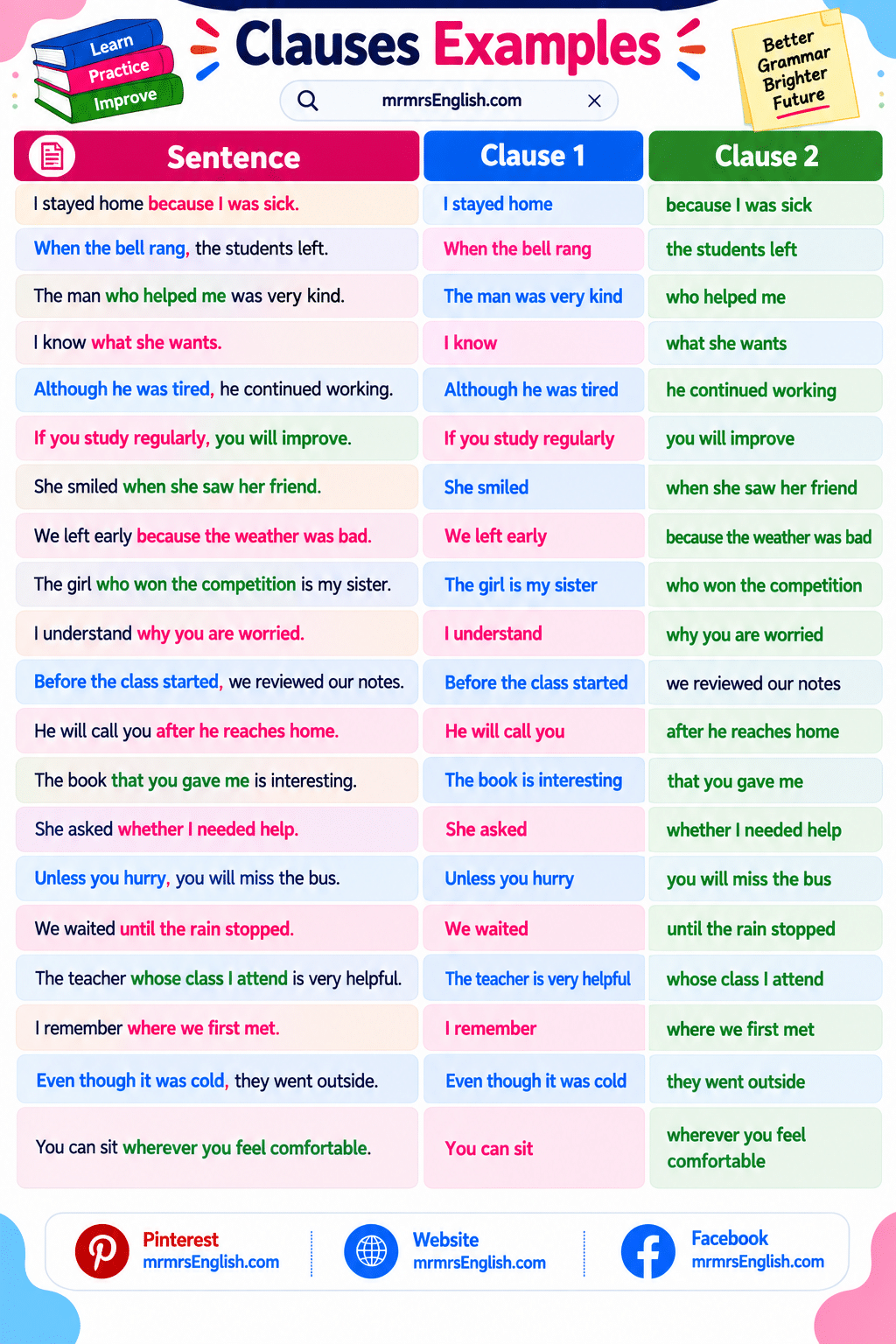
| Sentence | Clause 1 | Clause 2 |
|---|---|---|
| I stayed home because I was sick. | I stayed home | because I was sick |
| When the bell rang, the students left. | When the bell rang | the students left |
| The man who helped me was kind. | The man was kind | who helped me |
| I know what she wants. | I know | what she wants |
| Although he was tired, he continued working. | Although he was tired | he continued working |
| If you study, you will improve. | If you study | you will improve |
Examples of Clauses in Sentences
Learn more helpful articles



Leave a Comment