
Phrases are important groups of words that work together as a single unit but usually do not express a complete thought on their own. They come in different types, including noun, verb, adjective, adverb, prepositional, infinitive, gerund, and participial phrases, each performing a specific function in a sentence. Learning the types of phrases in English is a useful way to improve grammar while building clearer and more meaningful sentences. In this article, you will learn phrases with definitions and examples through simple explanations, helping students, teachers, beginners, and English learners identify different phrases, understand their functions, and use them correctly and confidently.
What Is a Phrase?
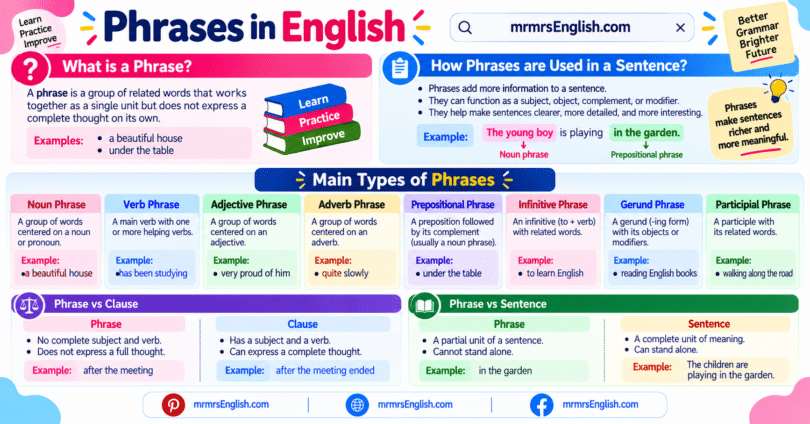
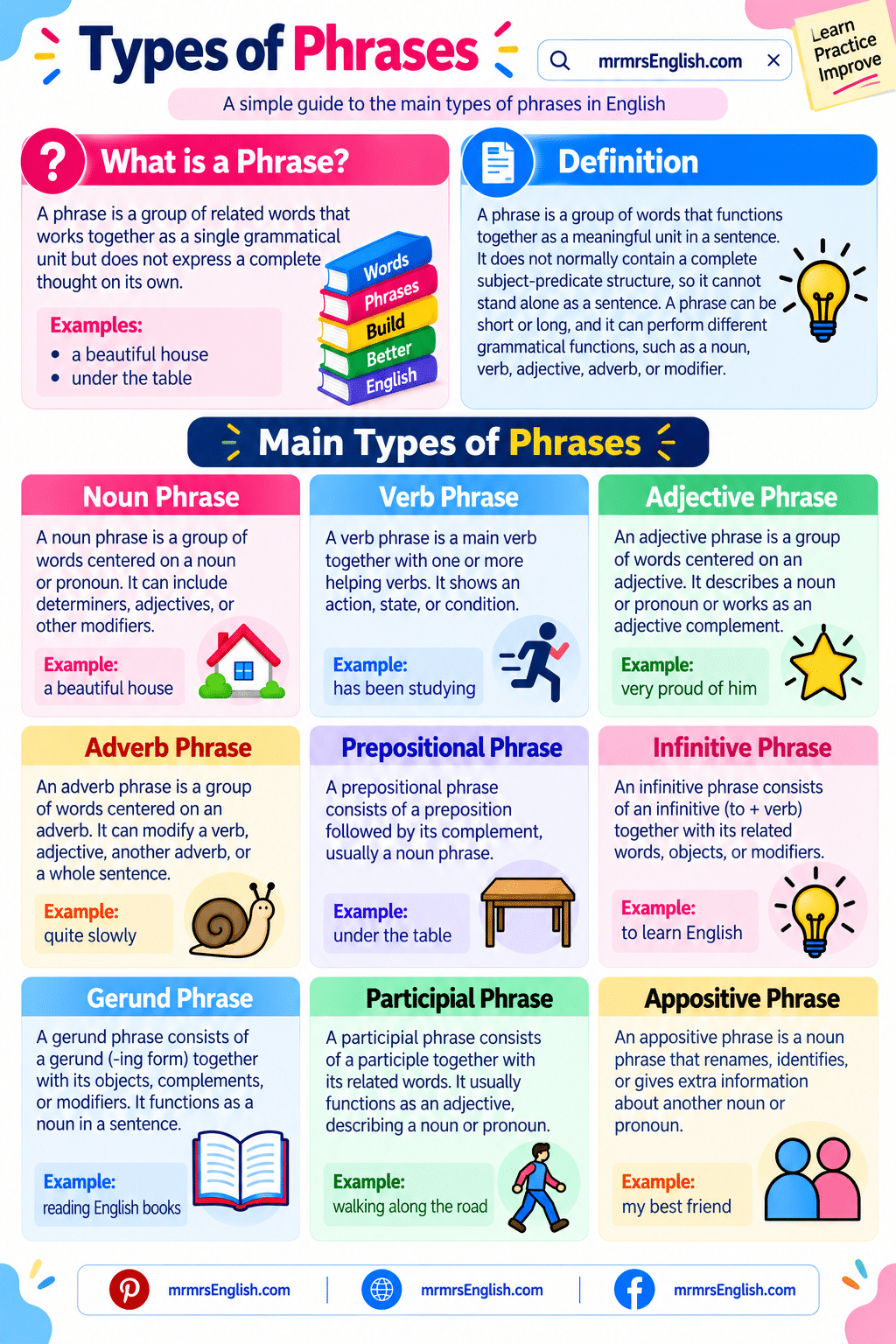
A phrase is a group of related words that works together as a single grammatical unit in a sentence. It does not normally contain a complete subject-predicate structure capable of forming an independent clause.
Examples:
- a beautiful house
- the tall young boy
- has been working
- very carefully
- under the table
- to learn English
- reading a book
A phrase can be short or long. Its words work together to perform a particular grammatical job.
For example:
The young boy is playing in the garden.
In this sentence, the young boy is a noun phrase because it is centered on the noun boy. In the garden is a prepositional phrase because it begins with the preposition in. It is important to remember that saying “a phrase has no verb” is not completely accurate. Some phrases contain verbs or verb forms, such as verb phrases, infinitive phrases, gerund phrases, and participial phrases.
Main Types of Phrases in English
Phrases can be classified according to their structure, head word, and function. The following are the major types commonly studied in English grammar.
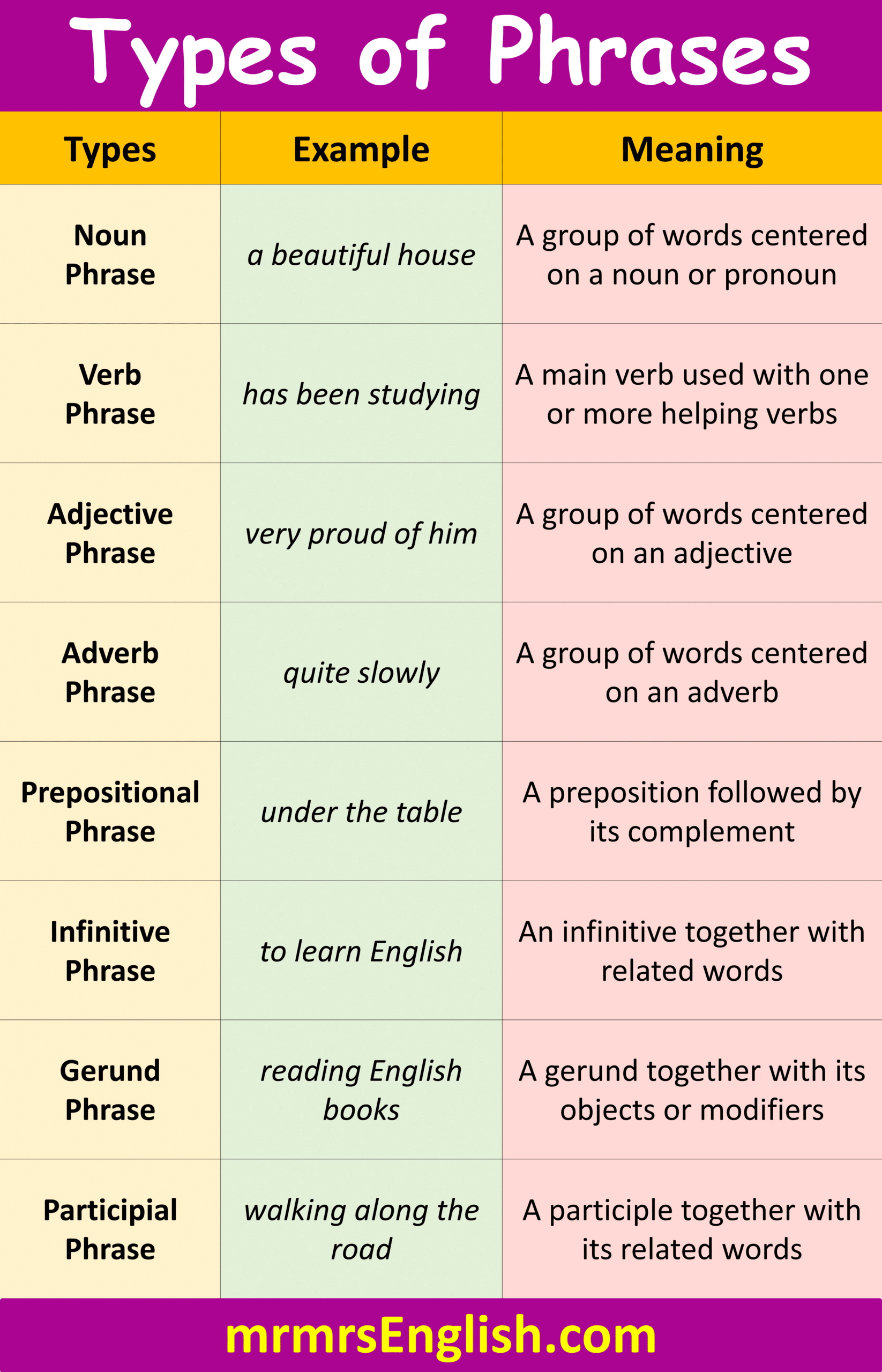
| Type of Phrase | Example | Meaning |
|---|---|---|
| Noun Phrase | a beautiful house | A group of words centered on a noun or pronoun |
| Verb Phrase | has been studying | A main verb used with one or more helping verbs |
| Adjective Phrase | very proud of him | A group of words centered on an adjective |
| Adverb Phrase | quite slowly | A group of words centered on an adverb |
| Prepositional Phrase | under the table | A preposition followed by its complement |
| Infinitive Phrase | to learn English | An infinitive together with related words |
| Gerund Phrase | reading English books | A gerund together with its objects or modifiers |
| Participial Phrase | walking along the road | A participle together with its related words |
Types of phrases with examples
Noun Phrase
A noun phrase is a group of words centered on a noun or pronoun. The central noun is called the head noun, while other words can identify, describe, count, or provide additional information about it.
Examples:
- a beautiful house
- the little girl
- my best friend
- those three books
- the old wooden chair
- the boy in the blue shirt
- a very interesting English book
Consider: The tall young boy won the race.
The complete expression the tall young boy is a noun phrase. Boy is its head noun, while the, tall, and young give more information about it.
Verb Phrase
A verb phrase is a grammatical unit centered on a main verb. In traditional school grammar, a verb phrase commonly consists of a main verb together with one or more auxiliary or helping verbs.
Examples:
- is reading
- has finished
- will come
- was sleeping
- has been studying
- might have forgotten
- will have completed
Consider: Sara has been studying English.
The complete verb phrase is has been studying. Studying carries the main lexical meaning, while has and been help express tense and aspect.
Examples of Verb Phrases in Sentences
- She is reading a book.
- They have completed the project.
- He will visit us tomorrow.
- We have been waiting for an hour.
- The work was completed yesterday.
- She might have forgotten my name.
A verb phrase forms an important part of the predicate of a clause.
Adjective Phrase
An adjective phrase is a group of words centered on an adjective. It describes a noun or pronoun or functions as an adjective complement within a sentence.
Examples:
- very beautiful
- extremely difficult
- quite expensive
- proud of his son
- full of water
- afraid of the dark
- very interested in science
Consider: The students were very happy with the result.
The adjective happy is the head of the phrase. Very modifies happy, while with the result completes or expands its meaning.
Adverb Phrase
An adverb phrase is a group of words centered on an adverb. It can modify a verb, adjective, another adverb, or sometimes a larger part of a sentence.
Examples:
- very slowly
- quite carefully
- extremely well
- rather quickly
- surprisingly easily
- much more carefully
Consider: The old man walked very slowly.
The adverb slowly is the head of the phrase, while very modifies it.
Prepositional Phrase
A prepositional phrase consists of a preposition followed by its complement, which is commonly a noun phrase.
Common English prepositions include:
in, on, at, under, over, behind, beside, between, through, across, with, without, from, for, and after.
Examples:
- under the table
- in the garden
- behind the house
- with my friends
- across the road
- after the meeting
- between the two buildings
Consider: The keys are on the table.
Here, on is the preposition and the table is its complement. Together, they form the prepositional phrase on the table.
Infinitive Phrase
An infinitive phrase consists of an infinitive, usually to + base form of a verb, together with its complements and modifiers.
Examples:
- to learn English
- to buy a new car
- to help other people
- to become a doctor
- to finish the work quickly
- to complete the project on time
Consider: She wants to learn English.
The infinitive to learn combines with its object English to form the infinitive phrase.
Gerund Phrase
A gerund phrase consists of a gerund, an -ing verb form functioning as a noun, together with its objects, complements, or modifiers.
Examples:
- reading English books
- playing football after school
- swimming in the sea
- learning a foreign language
- helping other people
- walking every morning
Consider: Reading English books improves vocabulary.
Here, reading is a gerund, while English books is its object. The complete gerund phrase functions as the subject.
Participial Phrase
A participial phrase consists of a participle together with its complements or modifiers. It normally functions adjectivally by providing information about a noun or pronoun.
Examples:
- walking along the road
- wearing a blue jacket
- carrying a heavy bag
- damaged by the storm
- covered with snow
- excited about the journey
Consider: Walking along the road, Ahmed saw an injured bird.
The phrase walking along the road describes Ahmed.
Present Participial Phrase
A present participial phrase contains a present participle ending in -ing.
Examples:
- running through the park
- smiling at everyone
- carrying a large box
Running through the park, Sara saw her friend.
Past Participial Phrase
A past participial phrase contains a past participle.
Examples:
- damaged by the storm
- written in English
- surprised by the news
- covered with snow
Surprised by the result, the students remained silent.
What Is a Phrase with Types and Examples
Gerund Phrase vs Participial Phrase
Gerund and present participial phrases are frequently confused because both can begin with an -ing form. The major difference is their grammatical function.
| Gerund Phrase | Participial Phrase |
|---|---|
| Functions as a noun | Functions adjectivally |
| Can serve as subject or object | Modifies a noun or pronoun |
| Swimming every day is healthy. | Swimming in the pool, Ali saw his friend. |
| She enjoys reading novels. | Reading a novel, Sara fell asleep. |
Compare these sentences:
Running every morning keeps me healthy.
Here, running every morning functions as the subject, so it is a gerund phrase.
Running down the street, the boy dropped his bag.
Here, running down the street describes the boy, so it is a participial phrase.
Appositive Phrase
An appositive phrase is a noun phrase placed next to another noun or noun phrase to rename, identify, or provide additional information about it.
Examples:
- Ali, my best friend, lives nearby.
- Mr. Brown, our English teacher, entered the room.
- William Shakespeare, a famous English playwright, wrote many plays.
Consider: Sara, the captain of our team, received the trophy.
The phrase the captain of our team provides additional information about Sara.
Restrictive and Nonrestrictive Appositives
A nonrestrictive appositive adds extra information and is normally separated by commas.
Hamlet, a tragedy by Shakespeare, is widely studied.
A restrictive appositive is necessary to identify the noun and normally does not take commas.
The poet Robert Frost wrote “The Road Not Taken.”
Absolute Phrase
An absolute phrase provides additional background or circumstantial information about an entire clause rather than simply modifying one individual word. It commonly contains a noun or pronoun together with a participle or another complement.
Examples:
- The weather being pleasant, we went outside.
- His work completed, Ahmed went home.
- Her arms folded, she waited quietly.
- The meeting over, everyone left.
Consider: The sun having set, the travelers returned home.
The absolute phrase provides background information about the circumstances in which the main action occurred. Absolute phrases are more common in formal, descriptive, and literary writing.
Basic and Advanced Types of Phrases
For students, it is useful to separate the most commonly taught phrase types from structures generally introduced at higher levels.
| Level | Phrase Types |
|---|---|
| Basic to Intermediate | Noun, Verb, Adjective, Adverb, Prepositional |
| Intermediate | Infinitive, Gerund, Participial |
| Intermediate to Advanced | Appositive, Absolute |
The exact classification used in textbooks can vary because different grammatical frameworks analyze phrase structure in different ways. For examinations, students should follow the terminology used in their particular curriculum while understanding the underlying grammatical structure.
Head Words in Phrases
A head word is the central element of a phrase. In many phrase types, the head determines the grammatical category of the complete phrase.
| Phrase | Example | Head Word |
|---|---|---|
| Noun Phrase | the beautiful old house | house |
| Verb Phrase | has been working | working |
| Adjective Phrase | very proud of her | proud |
| Adverb Phrase | extremely slowly | slowly |
| Prepositional Phrase | under the table | under |
For example: the young boy in the garden
The overall expression is a noun phrase because its head is the noun boy. However, it contains the smaller prepositional phrase in the garden. This shows that one phrase can contain another phrase.
Functions of Phrases in English Sentences
The type of a phrase describes its grammatical structure, while its function tells us what job it performs in a particular sentence.
Phrases can function as subjects, objects, complements, modifiers, and adverbials.
Phrase as a Subject
The tall boy in the corner is my brother.
The noun phrase functions as the subject.
Phrase as an Object
She bought a beautiful new dress.
The noun phrase functions as the object of bought.
Phrase as a Complement
Ahmed is a talented student.
The noun phrase complements the subject Ahmed.
Phrase as a Modifier
The girl in the blue dress is my sister.
The prepositional phrase modifies girl.
Phrase as an Adverbial
They arrived in the morning.
The prepositional phrase functions adverbially by telling us when they arrived.
Understanding the distinction between phrase type and phrase function is particularly important at intermediate and advanced levels.
Phrase vs Clause
A phrase is a group of words that works as a single grammatical unit but lacks a complete subject–verb combination. A clause contains a subject and verb and expresses an idea.
| Phrase | Clause |
|---|---|
| Functions as a grammatical unit | Contains a subject-predicate relationship |
| Does not normally contain a complete predicating structure | Contains a subject and a verb functioning as its predicate |
| after the meeting | after the meeting ended |
| under the table | because the keys were under the table |
| the boy in the garden | the boy who is standing in the garden |
Compare:
after the class — Phrase
after the class ended — Clause
In the second example, the class is the subject and ended is the verb.
Phrase vs Sentence
A phrase normally functions as part of a larger grammatical structure, whereas a complete sentence can communicate independently.
| Phrase | Sentence |
|---|---|
| A grammatical unit | A complete unit of communication |
| Usually forms part of a sentence or clause | Can stand independently |
| under the old tree | The children are sitting under the old tree. |
| a beautiful flower | This is a beautiful flower. |
| very slowly | The old man walked very slowly. |
For example:
in the garden
does not communicate a complete statement by itself.
The children are playing in the garden.
is a complete sentence.
Noun Phrase vs Gerund Phrase
Both noun phrases and gerund phrases can perform noun functions, but their structures are different.
A noun phrase is centered on a noun:
The young student won the competition.
A gerund phrase is centered on an -ing form functioning as a noun:
Studying every day improves your English.
Therefore, the grammatical function alone does not determine phrase type. Students should also examine the internal structure.
Adjective Phrase vs Adverb Phrase
An adjective phrase is centered on an adjective and typically describes a noun or pronoun or functions as a complement.
She is extremely happy.
An adverb phrase is centered on an adverb and typically modifies a verb, adjective, or another adverb.
She smiled extremely happily.
A simple method is to find the head word:
- very beautiful → beautiful is an adjective → adjective phrase
- very beautifully → beautifully is an adverb → adverb phrase
Adverb Phrase vs Adverbial Phrase
These terms are sometimes used loosely as though they mean exactly the same thing, but a more precise grammatical analysis distinguishes them.
An adverb phrase is structurally centered on an adverb:
very slowly
An adverbial phrase is a broader functional description for a phrase performing an adverbial role.
Consider:
She arrived in the morning.
In the morning is structurally a prepositional phrase, but it functions as an adverbial because it tells us when she arrived.
Therefore, phrase type describes structure, while adverbial describes function.
Prepositional Phrase vs Infinitive Phrase
Prepositional and infinitive phrases can both begin with to, but to performs different grammatical roles.
Compare:
She went to the market.
Here, to is a preposition, followed by the noun phrase the market. Therefore, to the market is a prepositional phrase.
Now consider:
She wants to buy a dress.
Here, to buy is an infinitive, so to buy a dress is an infinitive phrase.
A useful basic rule is:
- to + noun/noun phrase → usually a prepositional phrase
- to + base form of verb → usually an infinitive construction
How to Identify Different Types of Phrases
Students can identify phrases more accurately by examining both their structure and function.
Find the Group of Related Words
First, identify words that work together as one grammatical unit.
Consider:
The little boy in the garden is playing.
Possible phrase units include:
- the little boy in the garden
- in the garden
Find the Head Word
Determine the central word.
If the head is a:
- noun → noun phrase
- adjective → adjective phrase
- adverb → adverb phrase
- preposition → prepositional phrase
Examine the Verb Form
If a phrase contains a verb or verb-derived form, determine how it is being used.
- has been working → verb phrase
- to learn English → infinitive phrase
- reading books every day functioning as a noun → gerund phrase
- reading a book by the window modifying a person → participial phrase
Determine Its Function
Finally, ask what the complete phrase does in the sentence.
Does it:
- name a person, place, thing, or idea?
- express an action or state?
- describe a noun?
- modify a verb?
- indicate time, place, manner, or purpose?
- function as a subject or object?
This approach is more reliable than identifying phrases from a single word.
Examples of Phrases in Sentences
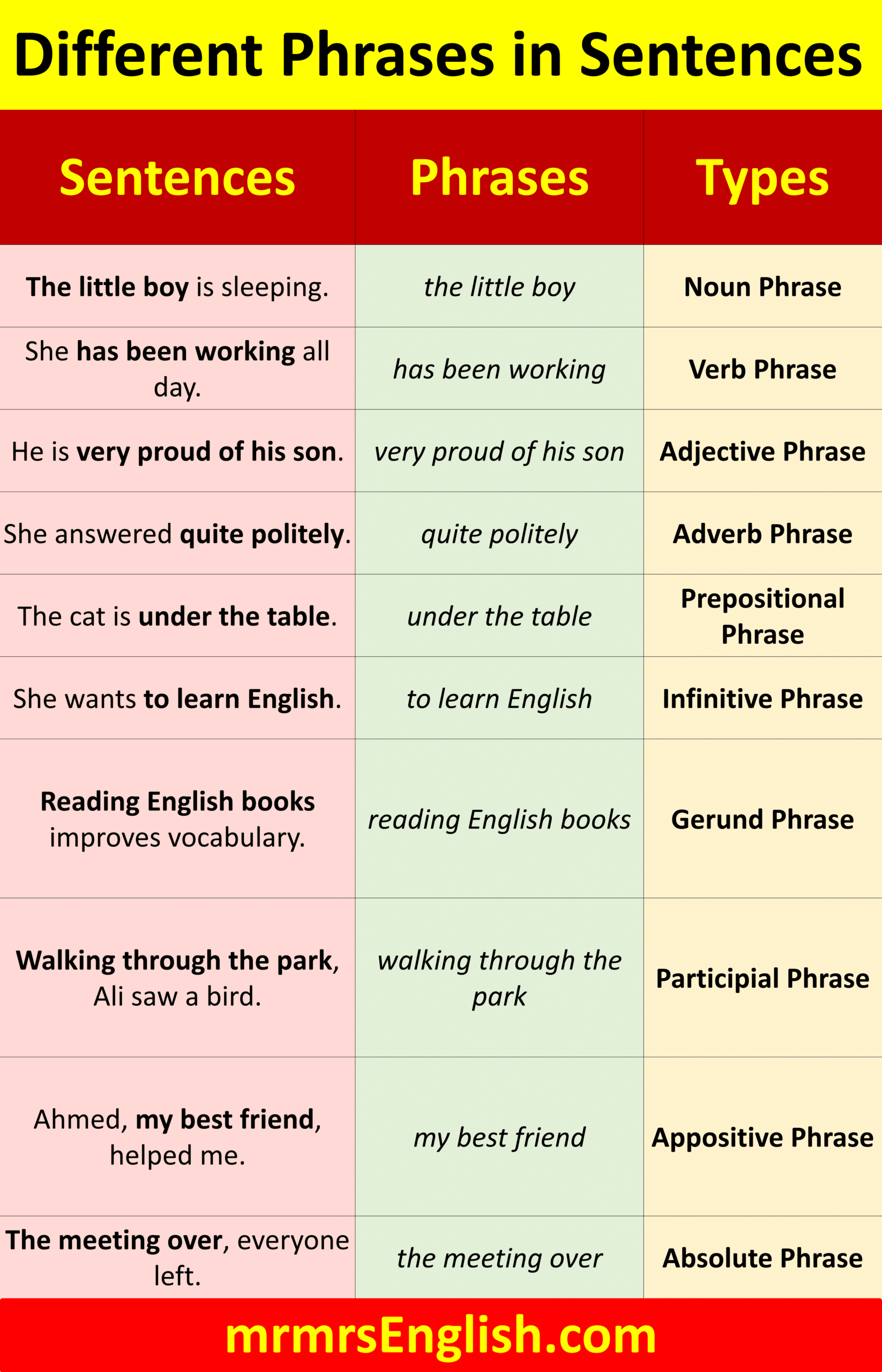
| Sentence | Phrase | Type |
|---|---|---|
| The little boy is sleeping. | the little boy | Noun Phrase |
| She has been working all day. | has been working | Verb Phrase |
| He is very proud of his son. | very proud of his son | Adjective Phrase |
| She answered quite politely. | quite politely | Adverb Phrase |
| The cat is under the table. | under the table | Prepositional Phrase |
| She wants to learn English. | to learn English | Infinitive Phrase |
| Reading English books improves vocabulary. | reading English books | Gerund Phrase |
| Walking through the park, Ali saw a bird. | walking through the park | Participial Phrase |
| Ahmed, my best friend, helped me. | my best friend | Appositive Phrase |
| The meeting over, everyone left. | the meeting over | Absolute Phrase |
Examples of Phrases in Sentences
How Phrases Make Sentences Better
Phrases allow us to expand basic sentences by adding useful information without necessarily creating additional clauses.
Start with:
The boy smiled.
Add information to the noun phrase:
The young boy with curly hair smiled.
Add information about manner:
The young boy with curly hair smiled very happily.
Add another phrase:
The young boy with curly hair smiled very happily at his mother.
The central idea remains easy to understand, but phrases make the sentence more specific, descriptive, and informative.
Importance of Phrases in English Grammar
Phrases are important because they form many of the structures used to build clauses and sentences. A good understanding of phrases helps students see how individual words combine into larger grammatical units.
Learning phrases can help ESL students:
- understand sentence structure
- identify subjects and objects
- use modifiers correctly
- write more detailed sentences
- improve reading comprehension
- understand grammar questions in examinations
- distinguish phrases from clauses
- recognize relationships between words
- improve academic and creative writing
Phrases are therefore useful not only for grammar exercises but also for speaking, reading, and writing English accurately.
Common Mistakes When Using Phrases
One common mistake is believing that a phrase cannot contain a verb. Several phrase types contain verbs or verb forms. What matters is whether the expression forms a complete predicating clause.
Another common mistake is confusing a gerund phrase with a participial phrase. Both may contain an -ing form, but the gerund phrase functions as a noun while the participial phrase modifies a noun or pronoun.
Students also sometimes confuse phrase type with phrase function. For example:
The students arrived after lunch.
After lunch is structurally a prepositional phrase, while its function is adverbial.
Another important issue involves misplaced or dangling modifiers.
Consider:
Walking through the park, the flowers looked beautiful.
This structure incorrectly suggests that the flowers were walking.
A clearer version is:
Walking through the park, I noticed the beautiful flowers.
Now the participial phrase logically modifies I.
Tips for Learning Types of Phrases
Do not rely only on memorizing examples. Instead, learn how each phrase is formed and used.
Start by identifying the head word. Then determine whether the phrase contains a noun, adjective, adverb, preposition, infinitive, gerund, or participle as its central element.
After identifying its structure, examine its function in the complete sentence. This two-step approach—structure first, function second—helps avoid many common grammar mistakes.
Regular sentence analysis is also useful. Take a simple sentence and identify its noun phrases, verb phrase, modifiers, and prepositional phrases. With practice, longer sentences become much easier to understand.
Frequently Asked Questions About Phrases
What is a phrase in English grammar?
A phrase is a group of related words that functions together as a grammatical unit. It does not normally contain the complete subject-predicate structure needed to form an independent clause.
What are the main types of phrases in English?
The main types commonly taught are noun phrases, verb phrases, adjective phrases, adverb phrases, prepositional phrases, infinitive phrases, gerund phrases, and participial phrases. Appositive and absolute phrases are also useful at more advanced levels.
What is a noun phrase with an example?
A noun phrase is centered on a noun or pronoun.
Example:
The little boy in the garden is my brother.
The complete expression the little boy in the garden is a noun phrase centered on boy.
What is a verb phrase with an example?
A verb phrase is centered on a main verb and, in traditional grammar, commonly includes one or more auxiliary verbs.
Example:
She has been studying since morning.
What is the difference between a phrase and a clause?
A phrase does not normally contain a complete subject-predicate relationship, while a clause contains a subject and a verb functioning as its predicate.
For example:
after the meeting — Phrase
after the meeting ended — Clause
Can a phrase contain a verb?
Yes. Verb phrases, infinitive phrases, gerund phrases, and participial phrases contain verbs or verb forms. Therefore, a phrase should not simply be described as “a group of words without a verb.”
Can one phrase contain another phrase?
Yes. A larger phrase can contain one or more smaller phrases.
For example:
the boy in the blue shirt
The entire expression is a noun phrase, while in the blue shirt is a prepositional phrase inside it.
What is the easiest way to identify a phrase?
First, identify the group of words working together. Then look for its head word or central structure and finally determine its function in the sentence. Using both structure and function produces a more accurate analysis.
Learn more helpful articles

Leave a Comment