
Possessive nouns are an important part of English grammar because they show ownership, belonging, and relationships between people, animals, places, and things. They help us explain who owns something or to whom something belongs. For example, Sarah’s book, the dog’s tail, and the students’ classroom all contain possessive nouns. Learning how to form and use them correctly can improve your speaking, writing, and understanding of English. In this article, you will learn what possessive nouns are, explore their rules, study easy examples, and understand how to use apostrophes correctly.
What Are Possessive Nouns in English?
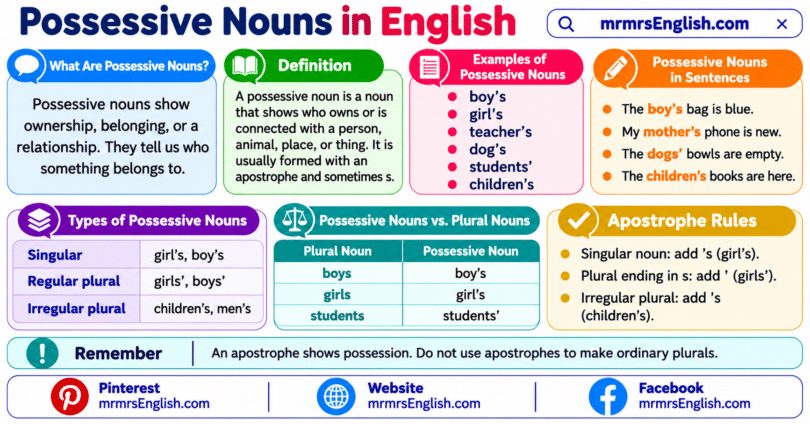
A possessive noun is a noun that shows ownership, belonging, or a relationship between one person, animal, place, or thing and another. It is usually formed by adding an apostrophe (‘) and sometimes the letter s to a noun.
Possessive nouns answer questions such as Whose book?, Whose car?, or Whose house? They tell us who owns or is connected with something.
For example:
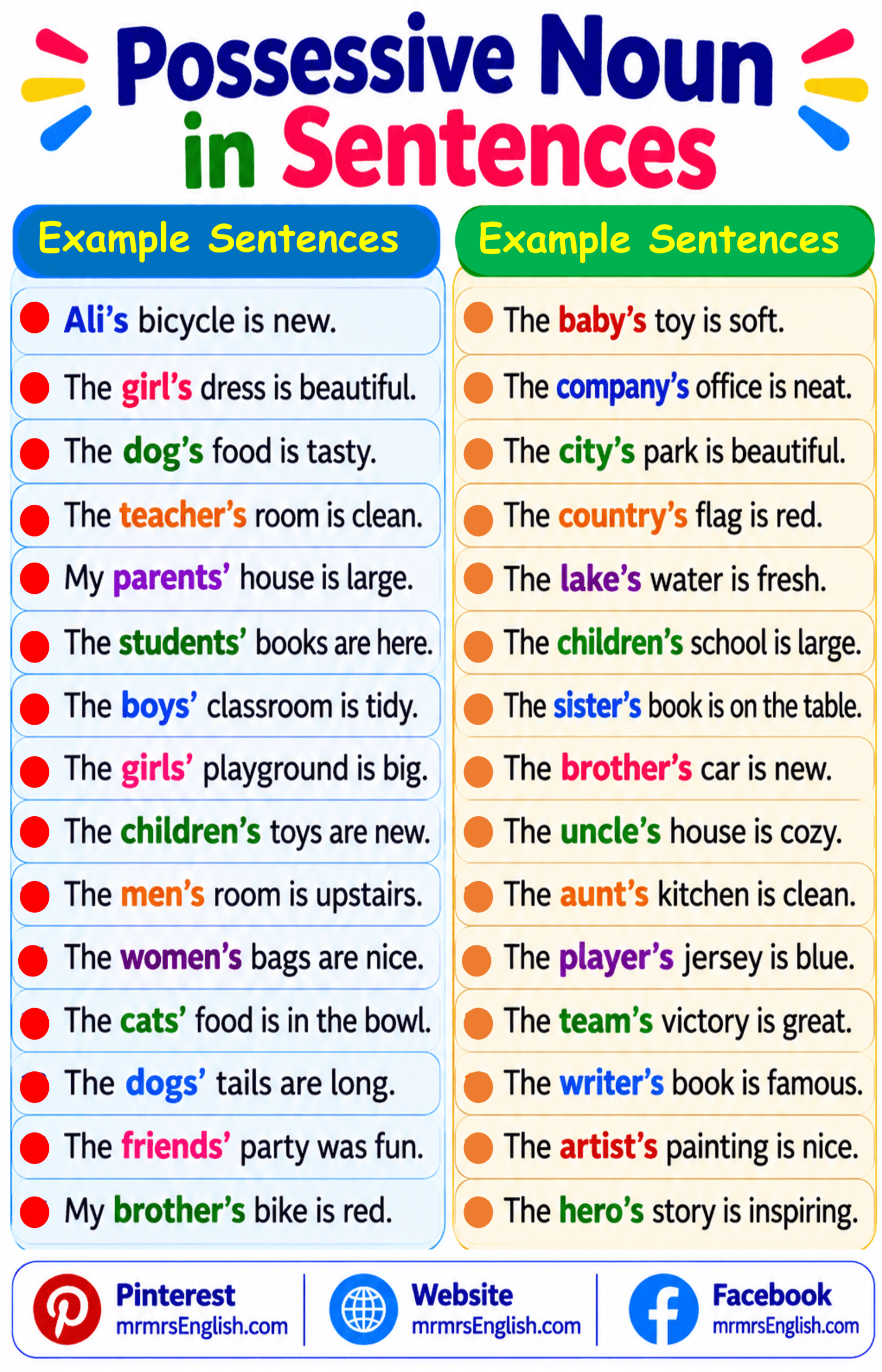
- Ali’s bicycle is new.
- The girl’s dress is beautiful.
- The dog’s food is in the kitchen.
- The teachers’ room is upstairs.
- My parents’ house is large.
Possessive Nouns Examples Sentences
Possessive nouns are commonly used in everyday conversations, books, schoolwork, and formal writing. They can show ownership by a single person, several people, animals, or even things.
| Possessive Noun | Example Sentence |
|---|---|
| Boy’s | The boy’s shoes are dirty. |
| Girl’s | The girl’s bag is pink. |
| Father’s | My father’s car is outside. |
| Mother’s | My mother’s phone is ringing. |
| Teacher’s | The teacher’s desk is clean. |
| Student’s | The student’s answer is correct. |
| Dog’s | The dog’s tail is short. |
| Cat’s | The cat’s bowl is empty. |
| Bird’s | The bird’s nest is in the tree. |
| Baby’s | The baby’s toys are colorful. |
| Children’s | The children’s playground is large. |
| Men’s | The men’s changing room is closed. |
| Women’s | The women’s bags are on the table. |
| Students’ | The students’ books are on the shelf. |
| Parents’ | Their parents’ house is beautiful. |
Possessive Nouns Examples Sentences
Rules for Forming Possessive Nouns
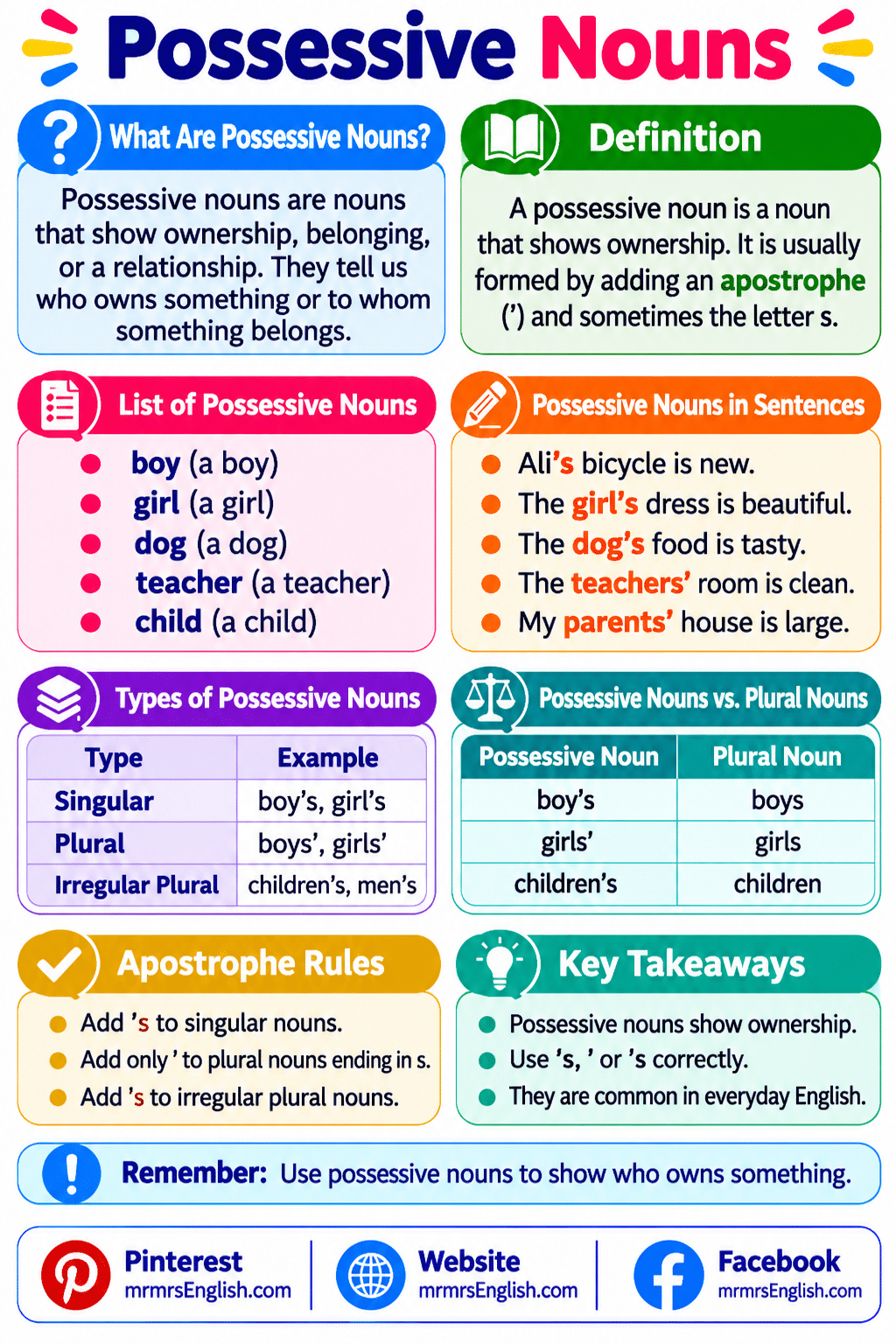
There are several rules for forming possessive nouns in English. The correct rule depends on whether the noun is singular, plural, or an irregular plural noun.
1. Add Apostrophe and S to Singular Nouns
To make most singular nouns possessive, add an apostrophe followed by the letter s (‘s). This rule applies even when the singular noun already ends in the letter s, although some style guides allow an apostrophe alone for certain names.
Examples:
| Singular Noun | Possessive Noun | Example Sentence |
|---|---|---|
| Boy | Boy’s | The boy’s bicycle is blue. |
| Girl | Girl’s | The girl’s hair is long. |
| Teacher | Teacher’s | The teacher’s book is missing. |
| Student | Student’s | The student’s uniform is clean. |
| Doctor | Doctor’s | The doctor’s office is open. |
| Dog | Dog’s | The dog’s collar is red. |
| Cat | Cat’s | The cat’s eyes are green. |
| James | James’s | James’s car is parked outside. |
| Child | Child’s | The child’s toy is broken. |
| Friend | Friend’s | My friend’s house is nearby. |
Examples in sentences:
- The boy’s shoes are under the bed.
- My mother’s birthday is in December.
- The doctor’s advice was helpful.
- The student’s notebook is on the desk.
2. Add Only an Apostrophe to Regular Plural Nouns Ending in S
When a plural noun already ends in s, add only an apostrophe after the final s to make it possessive. You do not need to add another s.
Examples:
| Plural Noun | Possessive Noun | Example Sentence |
|---|---|---|
| Boys | Boys’ | The boys’ classroom is clean. |
| Girls | Girls’ | The girls’ dresses are beautiful. |
| Teachers | Teachers’ | The teachers’ meeting starts at noon. |
| Students | Students’ | The students’ results are excellent. |
| Parents | Parents’ | The parents’ cars are outside. |
| Doctors | Doctors’ | The doctors’ room is upstairs. |
| Players | Players’ | The players’ uniforms are new. |
| Workers | Workers’ | The workers’ tools are ready. |
| Friends | Friends’ | My friends’ houses are nearby. |
| Dogs | Dogs’ | The dogs’ food is in the bowls. |
Examples in sentences:
- The students’ books are on the table.
- The teachers’ lounge is on the second floor.
- The players’ bags are in the changing room.
- The parents’ meeting will begin soon.
3. Add Apostrophe and S to Irregular Plural Nouns
Some plural nouns do not end in s. These are called irregular plural nouns. To make them possessive, add an apostrophe and s (‘s) at the end.
Examples:
| Singular Noun | Plural Noun | Possessive Noun |
|---|---|---|
| Child | Children | Children’s |
| Man | Men | Men’s |
| Woman | Women | Women’s |
| Person | People | People’s |
| Mouse | Mice | Mice’s |
| Goose | Geese | Geese’s |
| Foot | Feet | Feet’s |
| Tooth | Teeth | Teeth’s |
Examples in sentences:
- The children’s toys are in the box.
- The men’s clothing section is downstairs.
- The women’s team won the match.
- The people’s choice was respected.
- The mice’s hiding place was behind the cupboard.
Note: Some possessive forms are less common in everyday English. The important rule is that irregular plural nouns that do not end in s take (‘s).
4. Use an Apostrophe with Compound Nouns
A compound noun is made up of two or more words that work together as one noun. To make a compound noun possessive, usually add an apostrophe and s to the end of the complete compound noun.
Examples:
| Compound Noun | Possessive Form | Example Sentence |
|---|---|---|
| Mother-in-law | Mother-in-law’s | My mother-in-law’s garden is beautiful. |
| Father-in-law | Father-in-law’s | My father-in-law’s car is new. |
| Brother-in-law | Brother-in-law’s | My brother-in-law’s office is nearby. |
| Sister-in-law | Sister-in-law’s | My sister-in-law’s dress is lovely. |
| Passerby | Passerby’s | The passerby’s phone was ringing. |
5. Use Apostrophes to Show Joint Ownership
When two or more people share ownership of the same thing, add the possessive ending to the last name only.
Examples:
- Sarah and John’s house is beautiful.
- Ali and Ahmed’s business is successful.
- Tom and Jack’s room is clean.
- Emma and Sophia’s project received an award.
In these sentences, the people share the same house, business, room, or project.
6. Use Apostrophes to Show Separate Ownership
When two or more people own different things individually, make each noun possessive by adding the appropriate apostrophe ending.
Examples:
- Sarah’s and John’s cars are parked outside.
- Ali’s and Ahmed’s books are on different desks.
- Tom’s and Jack’s rooms are on separate floors.
- Emma’s and Sophia’s projects were submitted.
Here, each person owns a separate car, book, room, or project.
Types and Uses of Possessive Nouns
Possessive nouns can express different kinds of ownership and relationships. They are not limited to physical objects. They can also show family connections, personal associations, and connections with places or events.
1. Possession by People
Possessive nouns often show that something belongs to a person.
Examples:
- My brother’s laptop is expensive.
- The teacher’s explanation was clear.
- Sarah’s handbag is on the chair.
- My father’s office is near the market.
2. Possession by Animals
We also use possessive nouns to show that something belongs to an animal or is connected with it.
Examples:
- The lion’s roar was loud.
- The bird’s wings are beautiful.
- The cat’s tail is fluffy.
- The horse’s legs are strong.
3. Possession by Places and Organizations
Possessive nouns can show a connection between a place or organization and something associated with it.
Examples:
- The company’s website is easy to use.
- The school’s library is large.
- The country’s economy is growing.
- The city’s streets are crowded.
4. Possession by Time and Measurement
Possessive forms are also used with periods of time and measurements.
Examples:
- A day’s work can be tiring.
- Two weeks’ holiday is enough.
- One hour’s journey is not too long.
- A month’s salary was paid.
- Three years’ experience is required.
These expressions show a period, duration, or amount of time associated with something.
Types of Possessive Nouns with Examples
Possessive Nouns vs. Plural Nouns
Possessive nouns and plural nouns may look similar, but they have different meanings and uses. A plural noun refers to more than one person, animal, place, or thing. A possessive noun shows ownership, belonging, or a relationship.
| Plural Noun | Possessive Noun |
|---|---|
| Boys | Boy’s |
| Girls | Girl’s |
| Teachers | Teacher’s |
| Students | Student’s |
| Dogs | Dog’s |
| Cats | Cat’s |
| Parents | Parent’s |
| Books | Book’s |
Examples:
- The boys are playing football. (More than one boy)
- The boy’s ball is new. (The ball belongs to one boy)
- The teachers are in the staffroom. (More than one teacher)
- The teacher’s desk is clean. (The desk belongs to one teacher)
- The students are studying. (More than one student)
- The students’ classroom is large. (The classroom belongs to or is used by the students)
Important: A plural noun does not automatically show ownership. An apostrophe is needed when you want to form a possessive noun.
Possessive Nouns vs. Possessive Pronouns
Possessive nouns and possessive pronouns both show ownership, but they are different parts of speech.
A possessive noun is formed from a noun using an apostrophe, while a possessive pronoun replaces a noun phrase to show ownership without repeating the noun.
Compare these examples:
- This is Ali’s book. (Possessive noun)
- This book is his. (Possessive pronoun)
| Possessive Noun | Possessive Pronoun | Example |
|---|---|---|
| Ali’s | His | Ali’s bag is new. The bag is his. |
| Sara’s | Hers | Sara’s dress is red. The dress is hers. |
| The boys’ | Theirs | The boys’ room is clean. The room is theirs. |
| The children’s | Theirs | The children’s toys are here. The toys are theirs. |
| My parents’ | Theirs | My parents’ house is large. The house is theirs. |
Possessive Pronouns and Possessive Determiners
It is also important to understand the difference between possessive pronouns and possessive determiners.
Possessive determiners come before nouns to show ownership. Examples include my, your, his, her, its, our, and their.
Possessive pronouns stand independently and replace a noun phrase. Examples include mine, yours, his, hers, ours, and theirs.
| Possessive Determiner | Possessive Pronoun |
|---|---|
| My | Mine |
| Your | Yours |
| His | His |
| Her | Hers |
| Its | No commonly used independent equivalent |
| Our | Ours |
| Their | Theirs |
Examples:
- This is my pen. (Possessive determiner)
- This pen is mine. (Possessive pronoun)
- That is her bag. (Possessive determiner)
- That bag is hers. (Possessive pronoun)
- These are their books. (Possessive determiner)
- These books are theirs. (Possessive pronoun)
Possessive Nouns and Apostrophe Rules
An apostrophe is a punctuation mark used to form possessive nouns. Its position is important because it can change the meaning of a sentence.
Difference Between S, ‘S, and S’
These forms are often confusing for English learners. The following examples explain how they work.
| Form | Meaning | Example |
|---|---|---|
| S | Usually forms a regular plural noun | The boys are playing. |
| ‘S | Usually forms a singular possessive noun | The boy’s bag is red. |
| S’ | Forms a possessive from a regular plural noun ending in s | The boys’ bags are red. |
Singular Nouns Ending in S
For most singular nouns ending in s, you can add apostrophe and s (‘s) to form the possessive.
Examples:
- James’s book is on the table.
- Chris’s car is new.
- The boss’s office is upstairs.
Some style guides also accept an apostrophe alone for certain names ending in s, such as James’ book. Follow the style guide required by your school, examination, or publication and remain consistent.
Do Not Use Apostrophes to Form Ordinary Plurals
Apostrophes are not normally used to make regular nouns plural.
Incorrect: Apple’s are healthy.
Correct: Apples are healthy.
Incorrect: The student’s are studying.
Correct: The students are studying.
Use an apostrophe only when you need to show possession or in certain special cases, such as omitted letters in contractions.
Difference Between Its and It’s
Its and it’s sound the same, but they have different grammatical functions.
- Its is a possessive determiner. It shows that something belongs to or is associated with an animal, object, or organization.
- It’s is a contraction of it is or it has. It does not show possession.
| Word | Meaning | Example |
|---|---|---|
| Its | Shows possession | The dog wagged its tail. |
| It’s | It is | It’s a beautiful day. |
| It’s | It has | It’s been a long journey. |
Remember: Unlike most possessive nouns, its does not contain an apostrophe. This is because it’s is already used as a contraction.
Common Mistakes When Using Possessive Nouns
English learners sometimes make mistakes when adding apostrophes or choosing the correct possessive form. Understanding these common errors can help you write more accurately.
| Incorrect Sentence | Correct Sentence |
|---|---|
| The boys’s bags are new. | The boys’ bags are new. |
| The girls dresses are beautiful. | The girls’ dresses are beautiful. |
| The childs toy is broken. | The child’s toy is broken. |
| The childrens books are here. | The children’s books are here. |
| The dogs tail is long. | The dog’s tail is long. |
| The teachers room is clean. | The teacher’s room is clean. |
| The students’s books are missing. | The students’ books are missing. |
| Its raining outside. | It’s raining outside. |
Mistakes to Avoid
- Do not add an apostrophe to ordinary plural nouns. Write books, not book’s, when you mean more than one book.
- Do not forget the apostrophe in singular possessive nouns. Write the girl’s bag, not the girls bag, when one girl owns the bag.
- Do not add an extra s to regular plural nouns ending in s. Write students’ books, not students’s books.
- Remember irregular plural nouns. Write children’s toys, not childrens’ toys.
- Do not confuse its with it’s. Use its for possession and it’s for it is or it has.
How to Identify Possessive Nouns in a Sentence
You can identify a possessive noun by looking for an apostrophe and checking whether the noun shows ownership, belonging, or a relationship.
Follow these simple steps:
- Look for an apostrophe: Check whether a noun contains an apostrophe followed by s or an apostrophe after its final s.
- Find the related noun: Look at the word or thing connected with the possessive noun.
- Ask a question: Ask Whose? to understand the relationship.
- Check the meaning: Make sure the noun expresses ownership or association rather than simply being plural.
Examples:
- Ahmed’s bicycle is expensive. (Whose bicycle? Ahmed’s.)
- The cat’s food is in the bowl. (Whose food? The cat’s.)
- The students’ classroom is clean. (Whose classroom? The students’.)
- The children’s playground is large. (Whose playground? The children’s.)
- In each sentence, the possessive noun identifies the person or group associated with something.
Possessive Nouns in Everyday English
Possessive nouns are frequently used in everyday conversations. They make sentences shorter, clearer, and more natural because they show relationships without requiring lengthy explanations.
| Situation | Example Sentence |
|---|---|
| At home | My mother’s phone is ringing. |
| At school | The teacher’s book is on the desk. |
| At work | The manager’s office is closed. |
| At the market | The shop’s prices are reasonable. |
| At the hospital | The doctor’s appointment is at 10 a.m. |
| With friends | My friend’s birthday is tomorrow. |
| With animals | The horse’s food is ready. |
| While traveling | The hotel’s entrance is on the left. |
| At a restaurant | The restaurant’s menu has changed. |
| In a city | The city’s roads are busy. |
Learn more helpful articles

Leave a Comment