
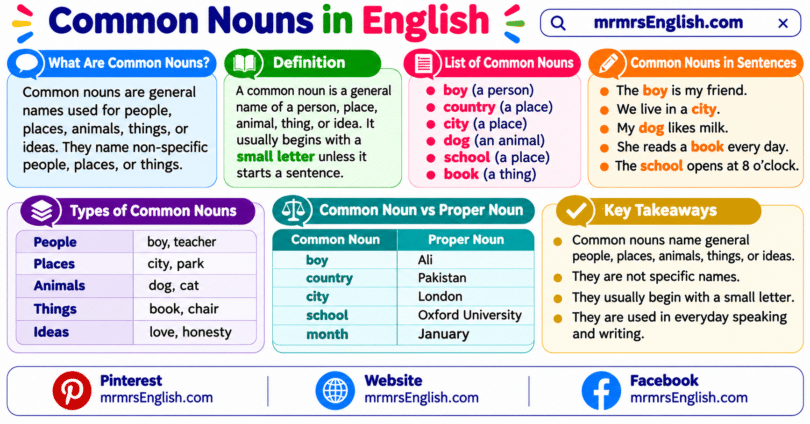
What Are Common Nouns?
Common nouns are words that name general people, places, animals, things, or ideas rather than particular individuals or specific names. They refer to members of a general class or group and are usually written with lowercase letters unless they appear at the beginning of a sentence.
Common Noun Examples in Sentences
The following sentences show how common nouns are used in everyday English:
- The boy is playing in the garden.
- My mother works in a hospital.
- The teacher is explaining the lesson.
- A dog is sleeping under the table.
- We visited a beautiful city.
- The children are reading books.
- She bought a new dress.
- The birds are flying in the sky.
- My brother likes playing football.
- The shopkeeper opened his shop early.
In these sentences, the bold words are common nouns because they refer to general people, places, animals, or things rather than specific names.
Examples of Common Nouns with Meanings
Common nouns appear in almost every area of daily communication. They help us describe people, animals, places, objects, and ideas. The following table contains commonly used nouns with their simple meanings.
| Common Noun | Meaning |
|---|---|
| Teacher | A person who teaches students |
| Student | A person who studies |
| Doctor | A person who treats sick people |
| Farmer | A person who grows crops |
| Child | A young person |
| Friend | A person you know and like |
| School | A place where students learn |
| Hospital | A place where sick people receive treatment |
| Garden | A place where plants and flowers grow |
| Village | A small community or settlement |
| Book | A set of written or printed pages |
| Chair | A piece of furniture for sitting |
| Table | A piece of furniture with a flat top |
| Pencil | A tool used for writing or drawing |
| Computer | An electronic device used for processing information |
| Dog | A common domestic animal |
| Lion | A large wild animal of the cat family |
| Horse | A large animal used for riding and work |
| Bird | An animal with feathers and wings |
| Fish | An animal that lives in water |
| Happiness | A feeling of pleasure or joy |
| Honesty | The quality of being truthful |
| Kindness | The quality of being kind |
| Freedom | The state of being free |
| Courage | The ability to face danger or difficulty |
Types of Common Nouns
Common nouns can be classified into different categories according to what they name and how they are used. Understanding these categories makes it easier to identify and use common nouns correctly in English grammar.
1. Common Nouns for People
These nouns refer to people in general, including their occupations, relationships, roles, and social positions. They do not identify a particular individual.
Examples include:
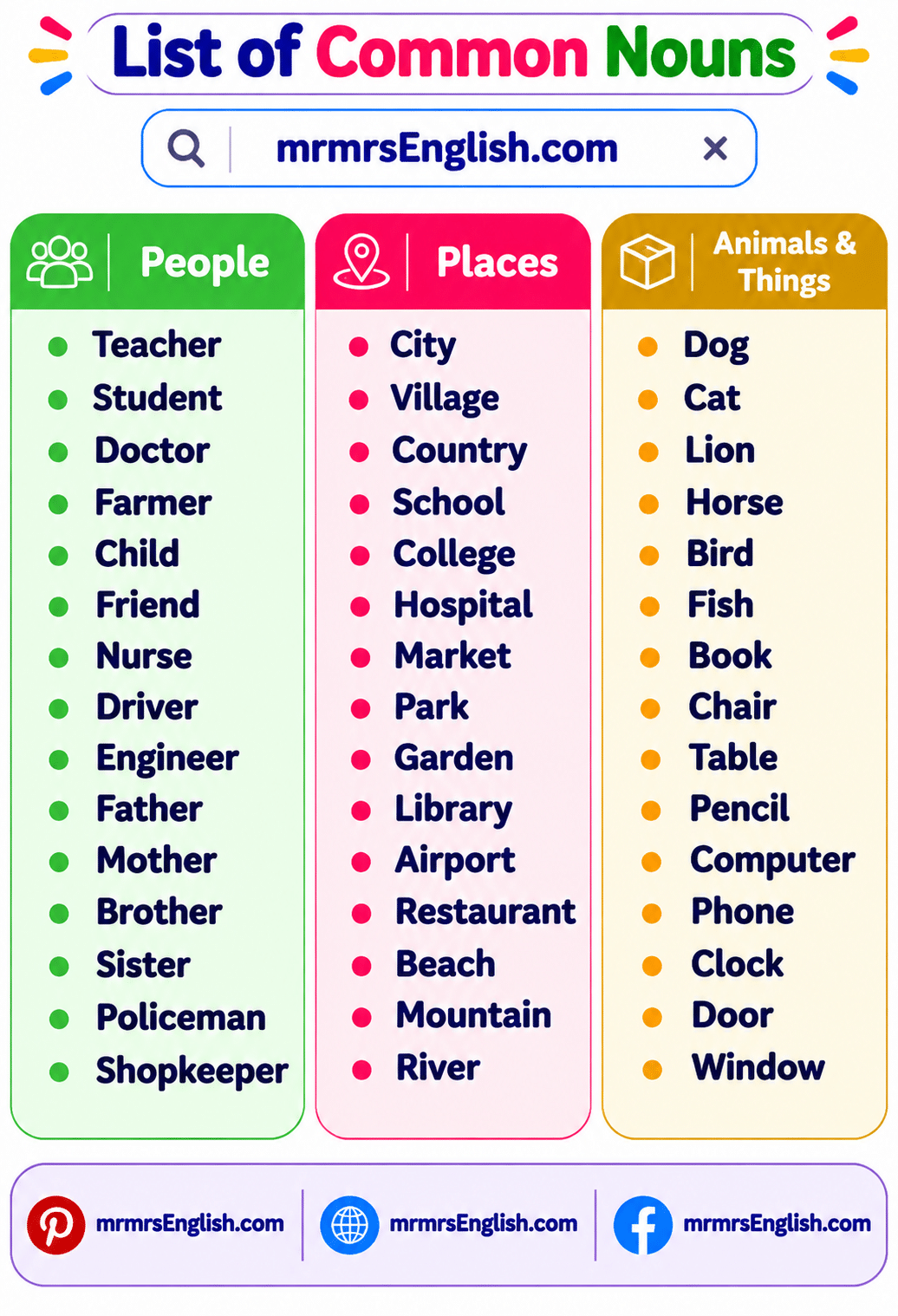
- Teacher
- Student
- Doctor
- Nurse
- Farmer
- Driver
- Engineer
- Father
- Mother
- Brother
- Sister
- Policeman
- Shopkeeper
- Carpenter
- Chef
Example sentences:
- The teacher teaches English grammar.
- My father works in an office.
- A doctor treats patients.
- The farmer grows vegetables.
- The driver drives the bus.
2. Common Nouns for Places
These nouns name general locations, buildings, geographical features, and places where people live, work, study, or visit. They do not refer to a particular named location.
Examples include:
- City
- Village
- Country
- School
- College
- Hospital
- Market
- Park
- Garden
- Library
- Airport
- Restaurant
- Beach
- Mountain
- River
Example sentences:
- My school is near my house.
- We visited a beautiful park.
- The hospital is open all day.
- She works in a large city.
- The children are playing in the garden.
3. Common Nouns for Animals
These nouns refer to animals in general rather than individual animals with particular names. They include domestic animals, wild animals, birds, insects, and aquatic animals.
Examples include:
- Cat
- Dog
- Lion
- Tiger
- Elephant
- Horse
- Cow
- Goat
- Rabbit
- Monkey
- Eagle
- Parrot
- Butterfly
- Snake
- Dolphin
Example sentences:
- The cat is drinking milk.
- A lion lives in the forest.
- The elephant has a long trunk.
- A parrot can imitate human speech.
- The horse is running fast.
4. Common Nouns for Things
These nouns name ordinary objects, materials, tools, furniture, food items, and other physical things. They are commonly used in everyday conversations.
Examples include:
- Book
- Pen
- Pencil
- Bag
- Chair
- Table
- Bottle
- Phone
- Computer
- Clock
- Door
- Window
- Shoes
- Plate
- Spoon
Example sentences:
- I bought a new phone.
- The book is on the table.
- She put water in the bottle.
- My bag is under the chair.
- Please close the door.
5. Common Nouns for Ideas and Qualities
Some common nouns name things that cannot be physically touched or seen. These nouns express feelings, emotions, qualities, conditions, and ideas. They are generally known as abstract nouns.
Examples include:
- Love
- Happiness
- Sadness
- Honesty
- Kindness
- Courage
- Freedom
- Wisdom
- Beauty
- Childhood
- Knowledge
- Friendship
- Patience
- Fear
- Anger
Example sentences:
- Honesty is an important quality.
- Love makes people happy.
- She showed great courage.
- Knowledge helps us make better decisions.
- Kindness makes the world a better place.
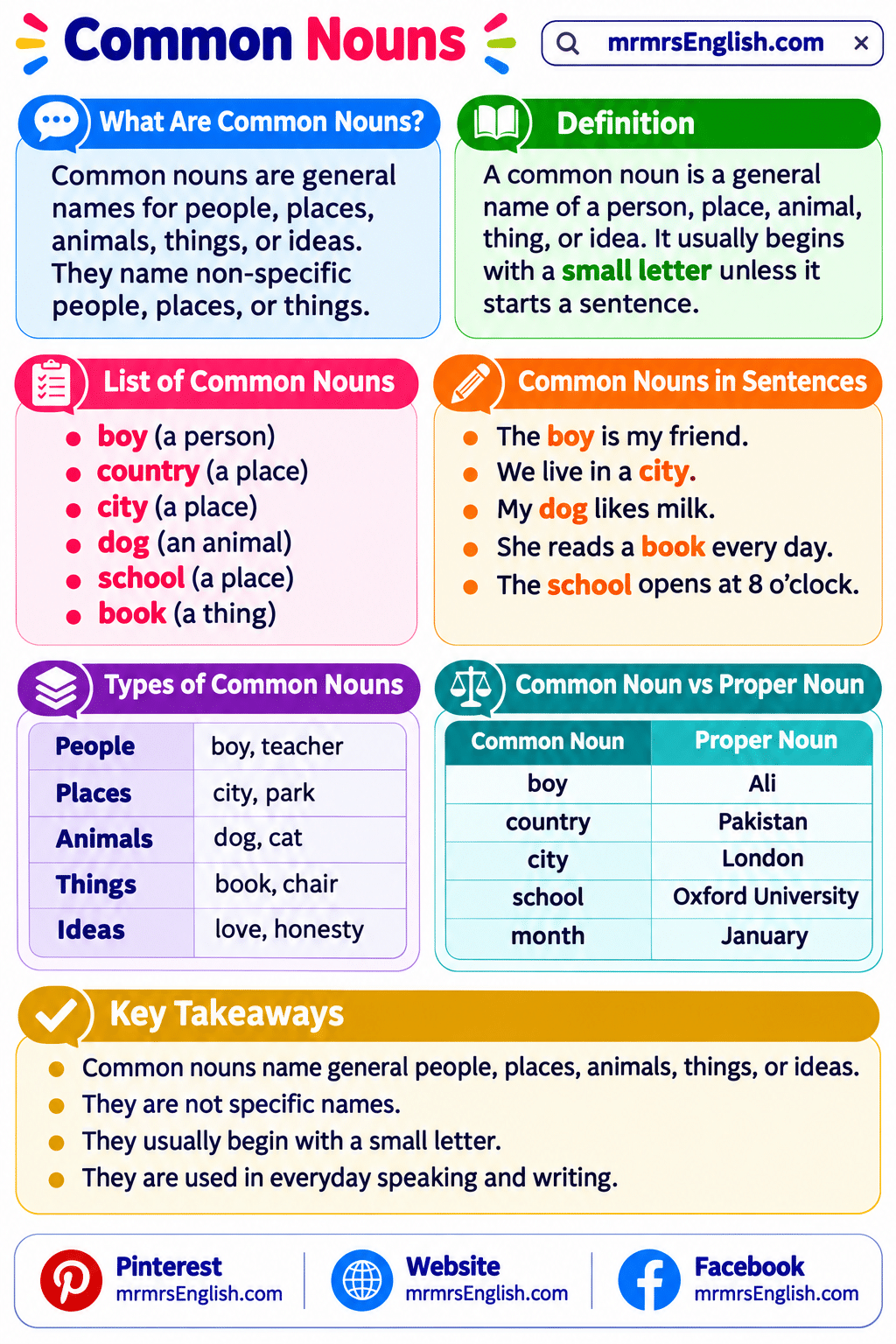
Types of Common Nouns with Examples
Common Nouns Based on Their Grammatical Categories
In English grammar, common nouns can also be studied according to their number, countability, and structure. These categories help learners understand how nouns work in sentences.
1. Countable Common Nouns
Countable common nouns are nouns that refer to people, animals, places, or things that can be counted individually. They have both singular and plural forms and can be used with numbers and words such as a, an, many, and few.
Examples:
| Singular | Plural |
|---|---|
| Book | Books |
| Chair | Chairs |
| Student | Students |
| Apple | Apples |
| Dog | Dogs |
| Teacher | Teachers |
| Table | Tables |
| Flower | Flowers |
| Car | Cars |
| Child | Children |
Example sentences:
- I have three books.
- A student is standing outside.
- There are five chairs in the room.
- She bought an apple.
- Many children are playing outside.
2. Uncountable Common Nouns
Uncountable common nouns refer to substances, materials, or abstract concepts that are not normally counted as separate individual units. They generally do not have plural forms and are not used directly with a or an.
Examples:
| Uncountable Noun | Meaning |
|---|---|
| Water | A clear liquid essential for life |
| Milk | A white liquid produced by mammals |
| Rice | A cereal grain used as food |
| Sugar | A sweet substance used in food |
| Flour | Powder made by grinding grains |
| Furniture | Items used to furnish a room |
| Information | Facts or knowledge about something |
| Advice | Suggestions about what someone should do |
| Knowledge | Information and understanding |
| Equipment | Tools and objects needed for a task |
Example sentences:
- We need some water.
- My mother bought rice.
- She gave me useful advice.
- The room has new furniture.
- He has a lot of knowledge about science.
Remember that uncountable nouns generally take singular verbs. For example, we say The information is useful, not The information are useful.
3. Singular Common Nouns
Singular common nouns refer to one person, place, animal, thing, or idea. They are used when talking about a single member of a general class.
Examples:
- Boy
- Girl
- Teacher
- Doctor
- Cat
- Bird
- House
- School
- Book
- Flower
Example sentences:
- A boy is running.
- The teacher is teaching English.
- A bird is sitting on the tree.
- She lives in a small house.
4. Plural Common Nouns
Plural common nouns refer to two or more people, animals, places, things, or ideas. Most plural nouns are formed by adding -s or -es to their singular forms, although some nouns have irregular plural forms.
- Examples:
- Boys
- Girls
- Teachers
- Doctors
- Cats
- Birds
- Houses
- Schools
- Books
- Children
Example sentences:
- The boys are playing football.
- The teachers are attending a meeting.
- Many birds are flying in the sky.
- The children are studying in the classroom.
Common Nouns and Proper Nouns in Sentences
| Common Noun | Proper Noun | Example Sentence |
|---|---|---|
| boy | Ali | The boy named Ali is playing cricket. |
| girl | Sarah | The girl named Sarah is reading a book. |
| city | London | London is a beautiful city. |
| country | Pakistan | Pakistan is my country. |
| river | Nile | The Nile is a long river. |
| mountain | Everest | Mount Everest is the highest mountain. |
| school | Oxford | Oxford is a famous school. |
| teacher | Mr. Ahmed | Mr. Ahmed is our English teacher. |
| doctor | Dr. Khan | Dr. Khan is a kind doctor. |
| dog | Bruno | Bruno is a friendly dog. |
| cat | Mimi | Mimi is my pet cat. |
| book | Harry Potter | Harry Potter is an interesting book. |
| month | January | January is the first month of the year. |
| day | Monday | Monday is the first working day of the week. |
| ocean | Pacific Ocean | The Pacific Ocean is the largest ocean. |
| company | Microsoft | Microsoft is a famous technology company. |
| monument | Eiffel Tower | The Eiffel Tower is a famous monument. |
| planet | Mars | Mars is a red planet. |
| festival | Eid | Eid is a special festival for Muslims. |
| continent | Asia | Asia is the largest continent. |
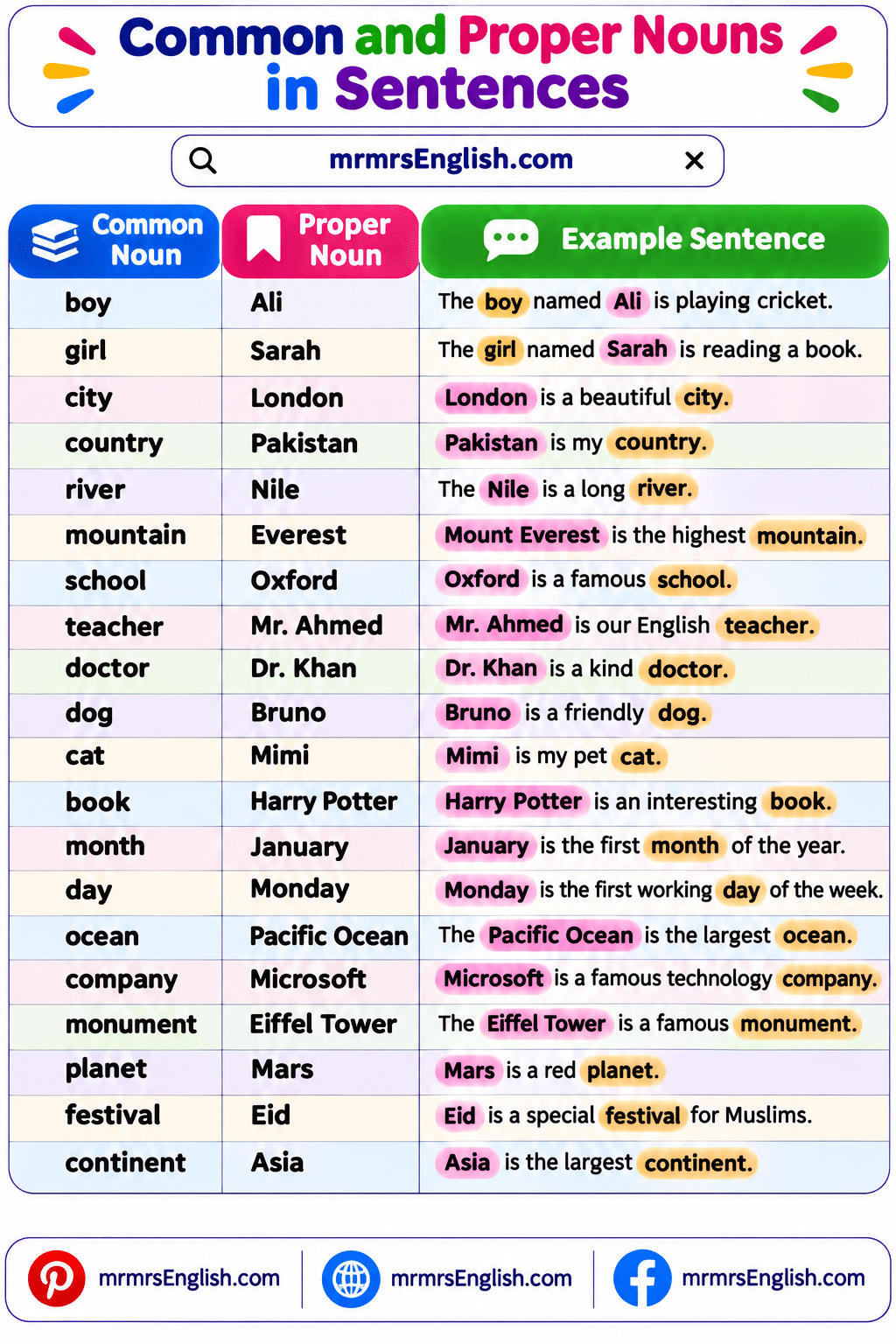
Common and Proper Nouns in sentences
Rules for Using Common Nouns in English
Common nouns follow certain grammatical rules. Learning these rules helps students avoid common mistakes in writing and speaking.
1. Use Lowercase Letters for Common Nouns
Common nouns are generally written with lowercase letters. They do not need capital letters unless they appear at the beginning of a sentence or form part of a proper name.
- Correct: The teacher is in the classroom.
- Incorrect: The Teacher is in the classroom.
However, when a common noun begins a sentence, it must start with a capital letter.
– Children are playing outside.
2. Use Articles with Singular Countable Nouns
Singular countable common nouns generally require a determiner, such as a, an, or the, when used as a complete noun phrase.
Examples:
- I saw a dog.
- She bought an umbrella.
- The teacher is absent today.
- He lives in a village.
Use a before a consonant sound and an before a vowel sound.
3. Use Plural Forms When Referring to More Than One
When a countable common noun refers to more than one person or thing, use its plural form.
Examples:
- One book – Two books
- One student – Five students
- One box – Three boxes
- One child – Four children
The plural form should agree with the verb in the sentence.
- The student is reading.
- The students are reading.
4. Use Singular Verbs with Singular Nouns
A singular common noun generally takes a singular verb in the present simple tense.
Examples:
- The boy plays cricket.
- A bird flies in the sky.
- The teacher explains the lesson.
- My mother cooks food.
5. Use Plural Verbs with Plural Nouns
Plural common nouns generally take plural verbs in the present simple tense.
Examples:
- The boys play cricket.
- The birds fly in the sky.
- The teachers explain the lessons.
- My friends live nearby.
6. Use Appropriate Determiners with Uncountable Nouns
Uncountable common nouns are generally used with words such as some, much, little, and a lot of rather than a or an directly.
Examples:
- We need some water.
- There isn’t much milk.
- She has a little knowledge of French.
- He gave me some useful advice.
To count uncountable nouns, use suitable measurement or quantity expressions.
- A glass of water
- Two bottles of milk
- Three pieces of advice
- A loaf of bread
- Two bags of rice
Common Nouns in Different Parts of Speech and Sentence Functions
Common nouns perform different grammatical functions in English sentences. They can act as subjects, objects, subject complements, and objects of prepositions.
1. Common Nouns as Subjects
A common noun can function as the subject of a sentence. The subject tells us who or what performs an action or what the sentence is about.
Examples:
- The baby is sleeping.
- The teacher explains the lesson.
- A dog is barking.
- The sun shines brightly.
2. Common Nouns as Direct Objects
A common noun can work as a direct object when it receives the action of a verb.
Examples:
- She reads a book.
- He bought a car.
- The boy kicked the ball.
- My mother prepared dinner.
3. Common Nouns as Indirect Objects
A common noun can function as an indirect object when it identifies the person or thing that receives something.
Examples:
- The teacher gave the student a book.
- My father bought my sister a dress.
- She sent her friend a letter.
- The mother told her child a story.
4. Common Nouns as Objects of Prepositions
Common nouns can also appear after prepositions and function as their objects.
Examples:
- The book is on the table.
- She is sitting in the room.
- The children are playing in the garden.
- He walked towards the market.
5. Common Nouns as Subject Complements
A common noun can follow a linking verb, such as is, am, are, or was, and identify or describe the subject.
Examples:
- My father is a doctor.
- Sara is a student.
- His brother became a teacher.
- My uncle is a farmer.
Examples of Common Nouns in Sentences
| Sentence | Common Noun |
|---|---|
| The girl is reading a book. | Girl, book |
| My father drives a car. | Father, car |
| The teacher entered the classroom. | Teacher, classroom |
| A bird is sitting on a tree. | Bird, tree |
| The baby is drinking milk. | Baby, milk |
| The farmer works in the field. | Farmer, field |
| The doctor examined the patient. | Doctor, patient |
| My sister bought a new dress. | Sister, dress |
| The children are playing games. | Children, games |
| The dog is sleeping near the door. | Dog, door |
| The shopkeeper sells fresh fruit. | Shopkeeper, fruit |
| The students are writing sentences. | Students, sentences |
| My mother is cooking dinner. | Mother, dinner |
| The horse is running in the field. | Horse, field |
| The carpenter made a wooden chair. | Carpenter, chair |
| The nurse works in a hospital. | Nurse, hospital |
| The fisherman caught a fish. | Fisherman, fish |
| The boy opened the window. | Boy, window |
| The family lives in a village. | Family, village |
| The gardener waters the flowers. | Gardener, flowers |
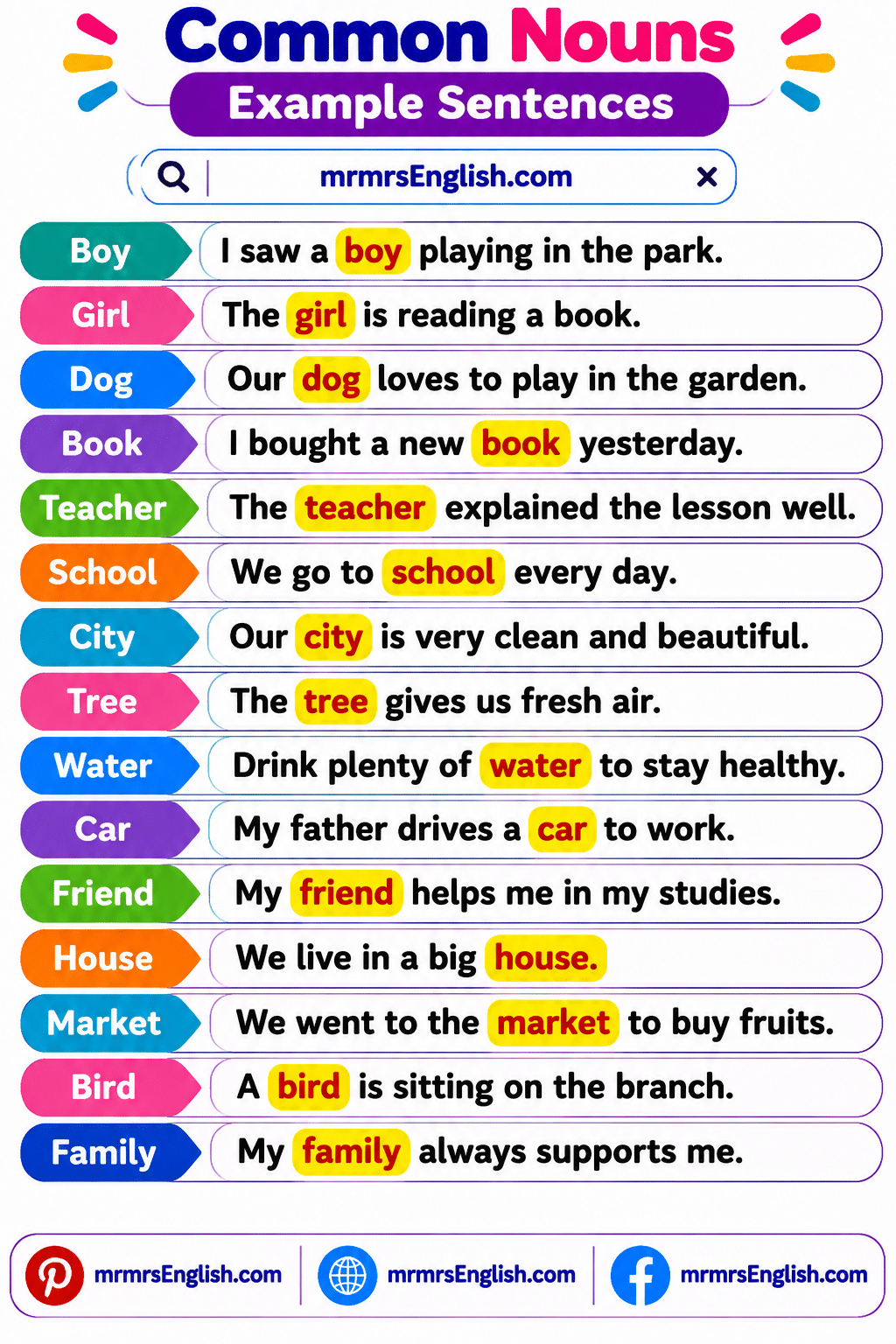
Examples of Common Nouns
Common Mistakes Students Make When Using Common Nouns
English learners sometimes make mistakes when identifying and using common nouns. Understanding these errors can improve grammatical accuracy and help students prepare for English examinations.
| Incorrect Usage | Correct Usage | Explanation |
|---|---|---|
| I saw Dog. | I saw a dog. | A singular countable noun generally needs a determiner. |
| The childs are playing. | The children are playing. | The plural of child is children. |
| She bought a furnitures. | She bought some furniture. | Furniture is uncountable. |
| The student are present. | The students are present. | A plural subject takes a plural verb. |
| My Teacher is kind. | My teacher is kind. | Common nouns do not normally need capital letters in the middle of a sentence. |
| He gave me an advice. | He gave me some advice. | Advice is uncountable. |
| The informations are useful. | The information is useful. | Information is generally uncountable. |
Importance of Learning Common Nouns
Learning common nouns is an essential part of developing English language skills. These nouns are used in everyday communication, academic writing, reading, and conversations. Students who understand common nouns can identify the names of ordinary people, places, animals, objects, and ideas in different sentences.
Common nouns also help learners understand the difference between general and specific names. This knowledge is particularly useful when studying proper nouns, abstract nouns, collective nouns, and other grammatical categories. In addition, understanding singular and plural forms, countable and uncountable nouns, and noun functions helps students construct grammatically correct sentences.
For ESL learners, common nouns provide a foundation for improving vocabulary, sentence formation, reading comprehension, and writing skills.
Frequently Asked Questions About Common Nouns
1. What is a common noun in English?
A common noun is a word that names a general person, place, animal, thing, or idea rather than a particular one. Examples include boy, city, teacher, dog, and book.
2. What are 10 examples of common nouns?
Ten examples of common nouns are:
- Boy
- Girl
- Teacher
- School
- Hospital
- Dog
- Cat
- Book
- Chair
- Garden
List of Common Nouns
3. What is the difference between common nouns and proper nouns?
A common noun names a general person, place, animal, or thing, while a proper noun identifies a specific one. For example, city is a common noun, whereas Karachi is a proper noun. Common nouns are generally written in lowercase, while proper nouns begin with capital letters.
4. Are common nouns always written in lowercase letters?
Common nouns are generally written in lowercase letters, except when they appear at the beginning of a sentence or form part of a proper name. For example, teacher is lowercase in the middle of a sentence but capitalized in “Teacher, please check my work.”
5. Can common nouns be countable and uncountable?
Yes. Common nouns can be countable or uncountable. Countable nouns include books, chairs, and students, which can be counted individually. Uncountable nouns include water, milk, furniture, and information, which are not normally counted as separate units.
6. Can a common noun be abstract?
Yes. Some common nouns name abstract ideas, feelings, qualities, and conditions that cannot be physically touched. Examples include love, honesty, happiness, courage, and freedom.
7. Is the word ‘school’ a common noun?
Yes, school is a common noun because it refers to a general place where students receive education. However, a specific school name, such as City School, is a proper noun.
8. Is the word ‘water’ a common noun?
Yes, water is a common noun. It names a general substance rather than a specific individual or place. It is also an uncountable noun because we do not normally count water as individual units.
9. Is ‘family’ a common noun?
Yes, family is a common noun because it refers to a general group of related people. It is also a collective noun because it represents several individuals as one group.
10. How can students identify common nouns in a sentence?
Students can identify common nouns by looking for words that name general people, places, animals, things, or ideas. Asking questions such as Who? What? and Which place? can help identify nouns. For example, in “The teacher gave the student a book,” the words teacher, student, and book are common nouns.
Learn more helpful articles

Leave a Comment