
What Are Regular Verbs?
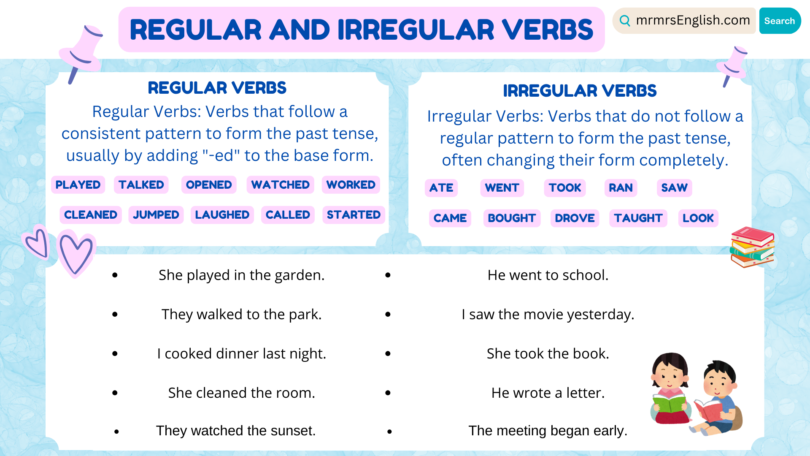
Regular verbs follow a simple and predictable pattern when forming their past tense and past participle. To create the past forms of regular verbs, you simply add -ed or d to the base form of the verb.
Examples of Regular Verbs:
| Base Form | Past Tense | Past Participle |
|---|---|---|
| play | played | played |
| walk | walked | walked |
| dance | danced | danced |
| clean | cleaned | cleaned |
| study | studied | studied |
Key Points to Remember:
- Regular verbs are consistent in forming their past tense by adding -ed or -d to the base verb.
- If the verb ends with a consonant + y, you change y to i before adding -ed. For example, study becomes studied.
Example Sentences:
- She walked to the store yesterday.
- They have played football all day.
What Are Irregular Verbs?
Irregular verbs, on the other hand, do not follow a fixed pattern when forming their past tense or past participle. Instead of adding -ed, the verb changes form in different ways, and there’s no single rule to memorize.
Examples of Irregular Verbs:
| Base Form | Past Tense | Past Participle |
|---|---|---|
| go | went | gone |
| eat | ate | eaten |
| take | took | taken |
| have | had | had |
| see | saw | seen |
Key Points to Remember:
- Irregular verbs change form unpredictably. You need to memorize the past forms since they don’t follow the regular -ed rule.
- Many irregular verbs are commonly used in English, so practicing them is essential.
Example Sentences:
- She went to the park last week.
- I have seen that movie before.

Regular & Irregular Verbs with examples
Differences Between Regular and Irregular Verbs
Understanding the differences between regular and irregular verbs is crucial for building grammatically correct sentences. Here’s a simple comparison:
| Aspect | Regular Verbs | Irregular Verbs |
|---|---|---|
| Past Tense Formation | Add -ed or -d to the base form | Change form in various ways |
| Predictability | Always follow the same rule | No fixed rule; must be memorized |
| Examples | play → played | go → went |
| Past Participle Formation | Same as past tense (played) | May differ from past tense (gone) |
Common Mistakes When Using Regular and Irregular Verbs
Many ESL learners make mistakes when using regular and irregular verbs, especially with irregular forms. Let’s look at a few common errors and how to avoid them.
Mistake 1: Using -ed with Irregular Verbs
Since irregular verbs do not follow the regular -ed rule, adding -ed to an irregular verb is incorrect.
- Incorrect: She goed to the store.
- Correct: She went to the store.
Mistake 2: Mixing Up Past Tense and Past Participle Forms
Sometimes learners confuse the past tense with the past participle forms of irregular verbs.
- Incorrect: I have saw that movie.
- Correct: I have seen that movie.
Mistake 3: Forgetting Spelling Changes in Regular Verbs
Remember, some regular verbs require spelling changes before adding -ed.
- Incorrect: She studyed all night.
- Correct: She studied all night.
How to Identify Regular and Irregular Verbs
If you’re unsure whether a verb is regular or irregular, here are some quick tips:
- Check the Past Tense and Past Participle Forms: If the past tense ends with -ed (like played), it’s a regular verb. If it changes form completely (like went), it’s irregular.
- Memorize Common Irregular Verbs: Start by learning the most commonly used irregular verbs. With practice, you’ll begin to recognize them easily.
List of Common Regular and Irregular Verbs
Here’s a quick list of some regular and irregular verbs to help you get started:
Regular Verbs:
| Base Form | Past Tense | Past Participle |
|---|---|---|
| call | called | called |
| look | looked | looked |
| live | lived | lived |
| open | opened | opened |
| start | started | started |
Irregular Verbs:
| Base Form | Past Tense | Past Participle |
|---|---|---|
| come | came | come |
| drink | drank | drunk |
| write | wrote | written |
| break | broke | broken |
| sing | sang | sung |
Advanced Concepts: Mixed Verbs
Some verbs can be both regular and irregular depending on how they are used. These verbs are known as mixed verbs.
Example:
- Burn: In British English, burn can be both regular and irregular:
- Regular: He burned the toast.
- Irregular: He burnt the toast.
Example Sentences of Regular & Irregular Verbs
| Regular Verbs (Sentence) | Irregular Verbs (Sentence) |
|---|---|
| She played tennis with her friend. | He ate a big breakfast. |
| We talked about the meeting. | She went to the market yesterday. |
| He opened the window to let fresh air in. | They took the bus to school. |
| They watched TV after dinner. | He ran five miles this morning. |
| I worked on my assignment last night. | We saw a beautiful rainbow. |
| She cleaned the kitchen after cooking. | They came home late last night. |
| He jumped over the small fence. | I bought a new phone last week. |
| They laughed at the funny joke. | She drove to the office early. |
| We called him to ask for help. | He taught the class today. |
| She started her new job yesterday. | They swam in the pool for hours. |
| He fixed the broken chair. | I wrote a letter to my friend. |
| They lived in a small village. | She took a photo of the sunset. |
| We visited the museum last weekend. | He gave her a nice gift. |
| She danced all night at the party. | They sang their favorite song. |
| He waited for the bus for an hour. | I read the book last month. |
| I watched a movie before bed. | She fell off the bike and got hurt. |
| She helped her brother with homework. | He drank a glass of water. |
| They walked to the park together. | We found the missing keys. |
| We asked the teacher for extra help. | They met at the café for lunch. |
| I played the piano for my friends. | He broke his phone yesterday. |

Example Sentences of Regular & Irregular Verbs
List of Regular & Irregular Verbs
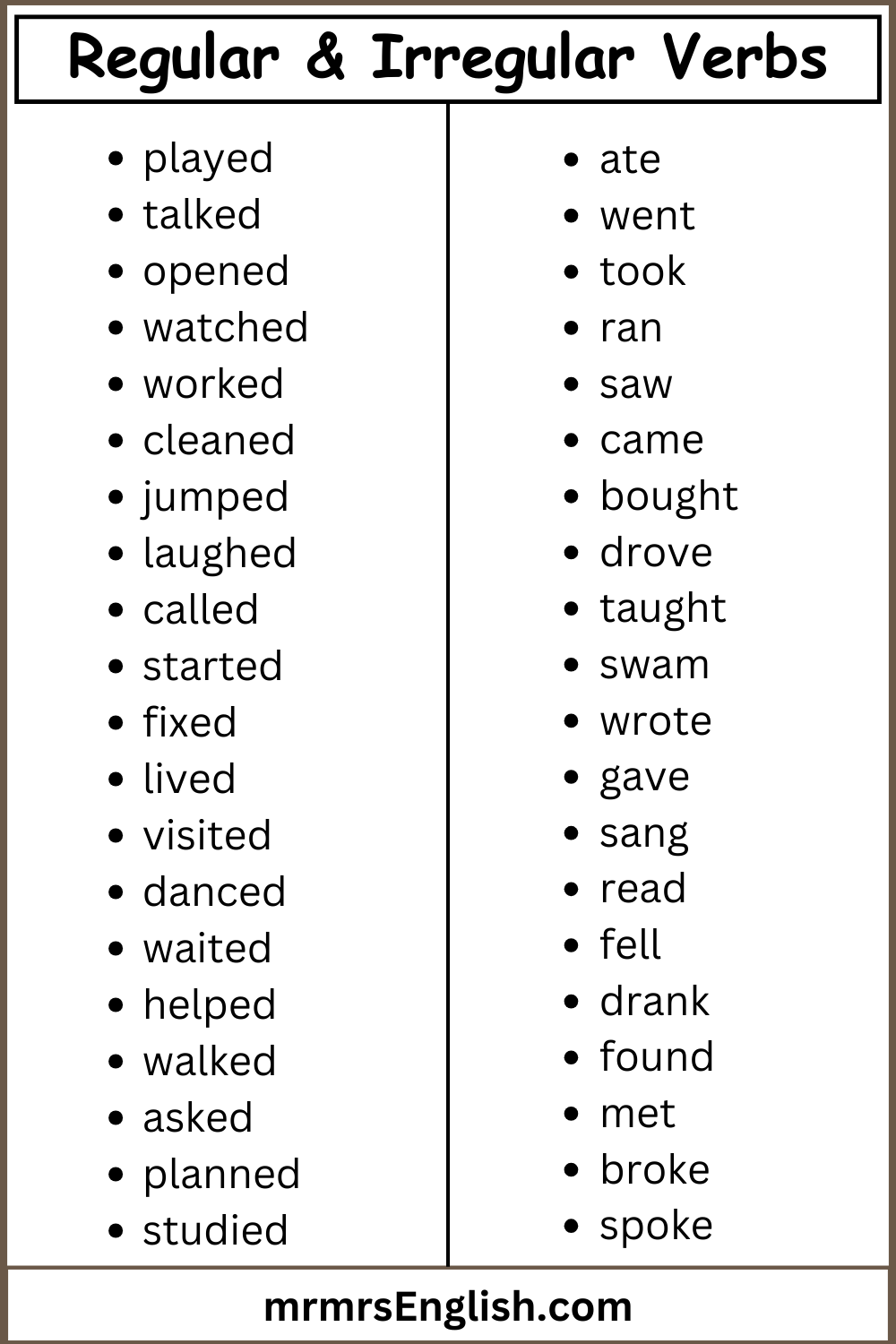
Regular Verbs:
- played
- talked
- opened
- watched
- worked
- cleaned
- jumped
- laughed
- called
- started
- fixed
- lived
- visited
- danced
- waited
- helped
- walked
- asked
- planned
- studied
Irregular Verbs:
- ate
- went
- took
- ran
- saw
- came
- bought
- drove
- taught
- swam
- wrote
- gave
- sang
- read
- fell
- drank
- found
- met
- broke
- spoke
List of Regular and Irregular Verbs







Leave a Comment