
What Are Adverbial Phrases?
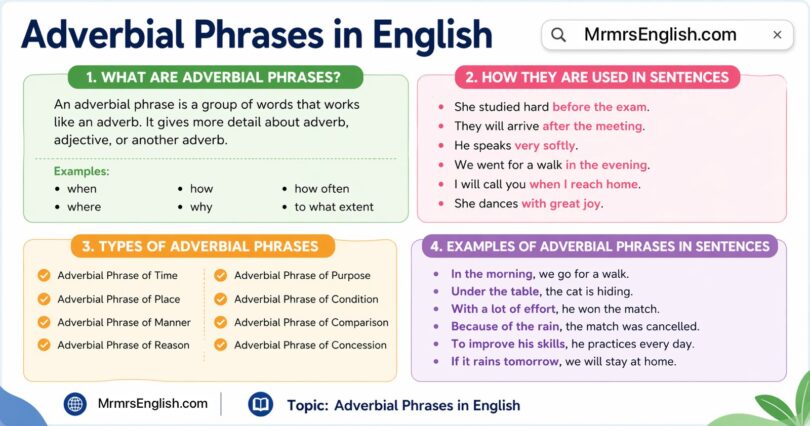
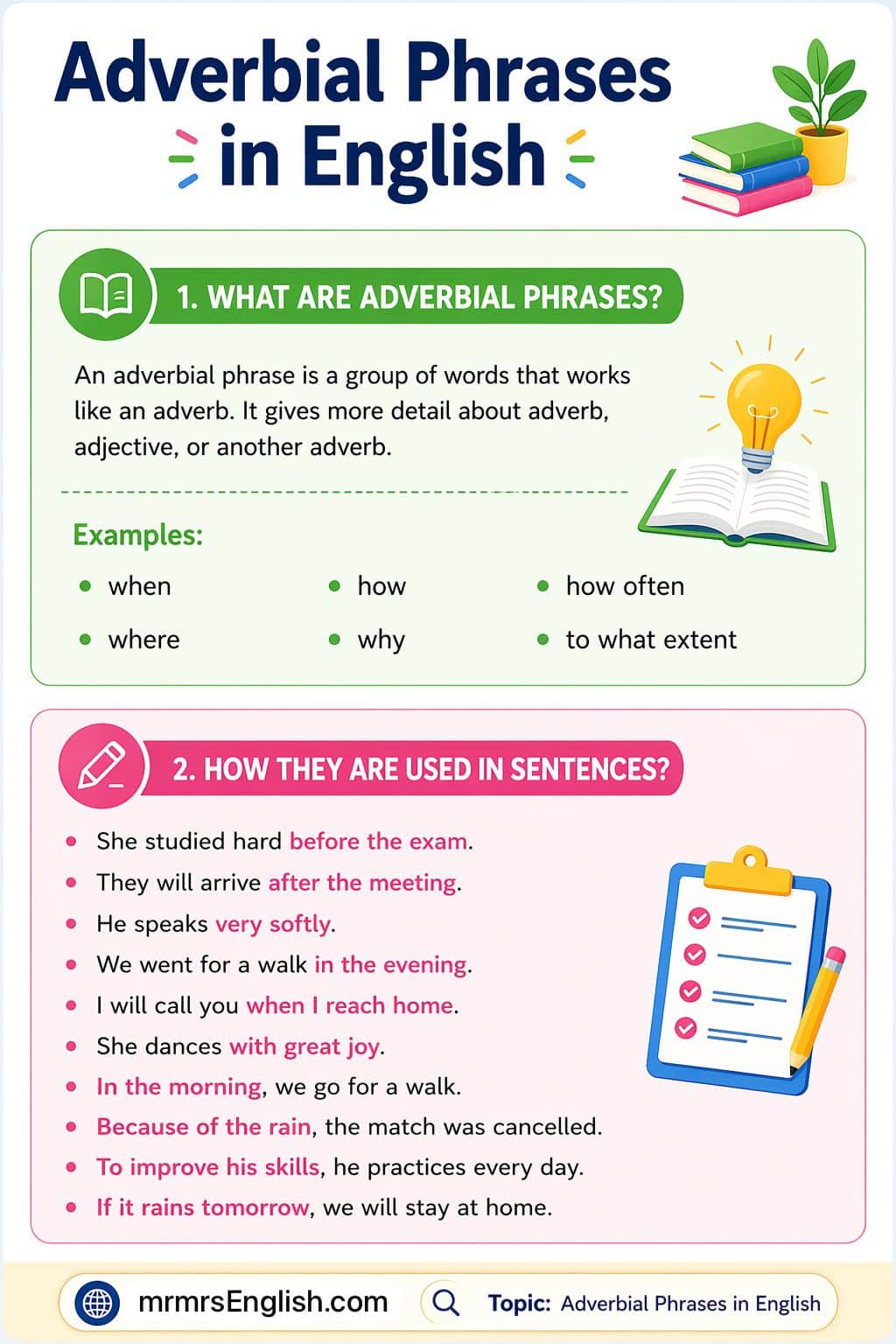
An adverbial phrase is a group of words that works like an adverb. It gives more details about a verb, an adjective, or another adverb.
It usually answers questions like:
- When?
- Where?
- How?
- Why?
- How often?
- Under what condition?
Examples:
- She arrived in the morning. (When?)
- He sat on the chair. (Where?)
- They worked with great care. (How?)
- We stayed home because of the rain. (Why?)
An adverbial phrase does not usually contain a subject and verb together. If it has both, it may become an adverbial clause.
Structure of Adverbial Phrases in English
Adverbial phrases can be made in different forms:
| Structure | Example | Use |
|---|---|---|
| Prepositional Phrase | in the evening | Time |
| Infinitive Phrase | to win the match | Purpose |
| Noun Phrase | last night | Time |
| Participial Phrase | speaking softly | Manner |
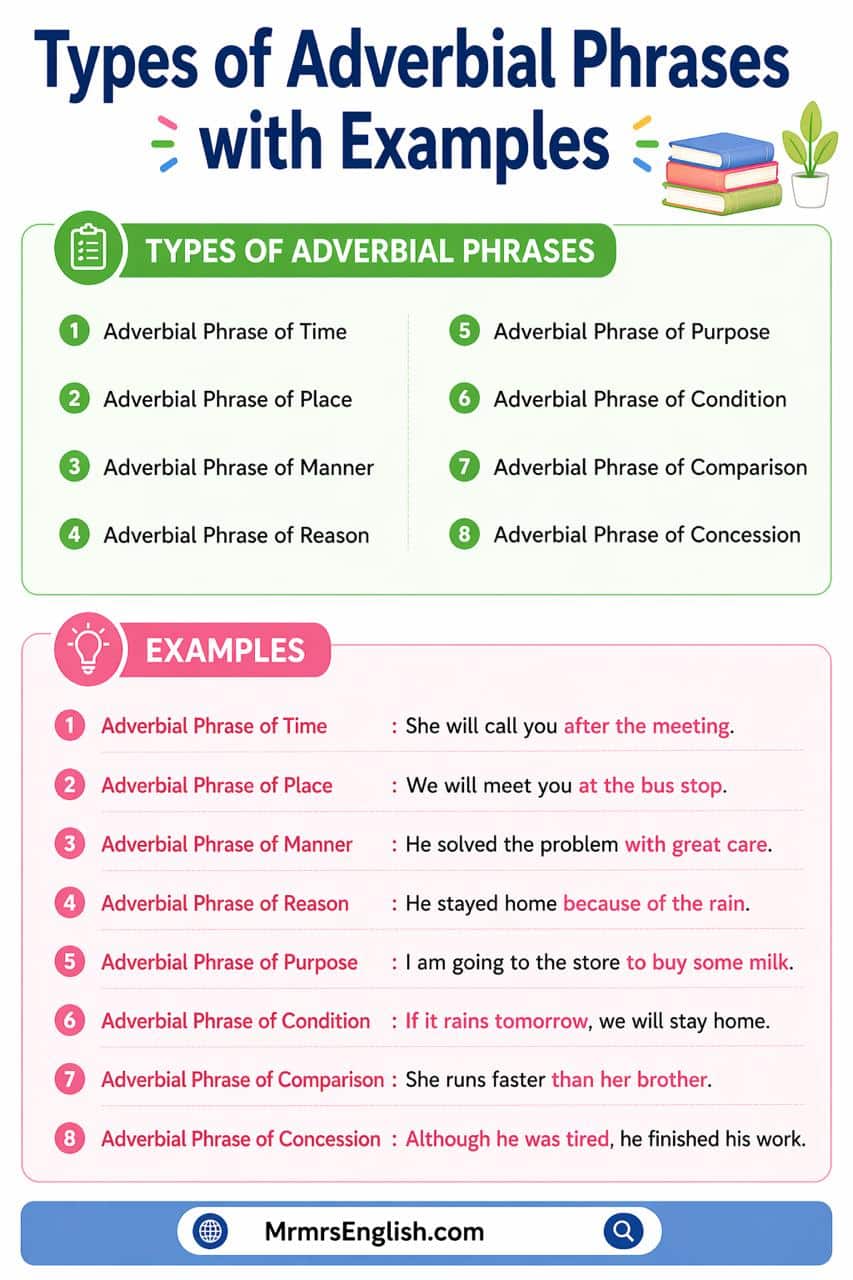
Types of Adverbial Phrases with Examples
Adverbial Phrases of Time
These phrases tell us when something happens.
Examples:
- We met last week.
- She will come in the afternoon.
- They left after dinner.
- I studied all night.
Common Time Phrases:
| Phrase | Meaning |
|---|---|
| yesterday morning | time in past |
| at noon | exact time |
| before sunrise | earlier time |
| in a few minutes | future time |
Adverbial Phrases of Place
These phrases tell us where something happens.
Examples:
- The keys are on the table.
- Children are playing in the park.
- He stood near the gate.
- She lives across the street.
Common Place Phrases:
| Phrase | Meaning |
|---|---|
| at home | location |
| under the bed | lower place |
| beside me | next to |
| far away | distant place |
Adverbial Phrases of Manner
These phrases tell us how something happens.
Examples:
- She spoke with confidence.
- He answered in a polite way.
- They worked with care.
- The child smiled with joy.
Common Manner Phrases:
| Phrase | Meaning |
|---|---|
| with speed | quickly |
| in silence | silently |
| with honesty | honestly |
| without fear | bravely |
Types of Adverbial Phrases with Examples
Adverbial Phrases of Reason
These phrases explain why something happens.
Examples:
- We canceled the trip because of the storm.
- He was absent due to illness.
- She cried from sadness.
- They succeeded through hard work.
Adverbial Phrases of Frequency
These phrases tell us how often something happens.
Examples:
- He visits us every month.
- She goes jogging twice a week.
- We meet from time to time.
- I call my parents every day.
Adverbial Phrases of Purpose
These phrases explain the aim or goal of an action.
Examples:
- She studies hard to pass the exam.
- They saved money for a new car.
- He went out to buy groceries.
Adverbial Phrases of Condition
These phrases show a condition for something.
Examples:
- In case of fire, leave immediately.
- With your permission, I will start.
- Without your help, I could not finish.
Position of Adverbial Phrases in Sentences
Adverbial phrases can come at the beginning, middle, or end of a sentence.
Beginning:
- In the morning, I exercise.
Middle:
- I with great effort completed the task.
End:
- She finished her homework before dinner.
Adverbial Phrase vs Adverb
| Adverb | Adverbial Phrase |
|---|---|
| quickly | with great speed |
| here | in this room |
| yesterday | last night |
| silently | in silence |
Both do the same job, but phrases use more than one word.
Adverbial Phrase vs Adverbial Clause
| Adverbial Phrase | Adverbial Clause |
|---|---|
| before sunrise | before the sun rises |
| in the morning | when morning comes |
| because of rain | because it rained |
An adverbial clause has a subject and verb.
An adverbial phrase does not.
Use of Adverbial Phrases in Writing
Adverbial phrases make writing stronger and clearer.
Basic Sentence:
- She sang.
Better Sentence:
- She sang with confidence.
Another Example:
- We met after class at the library.
Now the sentence gives time and place.
Common Examples of Adverbial Phrases
| Sentence | Adverbial Phrase | Type |
|---|---|---|
| He arrived after lunch. | after lunch | Time |
| The dog slept under the bed. | under the bed | Place |
| She answered with kindness. | with kindness | Manner |
| They stayed home because of snow. | because of snow | Reason |
| I exercise every morning. | every morning | Frequency |
Common Examples of Adverbial Phrases
Adverbial Phrases in Exams
Adverbial phrases often appear in grammar tests, school exams, and ESL papers.
You may be asked to:
- Identify the adverbial phrase.
- State its type.
- Use it in a sentence.
- Change an adverb into an adverbial phrase.
- Distinguish phrase and clause.
Example Question:
Identify the adverbial phrase:
He waited at the station.
Answer: at the station (place)
Advanced Use of Adverbial Phrases
Skilled writers use multiple adverbial phrases in one sentence.
Example:
- After the meeting, she spoke with confidence in front of the team.
This sentence gives:
- Time = after the meeting
- Manner = with confidence
- Place = in front of the team
Practice Sentences
Find the adverbial phrase:
- She arrived before sunset.
- The cat hid behind the sofa.
- He spoke with anger.
- We travel every summer.
- They stayed inside because of the heat.
Answers:
- before sunset
- behind the sofa
- with anger
- every summer
- because of the heat
Tips to Learn Adverbial Phrases Fast
- Ask questions: when, where, how, why
- Look for groups of words doing the job of an adverb
- Read English stories and underline phrases
- Practice writing daily sentences
- Learn common prepositions: in, on, at, by, with, under, after
Learn more Helpful articles




Leave a Comment