
What Are Adverbial Phrases?
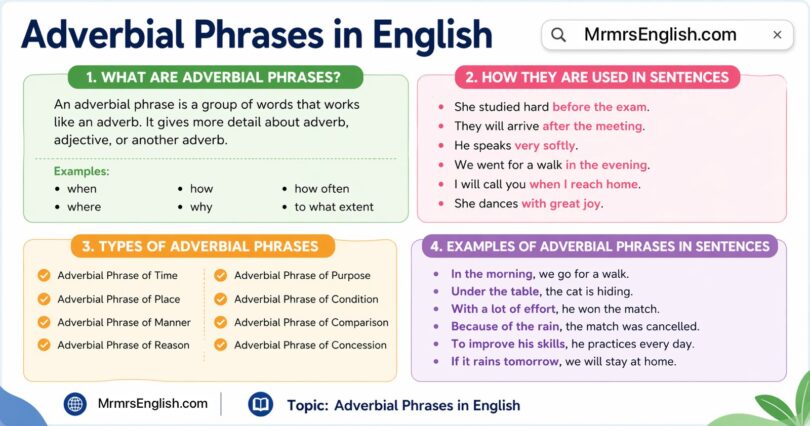
An adverbial phrase is a group of words that works like an adverb. It gives more details about a verb, an adjective, or another adverb.
It usually answers questions like:
- When?
- Where?
- How?
- Why?
- How often?
- Under what condition?
Examples:
- She arrived in the morning. (When?)
- He sat on the chair. (Where?)
- They worked with great care. (How?)
- We stayed home because of the rain. (Why?)
An adverbial phrase does not usually contain a subject and verb together. If it has both, it may become an adverbial clause.
Structure of Adverbial Phrases in English
Adverbial phrases can be made in different forms:
| Structure | Example | Use |
|---|---|---|
| Prepositional Phrase | in the evening | Time |
| Infinitive Phrase | to win the match | Purpose |
| Noun Phrase | last night | Time |
| Participial Phrase | speaking softly | Manner |
Types of Adverbial Phrases with Examples in English
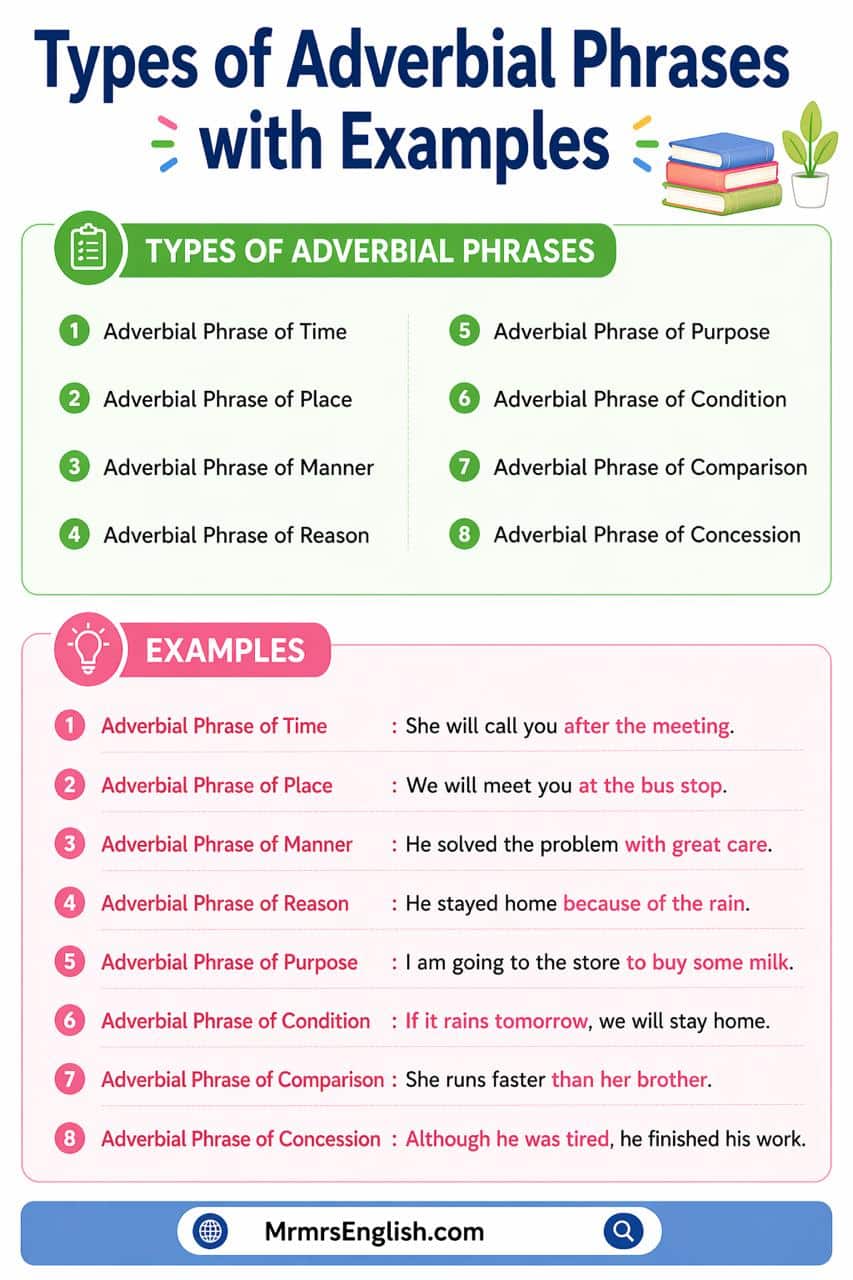
Adverbial phrases are grouped by the kind of detail they add to a sentence. They can show time, place, manner, frequency, degree, reason, purpose, or condition and make meanings more precise.
Adverbial Phrases of Time
Adverbial phrases of time tell when an action happens, how long it continues, or how often it occurs. They add clear time-related information and help explain the timing of events.
Examples:
- We met last week.
- She will come in the afternoon.
- They left after dinner.
- I studied all night.
Common Time Phrases
| Phrase | Meaning |
|---|---|
| yesterday morning | time in past |
| at noon | exact time |
| before sunrise | earlier time |
| in a few minutes | future time |
Adverbial Phrases of Place
Adverbial phrases of place show where an action happens or in which direction someone or something moves. They provide location-related details and make the meaning of a sentence clearer.
Examples
- The keys are on the table.
- Children are playing in the park.
- He stood near the gate.
- She lives across the street.
Common Place Phrases
| Phrase | Meaning |
|---|---|
| at home | location |
| under the bed | lower place |
| beside me | next to |
| far away | distant place |
Adverbial Phrases of Manner
Adverbial phrases of manner explain how or in what way an action is performed. They add details about the method, style, or manner of an action in a sentence.
Examples
- She spoke with confidence.
- He answered in a polite way.
- They worked with care.
- The child smiled with joy.
Common Manner Phrases
| Phrase | Meaning |
|---|---|
| with speed | quickly |
| in silence | silently |
| with honesty | honestly |
| without fear | bravely |
Types of Adverbial Phrases with Examples
Adverbial Phrases of Reason
Adverbial phrases of reason explain why an action happens or why a particular situation exists. They provide the cause or reason behind an action, event, decision, or condition in a sentence.
Examples
- We canceled the trip because of the storm.
- He was absent due to illness.
- She cried from sadness.
- They succeeded through hard work.
Adverbial Phrases of Frequency
Adverbial phrases of frequency explain how often an action happens or an event occurs. They indicate whether something takes place regularly, occasionally, repeatedly, rarely, or at particular intervals.
Examples
- He visits us every month.
- She goes jogging twice a week.
- We meet from time to time.
- I call my parents every day.
Adverbial Phrases of Purpose
Adverbial phrases of purpose explain why an action is performed or what it is intended to achieve. They show the aim, intention, or desired result behind an action in a sentence.
Examples
- She studies hard to pass the exam.
- They saved money for a new car.
- He went out to buy groceries.
Adverbial Phrases of Condition
Adverbial phrases of condition explain the circumstances required for an action or event to happen. They show the particular condition under which something can occur, change, continue, or become possible.
Examples:
- In case of fire, leave immediately.
- With your permission, I will start.
- Without your help, I could not finish.
Position of Adverbial Phrases in Sentences
Adverbial phrases can appear at the beginning, middle, or end of a sentence, depending on their purpose and emphasis. Their position helps organize information and make the intended meaning clearer.
Beginning:
- In the morning, I exercise.
Middle:
- I with great effort completed the task.
End:
- She finished her homework before dinner.
Adverbial Phrase vs Adverb
An adverb is usually a single word that modifies a verb, adjective, or another adverb, while an adverbial phrase uses two or more words to perform a similar function.
| Adverb | Adverbial Phrase |
|---|---|
| quickly | with great speed |
| here | in this room |
| yesterday | last night |
| silently | in silence |
Both do the same job, but phrases use more than one word.
Adverbial Phrase vs Adverbial Clause
An adverbial phrase is a group of words without its own subject–verb combination, while an adverbial clause contains a subject and verb. Both provide additional information about an action.
| Adverbial Phrase | Adverbial Clause |
|---|---|
| before sunrise | before the sun rises |
| in the morning | when morning comes |
| because of rain | because it rained |
An adverbial clause has a subject and verb.
An adverbial phrase does not.
Use of Adverbial Phrases in Writing
Adverbial phrases make writing clearer, more detailed, and more precise by explaining when, where, how, why, or under what conditions something happens. They also help writers vary sentence structure naturally.
Basic Sentence:
- She sang.
Better Sentence:
- She sang with confidence.
Another Example:
- We met after class at the library.
Now the sentence gives time and place.
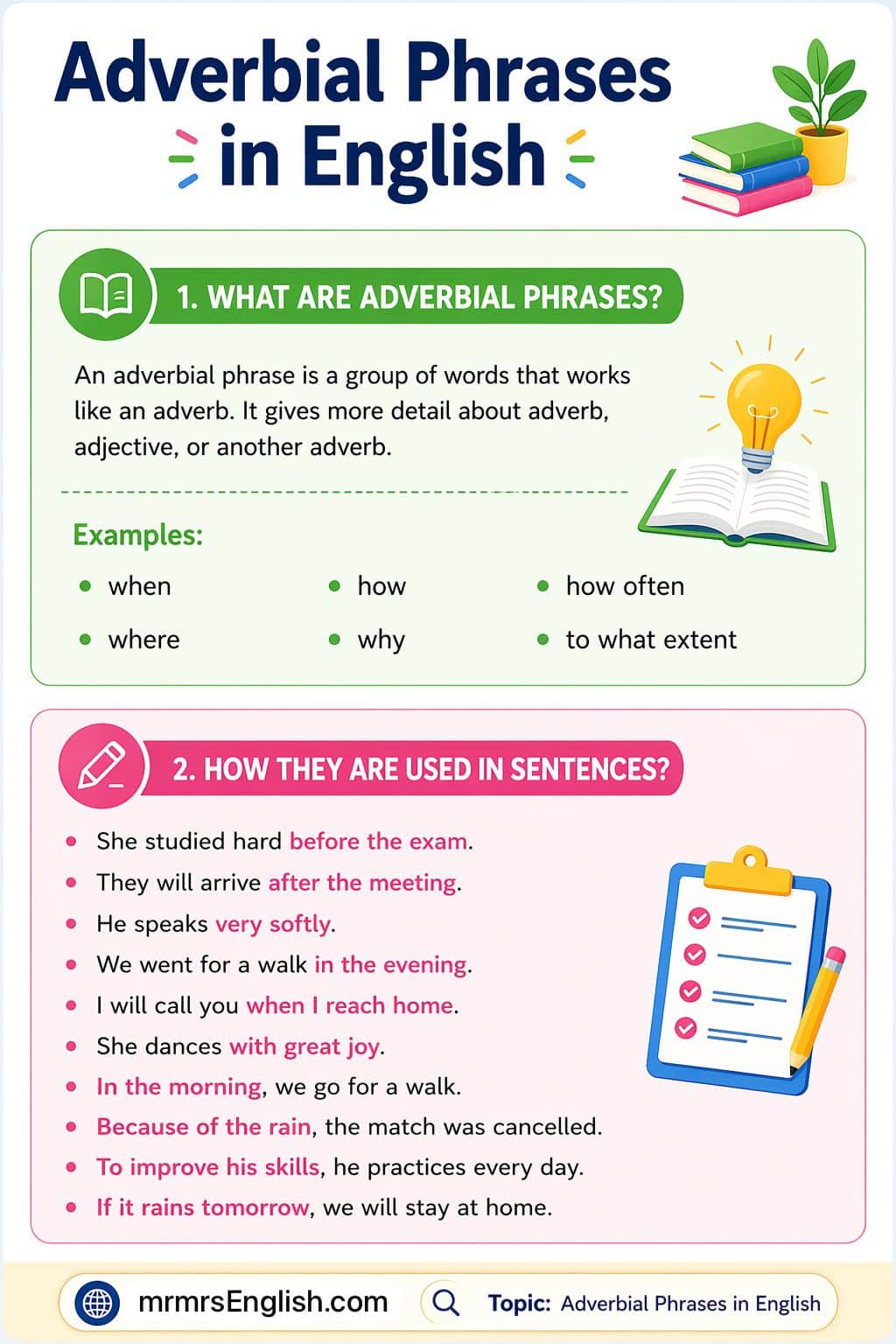
Common Examples of Adverbial Phrases
| Sentence | Adverbial Phrase | Type |
|---|---|---|
| He arrived after lunch. | after lunch | Time |
| The dog slept under the bed. | under the bed | Place |
| She answered with kindness. | with kindness | Manner |
| They stayed home because of snow. | because of snow | Reason |
| I exercise every morning. | every morning | Frequency |
Common Examples of Adverbial Phrases
Adverbial Phrases in Exams
Adverbial phrases often appear in grammar exercises, sentence analysis, and language exams. Students may need to identify them, determine their type, explain their function, or use them correctly in sentences.
You may be asked to:
- Identify the adverbial phrase.
- State its type.
- Use it in a sentence.
- Change an adverb into an adverbial phrase.
- Distinguish phrase and clause.
Example Question
Identify the adverbial phrase:
He waited at the station.
Answer: at the station (place)
Advanced Use of Adverbial Phrases
At an advanced level, adverbial phrases can be used to control emphasis, add precise details, and vary sentence structure. Their careful placement helps writers express complex ideas clearly and naturally.
Example:
- After the meeting, she spoke with confidence in front of the team.
This sentence gives:
- Time = after the meeting
- Manner = with confidence
- Place = in front of the team
Practice Sentences
Find the adverbial phrase:
- She arrived before sunset.
- The cat hid behind the sofa.
- He spoke with anger.
- We travel every summer.
- They stayed inside because of the heat.
Answers:
- before sunset
- behind the sofa
- with anger
- every summer
- because of the heat
Tips to Learn Adverbial Phrases Fast
- Ask questions: when, where, how, why
- Look for groups of words doing the job of an adverb
- Read English stories and underline phrases
- Practice writing daily sentences
- Learn common prepositions: in, on, at, by, with, under, after
Learn more helpful articles

Leave a Comment