
What Is Catachresis in English?
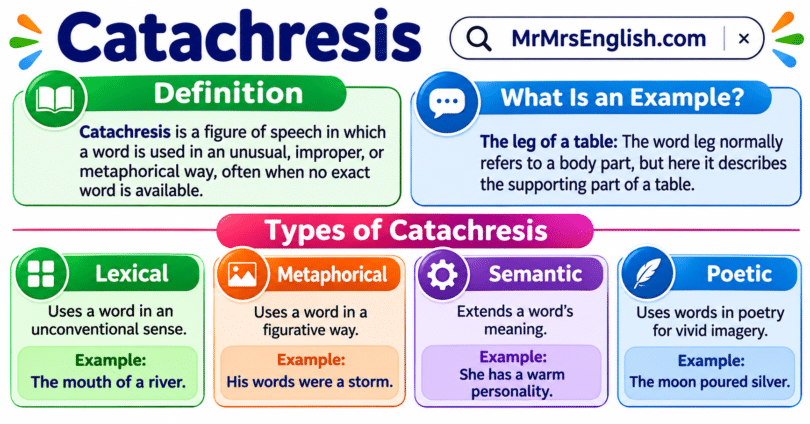
Catachresis is a figure of speech in which a word is used in an unusual, improper, or unconventional sense, often by applying it to something for which there is no exact or suitable word. It may also involve combining words that do not normally go together to create a striking expression or describe something in a new way.
For example:
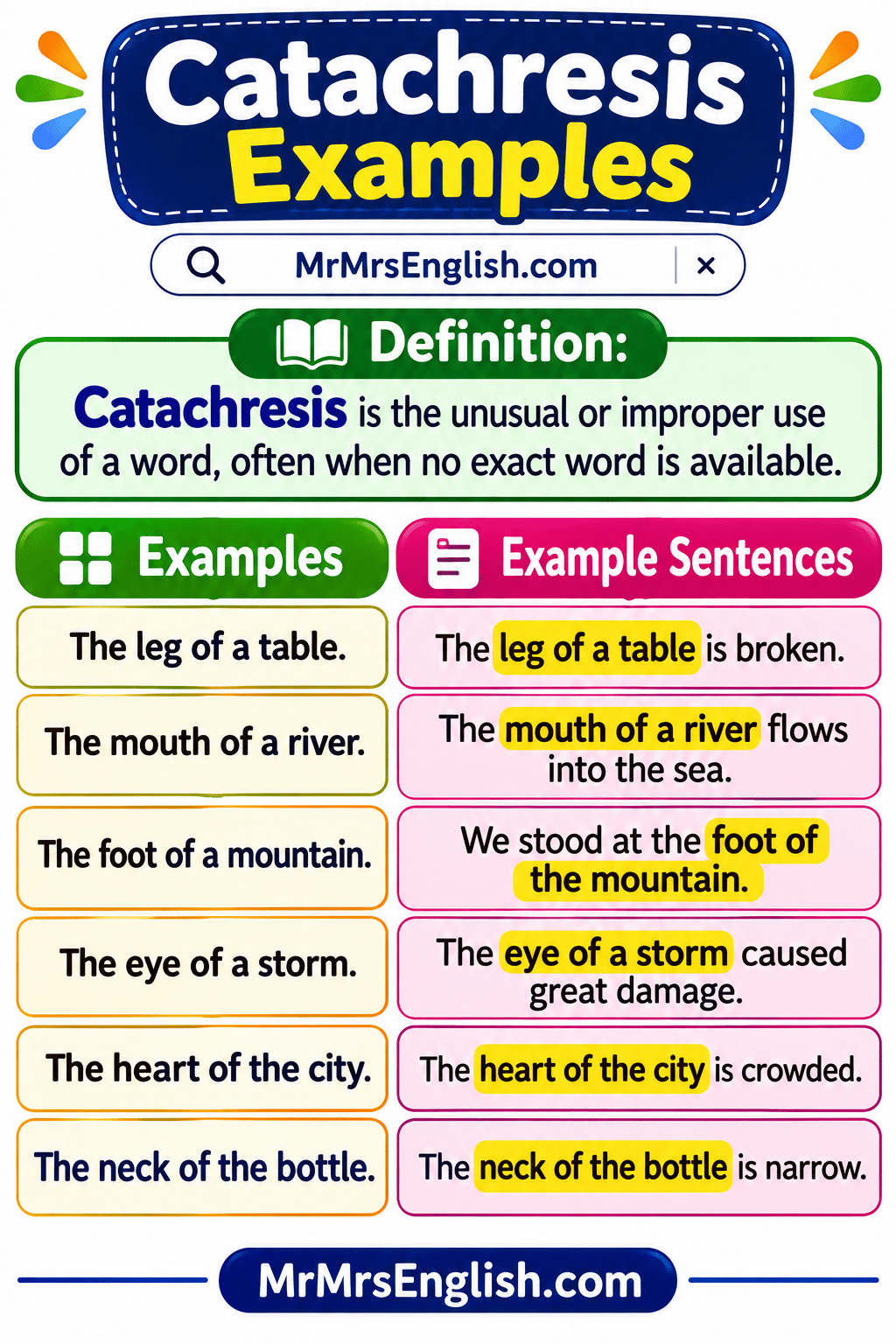
- The leg of a table: The word leg normally refers to a body part, but here it describes the supporting part of a table.
- The mouth of a river: The word mouth refers to the opening of a person’s face, but it is used to describe the place where a river enters a sea, lake, or another body of water.
- The foot of a mountain: The word foot normally refers to the lower part of a human or animal body, but it describes the bottom part of a mountain.
Types of Catachresis in English
Catachresis can appear in different forms depending on how a word is used and the effect it creates. The following categories explain some common ways in which unconventional expressions occur.
1. Lexical Catachresis
Lexical catachresis occurs when an existing word is used to describe something outside its original or usual meaning. It often happens when a language does not have a separate, commonly accepted word for a particular object or feature.
For example:
- The foot of the bed.
- The mouth of a cave.
- The eye of a storm.
- The arm of a chair.
In these examples, words associated with the human body are applied to different objects or natural features.
2. Metaphorical Catachresis
Metaphorical catachresis involves using a word or expression in an unconventional figurative sense. It creates a connection between two things that are not normally associated.
For example:
- The river swallowed the village.
- His words were a storm.
- The city is a hungry monster.
These expressions use imaginative language to communicate ideas more strongly.
3. Semantic Catachresis
Semantic catachresis involves an unusual extension or alteration of a word’s meaning. A familiar word is used in a context that gives it a different or unexpected interpretation.
For example:
- She has a warm personality.
- His argument has a weak foundation.
- The idea took root in her mind.
These expressions use words in extended senses to describe abstract qualities or situations.
4. Poetic Catachresis
Poetic catachresis is the unconventional use of words in poetry and creative writing to produce unusual images, emotional effects, or imaginative descriptions.
For example:
- The moon poured silver over the sleeping earth.
- The stars whispered secrets to the night.
- The silence screamed through the empty hall.
Such expressions help poets create vivid mental pictures and communicate emotions in distinctive ways.
Catachresis in Literature and Poetry
Catachresis is an important concept in literary language because it allows writers to use words in unconventional ways. It can make descriptions more vivid, communicate complex emotions, and challenge readers to think about familiar words differently.
Writers may use catachresis when ordinary vocabulary cannot fully express an idea. They may also deliberately combine words that appear contradictory or unsuitable to create a memorable effect.
For example, the expression “deafening silence” combines two apparently conflicting ideas. Silence is the absence of sound, while deafening refers to an extremely loud sound. Together, the words describe a silence that feels overwhelming or emotionally powerful.
Similarly, an expression such as “the roots of sorrow” uses the word roots to suggest that sadness has deep causes or has developed over time.
Catachresis is particularly useful in poetry, where unusual language can communicate feelings and ideas that ordinary sentences may not express as effectively.
Origin and History of Catachresis
The word catachresis comes from the Greek word katakhresis, which means misuse or improper use. It is derived from the Greek elements kata (against or down) and chresis (use).
The term became part of rhetorical and literary studies through classical discussions of language and figures of speech. Ancient Greek and Roman scholars studied how words could be used beyond their ordinary meanings to communicate ideas more effectively.
Over time, catachresis became an important concept in rhetoric, poetry, literary criticism, and linguistics. Writers have used it to create unusual descriptions, express difficult ideas, and develop imaginative language.
Today, it is studied as a figure of speech and is particularly useful for understanding how language changes and how words acquire additional meanings.
Characteristics of Catachresis
Catachresis has several characteristics that help distinguish it from other figures of speech. Understanding these features makes it easier to identify catachresis in literature and everyday communication.
1. Unusual Use of WordsCatachresis involves using a familiar word in an unfamiliar or unconventional context. The word may describe something different from its original meaning.
For example: The mouth of the cave was dark.
2. Extension of MeaningIt often extends the meaning of an existing word to describe an object, place, or situation. This allows speakers and writers to communicate ideas without needing a completely new word.
For example: The neck of the bottle is narrow.
3. Creative ExpressionCatachresis can make language more imaginative and expressive. Writers use unusual word combinations to create strong descriptions and attract readers’ attention.
For example: The angry sky swallowed the sunlight.
4. Unconventional Word CombinationsSome examples involve combining words that do not normally appear together. Such combinations can create surprising or striking expressions.
For example: A deafening silence filled the room.
5. Context-Based MeaningThe intended meaning of catachresis often depends on the surrounding words and situation. Readers need to understand the context to interpret the expression correctly.
For example: He planted his words in her mind.
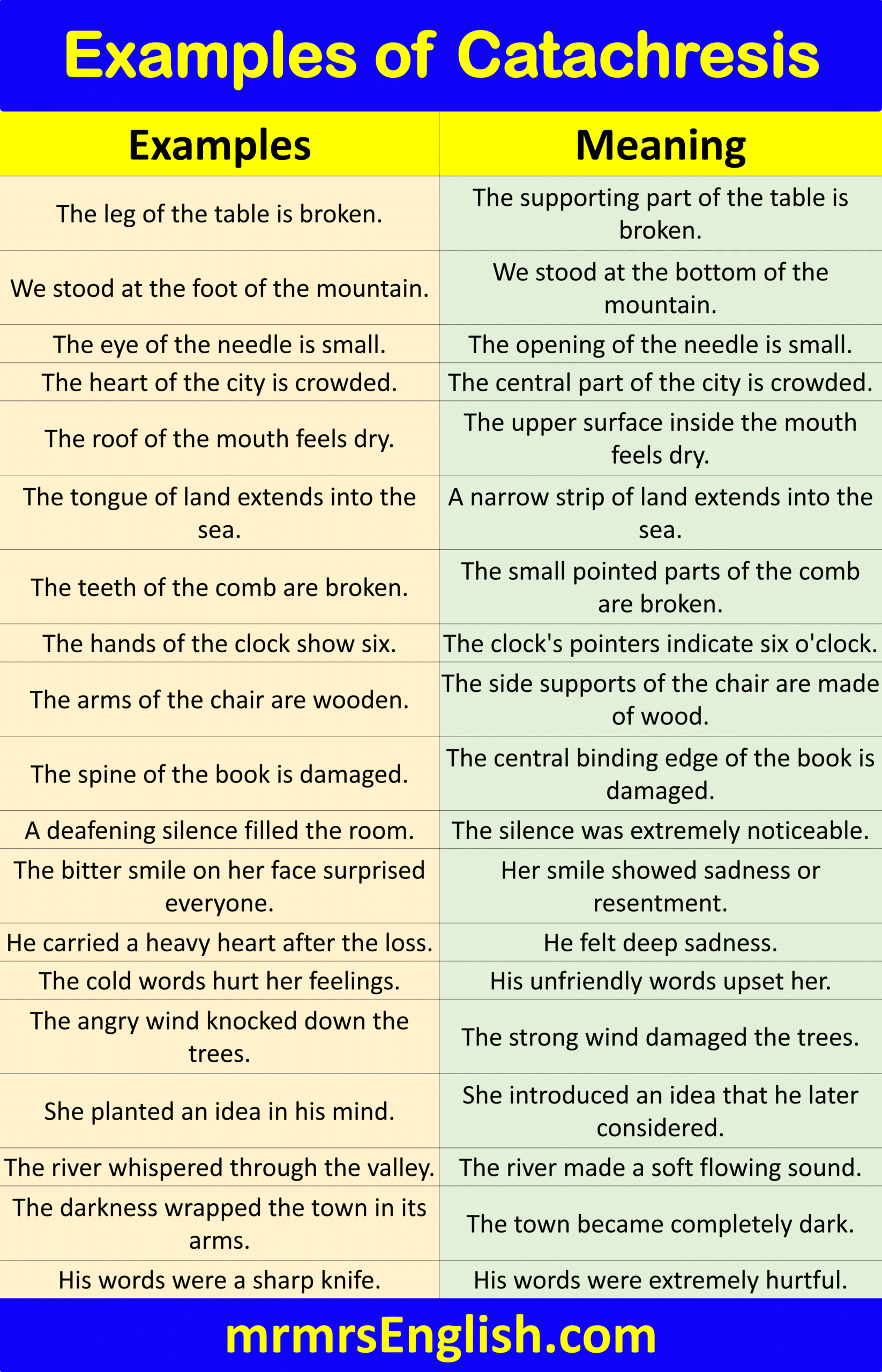
Examples of Catachresis in English with Meanings
| Catachresis Examples | Meaning |
|---|---|
| The leg of the table is broken. | The supporting part of the table is broken. |
| The mouth of the river is wide. | The place where the river enters another body of water is wide. |
| We stood at the foot of the mountain. | We stood at the bottom of the mountain. |
| The neck of the bottle is narrow. | The upper narrow part of the bottle is narrow. |
| The eye of the needle is small. | The opening of the needle is small. |
| The heart of the city is crowded. | The central part of the city is crowded. |
| The roof of the mouth feels dry. | The upper surface inside the mouth feels dry. |
| The branches of the government work independently. | Different divisions of the government work independently. |
| The head of the department addressed everyone. | The person in charge of the department addressed everyone. |
| The shoulder of the road was damaged. | The strip of land beside the road was damaged. |
| The tongue of land extends into the sea. | A narrow strip of land extends into the sea. |
| The teeth of the comb are broken. | The small pointed parts of the comb are broken. |
| The hands of the clock show six. | The clock’s pointers indicate six o’clock. |
| The arms of the chair are wooden. | The side supports of the chair are made of wood. |
| The spine of the book is damaged. | The central binding edge of the book is damaged. |
| A deafening silence filled the room. | The silence was extremely noticeable. |
| The bitter smile on her face surprised everyone. | Her smile showed sadness or resentment. |
| He carried a heavy heart after the loss. | He felt deep sadness. |
| The cold words hurt her feelings. | His unfriendly words upset her. |
| The sweet voice of the singer attracted everyone. | The singer had a pleasant and beautiful voice. |
| The city swallowed the small village. | The growing city gradually surrounded or absorbed the village. |
| The angry wind knocked down the trees. | The strong wind damaged the trees. |
| She planted an idea in his mind. | She introduced an idea that he later considered. |
| The river whispered through the valley. | The river made a soft flowing sound. |
| The darkness wrapped the town in its arms. | The town became completely dark. |
| His words were a sharp knife. | His words were extremely hurtful. |
| The golden silence of the morning was beautiful. | The peaceful morning atmosphere was beautiful. |
| The frozen smile remained on his face. | His smile looked fixed and unnatural. |
| The hungry fire consumed the wooden house. | The fire spread and destroyed the house. |
| The roots of the problem are difficult to find. | The basic causes of the problem are difficult to identify. |
Catachresis examples in English
Difference Between Catachresis and Metaphor
Catachresis and metaphor are related figures of speech because both involve using words beyond their literal meanings. However, they are not exactly the same.
A metaphor directly describes one thing as another to create a comparison or relationship between them. Catachresis generally involves an unusual, strained, or unconventional use of a word, sometimes because no exact term is available.
| Catachresis | Metaphor |
|---|---|
| Uses a word in an unconventional or improper sense. | Describes one thing as another based on a perceived similarity. |
| May arise from a lack of a suitable word. | Usually creates an imaginative comparison. |
| Can involve unusual or strained word combinations. | Creates a figurative relationship between two ideas. |
| Example: The mouth of a river. | Example: Time is a thief. |
| Example: The leg of a table. | Example: Her voice is music. |
Difference Between Catachresis and Metonymy
Catachresis and metonymy are both figures of speech, but they work differently. Metonymy replaces the name of something with another word that is closely associated with it. Catachresis uses a word in an unusual or unconventional sense.
| Catachresis | Metonymy |
|---|---|
| Involves an unconventional use of a word. | Involves substitution based on association. |
| May extend a word’s meaning to describe something else. | Uses a related name to represent something. |
| Example: The mouth of a river. | Example: The crown represents a monarchy. |
| Example: The foot of a mountain. | Example: The White House issued a statement. |
Difference Between Catachresis and Oxymoron
Catachresis and oxymoron can sometimes appear similar because both may involve unusual expressions. However, their purposes and structures are different.
An oxymoron combines two contradictory or opposite words to create a particular meaning. Catachresis involves using a word in an unconventional or unsuitable sense.
| Catachresis | Oxymoron |
|---|---|
| Uses a word in an unusual or unconventional way. | Combines two contradictory words. |
| Does not always require opposite meanings. | Requires a contrast or apparent contradiction. |
| Example: The mouth of a cave. | Example: Deafening silence. |
| Example: The foot of a mountain. | Example: Living dead. |
The expression “deafening silence” is a clear example of an oxymoron. It may also be discussed in broader rhetorical discussions of catachresis, but the two terms should not be treated as interchangeable.
Importance of Catachresis in English
Catachresis plays a useful role in language, literature, and communication. It shows how words can be adapted to express ideas beyond their ordinary meanings.
Some important uses of catachresis include:
1. Makes Language More Expressive
Catachresis allows writers to communicate ideas through unusual expressions. It can make descriptions more interesting and memorable.
2. Helps Describe Unfamiliar Things
Sometimes, a language does not have a specific word for an object or feature. In such situations, an existing word can be extended to describe it.
For example, the expression “the eye of a needle” describes the small opening of a needle.
3. Improves Literary Writing
Writers and poets use unconventional expressions to create vivid descriptions and communicate emotions. These expressions can make literary works more engaging.
4. Develops Vocabulary Understanding
Learning catachresis helps students understand how words develop additional meanings and how context influences interpretation.
5. Creates Strong Impressions
Unusual expressions can attract readers’ attention and make particular ideas stand out.
How to Identify Catachresis in a Sentence
Identifying catachresis becomes easier when you understand how words are normally used. Follow these steps to recognize it in English sentences.
- Identify the unusual word: Look for a word that appears to have a different meaning from its ordinary use.
- Understand the literal meaning: Consider what the word normally describes.
- Examine the context: Read the complete sentence to understand what the writer intends to communicate.
- Look for an unconventional application: Check whether the word is being applied to an object, place, or idea in an unusual way.
- Determine the intended meaning: Explain what the expression communicates in that particular context.
For example:
The mouth of the cave was covered with rocks.
- Unusual word: Mouth.
- Literal meaning: The opening of a person’s face.
- Contextual meaning: The entrance of the cave.
- Intended message: The cave entrance was covered with rocks.
This process helps students identify and explain catachresis in reading comprehension and literary analysis.
Catachresis Examples in Sentences for Students
- The mouth of the tunnel was completely dark.
- We rested at the foot of the hill.
- The neck of the vase was beautifully decorated.
- The eye of the storm caused serious damage.
- The heart of the forest was peaceful.
- The legs of the chair need repair.
- The arms of the river spread across the land.
- The teeth of the zipper were damaged.
- The head of the company welcomed the guests.
- The shoulder of the highway was covered with snow.
- A bitter smile appeared on his face.
- The cold words made her cry.
- The city swallowed the surrounding villages.
- The river whispered beneath the bridge.
- A heavy sadness filled his heart.
Examples of Catachresis in Sentences
Advantages and Limitations of Catachresis
Catachresis can make language more expressive, but its use also requires care. Unusual expressions are not always easy for readers to understand.
| Advantages | Limitations |
|---|---|
| Makes language more imaginative. | May confuse inexperienced readers. |
| Helps describe unfamiliar objects and features. | Can make sentences difficult to interpret. |
| Creates memorable expressions. | May sound unnatural when used incorrectly. |
| Adds variety to literary writing. | Can reduce clarity in formal communication. |
| Encourages creative use of vocabulary. | Requires readers to understand the context. |
Writers should use catachresis when it improves meaning or creates a useful literary effect. In academic and professional writing, clarity should generally remain the priority.
Frequently Asked Questions About Catachresis
1. What is catachresis in simple words?
Catachresis is the unusual or unconventional use of a word or expression to describe something, especially when there is no exact or suitable word available. For example, the mouth of a river uses the word mouth to describe the place where a river meets another body of water.
2. What is the main purpose of catachresis?
The main purpose of catachresis is to express ideas through unconventional word usage. It can help writers describe unfamiliar things, create imaginative expressions, and communicate complex ideas.
3. What is an example of catachresis?
An example of catachresis is “the leg of a table.” The word leg normally refers to a body part, but it is used to describe the supporting part of a table.
4. Is catachresis a figure of speech?
Yes, catachresis is a figure of speech that involves the unusual, improper, or unconventional use of words. It is commonly studied in rhetoric, literature, and English language studies.
5. What is the difference between catachresis and metaphor?
A metaphor describes one thing as another based on a perceived similarity. Catachresis involves using a word in an unconventional or unsuitable sense. Although they are related, their meanings and functions are different.
6. Is catachresis used in everyday English?
Yes, many conventional expressions in everyday English have been discussed as examples of catachresis. Examples include the mouth of a river, the foot of a mountain, and the eye of a needle.
7. What is the origin of the word catachresis?
The word catachresis comes from the Greek word katakhresis, meaning misuse or improper use. It is associated with the study of rhetoric and figures of speech.
8. Why is catachresis important for English students?
Catachresis helps English students understand figurative language, unusual word meanings, literary expressions, and the creative use of vocabulary. It is also useful for literature examinations and language analysis.
Learn more helpful articles






Leave a Comment