
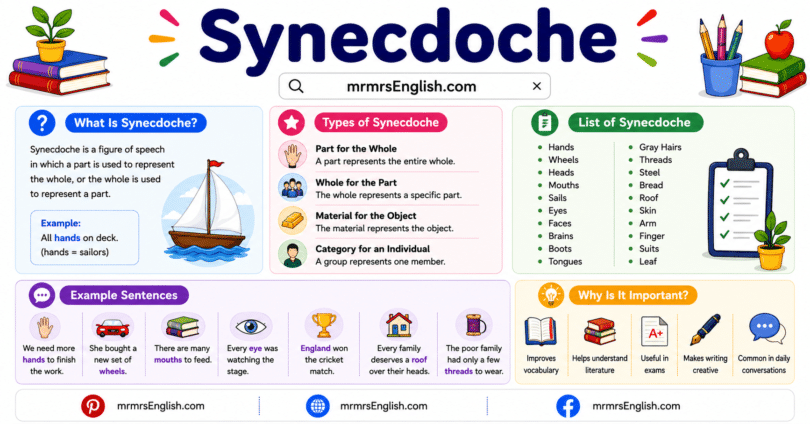
Synecdoche is a figure of speech in which a part of something is used to represent the whole, or the whole is used to represent a part. It is commonly found in everyday conversations, literature, speeches, and creative writing to make language more expressive and meaningful. Learning what synecdoche is, its meaning, and examples in English helps students and English learners understand this important literary device with ease. In this article, you will learn a simple definition, clear explanations, and practical examples that will help you recognize and use synecdoche correctly in both writing and speaking.
Table of Contents
ToggleWhat Is Synecdoche in English?
Synecdoche is a figure of speech in which a part of something is used to represent the whole, or the whole is used to represent a part. Instead of naming the complete object or group, one related part or the whole is used to express the intended meaning.
For example:
- All hands on deck.
In this sentence, hands means sailors or workers, not just their hands.
Another example:
- Nice wheels!
Here, wheels means a car, not only its wheels.
Why Is Synecdoche Important?
Learning synecdoche helps you:
- Improve English vocabulary.
- Understand literature and poetry.
- Recognize figurative language in exams.
- Write more creatively.
- Understand common English expressions.
How Does Synecdoche Work?
Synecdoche works by replacing one thing with its part or using the whole to represent one of its parts.
There are two main patterns:
- Part → Whole
- Whole → Part
Simple Formula of Synecdoche
Part → Whole
or
Whole → Part
Examples:
| Expression | Actual Meaning |
|---|---|
| Hands | Workers or sailors |
| Wheels | Car |
| Mouths | People to feed |
| England | England cricket team |
| America | United States (in some contexts) |
Types of Synecdoche
Part for the Whole
Part for the Whole is the most common type of synecdoche. It happens when a small part of a person, object, or thing is used to represent the entire person or object. This makes the expression shorter, more natural, and more effective while the listener easily understands the complete meaning from the context.
Examples:
- All hands on deck.
- We need more wheels.
- Every head was turned.
- There were many mouths to feed.
Whole for the Part
Whole for the Part occurs when the name of a complete group, country, organization, or object is used to refer to only one part or a few members of it. This type is commonly used in news reports, sports, speeches, and everyday English to keep language simple and concise.
Examples:
- England won the match.
- Pakistan celebrated the victory.
- The school won the science competition.
Material for the Object
Material for the Object uses the name of the material to refer to the object made from it. Instead of mentioning the actual item, the material is used because it is closely connected with the object. This type is often found in literature and everyday conversations.
Examples:
- The athlete won the silver.
- She wore beautiful diamonds.
- The museum displayed ancient bronze.
Category for an Individual
Category for an Individual uses the name of a larger group, class, or category to represent a particular person or a smaller group within it. This type helps express ideas in a broader and more meaningful way, especially in formal writing, speeches, and literary works.
Examples:
- Humanity must protect nature.
- Society expects honesty.
- The army entered the village.
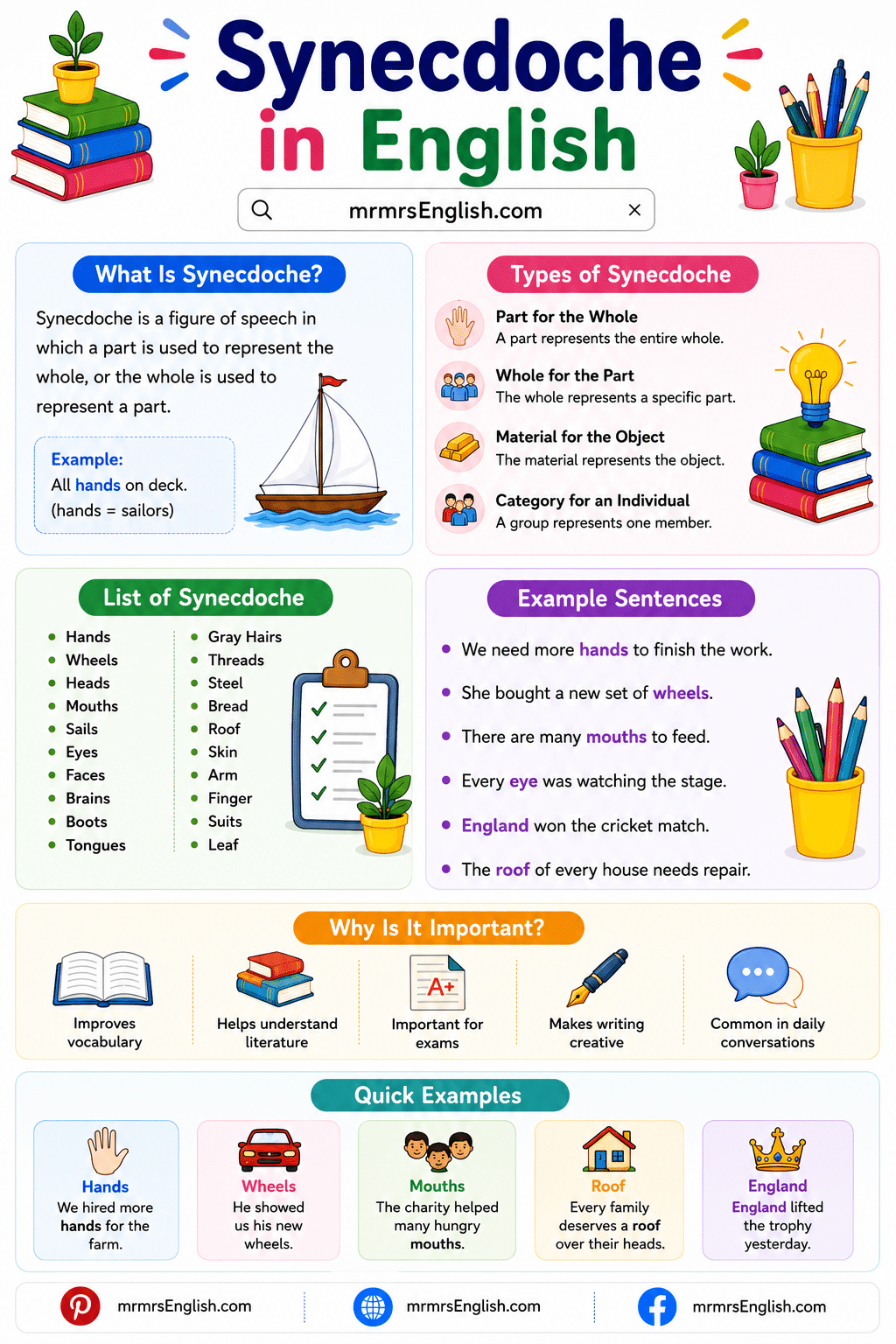
Types of Synecdoche with Examples
Common Examples of Synecdoche
| Synecdoche | Meaning |
|---|---|
| Hands | Workers |
| Wheels | Car |
| Mouths | Hungry people |
| Heads | People or animals |
| Faces | People |
| Roof | House |
| Sail | Ship |
| Bread | Food or livelihood |
| Steel | Sword or weapon |
| Threads | Clothes |
Synecdoche in Everyday English
Synecdoche is commonly used in everyday English without people even noticing it. It makes conversations shorter, more natural, and easier to understand by using a part to represent the whole or the whole to represent a part. You can hear it in daily speech, news, sports, workplaces, and casual conversations.
Examples:
- We need more hands to finish the work.
- She bought a new set of wheels.
- There are many mouths to feed.
- Every eye was watching the stage.
- The farm has two hundred head of cattle.
Synecdoche in Literature
Synecdoche is widely used in literature to make writing more expressive, vivid, and memorable. Authors use it to represent a whole idea through one important part or to let the whole stand for a part. This figure of speech strengthens imagery, adds symbolic meaning, and helps readers connect more deeply with characters and events.
Example:
“Friends, Romans, countrymen, lend me your ears.”
— William Shakespeare
Here, ears means attention, not just the physical ears.
Another example:
“All hands on deck.”
Hands represent the sailors needed to work on the ship.
Synecdoche in Poetry
Synecdoche is a popular figure of speech in poetry because it helps poets express deep emotions and vivid ideas with just a few words. By using a part to represent the whole or the whole to represent a part, poets create strong imagery, add symbolic meaning, and make their verses more memorable. This literary device also improves the rhythm of a poem while allowing readers to imagine a larger picture through a single word or expression.
Example:
- Every eye admired the sunset.
- Cold roofs covered the village.
- The pen fed many mouths.
These expressions make writing more powerful and imaginative.
Synecdoche in News and Media
Synecdoche is widely used in news reports, television broadcasts, newspapers, magazines, and online media because it makes headlines and stories shorter, clearer, and more engaging. Journalists often use a part to represent the whole or the whole to represent a specific group, allowing readers to understand the message quickly without unnecessary details. This figure of speech also helps create powerful headlines and keeps news writing concise while maintaining its meaning.
Examples:
- England Wins the Championship
- Hollywood Celebrates New Awards
- The Crown Approves New Policy
Some of these examples may also overlap with metonymy, depending on the relationship between the words.
Difference Between Synecdoche and Metonymy
Many students confuse these two figures of speech.
| Synecdoche | Metonymy |
|---|---|
| Uses a part for the whole or the whole for a part | Uses something closely related to represent another thing |
| Based on part-whole relationship | Based on close association |
| “Hands” means workers | “The White House” means the U.S. government |
Examples
Synecdoche
- All hands on deck.
- Nice wheels!
Metonymy
- The White House announced new rules.
- Hollywood released several movies.
Difference Between Synecdoche and Metaphor
| Synecdoche | Metaphor |
|---|---|
| Uses part-whole relationship | Makes a comparison |
| No comparison is made | Direct comparison is made |
Example of synecdoche:
- We need more hands.
Example of metaphor:
- Life is a journey.
Common Examples Explained
Hands
- Meaning: Workers
Sentence:
- We hired ten more hands for the farm.
Wheels
- Meaning: Car
Sentence:
- He showed us his new wheels.
Mouths
- Meaning: People to feed
Sentence:
- The charity helped many hungry mouths.
Head
- Meaning: Person or animal
Sentence:
- The farmer owns fifty head of cattle.
Roof
- Meaning: House
Sentence:
- Every family deserves a roof over their heads.
List of Synecdoche in English
- Hands
- Wheels
- Heads
- Mouths
- Sails
- Eyes
- Faces
- Brains
- Boots
- Tongues
- Gray Hairs
- Threads
- Steel
- Bread
- Roof
- Skin
- Arm
- Finger
- Suits
- Leaf
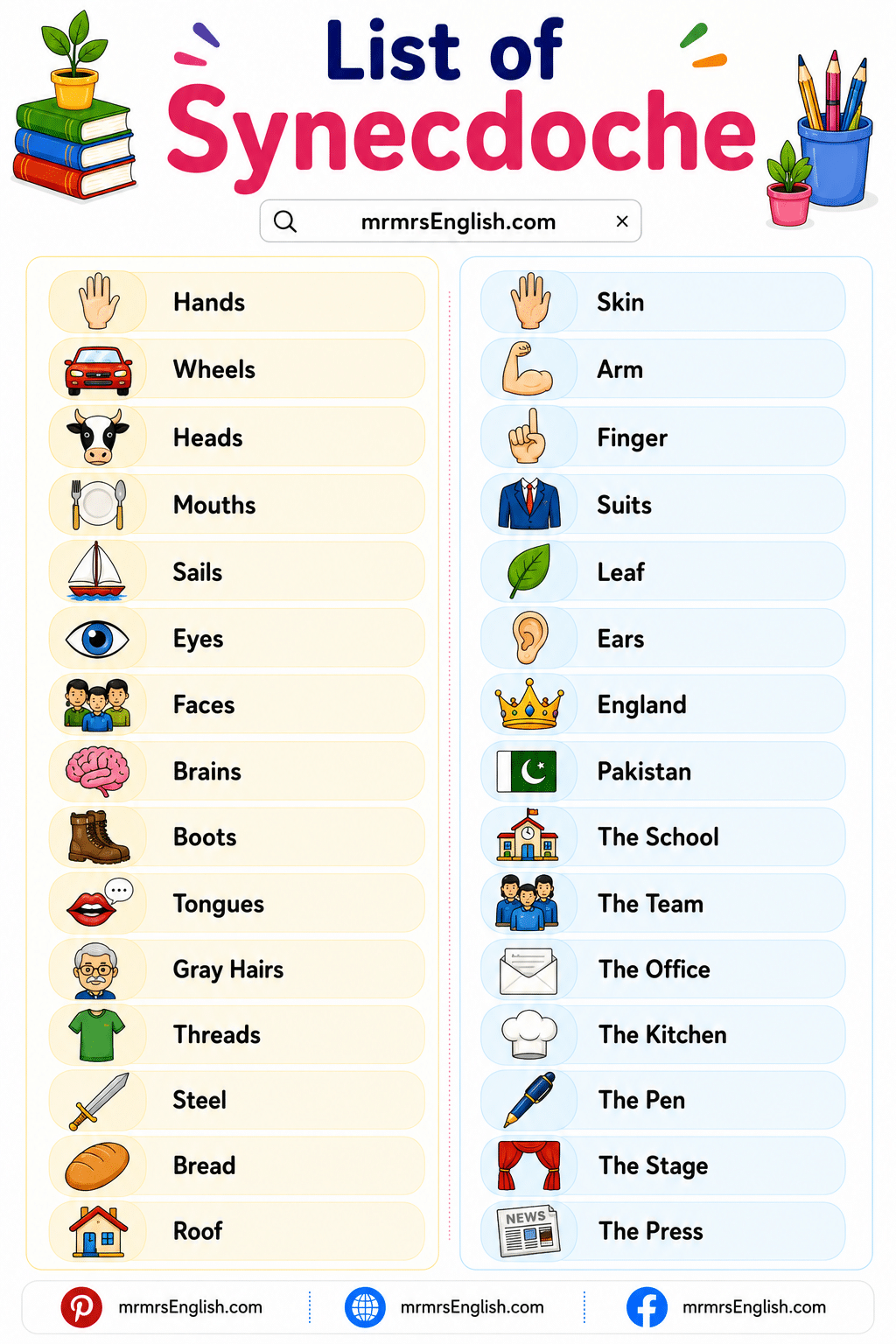
List of Synecdoche in English
Synecdoche Example Sentences
| Synecdoche | Example Sentence |
|---|---|
| Hands | We need more hands to finish the harvest before sunset. |
| Wheels | She finally bought a new set of wheels last week. |
| Heads | The farmer counted fifty heads of cattle in the field. |
| Mouths | There were many mouths to feed after the festival. |
| Sails | We spotted three sails on the horizon this morning. |
| Eyes | Keep your eyes on the road while driving. |
| Faces | It was great to see so many new faces at the meeting. |
| Brains | We need the best brains working on this project. |
| Boots | The army sent more boots to the border. |
| Tongues | The traveler spoke several tongues fluently. |
| Gray Hairs | The company values the advice of its gray hairs. |
| Threads | The poor family had only a few threads to wear. |
| Steel | The soldiers drew their steel before the battle began. |
| Bread | He works hard to earn his bread every day. |
| Roof | The charity helped many families find a roof over their heads. |
| Skin | The hunter sold the skin at the local market. |
| Arm | The machine needs another arm to increase production. |
| Finger | Every finger was busy preparing the decorations. |
| Suits | The suits from the head office visited the branch today. |
| Leaf | The gardener admired every leaf in the beautiful garden. |
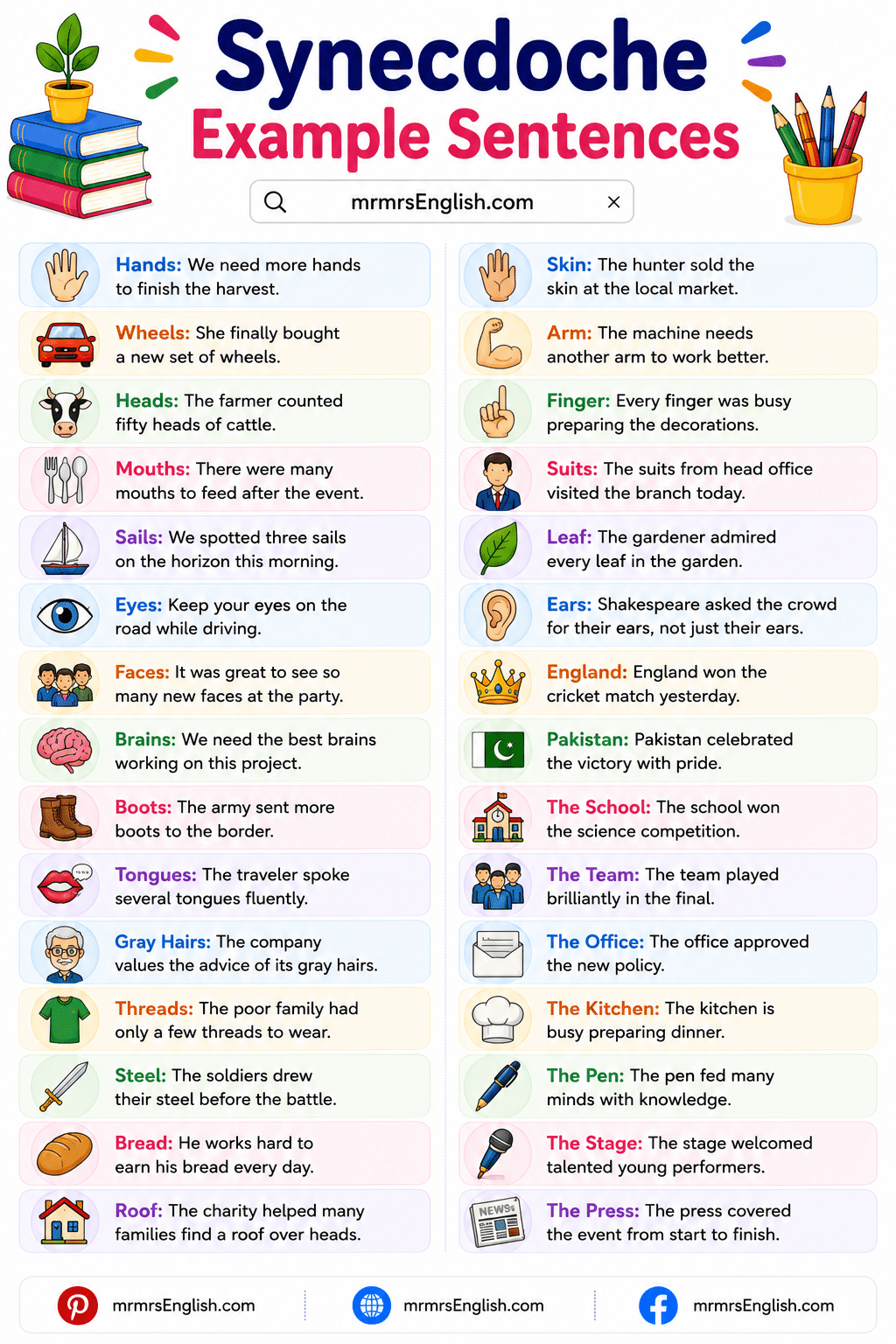
Synecdoche Example Sentences
Quick Summary
| Topic | Explanation |
|---|---|
| Meaning | A part represents the whole or the whole represents a part |
| Based On | Part-whole relationship |
| Common Uses | Literature, speeches, conversations, poetry |
| Purpose | Makes language concise and expressive |
| Similar Device | Metonymy |
| Different From | Metaphor |
Learn more helpful articles

Leave a Comment