
What Are Verbs in English?
A verb is a word that shows an action, state, or condition in a sentence. Verbs are very important because every complete sentence usually needs a verb.
Examples:
| Sentence | Verb | Meaning |
|---|---|---|
| She runs fast. | runs | action |
| He is happy. | is | state |
| They have a car. | have | possession |
| I think you are right. | think | mental action |
In simple words, verbs tell us what someone or something does, is, has, feels, or thinks.
Why Are Verbs Important in English?
Verbs are the heart of English sentences. Without a verb, a sentence is usually incomplete.
Example:
- The boy. ❌
- The boy plays. ✅
The second sentence is complete because it has a verb. Verbs help us talk about actions, time, feelings, habits, conditions, and events.
10 Types of Verbs in English Grammar:
- Action Verbs
- Linking Verbs
- Helping Verbs (Auxiliary Verbs)
- Modal Verbs
- Transitive Verbs
- Intransitive Verbs
- Dynamic Verbs
- Stative Verbs
- Phrasal Verbs
- Irregular Verbs
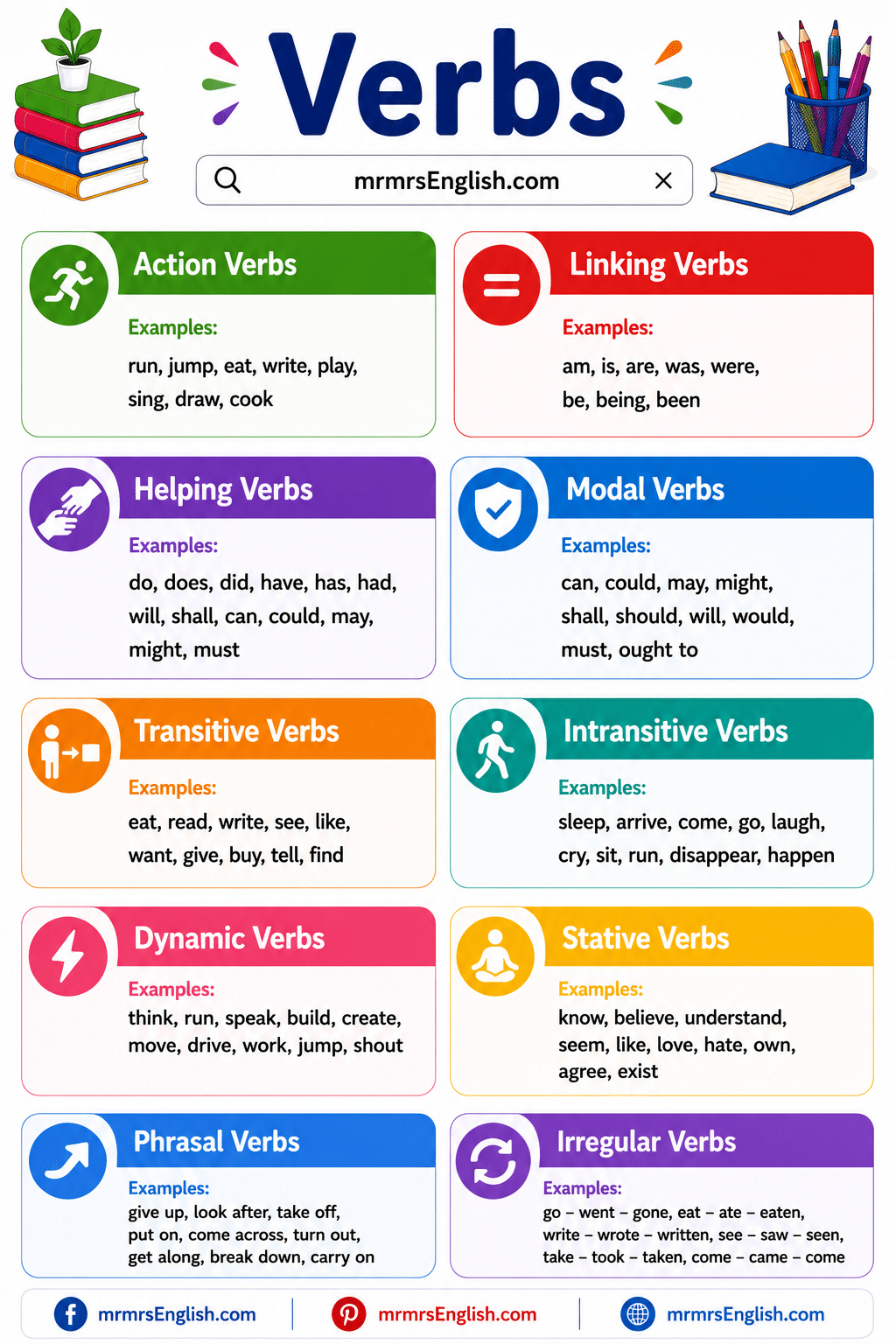
Verbs Examples in English
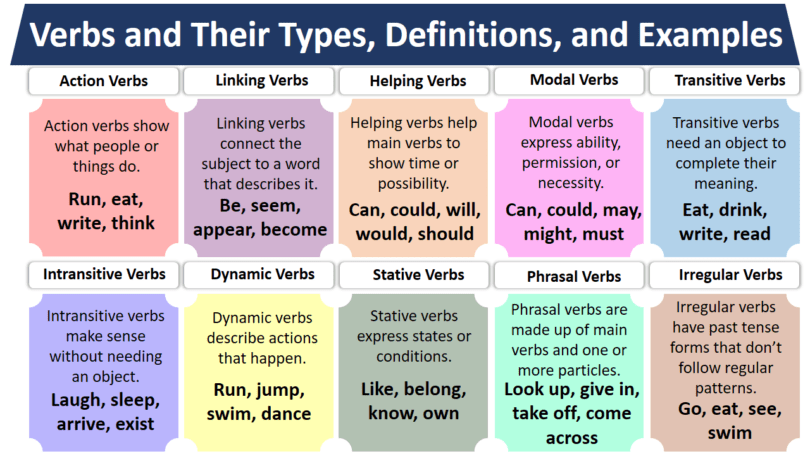
10 Verbs and Their Types, Definitions, and Examples:
Action Verbs:
- Definition: Action verbs show what someone or something does.
- Verbs: Run, eat, write, think.
- Examples:
- She runs every morning.
- He eats apples for breakfast.
- They write stories in class.
Linking Verbs:
- Definition: Linking verbs connect the subject to a word that describes it.
- Verbs: Be, seem, appear, become.
- Examples:
- She is a teacher.
- He seems happy today.
- They became friends quickly.
Helping Verbs:
- Definition: Helping verbs assist the main verb to show time or possibility.
- Verbs: Can, could, will, would, should.
- Examples:
- She can swim very well.
- They will visit us tomorrow.
- He should study for the test.
Modal Verbs:
- Definition: Modal verbs express ability, permission, or necessity.
- Verbs: Can, could, may, might, must.
- Examples:
- You can play the piano.
- She may come to the party.
- He must finish his homework.
Transitive Verbs:
- Definition: Transitive verbs need an object to complete their meaning.
- Verbs: Eat, drink, write, read.
- Examples:
- She eats pizza for dinner.
- He drinks coffee in the morning.
- They write letters to their friends.
Intransitive Verbs:
- Definition: Intransitive verbs make sense without needing an object.
- Verbs: Laugh, sleep, arrive, exist.
- Examples:
- She laughs at his jokes.
- He sleeps peacefully at night.
- They arrived early for the movie.
Dynamic Verbs:
- Definition: Dynamic verbs describe actions that happen.
- Verbs: Run, jump, swim, dance.
- Examples:
- They run every morning.
- He jumps over the puddle.
- She dances at parties.
Stative Verbs:
- Definition: Stative verbs express states or conditions.
- Verbs: Like, belong, know, own.
- Examples:
- She likes chocolate ice cream.
- The book belongs to him.
- They know the answer.
Phrasal Verbs:
- Definition: Phrasal verbs consist of main verbs and one or more particles.
- Verbs: Look up, give in, take off, come across.
- Examples:
- She looks up new words in the dictionary.
- He gave in to their demands.
- They came across an old photo.
Irregular Verbs:
- Definition: Irregular verbs have past tense forms that don’t follow regular patterns.
- Verbs: Go, eat, see, swim.
- Examples:
- She went to the store yesterday.
- He ate dinner an hour ago.
- They saw a movie last night.
Image of Verbs and Their Types, Definitions, and Examples
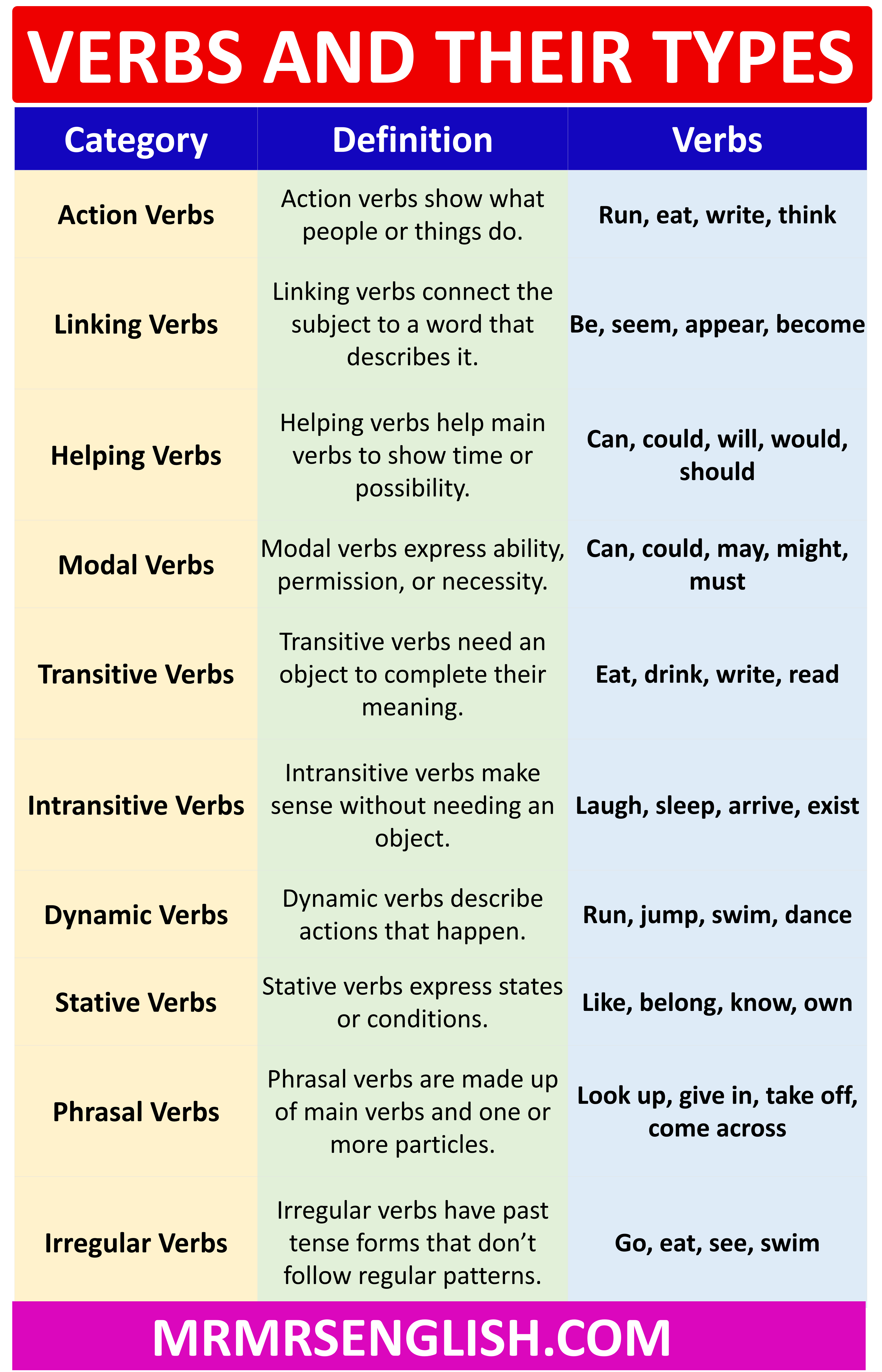
Image of Verbs and Their Types, Definitions, and Examples
Verb Forms in English
English verbs usually have five main forms.
| Form | Example with “write” |
|---|---|
| Base form | write |
| Third-person singular | writes |
| Past form | wrote |
| Present participle | writing |
| Past participle | written |
Examples in Sentences
- I write daily.
- She writes daily.
- He wrote yesterday.
- They are writing now.
- I have written the answer.
Verbs and Tenses
Verbs show the time of an action. This is called tense.
1. Present Tense
Present tense is used for habits, facts, routines, and current actions.
Examples
- I study English.
- She goes to school.
- The sun rises in the east.
2. Past Tense
Past tense is used for actions that happened before now.
Examples
- I visited my friend.
- She cooked dinner.
- They went home.
3. Future Tense
Future tense is used for actions that will happen later.
Examples
- I will call you.
- She will join the class.
- They will travel tomorrow.
Main Verb Tense Table
| Tense | Structure | Example |
|---|---|---|
| Simple Present | Subject + base verb / s, es | She plays. |
| Simple Past | Subject + past verb | She played. |
| Simple Future | Subject + will + base verb | She will play. |
| Present Continuous | is/am/are + verb-ing | She is playing. |
| Past Continuous | was/were + verb-ing | She was playing. |
| Present Perfect | has/have + past participle | She has played. |
| Past Perfect | had + past participle | She had played. |
Finite and Non-Finite Verbs
Finite Verbs
A finite verb changes according to the subject and tense.
Examples
- He plays cricket.
- They play cricket.
- She was happy.
- We were happy.
The verb changes with subject or time.
Non-Finite Verbs
A non-finite verb does not change according to subject or tense.
Examples
- I like to read.
- Reading is useful.
- She has a broken phone.
Types of non-finite verbs include:
| Type | Example |
|---|---|
| Infinitive | to go, to read |
| Gerund | going, reading |
| Participle | broken, written, running |
Gerunds, Infinitives, and Participles
Gerunds
A gerund is the -ing form of a verb used as a noun.
Examples
- Swimming is good exercise.
- I enjoy reading.
- Writing improves grammar.
Infinitives
An infinitive is to + base verb.
Examples
- I want to learn English.
- She likes to sing.
- They decided to leave.
Participles
Participles are verb forms used in different ways.
Present Participle
- The baby is sleeping.
- A running boy fell down.
Past Participle
- The window is broken.
- I have finished my work.
Subject-Verb Agreement
A verb must agree with its subject.
Basic Rule
Singular subject takes singular verb.
Plural subject takes plural verb.
| Subject | Verb | Example |
|---|---|---|
| He / She / It | goes | She goes to school. |
| I / You / We / They | go | They go to school. |
Common Examples
Correct:
- He likes tea.
- They like tea.
Incorrect:
- He like tea. ❌
- They likes tea. ❌
Active and Passive Verbs
Active Voice
In active voice, the subject does the action.
Examples
- Ali wrote a letter.
- She cleaned the room.
Passive Voice
In passive voice, the subject receives the action.
Examples
- A letter was written by Ali.
- The room was cleaned by her.
Active and Passive Table
| Active Voice | Passive Voice |
|---|---|
| She writes a letter. | A letter is written by her. |
| He opened the door. | The door was opened by him. |
| They will finish the work. | The work will be finished by them. |
Phrasal Verbs
A phrasal verb is made of a verb and a preposition or adverb. Its meaning is often different from the main verb.
Common Phrasal Verbs
| Phrasal Verb | Meaning | Example |
|---|---|---|
| give up | stop trying | Never give up. |
| look after | take care of | She looks after her brother. |
| turn on | start a machine | Please turn on the fan. |
| turn off | stop a machine | Turn off the light. |
| find out | discover | I will find out the answer. |
Phrasal verbs are very common in daily English.
Stative and Dynamic Verbs
Dynamic Verbs
Dynamic verbs show actions that can happen physically or mentally.
Examples
- run
- write
- eat
- play
- study
Example:
- She is writing a letter.
Stative Verbs
Stative verbs show states, feelings, opinions, possession, or senses.
Examples
| Stative Verb | Use |
|---|---|
| know | knowledge |
| believe | opinion |
| love | feeling |
| own | possession |
| seem | state |
| understand | mental state |
Examples:
- I know the answer.
- She loves music.
- He owns a car.
Many stative verbs are not usually used in continuous form.
Correct:
- I understand you.
Incorrect:
- I am understanding you. ❌
Common Mistakes with Verbs
1. Missing Verb
Incorrect:
- She very happy. ❌
Correct:
- She is very happy. ✅
2. Wrong Verb Form
Incorrect:
- He go to school daily. ❌
Correct:
- He goes to school daily. ✅
3. Wrong Past Form
Incorrect:
- I goed home. ❌
Correct:
- I went home. ✅
4. Incorrect Modal Verb Use
Incorrect:
- She can sings well. ❌
Correct:
- She can sing well. ✅
5. Confusing “Do” and “Does”
Incorrect:
- Does they play cricket? ❌
Correct:
- Do they play cricket? ✅
How to Identify a Verb in a Sentence
To find the verb, ask:
- What is the subject doing?
- What is happening?
- What is the state of the subject?
Examples
| Sentence | Verb |
|---|---|
| The child sleeps. | sleeps |
| She is happy. | is |
| They are playing. | are playing |
| I have finished. | have finished |
Practice Exercise
Find the verbs in these sentences:
- She writes neatly.
- They are watching TV.
- He went to the market.
- I can speak English.
- The food tastes delicious.
Answers
| Sentence | Verb |
|---|---|
| 1 | writes |
| 2 | are watching |
| 3 | went |
| 4 | can speak |
| 5 | tastes |
Quick Summary Table
| Verb Type | Purpose | Example |
|---|---|---|
| Action Verb | Shows action | run |
| Helping Verb | Helps the main verb | is, have, do |
| Linking Verb | Connects subject to information | seem |
| Transitive Verb | Needs object | buy |
| Intransitive Verb | Does not need an object | sleep |
| Regular Verb | Takes -ed | worked |
| Irregular Verb | Changes form | went |
| Modal Verb | Shows ability, advice, possibility | can, should |
Learn more helpful articles


Leave a Comment