
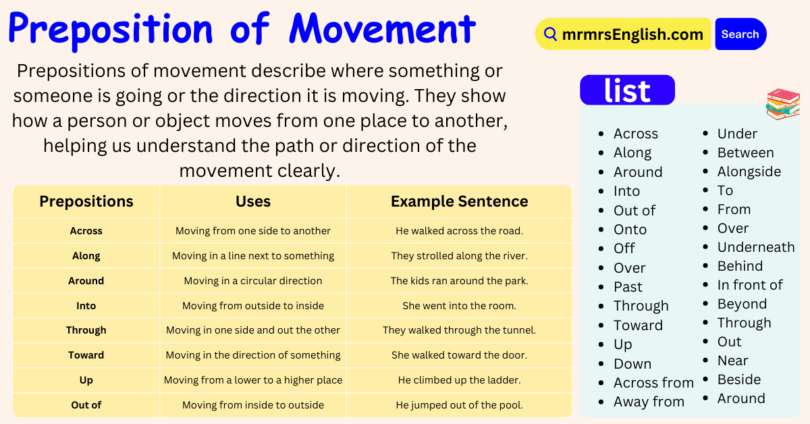
What Are Prepositions of Movement?
Prepositions of movement help describe motion or direction. They answer the question “Where is something moving?” or “In what direction?” These prepositions are used when someone or something moves from one place to another, helping to provide a clear sense of direction.
Common Prepositions of Movement Examples
Here are some common prepositions of movement and what they signify:
| Preposition | Use | Example Sentence |
|---|---|---|
| To | Moving towards a specific destination | She walks to school every day. |
| Into | Entering an enclosed space | He jumped into the pool. |
| Onto | Moving onto a surface | The cat climbed onto the roof. |
| Over | Moving above something without touching | The plane flew over the mountain. |
| Through | Moving from one side to another | They walked through the tunnel. |
| Across | Moving from one side to another | She ran across the field. |
| Up | Moving from a lower to a higher place | He climbed up the stairs. |
| Down | Moving from a higher to a lower place | The ball rolled down the hill. |
| Along | Moving in a line, typically following | They walked along the beach. |
| Past | Moving beyond or beside something | We drove past the library. |
| Around | Moving in a circular direction | They walked around the park. |

Preposition of Movement Made Easy with definitions
Basic Preposition of Movement
1. To – Movement Towards a Place
This preposition shows movement from one place to another. It indicates that someone or something is moving towards a specific destination.
Example Sentences:
- He is going to the gym.
- We are heading to the park.
2. Into – Entering a Space
“Into” is used when someone or something enters a defined or enclosed space. It implies a change from being outside to being inside.
Example Sentences:
- The bird flew into the house.
- She threw the paper into the bin.
3. Onto – Moving onto a Surface
“Onto” describes movement to a surface. It indicates that someone or something is moving from one place onto a surface, usually from below.
Example Sentences:
- He placed the books onto the shelf.
- The dog jumped onto the couch.
Advanced Preposition of Movement
1. Through – Moving from One Side to Another
“Through” is used when something moves within a space or object from one side to another, like going inside and coming out the other side.
Example Sentences:
- The car drove through the tunnel.
- We walked through the forest.
2. Over – Moving Above Without Touching
“Over” is used when something moves from one side to another while staying above it, without making contact.
Example Sentences:
- The bird flew over the lake.
- He jumped over the fence.
3. Around – Moving in a Circular Direction
“Around” describes circular motion or movement surrounding something. It shows the idea of moving along the outer edge.
Example Sentences:
- They walked around the building.
- The moon moves around the Earth.
Differences Between Prepositions of Movement
Understanding the differences between prepositions is key to using them correctly. Here is a table that highlights the subtle differences between some commonly confused prepositions of movement:
| Preposition | Key Difference | Example Sentences |
|---|---|---|
| To vs. Into | To indicate a direction, Into suggests entry | He walked to the door. / He went into the room. |
| Over vs. Above | Over suggests movement, Above is a static position | The bird flew over the bridge. / The lamp is above the table. |
| Along vs. Across | Along follows a line, Across means going from one side to another | We walked along the river. / She swam across the pool. |
Prepositions of Movement in Real-Life Situations
Movement in Travel
Prepositions of movement are very useful when talking about travel, directions, and motion.
Example Sentences:
- We drove through the city on our way to the countryside.
- The train goes past several villages before reaching its final stop.
Movement in Sports
In sports, we often describe actions using prepositions of movement to indicate the direction and flow of the game.
Example Sentences:
- The ball went over the goalpost.
- He ran around the track twice.
Example Sentences of Preposition of Movement
| Preposition of Movement | Example Sentence |
|---|---|
| Across | We walked across the bridge. |
| Along | He ran along the beach. |
| Around | The dog ran around the park. |
| Into | She went into the house. |
| Out of | He jumped out of the car. |
| Onto | The cat jumped onto the table. |
| Off | He fell off the bike. |
| Over | The plane flew over the city. |
| Past | We walked past the store. |
| Through | They walked through the forest. |
| Toward | She walked toward the door. |
| Up | He climbed up the mountain. |
| Down | The ball rolled down the hill. |
| Across from | The school is across from the park. |
| Away from | The cat ran away from the dog. |
| Under | He crawled under the table. |
| Between | She walked between the trees. |
| Alongside | He walked alongside his friend. |
| Onto | She stepped onto the bus. |
| Over | He jumped over the fence. |

Preposition of Movement Made Easy with definitions








Leave a Comment