
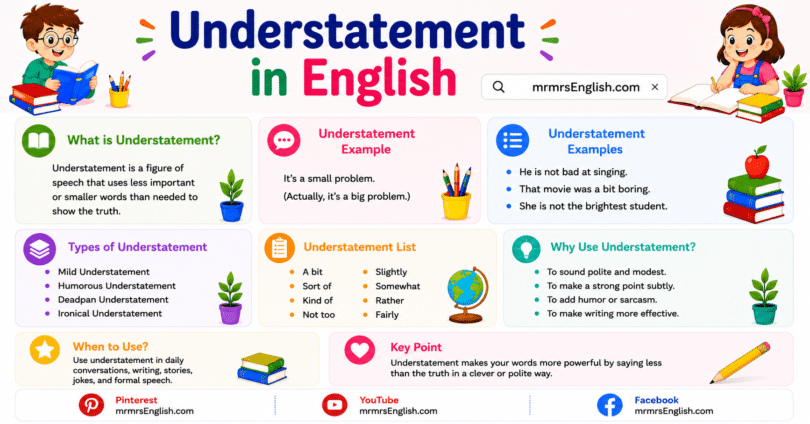
An understatement is a figure of speech in which something is described as less important, serious, or extreme than it really is. It is often used to create humor, show modesty, or emphasize a situation by deliberately downplaying it. Understatements are common in everyday conversations, literature, and formal writing. In this article, you will learn the meaning of understatement in English through a clear definition and simple examples, helping students, teachers, and English learners understand this figure of speech and use it confidently in speaking and writing.
What Is Understatement?
An understatement is a way of speaking or writing in which someone intentionally describes a serious, important, or extreme situation as if it were much smaller or less significant. Instead of making something sound bigger, understatement makes it sound smaller to create emphasis, humor, irony, or politeness.
Examples:
- The exam was a little difficult. (It was actually very difficult.)
- I have a few things to do today. (There are many tasks.)
- The storm caused a bit of damage. (It caused major destruction.)
- That suitcase is slightly heavy. (It is extremely heavy.)
Simple Formula of Understatement
| Structure | Example |
|---|---|
| Serious Situation + Mild Words | The movie was a little sad. |
| Big Problem + Small Description | We had a small issue with the engine. |
| Extreme Condition + Soft Expression | It’s a bit cold outside. |
Why Do People Use Understatement?
People use understatement for many different reasons in English.
- To sound polite
- To add humor
- To create irony
- To avoid sounding dramatic
- To make readers think more deeply
- To express confidence calmly
- To make a situation sound less emotional
Characteristics of Understatement
An understatement usually has these features:
- Makes something seem less important than it really is
- Uses simple and mild words
- Creates humor or irony
- Often appears in everyday English
- Can make writing sound more natural
- Does not exaggerate
- Depends on the listener understanding of the real situation
Types of Understatement
Literal Understatement
A situation is described with softer words than it deserves.
Example:
- Losing the final match was a little disappointing.
Ironic Understatement
The speaker intentionally says much less than the reality to create irony.
Example:
- After breaking his leg, he said,
“Well, this isn’t ideal.”
Humorous Understatement
Used to make people laugh by minimizing a serious event.
Example:
- After climbing Mount Everest,
“That was a decent walk.”
Polite Understatement
Used to avoid sounding rude or harsh.
Example:
- Your report needs a little improvement.
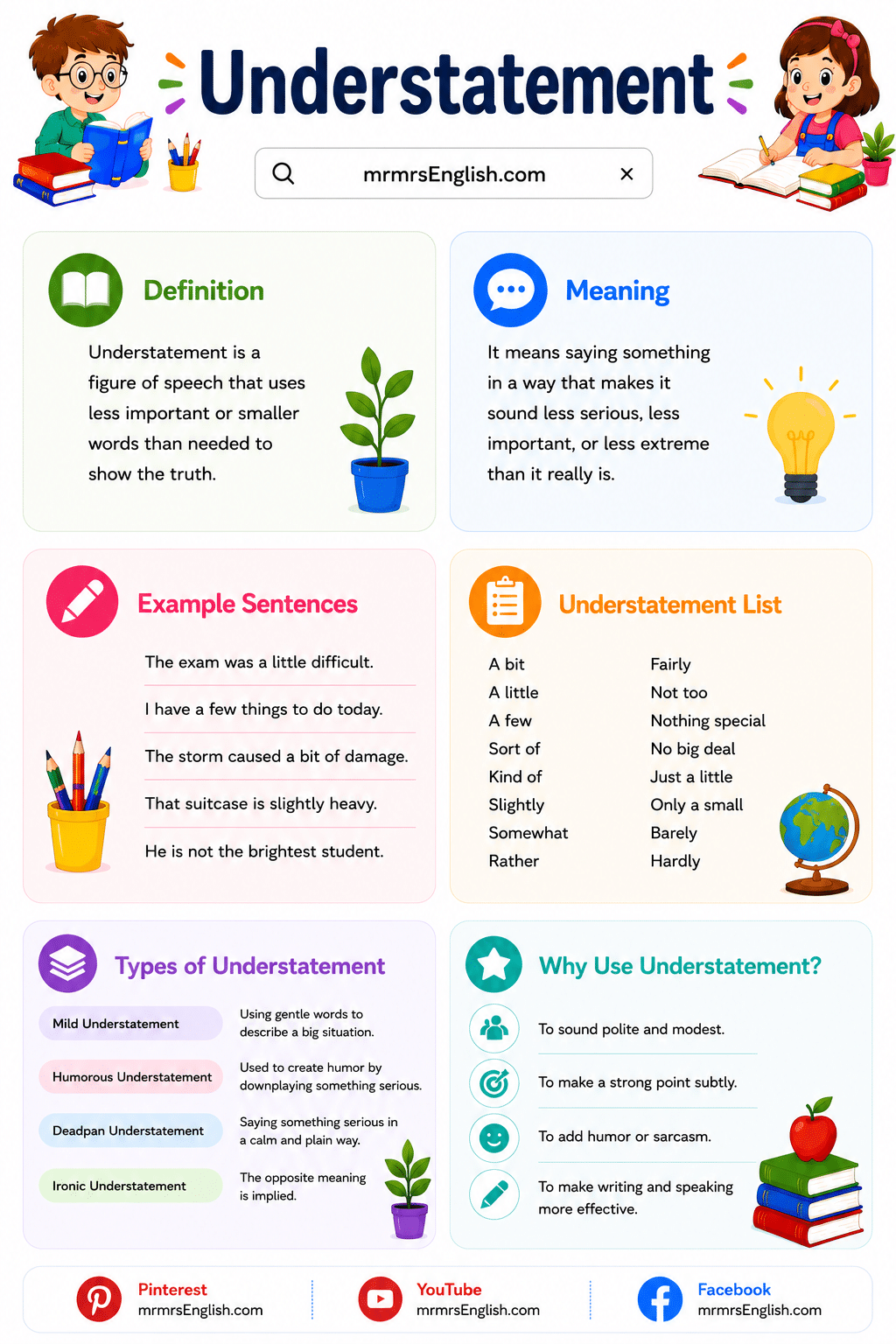
Types of understatement with Examples in Sentences
Understatement Examples in Everyday English
| Sentence | Actual Meaning |
|---|---|
| It’s a bit warm today. | It is extremely hot. |
| We had a small delay. | The delay was very long. |
| That was somewhat difficult. | It was very difficult. |
| The meeting took a little longer. | It lasted much longer than expected. |
| I feel slightly tired. | I am exhausted. |
| The road is a little busy. | There is heavy traffic. |
| The food was not bad. | The food was very good. |
| We have a minor problem. | The problem is serious. |
| He made a small mistake. | The mistake was huge. |
| The suitcase is a bit heavy. | It is extremely heavy. |
Understatement in Literature
Writers often use understatement to create irony or increase the emotional impact of a story.
Instead of directly describing a terrible event, they use calm language. This allows readers to realize the seriousness themselves, making the writing more powerful.
Example: After the house burned down, he quietly said,
“Well, that’s unfortunate.”
The calm response makes the situation feel even more dramatic.
Understatement in Daily Conversation
Native English speakers use understatement very often.
Examples
- I’m a little busy right now.
- This project is not exactly easy.
- That’s not my best day.
- The weather is a bit chilly.
- The interview was fairly stressful.
Understatement in Writing
Understatement makes writing sound more natural and less exaggerated.
It is commonly used in:
- Essays
- Stories
- Novels
- Newspaper articles
- Speeches
- Movies
- Comedy
- Business communication
Difference Between Understatement and Hyperbole
| Understatement | Hyperbole |
|---|---|
| Makes something seem smaller | Makes something seem bigger |
| Uses mild language | Uses exaggerated language |
| Creates subtle emphasis | Creates dramatic emphasis |
| Sounds calm | Sounds emotional |
| Often uses irony | Often uses exaggeration |
Examples
Understatement
- The test was a little challenging.
(It was extremely difficult.)
Hyperbole
- The test was impossible to finish.
Understatement vs Litotes
Many learners confuse these two figures of speech.
| Understatement | Litotes |
|---|---|
| Simply minimizes something | Uses double negatives or negative expressions |
| May not use negatives | Usually uses negatives |
| Can stand alone | Is a special type of understatement |
Examples
Understatement
- The movie was a little long.
Litotes
- The movie was not short.
Common Words Used in Understatement
These words often appear in understatement:
- A little
- A bit
- Slightly
- Somewhat
- Fairly
- Rather
- Not bad
- Not ideal
- Not the best
- Minor
More Examples of Understatement
| Understatement | Real Meaning |
|---|---|
| I made a tiny mistake. | The mistake was serious. |
| It’s a little noisy here. | It is extremely noisy. |
| He looks slightly upset. | He is very angry. |
| The movie was somewhat long. | It was very long. |
| We had a small accident. | It was a major accident. |
| That mountain is fairly high. | It is extremely high. |
| I was a bit nervous. | I was terrified. |
| This chapter is a little confusing. | It is very confusing. |
| She is not exactly pleased. | She is very unhappy. |
| The journey took a while. | It took a very long time. |
How to Identify Understatement
Ask yourself these questions:
- Is the situation actually much more serious than the words suggest?
- Is the speaker intentionally making something sound smaller?
- Does the sentence use soft or mild expressions?
- Would stronger words describe the situation more accurately?
If the answer is yes, it is probably an understatement.
Tips for Using Understatement Correctly
- Use it naturally.
- Avoid using it in every sentence.
- Make sure the listener understands the real situation.
- Use it to create humor or politeness.
- Do not confuse it with exaggeration.
- Practice with real-life conversations.
Understatement Examples Sentences in English
| Understatement | Example Sentence |
|---|---|
| A little difficult | The exam was a little difficult, even though most students failed it. |
| A bit tired | After running a marathon, I felt a bit tired. |
| A little warm | It was a little warm outside during the heatwave. |
| A small problem | We had a small problem when the engine completely stopped. |
| Slightly heavy | This suitcase is slightly heavy, but it weighs over 30 kilograms. |
| Somewhat expensive | The car was somewhat expensive, costing over $100,000. |
| A little noisy | The concert was a little noisy, making it impossible to talk. |
| Not ideal | Losing all our files was not ideal. |
| A minor issue | The flood caused a minor issue for the whole town. |
| Fairly busy | The airport was fairly busy during the holiday season. |
| A little confusing | The instructions were a little confusing, so nobody finished the task correctly. |
| Rather cold | It was rather cold during the snowstorm. |
| Not bad | Her performance was not bad; she won first prize. |
| A tiny mistake | I made a tiny mistake that ruined the entire project. |
| Somewhat late | The train was somewhat late, arriving three hours behind schedule. |
| A bit stressful | Organizing the international event was a bit stressful. |
| A little disappointing | Losing the championship was a little disappointing. |
| Not the best day | After missing my flight and losing my wallet, it was not the best day. |
| A little windy | It was a little windy during the powerful storm. |
| Slightly upset | She was slightly upset after hearing the shocking news. |
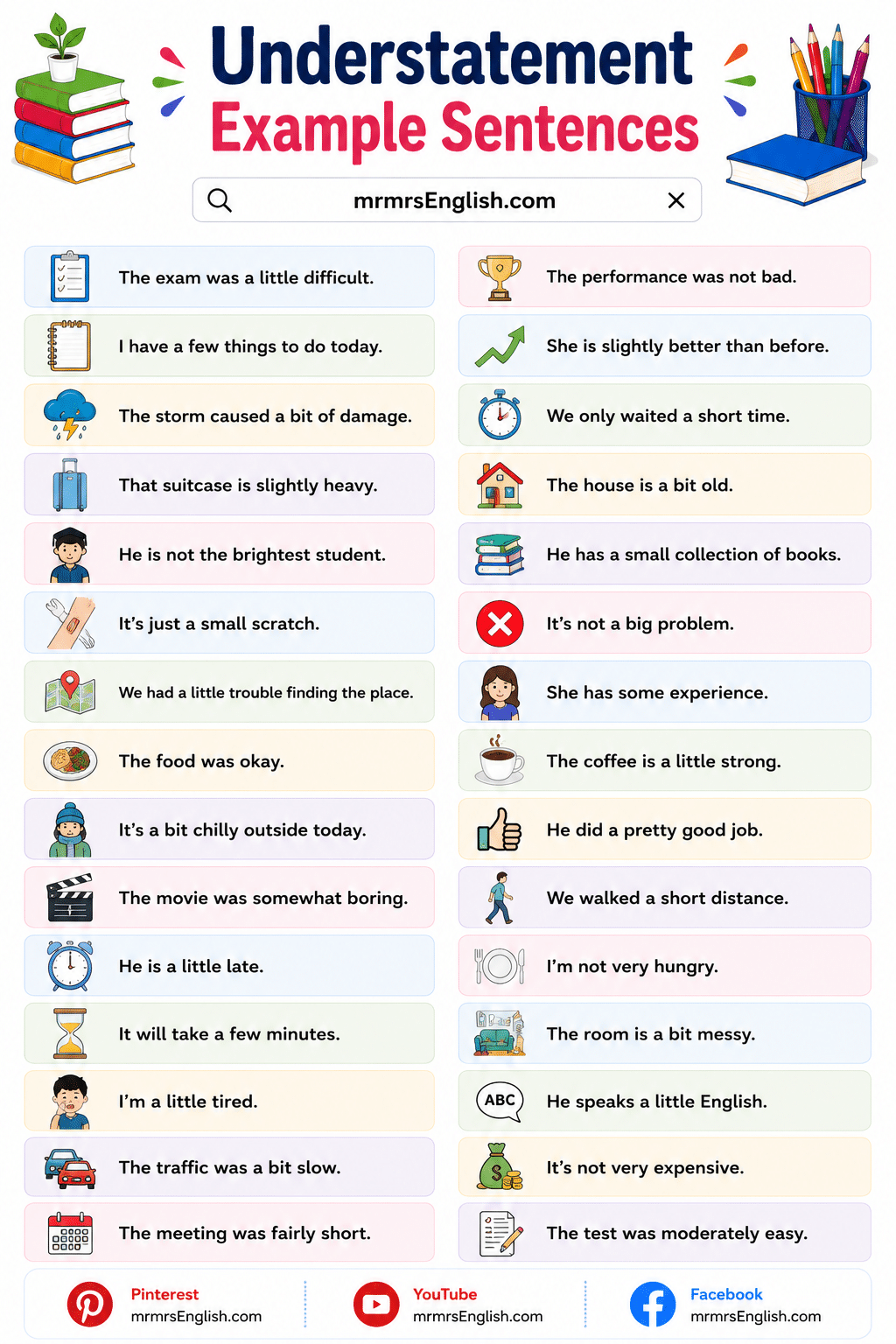
Understatement Examples Sentences in English




Leave a Comment