
Irony is an interesting literary and grammatical device used when there is a contrast between what is expected and what actually happens, or between what is said and what is meant. It is commonly used in everyday conversations, stories, poems, and literature to create humor, emphasize a point, or add deeper meaning. Understanding irony helps learners improve their reading comprehension, writing skills, and appreciation of language. In this article, you will learn the meaning of irony in English, its different types, and clear examples that make this important concept easy to understand and apply.
What Is Irony in English?
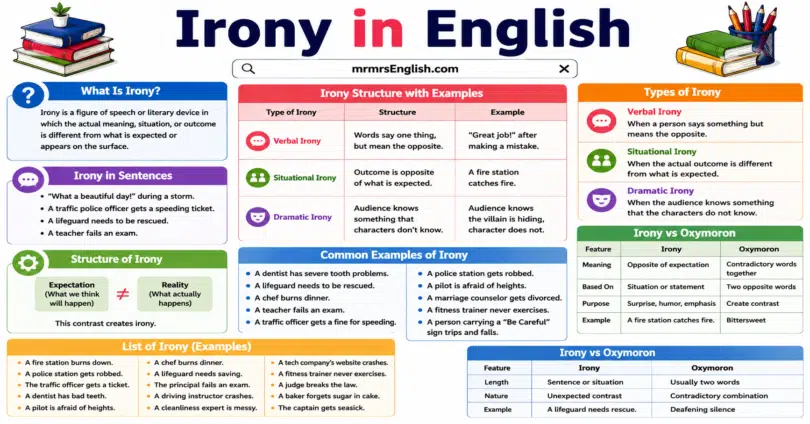
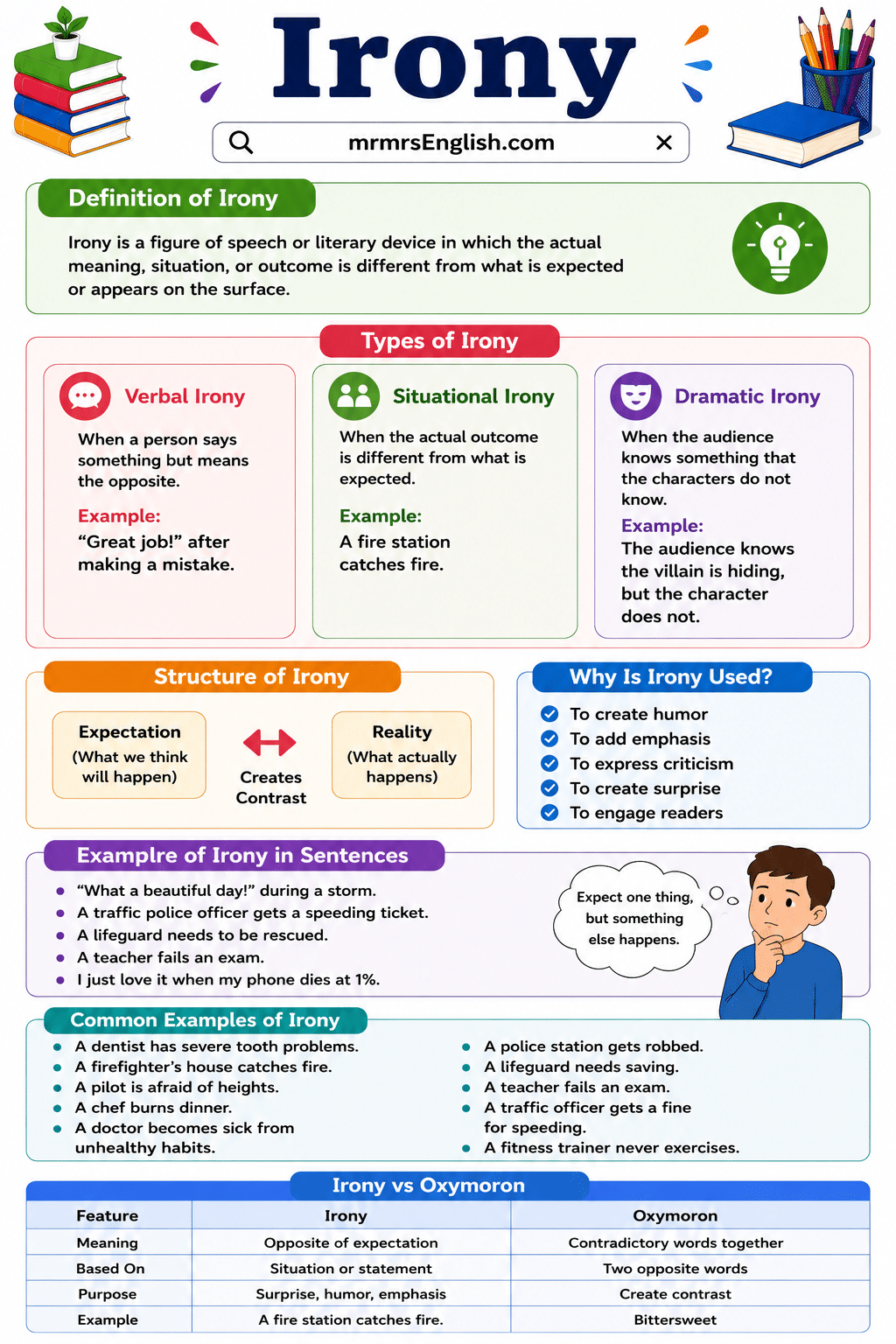
Irony is a figure of speech or literary device in which the actual meaning, situation, or outcome is different from what is expected or appears on the surface. In simple words, irony happens when there is a contrast between expectation and reality.
Simple Examples of Irony
| Situation | Why It Is Ironic |
|---|---|
| A fire station catches fire. | The place meant to prevent fires experiences one. |
| A traffic police officer gets a speeding ticket. | The person enforcing traffic laws breaks them. |
| A lifeguard needs to be rescued. | The rescuer becomes the one needing help. |
| A teacher fails an exam. | Someone who teaches the subject does not pass it. |
These situations are ironic because the outcome is opposite to what people normally expect.
Why Is Irony Used?
Writers and speakers use irony for many purposes.
To Create Humor
Irony often makes situations funny and entertaining.
To Add Emphasis
It highlights important ideas through contrast.
To Express Criticism
Writers may use irony to criticize people, actions, or society.
To Create Surprise
Unexpected outcomes make stories more interesting.
To Engage Readers
Irony encourages readers to think beyond the literal meaning.
Main Features of Irony in English
Irony has several characteristics that help identify it.
Contrast Between Expectation and Reality
The actual result differs from what people expect.
Hidden Meaning
The intended meaning is often different from the literal meaning.
Surprise Element
Irony usually contains an unexpected twist.
Strong Emotional Effect
It can create humor, sadness, suspense, or criticism.
Types of Irony in English
Irony is generally divided into three major types.
Verbal Irony
Verbal irony occurs when a speaker says something but means the opposite.
The listener understands the intended meaning from the context.
Examples
- Saying “What a beautiful day!” during a storm.
- Saying “Great job!” after someone makes a mistake.
- Saying “This food is delicious” when the meal tastes terrible.
Examples of Verbal Irony
| Statement | Actual Meaning |
|---|---|
| What a pleasant surprise! | The surprise is unpleasant. |
| Excellent work! | The work is poor. |
| Lovely weather today! | The weather is bad. |
Situational Irony
Situational irony occurs when the actual outcome is different from what people expect.
Examples
- A dentist has severe tooth problems.
- A firefighter’s house catches fire.
- A thief gets robbed.
Examples of Situational Irony
| Situation | Expected Result | Actual Result |
|---|---|---|
| Fire station | Stops fires | Catches fire |
| Lifeguard | Saves others | Needs rescue |
| Teacher | Passes exam | Fails exam |
Dramatic Irony
Dramatic irony occurs when readers or viewers know something that the characters do not know.
This type is very common in novels, movies, and plays.
Example
A character enters a room believing it is safe, but the audience already knows there is danger inside.
Examples of Dramatic Irony
| Situation | What Audience Knows | What Character Knows |
|---|---|---|
| Horror movie | The villain is hiding nearby | The character is unaware |
| Mystery story | The criminal’s identity | The detective does not know yet |
| Adventure film | A trap is ahead | The hero does not know |
Types of Irony with Meanings and Examples
Common Examples of Irony in Daily Life
Irony is frequently used in everyday conversations.
Examples
- Posting on social media that technology is ruining communication.
- Forgetting your phone while giving a speech about organization.
- A driving instructor getting a traffic ticket.
- A chef burning dinner.
- A doctor becoming sick from unhealthy habits.
Irony in Literature
Many authors use irony to make stories more engaging and meaningful.
Examples
| Literary Situation | Type of Irony |
|---|---|
| A hero’s success causes failure | Situational Irony |
| Audience knows a secret | Dramatic Irony |
| Character says the opposite of what they mean | Verbal Irony |
Irony often helps writers build suspense, humor, and deeper meaning.
Irony in Everyday Speech
People regularly use verbal irony without realizing it.
Examples
- “That went well,” after a major mistake.
- “You’re early,” when someone arrives very late.
- “Nice timing,” when a person interrupts an important conversation.
- “Wonderful!” after receiving bad news.
Irony in Movies and Television
Movies and television shows frequently use irony to entertain audiences.
Dramatic Irony Example
The audience sees a hidden danger, but the character walks directly toward it.
Situational Irony Example
A criminal spends years planning a robbery but accidentally steals fake money.
Verbal Irony Example
A character says, “Everything is under control,” while chaos surrounds them.
Importance of Irony in Writing
Makes Writing More Interesting
Irony keeps readers engaged and curious.
Creates Humor
Unexpected situations often make readers laugh.
Adds Depth
Irony can communicate complex ideas effectively.
Builds Suspense
Readers become eager to see what happens next.
Strengthens Themes
Authors use irony to highlight important messages.
Difference Between Irony and Sarcasm
Many students confuse irony and sarcasm.
| Feature | Irony | Sarcasm |
|---|---|---|
| Meaning | Opposite of expectation | Mocking or critical remark |
| Purpose | Contrast or surprise | Criticism or humor |
| Tone | May be neutral | Usually sharp or negative |
Examples
Irony: A fire station catches fire.
Sarcasm: “Excellent driving!” after someone crashes a car.
All sarcasm can involve irony, but not all irony is sarcasm.
Difference Between Irony and Coincidence
Irony and coincidence are different concepts.
| Feature | Irony | Coincidence |
|---|---|---|
| Opposite Outcome | Yes | Not necessary |
| Unexpected Event | Yes | Yes |
| Contrast Present | Usually | Not always |
Example
Coincidence: Two friends wear the same shirt accidentally.
Irony: A police officer breaks the law.
Difference Between Irony and Paradox
These literary devices are often confused.
| Feature | Irony | Paradox |
|---|---|---|
| Based on Contrast | Yes | Yes |
| Hidden Truth | Sometimes | Always |
| Form | Situation or statement | Statement |
Examples
Irony: A firefighter’s house catches fire.
Paradox: Less is more.
Common Irony Examples for Students
| Example | Type |
|---|---|
| A pilot is afraid of heights. | Situational Irony |
| “Wonderful weather!” during a storm. | Verbal Irony |
| Audience knows the villain’s plan. | Dramatic Irony |
| A police station gets robbed. | Situational Irony |
| “Perfect!” after dropping a phone. | Verbal Irony |
Common Mistakes When Identifying Irony
Thinking Every Unexpected Event Is Irony
Not all surprising events are ironic. There must be a meaningful contrast.
Confusing Irony with Sarcasm
Sarcasm is usually intended to criticize or mock someone.
Ignoring Context
The surrounding situation often determines whether something is ironic.
Tips for Learning Irony
Read Literature Regularly
Stories and novels contain many examples of irony.
Watch Movies Carefully
Pay attention to scenes where the audience knows more than the characters.
Learn the Three Main Types
Focus on:
- Verbal Irony
- Situational Irony
- Dramatic Irony
Analyze Everyday Situations
Try identifying ironic situations in real life.
Practice Exercise on Irony
Identify the type of irony in each example.
- A firefighter’s house catches fire.
- “Fantastic weather!” during heavy rain.
- The audience knows the villain is hiding in the room.
- A dentist has severe tooth decay.
- “Great job!” after a careless mistake.
Answers
| Example | Type of Irony |
|---|---|
| Firefighter’s house catches fire | Situational Irony |
| Fantastic weather during rain | Verbal Irony |
| Audience knows the villain is hiding | Dramatic Irony |
| Dentist has tooth decay | Situational Irony |
| Great job after a mistake | Verbal Irony |
Irony Examples in English
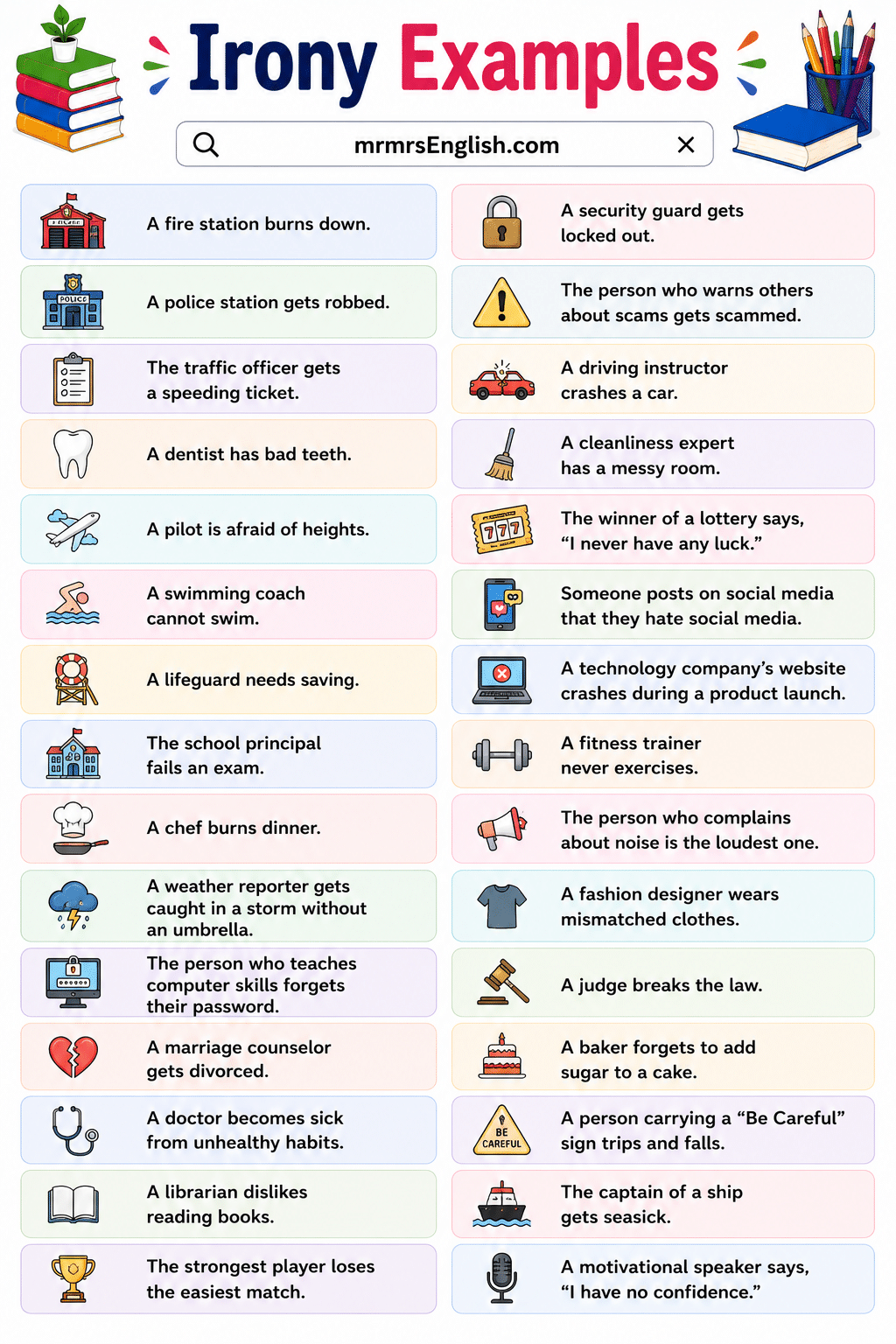
- A fire station burns down.
- A police station gets robbed.
- The traffic officer receives a speeding ticket.
- A dentist has bad teeth.
- A pilot is afraid of heights.
- A swimming coach cannot swim.
- A lifeguard needs saving.
- The school principal fails an exam.
- A chef burns dinner.
- A weather reporter gets caught in a storm without an umbrella.
- The person who teaches computer skills forgets their password.
- A marriage counselor gets divorced.
- A doctor becomes sick from unhealthy habits.
- A librarian dislikes reading books.
- The strongest player loses the easiest match.
- A security guard gets locked out.
- The person who warns others about scams gets scammed.
- A driving instructor crashes a car.
- A cleanliness expert has a messy room.
- The winner of a lottery says, “I never have any luck.”
- Someone posts on social media that they hate social media.
- A technology company’s website crashes during a product launch.
- A fitness trainer never exercises.
- The person who complains about noise is the loudest one.
- A fashion designer wears mismatched clothes.
- A judge breaks the law.
- A baker forgets to add sugar to a cake.
- A person carrying a “Be Careful” sign trips and falls.
- The captain of a ship gets seasick.
- A motivational speaker says, “I have no confidence.”
Irony Examples in English
Learn more helpful articles

Leave a Comment