
A paradox is a statement or idea that seems impossible or contradictory at first, but reveals a deeper or surprising truth when you think about it carefully. Paradoxes are commonly used in English, literature, philosophy, and everyday conversations to express complex ideas in a memorable way. Understanding them can improve your vocabulary, critical thinking, and reading comprehension. In this article, you will learn the meaning of paradox in English through simple definitions and easy examples, helping students, teachers, and English learners understand and use this figure of speech with confidence.
Table of Contents
ToggleWhat Is a Paradox?
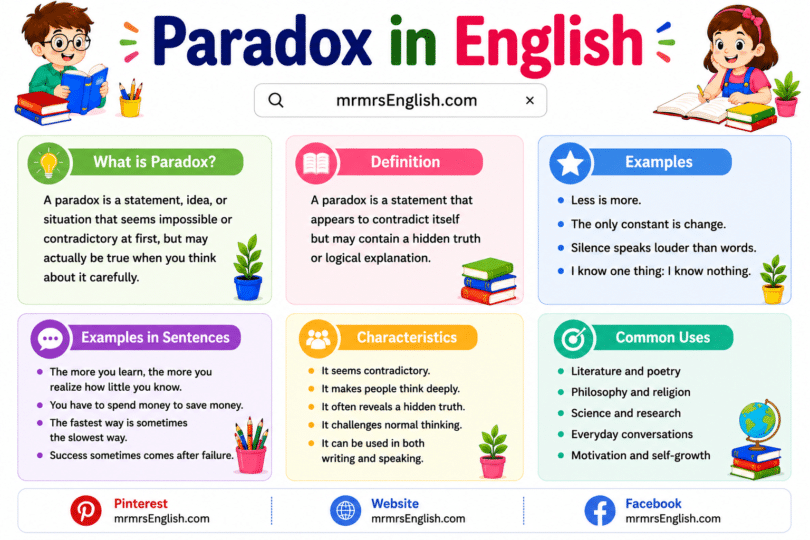
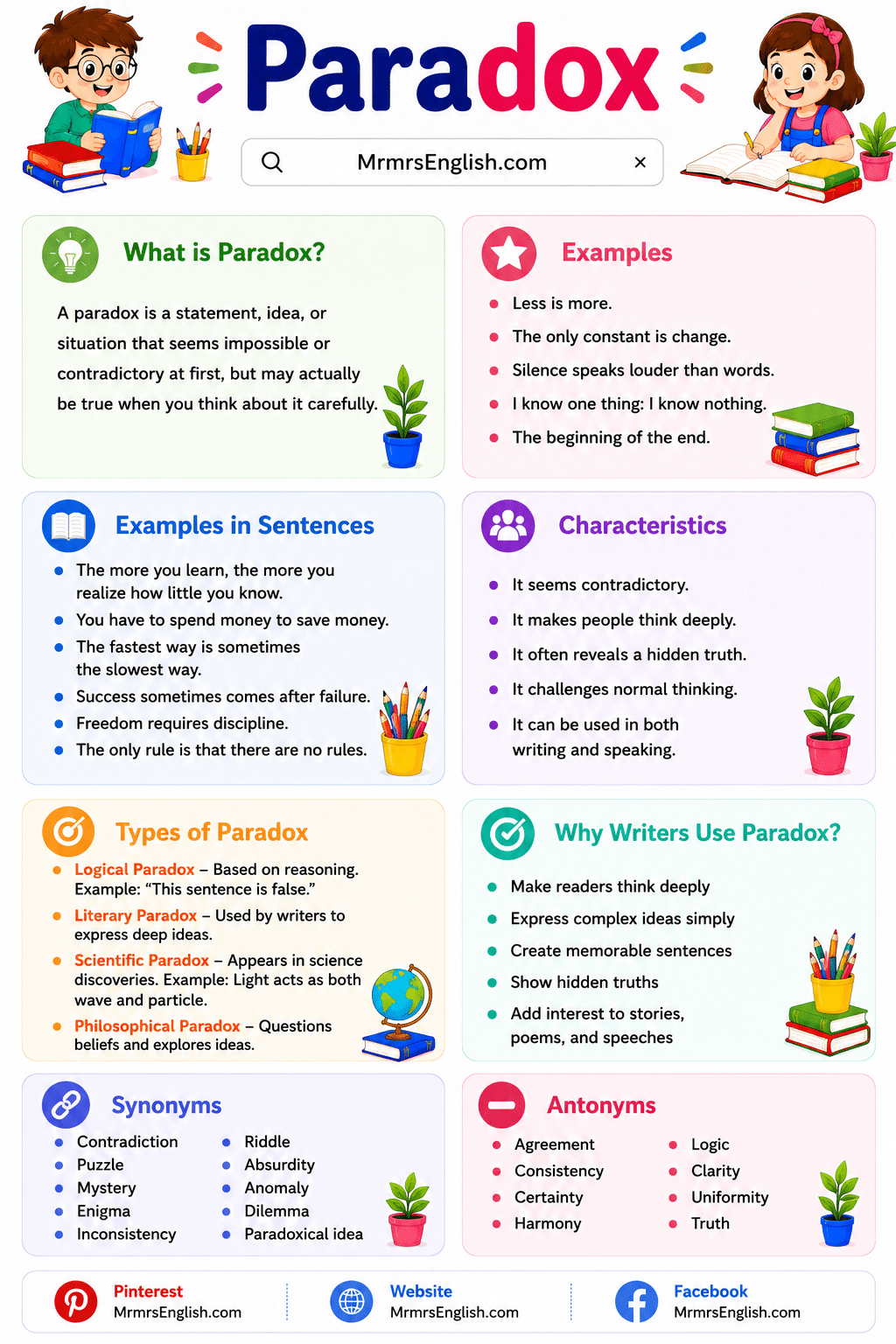
A paradox is a statement that appears to contradict itself but may contain a hidden truth or logical explanation. Although the words in the statement seem to disagree with each other, the overall idea often makes sense after careful thinking.
Pronunciation of Paradox
| Word | Pronunciation | Part of Speech |
|---|---|---|
| Paradox | PAIR-uh-doks (/ˈpær.ə.dɒks/) | Noun |
Simple Definitions of Paradox
| Level | Explanation |
|---|---|
| Beginner | A statement that seems impossible but may be true. |
| Elementary | An idea that looks contradictory but has meaning. |
| Intermediate | A sentence containing two opposite ideas that reveal a truth. |
| Advanced | A self-contradictory statement that appears false yet expresses a valid or logical reality. |
Origin of the Word “Paradox”
The word paradox comes from the Greek word paradoxon, which means “contrary to expectation” or “beyond belief.” It entered the English language many centuries ago and is now widely used in education, literature, philosophy, and science.
Characteristics of a Paradox
A paradox usually has these features:
- It seems contradictory.
- It makes people think deeply.
- It often reveals a hidden truth.
- It challenges normal thinking.
- It can be used in both writing and speaking.
Simple Examples of Paradox
Here are some easy examples that English learners can understand.
| Paradox | Why It Is a Paradox |
|---|---|
| Less is more. | Having less can sometimes produce better results. |
| The only constant is change. | Change itself never stops. |
| I know one thing: I know nothing. | Admitting ignorance shows wisdom. |
| The beginning of the end. | An ending can start with a beginning. |
| Silence speaks louder than words. | Silence can express stronger feelings than talking. |
What is Paradox in English with Examples
Paradox in Everyday Life
People often use paradoxes without realizing it.
Example 1
The more you learn, the more you realize how little you know.
This sounds contradictory, but gaining knowledge often makes people aware of how much remains to be learned.
Example 2
You have to spend money to save money.
Buying a quality product may reduce future expenses.
Example 3
The fastest way is sometimes the slowest way.
Rushing often causes mistakes that take more time to fix.
Examples of Paradox in Sentences
- Success sometimes comes after failure.
- He was painfully happy after hearing the emotional news.
- The only rule is that there are no rules.
- She became stronger because of her weaknesses.
- Freedom requires discipline.
- The closer we become, the less we truly know each other.
- Winning is not everything, but wanting to win is.
- The more choices we have, the harder it becomes to choose.
- He lost himself to find himself.
- The only certainty in life is uncertainty.
Types of Paradox
Logical Paradox
A logical paradox creates a contradiction based on reasoning.
Example:
“This sentence is false.”
If the sentence is true, then it must be false. If it is false, then it becomes true.
Literary Paradox
Writers use literary paradoxes to express deep ideas and make readers think.
Example:
“Deep down, you’re really shallow.”
This statement appears contradictory but communicates an interesting idea.
Scientific Paradox
Science sometimes presents observations that seem impossible until further research explains them.
Example:
Some particles in physics behave like both waves and particles.
Philosophical Paradox
Philosophers use paradoxes to question beliefs and explore difficult ideas.
Example:
Can an all-powerful person create something they cannot lift?
Difference Between Paradox and Oxymoron
| Paradox | Oxymoron |
|---|---|
| A complete statement or idea | Usually two opposite words together |
| May reveal a hidden truth | Creates a striking expression |
| Often longer | Usually very short |
| Example: Less is more. | Example: Bittersweet |
Difference Between Paradox and Contradiction
| Paradox | Contradiction |
|---|---|
| Appears false but may be true | Simply cannot both be true |
| Contains a deeper meaning | Contains direct conflict |
| Encourages thinking | Ends in disagreement |
Difference Between Paradox and Irony
| Paradox | Irony |
|---|---|
| Focuses on contradictory truth | Focuses on unexpected results |
| Often expresses wisdom | Often creates humor or surprise |
| Uses opposing ideas | Uses contrast between expectation and reality |
Why Writers Use Paradox
Authors use paradox to:
- Make readers think deeply
- Express complex ideas simply
- Create memorable sentences
- Show hidden truths
- Add interest to stories, poems, and speeches
Famous Examples of Paradox
| Example | Meaning |
|---|---|
| Less is more. | Simplicity can be better than excess. |
| The only constant is change. | Everything changes over time. |
| I can resist everything except temptation. | People often fail to resist temptation. |
| The beginning of the end. | An ending starts somewhere. |
| Nobody goes there anymore because it’s too crowded. | A humorous statement that reveals a surprising truth. |
Paradox in Literature
Many famous writers use paradox to make their writing more meaningful.
Examples include:
- “I must be cruel only to be kind.”
- “Fair is foul, and foul is fair.”
- “Death, thou shalt die.”
These statements sound impossible but express important ideas within their literary context.
Common Situations Where We Use Paradox
People use paradoxes when talking about:
- Education
- Life experiences
- Success
- Love
- Relationships
- Philosophy
- Science
- Literature
- Motivation
- Personal growth
Tips for Identifying a Paradox
You may have found a paradox if:
- The sentence sounds impossible.
- Two opposite ideas appear together.
- It makes you stop and think.
- It has a deeper meaning after reflection.
- The statement becomes understandable with context.
Common Mistakes Students Make
Many learners think every contradictory sentence is a paradox.
Remember:
- A paradox usually contains an important truth.
- A meaningless contradiction is not a paradox.
- A paradox is different from an oxymoron because it is usually a complete idea, not just two opposite words.
Practice Examples
Can you identify the paradox?
- The more we communicate, the less we understand each other.
- You must lose yourself to discover who you really are.
- The only certainty is uncertainty.
- Slow down to move faster.
- Sometimes silence is the loudest voice.
All of these are paradoxes because they combine opposite ideas to express meaningful truths.
Synonyms of Paradox in English
- Contradiction (in some contexts)
- Puzzle
- Mystery
- Enigma
- Inconsistency
- Riddle
- Absurdity (context-dependent)
- Anomaly
Antonyms of Paradox
- Agreement
- Consistency
- Certainty
- Harmony
- Logic
- Clarity
- Uniformity
Paradox Examples in English
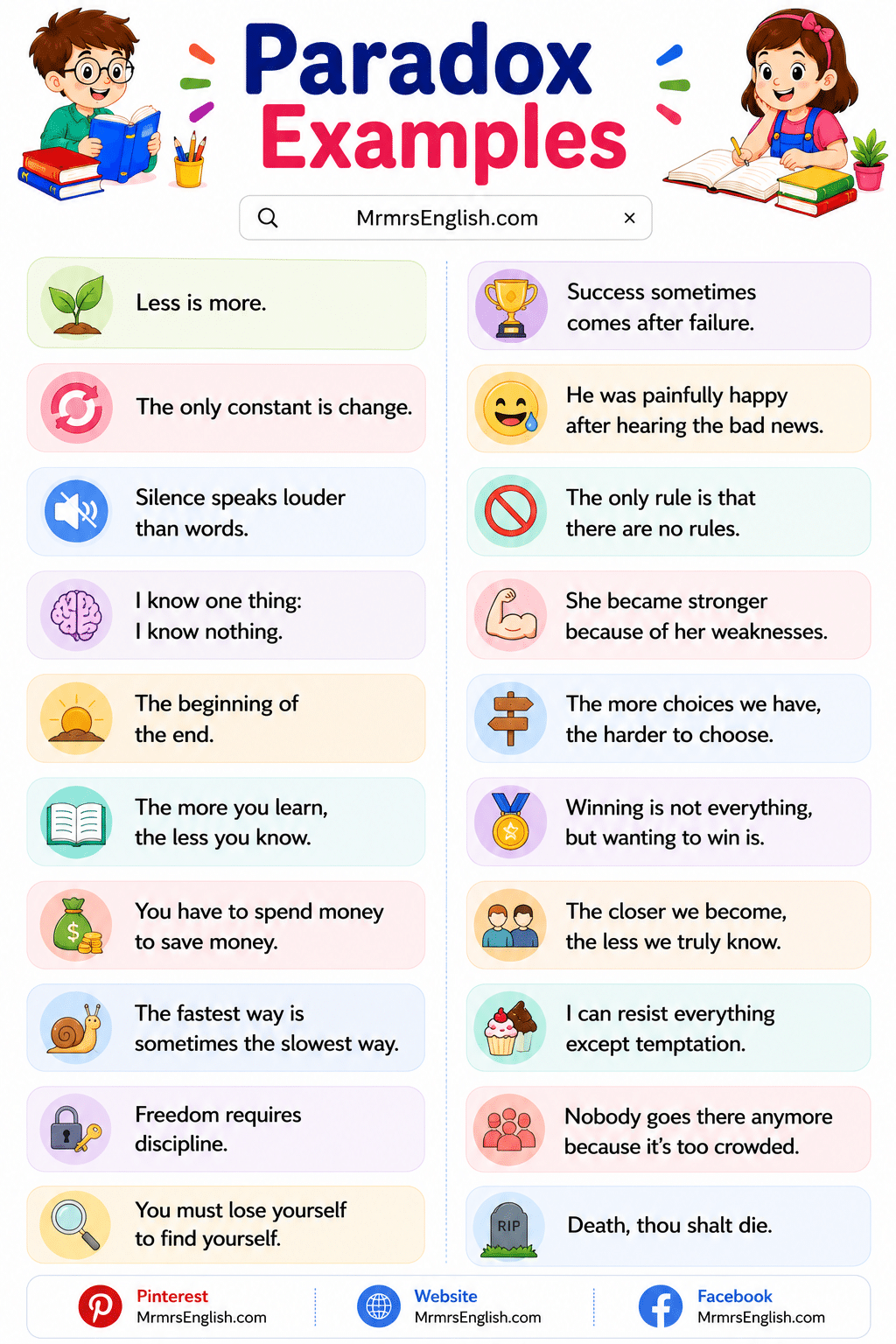
- Less is more.
- The only constant is change.
- I know one thing: I know nothing.
- This statement is false.
- You have to be cruel to be kind.
- The more you learn, the less you realize you know.
- Silence can be louder than words.
- The beginning of the end.
- The enemy of my enemy is my friend.
- The more choices you have, the harder it is to choose.
- You must lose yourself to find yourself.
- The fastest way to slow down is to hurry.
- Nobody goes there because it is too crowded.
- The only rule is that there are no rules.
- Freedom comes through discipline.
- The harder you try to sleep, the more awake you become.
- The only certainty in life is uncertainty.
- To lead, you must first learn to follow.
- Saving money can sometimes cost more.
- The closer you get, the farther it feels.
- You need to fail before you can truly succeed.
- The more connected we are online, the lonelier some people feel.
- A deafening silence filled the room.
- The best way to win is not to fight.
- The more you give, the more you receive.
- A wise fool can teach valuable lessons.
- The strongest people often ask for help.
- The end is just a new beginning.
- The more perfect something seems, the more flaws you may find.
- The more we control everything, the less control we actually have.
Paradox Examples in English

Leave a Comment