
Puns are a clever and entertaining form of wordplay that uses words with multiple meanings or similar sounds to create humor and make language more engaging. They are commonly found in jokes, advertisements, literature, and everyday conversations, adding creativity and wit to communication. Understanding puns can help English learners improve their vocabulary, language skills, and appreciation of humor. Whether simple or sophisticated, puns make expressions more memorable and enjoyable. In this article, you will learn what puns are, their meanings, and a variety of examples that will help you understand and use them effectively in English.
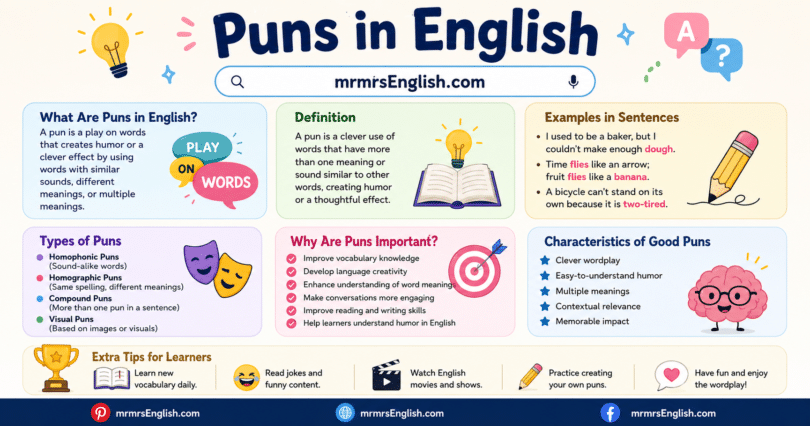
What Are Puns in English?
A pun is a play on words that creates humor or a clever effect by using words with similar sounds, different meanings, or multiple meanings.
Puns make language more interesting because they encourage readers or listeners to think about words in different ways.
Examples of Puns
- I used to be a baker, but I couldn’t make enough dough.
- Time flies like an arrow; fruit flies like a banana.
- A bicycle can’t stand on its own because it is two-tired.
In these examples, the humor comes from words that have more than one meaning or sound similar to other words.
Why Are Puns Important?
Puns play an important role in English communication and literature.
Benefits of Learning Puns
- Improve vocabulary knowledge
- Develop language creativity
- Enhance understanding of word meanings
- Make conversations more engaging
- Improve reading and writing skills
- Help learners understand humor in English
Many writers, speakers, comedians, and advertisers use puns to attract attention and make messages memorable.
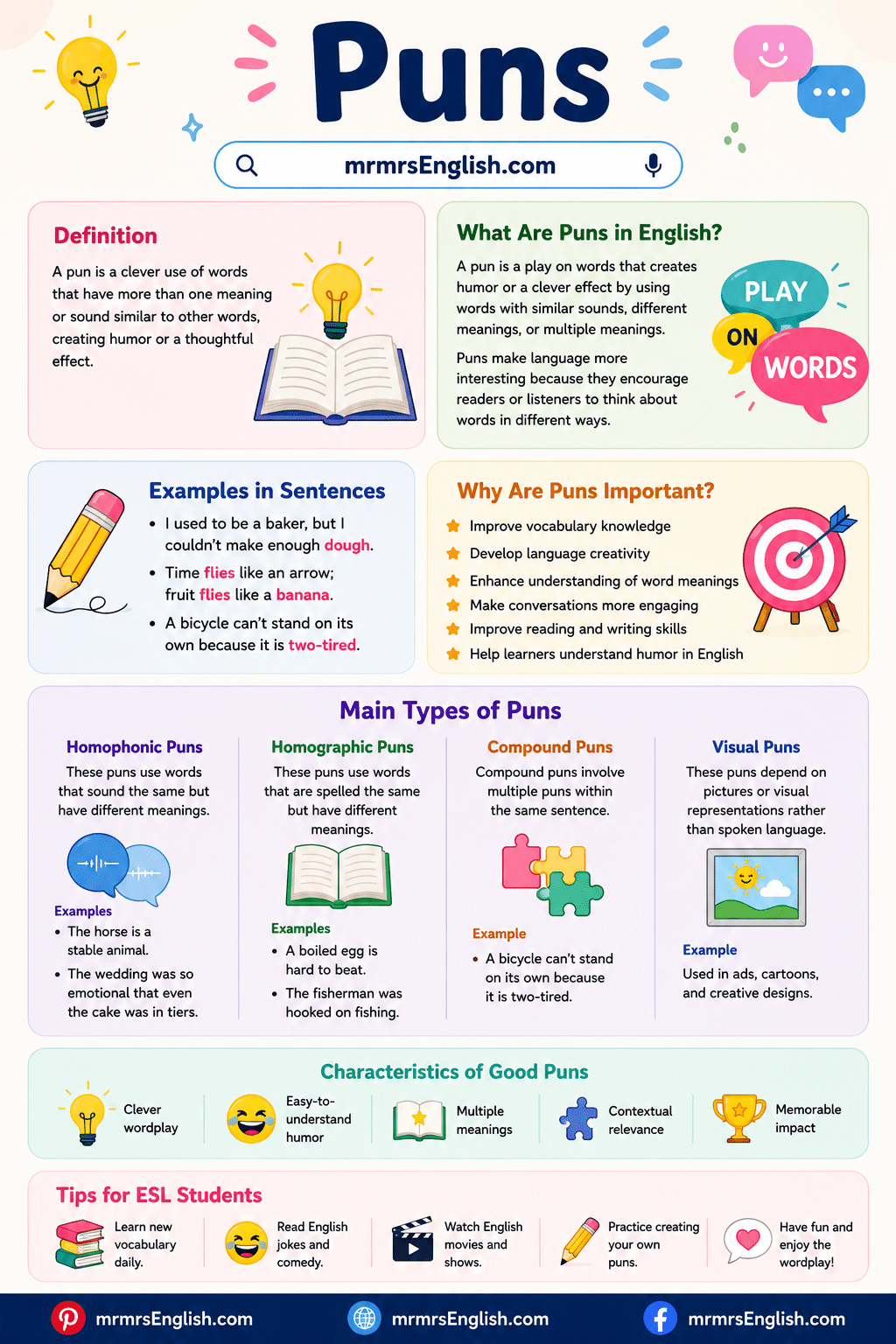
Main Types of Puns
English puns can be divided into several categories.
Homophonic Puns
These puns use words that sound the same but have different meanings.
Examples
- The horse is a stable animal.
- The wedding was so emotional that even the cake was in tiers.
Homographic Puns
These puns use words that are spelled the same but have different meanings.
Examples
- A boiled egg is hard to beat.
- The fisherman was hooked on fishing.
Compound Puns
Compound puns involve multiple puns within the same sentence.
Example
- A bicycle can’t stand on its own because it is two-tired.
Visual Puns
These puns depend on pictures or visual representations rather than spoken language.
They are commonly used in advertisements and cartoons.
Types of puns in English with meaning and Examples
Characteristics of Good Puns
A good pun usually has the following qualities:
- Clever wordplay
- Easy-to-understand humor
- Multiple meanings
- Contextual relevance
- Memorable impact
The best puns make readers smile while also appreciating the creativity behind the language.
Examples of Puns in English
Food Puns
| Pun | Meaning |
|---|---|
| I doughnut know. | Sounds like “I do not know.” |
| You’re bacon me crazy. | Uses “bacon” instead of “making.” |
| Lettuce celebrate. | Uses “lettuce” instead of “let us.” |
Animal Puns
| Pun | Meaning |
|---|---|
| Whale, hello there! | Whale sounds like “well.” |
| Bear with me. | Refers to a bear and patience. |
| Owl be seeing you. | Owl replaces “I’ll.” |
School Puns
| Pun | Meaning |
|---|---|
| Math teachers have too many problems. | Refers to math problems. |
| The pencil had a point. | Double meaning of point. |
| The book was full of stories. | Literal and figurative meaning. |
Puns in Literature
Many famous writers use puns to create humor and deeper meanings.
Shakespeare and Puns
William Shakespeare frequently used puns in his plays.
For example, characters often used wordplay to entertain audiences while also expressing important ideas.
Because of this, puns are considered an important literary device in English literature.
Puns in Advertising
Advertisers use puns to make products memorable.
Examples
- “Every kiss begins with Kay.”
- “We’re on the ball.”
These slogans are easy to remember because they use creative wordplay.
How to Create Your Own Puns
Creating puns becomes easier with practice.
Step 1: Find a Word with Multiple Meanings
Example:
- Light (brightness)
- Light (not heavy)
Step 2: Look for Similar-Sounding Words
Example:
- Flour and flower
- Sea and see
Step 3: Create a Funny Connection
Example:
- I wanted to become a florist, but it wasn’t my flower of expertise.
Common Mistakes When Using Puns
Using Unclear Wordplay
A pun should be understandable to the audience.
Overusing Puns
Too many puns can make writing confusing.
Ignoring Context
A pun should fit naturally into the conversation or text.
Tips for ESL Students
Learn Vocabulary Daily
The more words you know, the easier it becomes to understand puns.
Read English Jokes
Jokes often contain puns and wordplay.
Watch English Movies and Shows
Native speakers frequently use puns in conversations.
Practice Creating Your Own Puns
Try making simple puns using words you already know.
Difference Between Puns and Other Figures of Speech
| Figure of Speech | Purpose |
|---|---|
| Pun | Creates humor through wordplay |
| Irony | Shows contrast between expectation and reality |
| Metaphor | Compares two things directly |
| Simile | Compares using “like” or “as” |
| Hyperbole | Uses exaggeration |
Puns Example Sentences in English
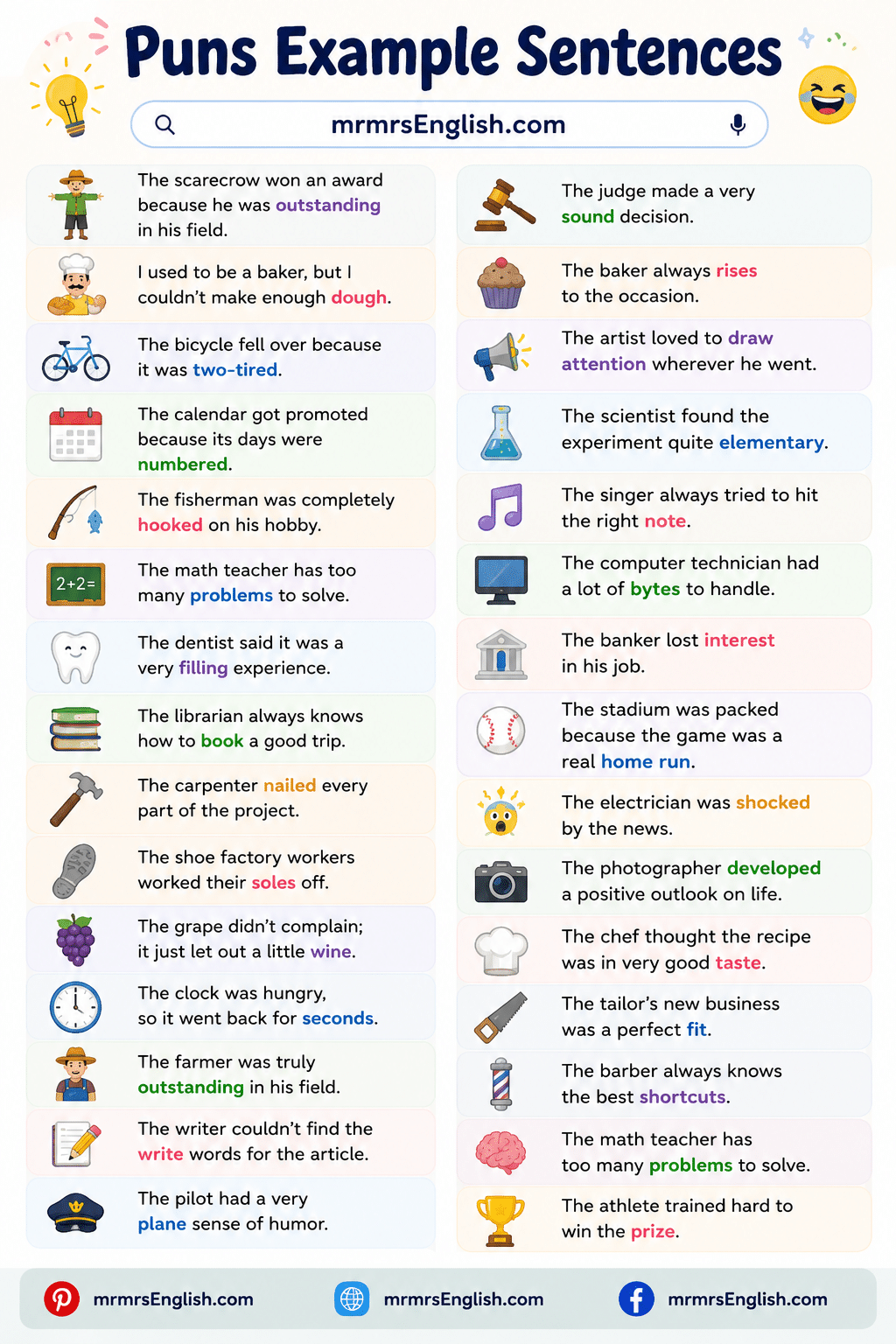
- The scarecrow won an award because he was outstanding in his field.
- I used to be a baker, but I couldn’t make enough dough.
- The bicycle fell over because it was two-tired.
- The calendar got promoted because its days were numbered.
- The fisherman was completely hooked on his hobby.
- The math teacher has too many problems to solve.
- The dentist said it was a very filling experience.
- The librarian always knows how to book a good trip.
- The gardener really knows how to grow a business.
- The musician got into treble after missing the concert.
- The electrician was shocked by the news.
- The photographer developed a positive outlook on life.
- The chef thought the recipe was in very good taste.
- The carpenter nailed every part of the project.
- The barber always knows the best shortcuts.
- The tailor’s new business was a perfect fit.
- The shoe factory workers worked their soles off.
- The grape didn’t complain; it just let out a little wine.
- The clock was hungry, so it went back for seconds.
- The farmer was truly outstanding in his field.
- The writer couldn’t find the write words for the article.
- The pilot had a very plane sense of humor.
- The judge made a very sound decision.
- The baker always rises to the occasion.
- The artist loved to draw attention wherever he went.
- The scientist found the experiment quite elementary.
- The singer always tried to hit the right note.
- The computer technician had a lot of bytes to handle.
- The banker lost interest in his job.
- The stadium was packed because the game was a real home run.
Puns Example Sentences in English
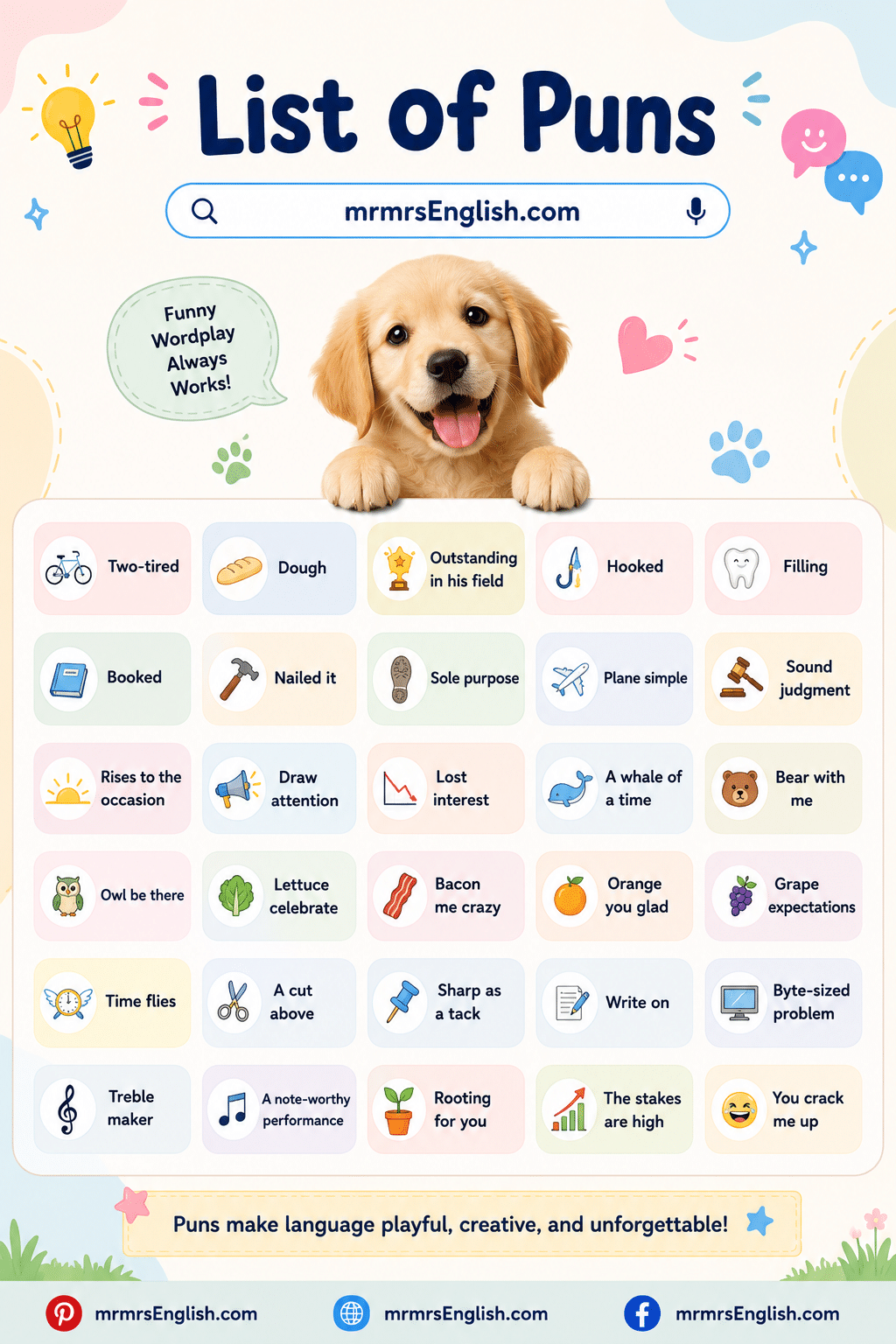
List of Puns in English
- Two-tired
- Dough
- Outstanding in his field
- Hooked
- Filling
- Booked
- Nailed it
- Sole purpose
- Plane simple
- Sound judgment
- Rises to the occasion
- Draw attention
- Lost interest
- A whale of a time
- Bear with me
- Owl be there
- Lettuce celebrate
- Bacon me crazy
- Orange you glad
- Grape expectations
- Time flies
- A cut above
- Sharp as a tack
- Write on
- Byte-sized problem
- Treble maker
- A note-worthy performance
- Rooting for you
- The stakes are high
- You crack me up
List of Puns in English
Learn more helpful articles

Leave a Comment