
Allusion is a common literary device that adds deeper meaning to writing by making a brief reference to a famous person, place, event, story, myth, or literary work. It appears in poetry, literature, speeches, conversations, and other forms of communication to connect an idea with something familiar to the reader. Learning the meaning of allusion in English is a useful way to improve reading comprehension and understand hidden references in different texts. In this article, you will learn allusion in English with simple meanings and example sentences, helping students, teachers, beginners, and English learners recognize, understand, and use allusions correctly and confidently.
What Is Allusion in English?
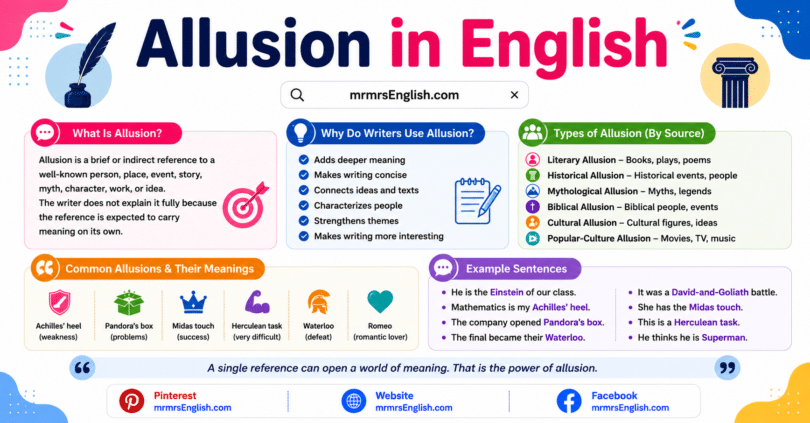
An allusion is a brief, usually indirect reference to a well-known person, place, event, story, character, literary work, myth, historical event, religious text, or cultural idea. The writer does not normally explain the full background because the reference is expected to carry meaning on its own.
For example: He is the Einstein of our class.
The sentence refers to Albert Einstein, who is widely associated with exceptional intelligence. The student is not literally Einstein. The reference suggests that he is unusually intelligent.
Another example is: Mathematics is her Achilles’ heel.
Achilles’ heel comes from Greek mythology. In modern English, it means a person’s weak or vulnerable point.
Pronunciation of Allusion
Allusion is pronounced: /əˈluː.ʒən/
It sounds approximately like: uh-LOO-zhuhn
The main stress falls on the second syllable. It is important not to confuse allusion with illusion. They sound similar, but they have different meanings.
How Does an Allusion Work?
Allusion depends on shared knowledge between the writer and the reader.
Consider this sentence:
The investigation opened a Pandora’s box of problems.
The writer does not retell the entire Greek myth of Pandora. Instead, the expression Pandora’s box brings a familiar association into the sentence.
In modern usage, opening Pandora’s box means starting something that leads to many unforeseen difficulties or problems.
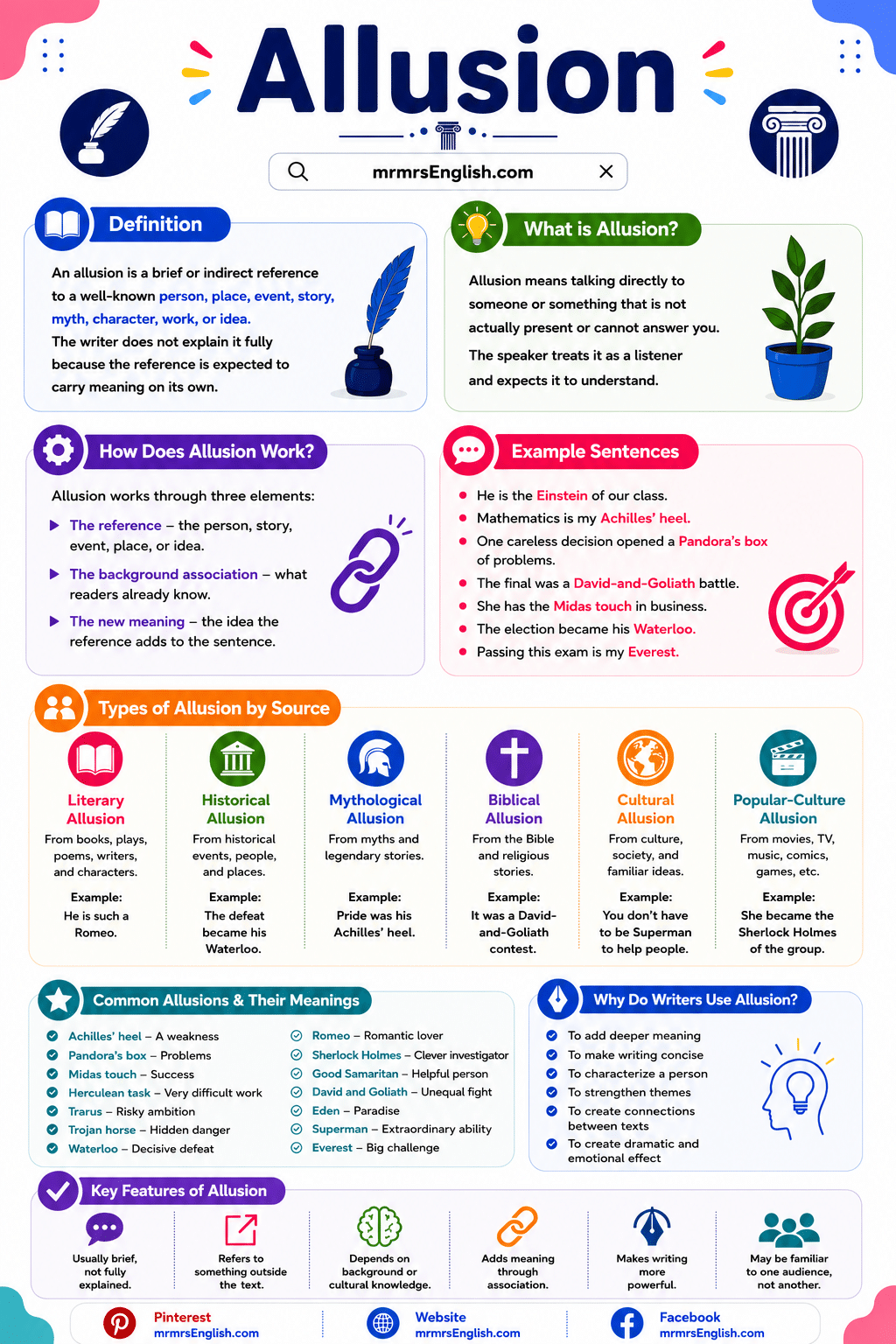
An allusion usually works through three elements:
- The reference — the person, story, event, place, character, or idea being mentioned.
- The background association — what readers already know about that source.
- The new meaning — the idea that the reference adds to the current sentence.
If readers do not know the source, they may understand the basic sentence but miss part of the intended meaning.
Main Characteristics of Allusion
Allusions have several features that help learners recognize them.
- They are usually brief rather than fully explained.
- They point to something outside the immediate text.
- They often depend on background or cultural knowledge.
- They may come from literature, history, mythology, religion, geography, politics, or popular culture.
- They add meaning through association.
- They can make writing more concise.
- Their exact meaning can change according to context.
- They may be obvious to one audience but unfamiliar to another.
For example: Winning this scholarship is my Everest.
The speaker is not literally talking about climbing Mount Everest. The mountain represents an extremely difficult challenge or major achievement.
Common Types of Allusion by Source
There is no single universal list of strict formal “types” of allusion. In education and literary analysis, allusions are often grouped according to the source of the reference.
| Type | Source | Example |
|---|---|---|
| Literary allusion | Books, plays, poems, writers, characters | He is such a Romeo. |
| Historical allusion | Historical people, events, places | The defeat became his Waterloo. |
| Mythological allusion | Myths and legendary figures | Pride was his Achilles’ heel. |
| Biblical allusion | Biblical people, events, stories | It was a David-and-Goliath battle. |
| Cultural allusion | Familiar cultural figures or ideas | He thinks he is Superman. |
| Popular-culture allusion | Film, television, music, comics, games | She became the Sherlock Holmes of the group. |
These categories are useful for teaching because they show where the reference comes from, but they should not be treated as rigid grammatical classifications.
Types of Allusion with Example
Literary Allusion
A literary allusion refers to a famous book, poem, play, writer, character, or other literary work.
For example: He is a real Romeo.
Romeo is a central character in William Shakespeare’s Romeo and Juliet. Calling someone a Romeo can suggest that he is romantic or behaves like a passionate lover.
Another example is: She became the Sherlock Holmes of the office.
Sherlock Holmes is the fictional detective created by Arthur Conan Doyle. The reference suggests that the person is observant, analytical, or skilled at solving problems.
Literary allusions are common in novels, poetry, drama, essays, speeches, and literary criticism.
Common Allusions and Their Meanings
The table below includes familiar allusive expressions and their common associations.
| Allusion | Source | Common meaning |
|---|---|---|
| Achilles’ heel | Greek mythology | A major weakness |
| Pandora’s box | Greek mythology | A source of unforeseen problems |
| Midas touch | Greek mythology | Ability to make things successful or profitable |
| Herculean task | Greek mythology | An extremely difficult task |
| Icarus | Greek mythology | Often associated with dangerous ambition or ignoring limits |
| Trojan horse | Greek mythology | Something dangerous hidden inside something apparently harmless |
| Waterloo | History | A decisive defeat |
| Romeo | Shakespeare | A romantic lover |
| Sherlock Holmes | Literature | A clever or observant investigator |
| Good Samaritan | Bible | A person who helps someone in need |
| David and Goliath | Bible | A weaker opponent facing a stronger one |
| Eden | Bible | Paradise or an ideal place |
| Superman | Popular culture | Someone with extraordinary ability or strength |
The meaning of an allusion should always be interpreted according to the context in which it appears.
Examples of Allusion in Sentences
Here are practical examples for ESL learners.
- Mathematics is my Achilles’ heel.
Achilles’ heel means a particular weakness. - One careless decision opened a Pandora’s box of problems.
The reference suggests many unforeseen difficulties. - The small company faced a David-and-Goliath battle.
The weaker side is competing against a more powerful one. - She seems to have the Midas touch in business.
The reference suggests repeated success or profitability. - The championship became the team’s Waterloo.
Waterloo represents a decisive defeat. - Ali is the Einstein of our class.
Einstein suggests exceptional intelligence. - Finishing the project overnight was a Herculean task.
Herculean suggests enormous difficulty or effort. - The detective became the Sherlock Holmes of the town.
The reference suggests strong investigative ability. - Passing this examination is my Everest.
Everest represents a major and difficult challenge. - A Good Samaritan helped the stranded family.
The expression refers to a helpful stranger. - The software update turned out to be a Trojan horse.
The reference suggests something harmful hidden inside something apparently useful or harmless. - His uncontrolled ambition made him an Icarus.
The reference may suggest excessive ambition, ignored warnings, or downfall.
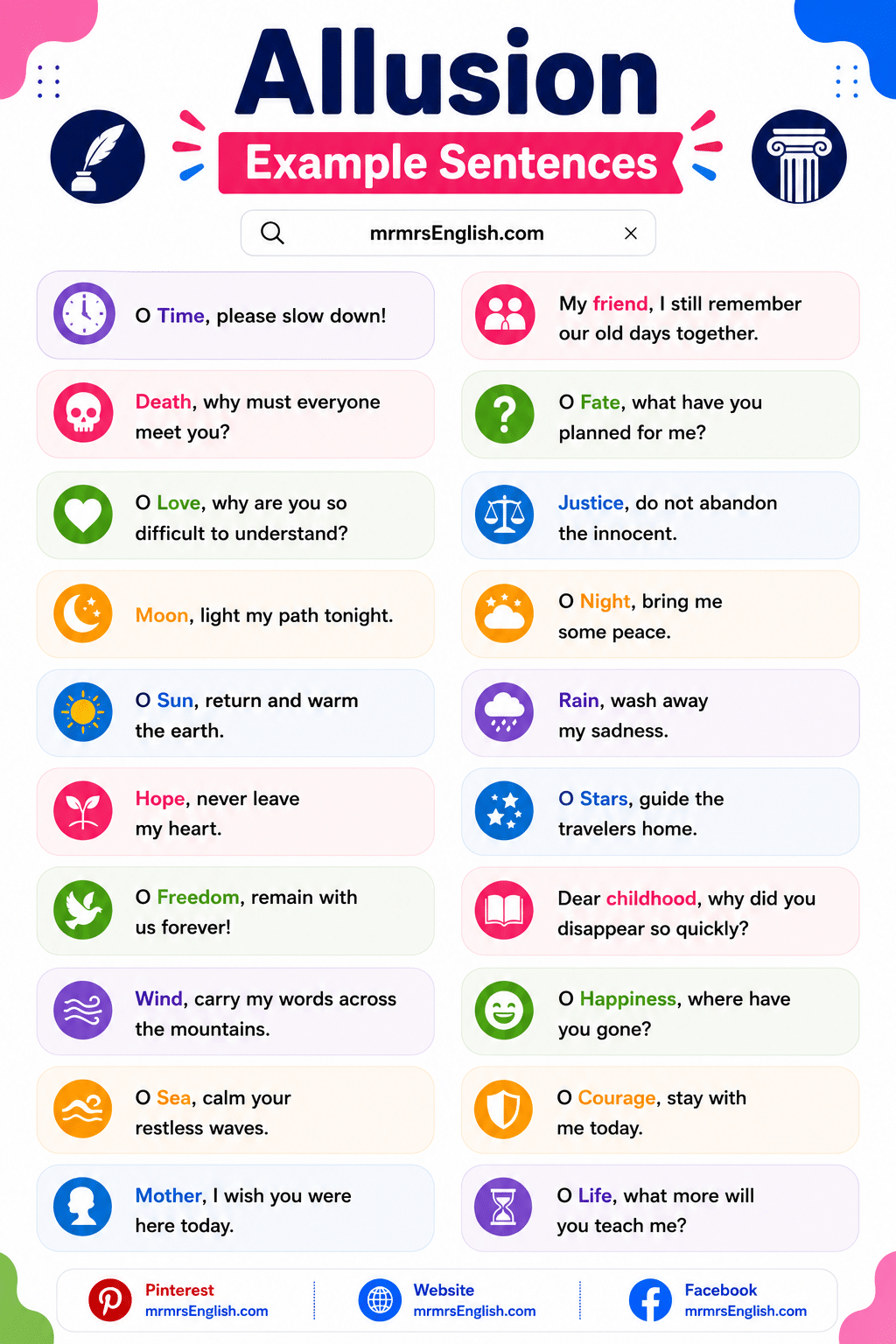
Allusion Example Sentences
What Is the Purpose of Allusion?
The purpose of allusion is to add meaning through a brief reference to a familiar person, event, story, myth, place, or literary work. Instead of explaining an idea at length, a writer can use a recognizable reference to communicate additional associations and strengthen the message.
For example: His ambition made him another Icarus. The reference to Icarus can suggest ambition, overconfidence, ignored warnings, risk, and eventual downfall. The intended meaning depends on how the reference relates to the surrounding context.
Allusion also makes writing more concise. In It was a David-and-Goliath contest, the reference immediately suggests a conflict between two sides with a significant difference in strength or power. Similarly, She is the Sherlock Holmes of our class uses a familiar literary character to suggest intelligence, observation, and analytical ability.
Writers also use allusions to reinforce themes such as ambition, love, courage, power, sacrifice, temptation, success, and failure. In literature, an allusion can connect a text with an earlier story, myth, historical event, or literary work, allowing the original source to contribute additional meaning to the new context.
How to Identify an Allusion
To identify an allusion, look for a reference to a recognizable person, character, event, story, place, myth, or work that contributes meaning beyond its literal use. The key is to determine whether knowledge of the original source helps explain the writer’s intended meaning.
For example: Winning the tournament will be our Everest. The sentence is not literally about Mount Everest. Instead, Everest is associated with extreme difficulty and achievement, so the reference presents winning the tournament as a major challenge.
When identifying an allusion, consider what is being referenced, which qualities or ideas are associated with that source, and how those associations relate to the current context. Simply recognizing a famous name is not enough; its function within the sentence determines whether it is being used allusively.
Direct Reference vs. Allusion
A direct reference discusses an actual person, event, place, or work, whereas an allusion uses that source to communicate meaning about another situation.
| Direct Reference | Allusion |
|---|---|
| Refers to the actual subject | Applies associations from the source to another context |
| Napoleon was defeated at Waterloo. | The election became his Waterloo. |
In the first sentence, Waterloo is part of a historical statement about Napoleon. In the second, Waterloo represents a decisive defeat in an entirely different situation. This use of association makes it an allusion.
Allusion vs. Illusion
Allusion and illusion are often confused because of their similar spelling and pronunciation, but their meanings are unrelated. An allusion is a reference to another source, while an illusion is a false or misleading appearance, impression, or perception.
| Word | Meaning | Example |
|---|---|---|
| Allusion | A reference to a recognizable source | The poem contains an allusion to Greek mythology. |
| Illusion | A false or misleading appearance or impression | The mirrors created an illusion of extra space. |
In short, allusion means reference, while illusion refers to something that appears different from reality.
Allusion vs. Metaphor
An allusion draws meaning from a recognizable person, event, story, character, or other source. A metaphor creates a direct comparison by describing one thing in terms of another.
For example, He is the Einstein of our class is allusive because its meaning depends on Einstein’s association with exceptional intellectual ability. In contrast, His mind is a computer is a metaphor because the mind is described in terms of a computer.
The two devices can overlap, but the main distinction is that allusion relies on an external reference, while metaphor relies on comparison.
Allusion vs. Simile
A simile explicitly compares two things, usually through words such as like or as. An allusion refers to a recognizable source and depends on the associations connected with it.
For example, He runs like the wind is a simile because it makes an explicit comparison. He thinks he is Superman is allusive because the meaning depends on the qualities associated with the fictional character Superman.
Both devices can appear together. In He fought like Hercules, like creates the simile, while the reference to Hercules is allusive because it draws on the mythological figure’s association with extraordinary strength.
Allusion vs. Analogy
An analogy develops a comparison to clarify or explain an idea, while an allusion generally communicates meaning through a shorter reference that depends on the reader’s knowledge of its source.
For example, This examination is my Everest is an allusion because Everest represents an exceptionally difficult challenge. By comparison, Learning a language is like building a house because both require a strong foundation is an analogy because the relationship between the two ideas is directly explained.
The essential difference is that an analogy develops the comparison, whereas an allusion relies primarily on association.
Allusion vs. Symbolism
Symbolism uses an object, image, character, or element to represent a broader idea, whereas allusion refers to an identifiable source outside the immediate context.
For example, a dove may symbolize peace because the dove represents an abstract idea. In He is the Romeo of our group, Romeo refers to a specific literary character, and the meaning depends on the associations readers have with that character.
Although symbolism and allusion can sometimes work together, symbolism is based on representation, while allusion is based on reference.
Can an Allusion Be Explicit?
An allusion can be explicit in the sense that the person, character, event, or work may be named directly. What makes the expression allusive is not whether the source is hidden, but whether the reference brings associations from that source into a new context.
For example: He is no Romeo. Romeo is directly named, yet the sentence relies on the reader’s knowledge of Shakespeare’s character to communicate its meaning. The reference therefore still functions as an allusion.
How Context Changes the Meaning of an Allusion
The meaning of an allusion depends on context because the same source can carry several associations. A reference to Icarus, for example, may emphasize ambition, overconfidence, ignored warnings, excessive risk, or downfall.
Readers should therefore consider which aspect of the original source is relevant to the passage. Identifying the source alone does not provide a complete interpretation; the connection between the reference and its current context determines its meaning.
How to Explain an Allusion in an Exam
When explaining an allusion in an exam or literary analysis, identify the source, explain the relevant association, and connect that association to the passage. This demonstrates both recognition of the reference and understanding of its function.
For example: The small company was preparing to face its Goliath.
“Goliath” alludes to the biblical story of David and Goliath. Goliath represents a much larger and more powerful opponent, so the reference emphasizes the significant imbalance between the small company and the competitor it is preparing to face.
A strong explanation focuses on the relevant association and its effect in the passage rather than retelling the entire original story.
How to Use Allusion Effectively in Writing
Allusion is most effective when it strengthens an idea and helps readers understand the writer’s message through a familiar reference. A carefully chosen allusion can add depth to a sentence without requiring a long explanation.
Choose a Familiar Reference
Select a reference that your intended readers are likely to recognize. References to famous people, historical events, myths, literature, religion, or popular culture can work well when they are familiar to the audience. If the source is too obscure, readers may miss the connection and become confused.
Keep the Reference Relevant
The qualities or ideas associated with the original source should match the situation being described. The connection should feel natural rather than forced.
For example: Ayesha is the Einstein of our science club.
This allusion is effective because Einstein is widely associated with intelligence, scientific knowledge, and achievement. The reference therefore suggests that Ayesha is exceptionally talented in science.
Think About Your Audience
Not every reader has the same background or knowledge. Before using an allusion, consider the age, culture, education, language background, religious knowledge, historical awareness, and familiarity with popular culture of your audience. Choosing references that suit your readers makes the intended meaning easier to understand.
Keep Creative Allusions Brief
In creative writing, an allusion usually has greater impact when it remains short and subtle. Explaining every detail of the original person, story, or event can weaken the effect of the reference. In educational writing, however, additional explanation may be appropriate because readers are learning how the allusion works.
Use Allusions in Moderation
Using too many allusions can make a passage difficult to understand, especially when readers are unfamiliar with the references. Include an allusion when it adds meaning, creates a useful comparison, or strengthens an idea. It should improve the writing rather than simply make it sound more complex.
Allusion in Formal and Informal English
Allusions are used in both formal writing and everyday communication. The main difference is usually the type of reference, its purpose, and how much background knowledge the audience is expected to have.
Allusion in Formal English
In essays, speeches, journalism, literary criticism, and other formal writing, an allusion can connect an idea to a significant historical event, literary work, myth, or well-known figure. Writers often use these references to give an argument or description greater depth without providing a lengthy explanation.
For example: The policy became the administration’s Waterloo.
Here, Waterloo refers to Napoleon’s final defeat at the Battle of Waterloo. In this context, the allusion suggests that the policy became a major or decisive failure for the administration.
Allusion in Informal English
Allusions are also common in ordinary conversations and informal writing. They often refer to familiar stories, fictional characters, myths, celebrities, or widely recognized cultural ideas.
For example:
- Don’t open that Pandora’s box.
- He thinks he’s Superman.
- That exam is my Everest.
These expressions communicate ideas quickly through familiar associations. Some allusions are used so frequently that people may understand their figurative meanings even when they do not know the complete story or origin behind them.
Advanced Interpretation of Allusion
Recognizing the original reference is only the first step in understanding an allusion. At a more advanced level, readers should examine why the writer selected that particular reference and what additional meaning it contributes to the passage.
When analyzing an allusion, consider:
- Why the writer chose that particular reference
- Which qualities or events from the original source are relevant
- Whether the reference carries positive or negative associations
- Whether it introduces irony or contrast
- How the original source relates to the new situation
- Whether the reference contains more than one possible layer of meaning
For example: His invention became his Frankenstein’s monster.
This expression alludes to Mary Shelley’s Frankenstein. In context, it can suggest that something a person created has produced harmful or unintended consequences and has become difficult for its creator to control.
A complete interpretation therefore goes beyond identifying the source. It explains how the original reference connects with the new context and what additional meaning that connection creates.

Leave a Comment