
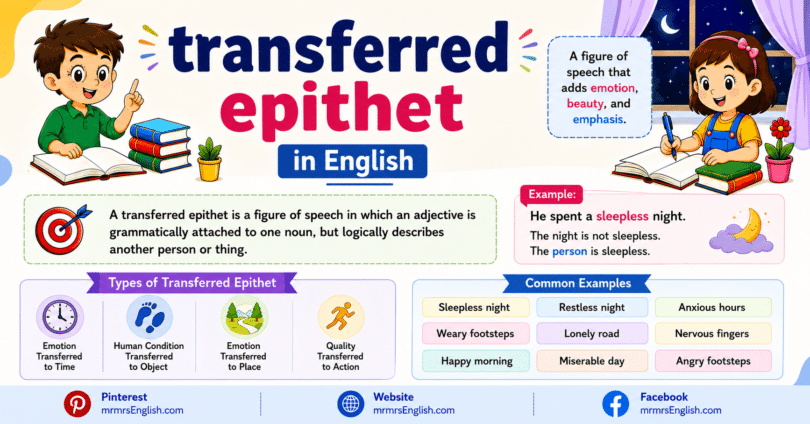
A transferred epithet is a figure of speech in which an adjective is grammatically attached to one noun, although it logically describes another person or thing. For example, in the phrase “a sleepless night,” the person is sleepless, not the night. This literary device adds emotion, imagination, and emphasis to ordinary expressions, making language more effective and interesting. It is commonly used in poetry, literature, speeches, and everyday English. In this article, you will learn what transferred epithet means, how it works, and its examples in English. This guide will help students and English learners understand and recognize transferred epithets easily.
What Is a Transferred Epithet in English?
A transferred epithet is a figure of speech in which an adjective or descriptive quality that logically belongs to one person or thing is transferred to another noun closely associated with it. In simple words, the adjective describes one noun grammatically, but its actual meaning belongs to someone or something else.
For example: He spent a sleepless night.
Here, sleepless grammatically describes night, but a night cannot sleep. It is actually the person who was unable to sleep.
Another example is: She walked along the lonely road.
The word lonely may express the loneliness of the person walking rather than a literal feeling experienced by the road.
Easy Meaning of Transferred Epithet
Transferred epithet simply means shifting a describing word from the person or thing it logically describes to another closely connected noun.
Consider: She had an anxious morning.
The morning itself was not anxious. She was anxious during the morning. The quality anxious has therefore been transferred from the person to morning.
This transfer makes an ordinary sentence more expressive.
Meaning of the Word Epithet
An epithet is a descriptive word or phrase used to express a quality or characteristic of someone or something.
For example:
- a brave soldier
- a beautiful flower
- a wise leader
In a transferred epithet, however, the descriptive word is shifted from the noun it logically describes to another associated noun.
Normal: The tired man walked slowly.
Transferred: The man walked with tired steps.
Logically, the man is tired, not the steps.
How Does a Transferred Epithet Work?
A transferred epithet usually involves three elements:
- A person or thing possessing a quality
- An adjective expressing that quality
- Another noun closely connected with that person or thing
The adjective is transferred to the associated noun.
Example: He spent a restless night.
The logical relationship is:
He was restless → He spent the night → Restless night
The adjective restless moves from the person to the period of time associated with his experience.
Common Structure of Transferred Epithet
Transferred epithets commonly follow this pattern:
Adjective + Noun
However, the adjective logically describes something else.
| Expression | Grammatical Description | Actual Meaning |
|---|---|---|
| Sleepless night | Night is sleepless | Person could not sleep |
| Anxious hours | Hours are anxious | Person felt anxious |
| Weary road | Road is weary | Traveler is weary |
| Happy morning | Morning is happy | Person feels happy |
| Angry storm | Storm is angry | Anger is figuratively associated with its violence |
Key Characteristics of Transferred Epithet
A transferred epithet can usually be recognized through these features:
- It normally contains an adjective and a noun.
- The adjective appears to describe one noun.
- Logically, the quality belongs to another person or thing.
- The two nouns are closely connected through an experience, action, place, or situation.
- It makes descriptions more vivid and compact.
- It often communicates the mood or emotional state of a character.
- It is especially common in poetry and literary prose.
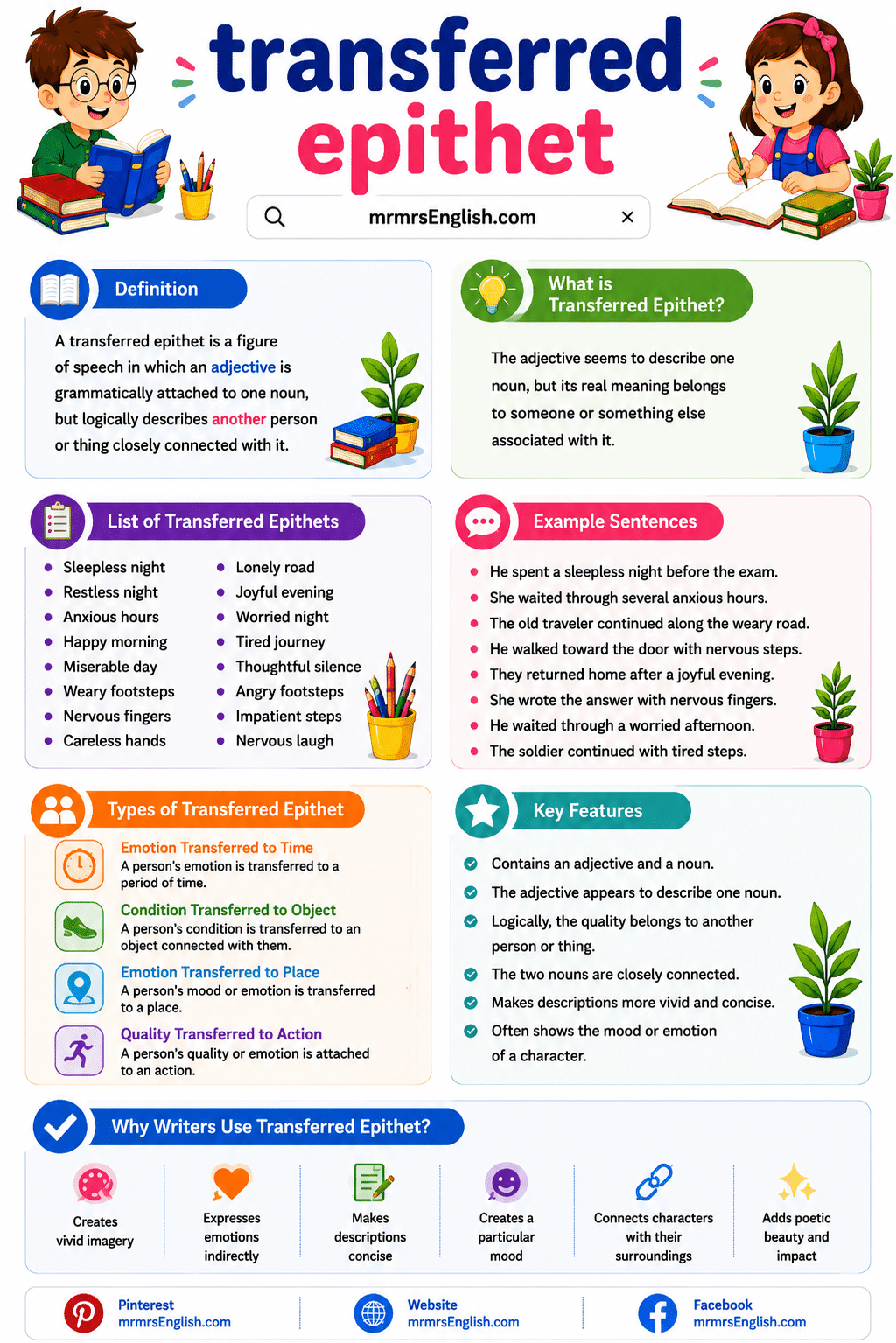
Types of Transferred Epithet in English
It can be grouped according to the relationship between the quality and the noun receiving it.
1. Emotion Transferred to Time
A person’s emotion or condition is transferred to a period of time such as a night, day, morning, or hour. This allows writers to communicate both the time and the emotional experience in a short expression, making descriptions more natural and expressive.
Examples:
- A sleepless night
- An anxious morning
- A miserable day
- Several worried hours
2. Human Condition Transferred to an Object
A person’s physical or emotional condition may be transferred to an object connected with the person’s action. The object does not literally experience the condition, but the transferred adjective helps readers imagine how the person performs the action or experiences the situation.
Examples:
- Weary footsteps
- Nervous fingers
- A careless pen
- Trembling words
3. Emotion Transferred to a Place
A writer may transfer a person’s mood or emotional state to a place or surrounding environment. The place itself does not experience human feelings, but describing it this way allows the setting to reflect the character’s emotional experience and creates stronger atmosphere.
Examples:
- A lonely road
- A cheerful room
- A sad home
- A gloomy street
4. Quality Transferred to an Action
Sometimes a person’s quality or emotional condition is attached to an action, movement, or result of that action. This form makes descriptions more compact because the adjective indirectly tells readers how the person feels while performing the action.
Examples:
- Angry footsteps
- A nervous laugh
- A careless walk
- A joyful dance
Types of Transferred Epithet in English
Common Examples of Transferred Epithet
Here are some commonly used expressions that help explain the concept:
- Sleepless night
- Restless night
- Anxious hours
- Happy morning
- Miserable day
- Weary footsteps
- Nervous fingers
- Careless hands
- Angry footsteps
- Lonely road
- Joyful evening
- Worried night
- Tired journey
- Thoughtful silence
- Impatient steps
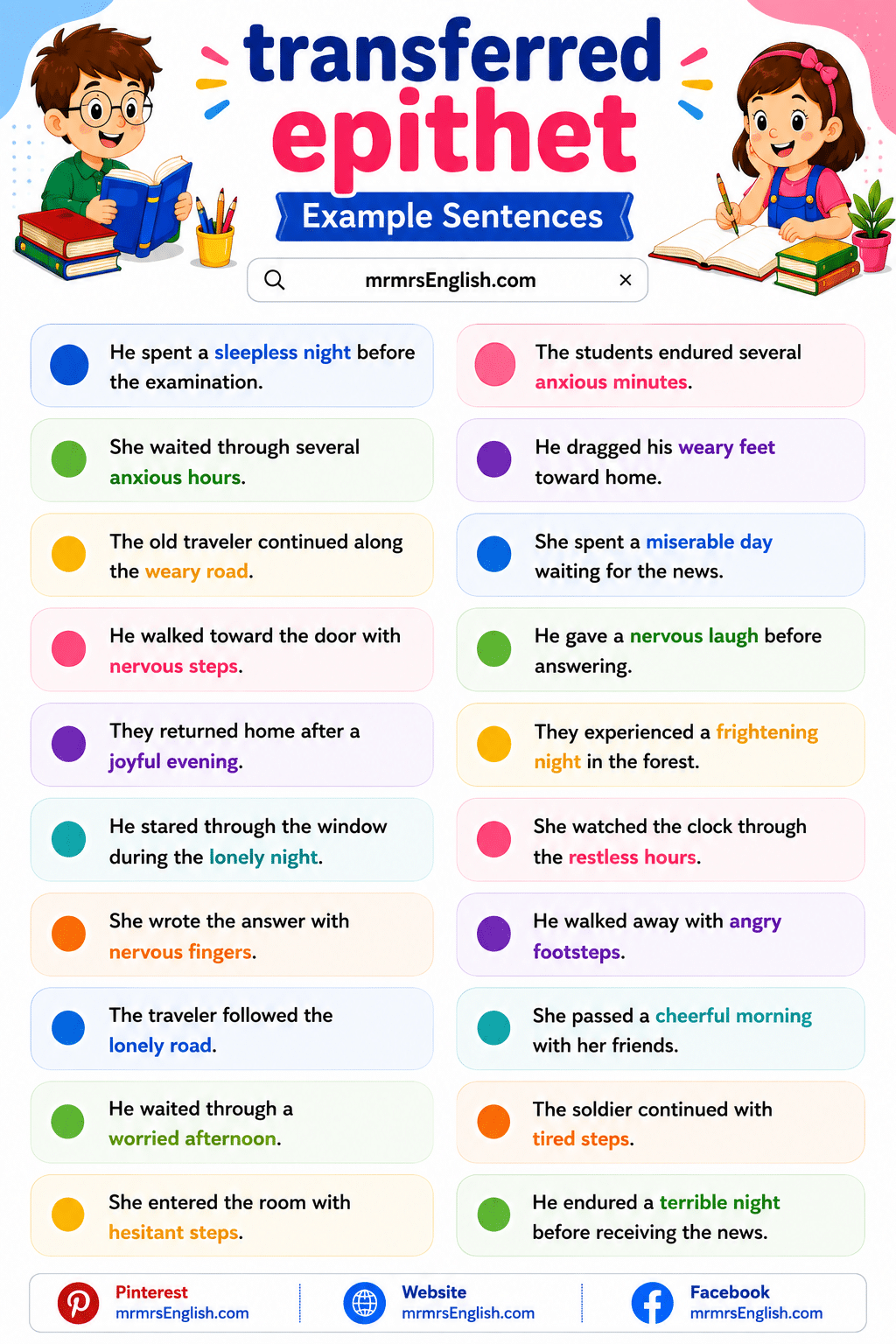
Transferred Epithet Examples in Sentences
- He spent a sleepless night before the examination.
- She waited through several anxious hours.
- The old traveler continued along the weary road.
- He walked toward the door with nervous steps.
- She passed a restless night thinking about the result.
- They returned home after a joyful evening.
- He stared through the window during the lonely night.
- She wrote the answer with nervous fingers.
- The traveler followed the lonely road toward the village.
- He waited through a worried afternoon.
- She entered the room with hesitant steps.
- The students endured several anxious minutes.
- He dragged his weary feet toward home.
- She spent a miserable day waiting for the news.
- He gave a nervous laugh before answering.
- They experienced a frightening night in the forest.
- She watched the clock through the restless hours.
- He walked away with angry footsteps.
- She passed a cheerful morning with her friends.
- The soldier continued with tired steps.
- He spent a thoughtful evening alone.
- She waited through a painful afternoon.
- The child approached with fearful steps.
- He returned after a busy day at work.
- She sat through several uneasy hours.
- They continued their tired journey toward home.
- He walked down the silent street with a heavy heart.
- She faced another uncertain morning.
- The traveler continued along the sleepy road.
- He endured a terrible night before receiving the news.
Transferred Epithet Examples in Sentences
Transferred Epithet Examples with Explanation
| Sentence | Transferred Epithet | Explanation |
|---|---|---|
| He spent a sleepless night. | Sleepless night | The man was sleepless, not the night. |
| She waited through anxious hours. | Anxious hours | She was anxious, not the hours. |
| He walked with tired steps. | Tired steps | The person was tired. |
| She gave a nervous laugh. | Nervous laugh | The person giving the laugh was nervous. |
| He passed a miserable day. | Miserable day | The person felt miserable during the day. |
Transferred Epithet in Literature
Transferred epithet is widely used in literature because it allows writers to communicate emotions through surrounding objects, places, actions, and periods of time. Instead of directly saying that a character is tired, worried, or lonely, an author can transfer that quality to something connected with the character.
For example: He walked along the weary road.
The road may not literally be weary. The expression can reflect the exhaustion of the traveler and make the entire scene feel tiring.
This technique makes literary descriptions more vivid and emotionally engaging.
Transferred Epithet in Poetry
Poets frequently use transferred epithets because poetry depends heavily on imagery, emotion, and compact expression. A single adjective attached to an unexpected noun can communicate both a physical scene and a character’s emotional state.
For example:
She waited through the anxious night.
Instead of separately explaining that the woman was anxious throughout the night, the adjective anxious transfers her emotion to night.
This creates a more poetic expression.
Transferred Epithet in Everyday English
Transferred epithets are also found in everyday English, although speakers may not recognize them as figures of speech. Expressions such as sleepless night, busy day, and restless evening can transfer a person’s experience or condition to a period of time.
For example: I had a sleepless night.
The speaker means that they could not sleep during the night, not that the night itself was unable to sleep.
Why Do Writers Use Transferred Epithet?
Writers use transferred epithets for several reasons:
- To create vivid imagery
- To express emotions indirectly
- To make descriptions more concise
- To create a particular mood
- To add poetic beauty
- To connect characters with their surroundings
- To make ordinary expressions more memorable
- To strengthen emotional impact
Instead of writing several words to explain a character’s state, a writer can sometimes communicate the same idea through one carefully placed adjective.
How to Identify a Transferred Epithet
A simple method can help students recognize transferred epithets.
Step 1: Find the adjective
Look for the describing word.
Sleepless night
The adjective is sleepless.
Step 2: Find the noun it modifies
The adjective grammatically modifies night.
Step 3: Ask whether the noun can logically possess that quality
Can a night actually sleep?
No.
Step 4: Find the real possessor of the quality
The person experiencing the night is sleepless.
Therefore, sleepless night contains a transferred epithet.
Transferred Epithet vs Personification
Transferred epithet and personification can look similar because both may attach human qualities to non-human things. However, they work differently.
| Transferred Epithet | Personification |
|---|---|
| Transfers a quality from its logical possessor | Gives human qualities to a non-human thing |
| The real possessor can often be identified | The object is deliberately imagined as human |
| He spent a sleepless night. | The wind whispered to us. |
| The person is actually sleepless | The wind is imagined as performing a human action |
The key difference is that a transferred epithet shifts an existing quality, while personification gives a human characteristic to something non-human.
Transferred Epithet vs Epithet
An epithet directly describes the person or thing possessing a quality, whereas a transferred epithet shifts that quality to another related noun.
| Epithet | Transferred Epithet |
|---|---|
| A tired traveler | A tired journey |
| An anxious student | An anxious morning |
| A restless man | A restless night |
| A nervous person | Nervous footsteps |
In the first column, the adjectives directly describe their nouns. In the second, their meanings can logically refer to someone associated with those nouns.
Transferred Epithet vs Metaphor
A metaphor creates an implied comparison between two unlike things, while a transferred epithet shifts a descriptive quality from one noun to another associated noun.
Metaphor:
Life is a journey.
Life is compared with a journey.
Transferred Epithet:
He spent a sleepless night.
The adjective sleepless is transferred from the person to the night.
Transferred Epithet vs Hypallage
The terms transferred epithet and hypallage are closely related and are sometimes used interchangeably. Hypallage is the broader rhetorical term for an unusual rearrangement in which a word is grammatically connected with something other than the element it logically describes.
A transferred epithet is commonly treated as a form of hypallage involving the transfer of an adjective or descriptive quality.
For ESL learners, transferred epithet is usually the easier term to recognize and explain in examinations.
Importance of Transferred Epithet in English
Understanding transferred epithet helps students see how English writers move beyond strictly literal descriptions. It demonstrates how an adjective can communicate mood, emotion, atmosphere, and character at the same time.
It is particularly useful for students studying:
- English literature
- Poetry
- Figures of speech
- Creative writing
- Literary analysis
- Reading comprehension
Recognizing this device can also help students explain why a particular literary sentence sounds more expressive than an ordinary statement.
Common Mistakes to Avoid
One common mistake is treating every adjective + noun combination as a transferred epithet. An ordinary adjective is not transferred when the quality naturally belongs to its noun.
For example: A red flower
This is not a transferred epithet because the flower can actually be red.
However: A sleepless night
This can function as a transferred epithet because sleepless logically describes the person experiencing the night.
Students should therefore focus on where the quality logically belongs, rather than simply looking for an adjective.
Practice Exercise
1. Which expression contains a transferred epithet?
A. A red flower
B. A sleepless night
C. A tall building
Answer: B. A sleepless night
2. Who is actually sleepless in “a sleepless night”?
A. The night
B. The person
C. The clock
Answer: B. The person
3. Which sentence uses a transferred epithet?
A. The tired man went home.
B. He walked home with tired steps.
C. The man opened the door.
Answer: B
4. What is transferred in a transferred epithet?
A. A descriptive quality
B. A complete sentence
C. A verb tense
Answer: A. A descriptive quality
5. Which expression directly describes its noun and is therefore not a transferred epithet?
A. A sleepless night
B. An anxious hour
C. A blue shirt
Answer: C. A blue shirt
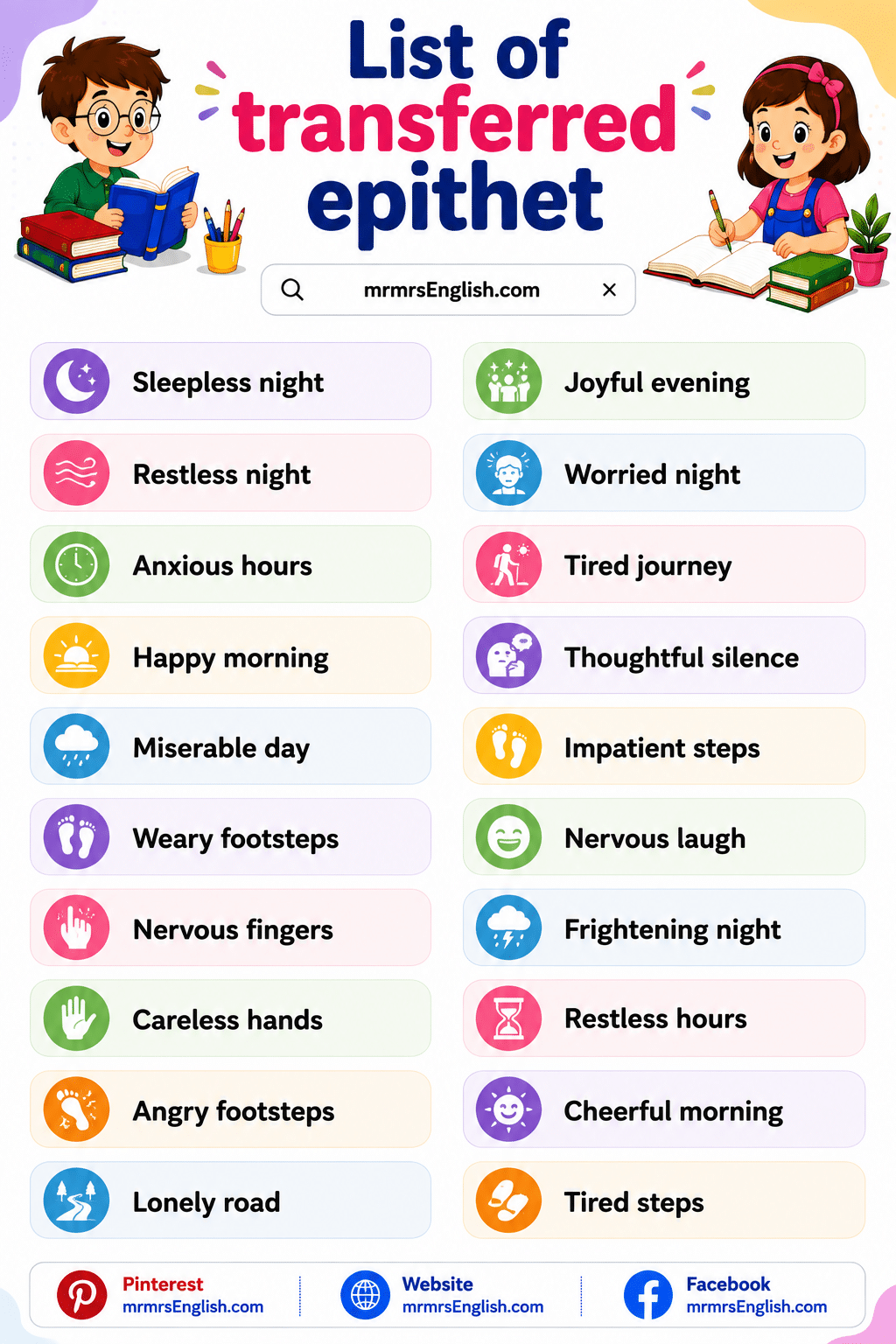
Examples of Transferred Epithet
- sleepless night
- anxious hours
- weary road
- nervous steps
- restless night
- joyful evening
- lonely night
- nervous fingers
- lonely road
- worried afternoon
- hesitant steps
- anxious minutes
- weary feet
- miserable day
- nervous laugh
- frightening night
- restless hours
- angry footsteps
- cheerful morning
- tired steps
- thoughtful evening
- painful afternoon
- fearful steps
- busy day
- uneasy hours
- tired journey
- silent street
- uncertain morning
- sleepy road
- terrible night
Examples of Transferred Epithet
Learn more helpful articles




Leave a Comment