
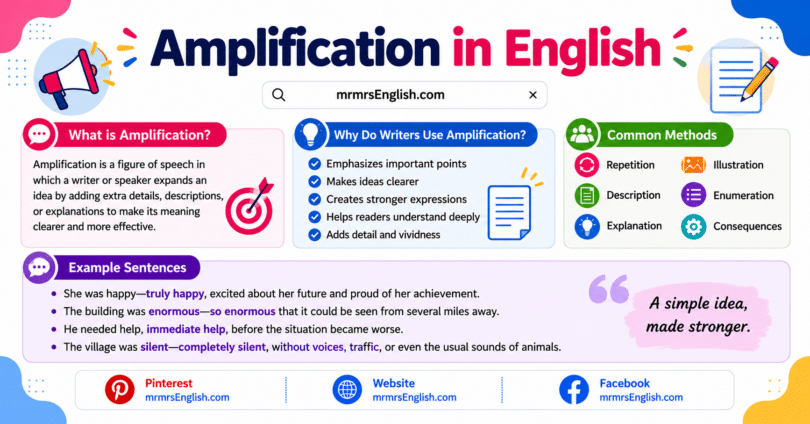
Amplification is a figure of speech used to expand an idea by adding extra details, descriptions, or explanations to make its meaning clearer and more effective. Writers and speakers use this technique to emphasize important points, create stronger expressions, and help readers understand an idea more deeply. Learning the meaning of amplification in English is useful for improving literary understanding, reading, and writing skills. It is commonly found in literature, speeches, poetry, and everyday communication. In this article, you will learn amplification as a figure of speech, its simple meaning, main purpose, and easy examples, helping learners recognize and use it correctly.
What Is Amplification in English?
Amplification is a figure of speech in which a writer or speaker repeats, restates, or develops an important idea by adding further details to emphasize it, explain it more clearly, or increase its effect.
The word amplification basically means making something greater or more extensive. In English writing, it means taking a simple idea and expanding it so that the reader understands its importance more clearly.
Simple Examples of Amplification
Here are some easy examples for ESL learners:
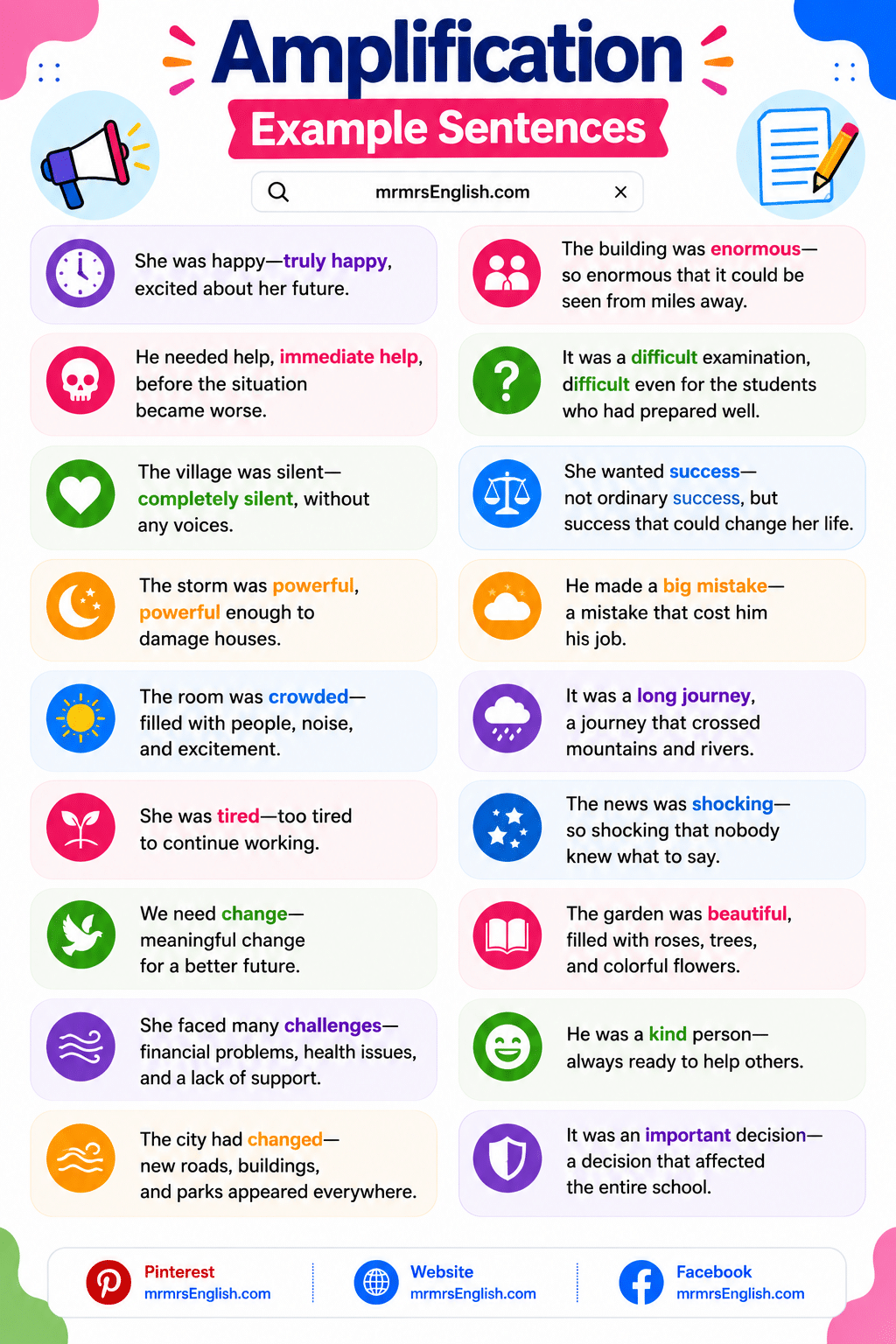
- She was happy—truly happy, excited about her future and proud of her achievement.
- The building was enormous—so enormous that it could be seen from several miles away.
- He needed help, immediate help, before the situation became worse.
- It was a difficult examination, difficult even for the students who had prepared well.
- The village was silent—completely silent, without voices, traffic, or even the usual sounds of animals.
- She wanted success—not ordinary success, but success that could completely change her life.
- The storm was powerful, powerful enough to damage houses and uproot large trees.
In these examples, the original idea is not merely repeated. It is expanded with meaningful information.
How Does Amplification Work?
Amplification works by taking a central idea and developing its meaning, significance, or rhetorical force through relevant additional detail. Rather than introducing a completely new point, the writer remains focused on the original thought and expands it through explanation, description, enumeration, consequences, comparison, or carefully controlled repetition.
The technique is effective because it moves from a general statement toward greater specificity. For instance, “The market was crowded” gives only a broad impression, whereas describing the shoppers, vendors, packed stalls, and congested streets develops the same idea into a fuller picture. Each additional detail contributes to the original statement rather than changing its subject.
Amplification has no single fixed grammatical structure. It may appear within one sentence or develop across an entire paragraph. What defines it is not sentence length or repetition, but purposeful expansion: the added material must clarify, strengthen, illustrate, or intensify the central idea.
Main Features of Amplification
Amplification has some important characteristics that make it easier to recognize.
| Feature | Explanation | Example |
|---|---|---|
| Expansion | The original idea receives additional information. | The task was hard—hard enough to require several days. |
| Emphasis | An important point receives greater attention. | We need action—immediate and effective action. |
| Repetition | A key word or idea may be repeated. | It was cold, terribly cold. |
| Explanation | Extra information clarifies the original statement. | He was exhausted—too tired even to speak. |
| Description | Details create a clearer mental picture. | The garden was beautiful, filled with roses, lilies, and colorful flowers. |
| Emotional Effect | Added details can increase emotional impact. | She lost everything—her home, savings, belongings, and livelihood. |
Types of Amplification in English
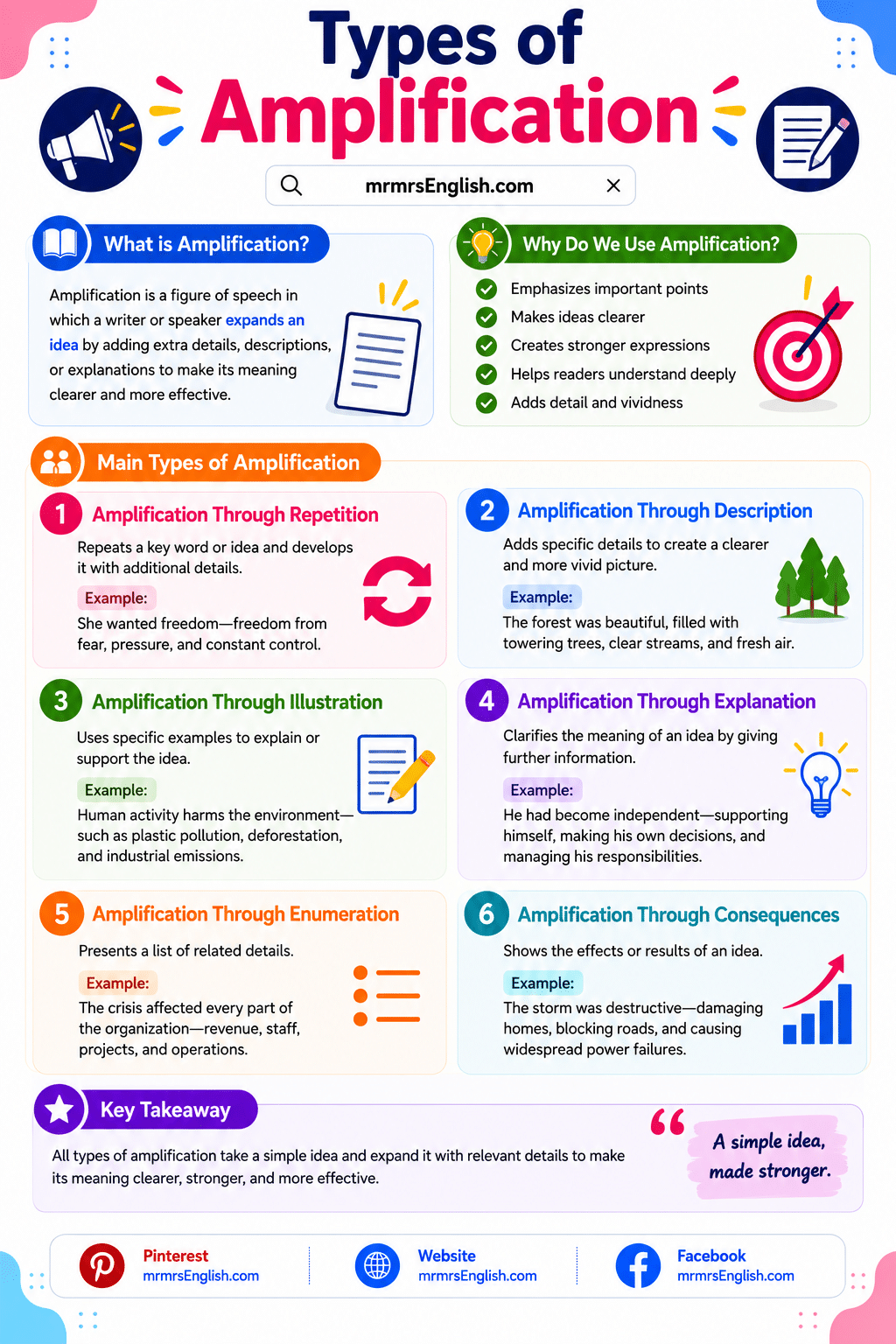
Amplification can be achieved through several rhetorical methods, depending on what aspect of an idea the writer wants to strengthen. Some forms emphasize a key expression through repetition, while others develop an idea through description, explanation, illustration, enumeration, or consequences. These forms are not rigid categories and often overlap within the same sentence or passage. What connects them is their common purpose: each method takes an existing idea and gives it greater clarity, scope, intensity, or significance.
Amplification Through Repetition
Repetition becomes a form of amplification when a significant word or phrase is repeated and then developed beyond its original meaning. The repetition draws attention to the central idea, while the material that follows gives that idea additional substance. In “She wanted freedom—freedom from fear, pressure, and constant control,” the repeated word freedom establishes emphasis, but the phrases that follow are what actually amplify the idea by defining the kind of freedom being sought.
This distinction is important because repetition alone does not necessarily constitute amplification. Simply repeating the same expression may create emphasis or rhythm, but amplification requires some form of meaningful development.
Amplification Through Description
Descriptive amplification develops a general statement by adding specific sensory, physical, or contextual details. It is particularly common in literary and descriptive prose, where a broad adjective or observation may not communicate enough information on its own.
A writer describing a forest as beautiful, for instance, may develop that impression through its towering trees, dense vegetation, flowing streams, changing light, and surrounding sounds. These details do more than decorate the sentence; they establish the particular qualities that justify the original description. Effective descriptive amplification therefore replaces vagueness with precision and gives the reader a fuller perception of the subject.
Amplification Through Illustration
An abstract or general claim can be amplified through specific instances that reveal its practical meaning or range. This method is especially useful in argumentative and expository writing because broad statements often become more convincing when they are supported by recognizable cases.
A claim that human activity can damage the environment gains greater substance when it is developed through plastic pollution, deforestation, industrial emissions, habitat destruction, and water contamination. The individual instances collectively establish the scope of the broader claim without shifting attention away from it.
Amplification Through Explanation
Explanatory amplification develops an idea by clarifying what it means, why it is true, or what it involves. Rather than simply asserting a quality or judgment, the writer supplies enough information for the reader to understand the reasoning behind it.
The statement “He had become completely independent” can be amplified by explaining that he supported himself financially, made his own decisions, managed his responsibilities, and dealt with problems without relying on others. The additional information gives precise meaning to the otherwise broad concept of independence. This form of amplification is particularly valuable in analytical and academic prose, where important claims require development rather than assertion alone.
Amplification Through Enumeration
Enumeration amplifies an idea by presenting a sequence of related details, qualities, objects, or circumstances. The cumulative effect of these elements demonstrates the scale or complexity of the original point.
A statement such as “The crisis affected every part of the organization” may be developed through declining revenue, staff reductions, cancelled projects, disrupted operations, and loss of customer confidence. Each item contributes another dimension to the original statement, allowing the reader to understand the extent of the crisis. Enumeration is especially effective when the listed elements follow a logical order rather than appearing as an unrelated collection.
Amplification Through Consequences
Consequential amplification develops an event, action, or condition by tracing the effects that follow from it. Instead of merely describing something as serious, destructive, beneficial, or influential, the writer demonstrates that judgment through its results.
Calling a storm destructive, for example, becomes considerably more meaningful when the statement is developed through damaged homes, blocked roads, uprooted trees, disrupted transport, and widespread power failures. The consequences provide substance to the original description and establish the scale of its impact. This method is particularly effective in persuasive writing because consequences help explain why an issue deserves attention.
Amplification Through Progressive Detail
In progressive amplification, an idea develops through a sequence of increasingly specific or significant details. The information is arranged so that each new element adds greater weight to what has already been stated, producing a gradual intensification of meaning.
The sentence “He lost everything—his position, his savings, his home, and finally the business he had spent twenty years building” progresses from individual losses toward the most personally significant one. This arrangement creates more than simple enumeration; the order of the details contributes to the emotional and rhetorical force of the statement.
Types of Amplification with Examples
Structure of Amplification
Amplification does not follow a fixed grammatical formula. Its structure is determined by rhetorical development rather than sentence grammar. It may occur within a single sentence, extend across several sentences, or organize an entire paragraph. In each case, however, there is usually a recognizable relationship between a central statement and the material used to develop it.
A writer may begin with a general claim and move toward specific details, introduce an important term and expand its meaning, present a judgment and establish it through consequences, or develop an abstract idea through concrete illustrations. Repetition and enumeration may also be incorporated when they contribute additional meaning rather than merely increasing length.
| Common Structure | How It Develops the Idea |
|---|---|
| General statement → specific details | Moves from a broad idea toward greater precision |
| Key idea → developed repetition | Repeats an important expression while extending its meaning |
| Claim → explanation | Clarifies what a statement means or why it is valid |
| General idea → illustrations | Makes an abstract or broad claim more concrete |
| Event or condition → consequences | Establishes importance by showing its effects |
| Central idea → enumeration | Demonstrates scope through a sequence of related elements |
| Statement → progressive details | Gradually increases the significance or intensity of the idea |
Amplification in Literature and Rhetoric
Amplification has an important place in both literary writing and rhetorical discourse because it allows authors and speakers to control how much attention an idea receives. A point that is merely stated may pass quickly; a point that is deliberately developed becomes more prominent within the passage.
In Literary and Descriptive Writing
Literary writers use amplification to develop character, setting, atmosphere, emotion, and thematic significance. A general description may be expanded through physical details, sensory impressions, memories, associations, or consequences. This allows the writer to communicate not merely what something is, but why it matters within the narrative.
The technique is especially useful when an ordinary object or event carries deeper significance. A writer describing a childhood home, for instance, may amplify the description through particular rooms, objects, sounds, and memories. These details transform the house from a physical setting into an emotionally meaningful part of the character’s experience.
In Speeches and Persuasive Writing
In rhetorical and persuasive discourse, amplification is often used to increase the perceived importance of an argument. A speaker may introduce a central claim and then develop its implications for different groups, circumstances, or aspects of society.
The statement “We need justice” carries rhetorical force on its own, but it can be expanded into “justice for those who were harmed, justice for families who were ignored, and justice from the institutions responsible for protecting them.” The expansion defines the scope of the demand while reinforcing the central concept.
This technique is particularly effective in speeches because repetition, parallel structure, and accumulation can combine with amplification to produce rhythm as well as emphasis.
In Poetry
Poetic amplification develops an image, emotion, or concept through a sequence of related expressions. Because poetry often depends on concentrated language, the deliberate expansion of a single image can give it unusual prominence.
A line such as “I waited for morning—for its light, its warmth, its promise of another beginning” develops morning beyond its literal meaning. The image gradually acquires emotional and symbolic significance. In poetry, amplification may therefore contribute simultaneously to imagery, rhythm, tone, and thematic development.
Amplification vs. Repetition
Amplification and repetition are closely related rhetorical techniques, but their defining functions are different. Repetition reproduces a word, phrase, structure, or idea, usually to create emphasis, rhythm, cohesion, or memorability. Amplification, by contrast, develops an existing idea by adding meaningful information.
| Amplification | Repetition |
|---|---|
| Develops or enlarges an existing idea | Repeats an existing element |
| Introduces additional meaning or detail | Does not necessarily introduce new information |
| May use explanation, description, consequences, or enumeration | Depends on recurring words, phrases, sounds, or structures |
| Can occur without repeating the original wording | Requires some recognizable form of recurrence |
| Often creates both clarity and emphasis | Commonly creates emphasis, rhythm, or memorability |
The distinction can be seen in “Run, run, run!”, where repetition intensifies the command without substantially developing its meaning. By contrast, “Run—run away from the building, beyond the smoke, and toward a safe place” expands the command by adding direction and context. Repetition can therefore contribute to amplification, but the two should not be treated as synonymous.
Amplification vs. Redundancy
The distinction between amplification and redundancy depends largely on whether the additional language contributes new rhetorical value. Amplification adds information that clarifies, specifies, illustrates, intensifies, or demonstrates the original thought. Redundancy merely restates information that the reader already possesses.
“The problem was serious—it threatened hundreds of jobs and placed the company’s future at risk” develops the meaning of serious by establishing its consequences. By contrast, describing the problem as “serious, very serious, extremely serious, and really serious” adds intensity through repeated modifiers but contributes little substantive information.
Effective amplification should therefore increase meaning, not merely length.
Amplification vs. Climax
Amplification and climax can overlap because both may involve progressive development. Their primary rhetorical purposes, however, are different. Amplification focuses on expanding an idea, whereas climax depends on arranging words, ideas, or events in an ascending order of importance or intensity.
| Amplification | Climax |
|---|---|
| Expands the meaning or significance of an idea | Arranges elements in increasing importance or intensity |
| May use details, explanations, examples, or consequences | Depends on deliberate progression |
| Does not require an increasingly strong sequence | Normally moves toward the strongest final element |
| Primarily creates development and emphasis | Primarily creates escalation and culmination |
A sentence describing damage to a building through broken windows, flooded rooms, and structural damage may function as amplification because the details develop the original claim. A sequence such as “He lost his savings, his business, his home, and finally his freedom” can function as climax when the elements are deliberately arranged to culminate in the most serious loss.
An amplified passage can also contain a climax if its supporting details are arranged in progressively increasing importance.
Amplification vs. Enumeration
Enumeration is the systematic listing of individual elements, whereas amplification is the broader rhetorical process of developing an idea. Enumeration may therefore serve as one method of amplification, but a list does not automatically constitute amplification.
The sentence “I bought apples, oranges, bananas, and grapes” simply identifies several purchases. In “The market displayed an extraordinary variety of fresh produce—rows of apples, baskets of oranges, bunches of bananas, and crates of grapes from different regions,” the enumeration contributes to the broader impression of abundance and variety.
The difference lies in function: enumeration identifies individual elements, while amplification uses additional material to enlarge the reader’s understanding or perception of a central idea.
Punctuation in Amplification
Amplification has no punctuation mark or grammatical construction exclusively associated with it. Because it is a rhetorical method rather than a sentence type, its punctuation depends on the syntactic relationship between the central statement and the information used to develop it.
Dashes and colons are particularly common because they can introduce explanatory or elaborative material directly after a statement. Commas work naturally when descriptive or enumerative details are grammatically integrated into the sentence, while semicolons may connect closely related independent clauses when amplification extends through more complex syntax.
| Punctuation | Typical Function in Amplification | Example |
|---|---|---|
| Dash (—) | Introduces an emphatic expansion or restatement | He was exhausted—too exhausted to continue the journey. |
| Colon (:) | Introduces details, consequences, or enumeration | The storm caused widespread damage: roads flooded, trees fell, and homes lost power. |
| Comma (,) | Integrates descriptive or enumerative details | The garden was enormous, filled with trees, fountains, pathways, and flower beds. |
| Semicolon (;) | Connects substantial but closely related developments | Conditions were deteriorating rapidly; roads were closing, water levels were rising, and communication systems were failing. |
Examples of Amplification in Sentences
| No. | Example |
|---|---|
| 1 | The mountain was enormous—so enormous that its peak disappeared into the clouds. |
| 2 | She was frightened, frightened enough to leave the house immediately. |
| 3 | We need change—meaningful change that improves people’s lives. |
| 4 | The room was silent, completely silent, without even the sound of footsteps. |
| 5 | He made a costly mistake—a mistake that eventually caused him to lose his job. |
| 6 | The weather was terrible: heavy rain, strong winds, and freezing temperatures continued all day. |
| 7 | She felt proud—proud of her work, her progress, and everything she had achieved. |
| 8 | The building was damaged—windows were broken, walls were cracked, and part of the roof had collapsed. |
| 9 | He wanted answers, clear answers that could finally explain what had happened. |
| 10 | The child was excited—so excited that he could hardly wait to open his present. |
| 11 | It was a long journey, one that crossed mountains, rivers, forests, and deserts. |
| 12 | The decision was important—important for the students, teachers, and entire school. |
| 13 | The garden was beautiful, filled with colorful flowers, tall trees, and small fountains. |
| 14 | She needed rest—proper rest without work, stress, or interruptions. |
| 15 | The fire spread rapidly, moving from one room to another and eventually reaching the roof. |
| 16 | He was a generous man, always willing to share his time, money, and knowledge with others. |
| 17 | The news was shocking—so shocking that nobody in the room knew what to say. |
| 18 | The problem was growing, affecting more people, creating greater costs, and becoming harder to control. |
| 19 | They wanted peace—not temporary peace, but lasting peace for future generations. |
| 20 | The city had changed completely—new roads, buildings, parks, and businesses appeared everywhere. |
Amplification Example Sentences in English
How to Identify Amplification
When you encounter a possible example in an exam or text, ask these questions:
- Is there a main idea or important statement?
- Is that idea repeated, restated, explained, or developed?
- Does the additional information make the idea clearer or stronger?
- Does the expansion add meaningful details rather than unnecessary words?
If the answer to these questions is yes, the sentence may contain amplification.
For example:
“The loss was enormous—millions of dollars disappeared, businesses closed, and hundreds of people lost their jobs.”
The word enormous introduces the main idea. The following details explain the size and consequences of the loss.
How to Use Amplification in Your Own Writing
Start with a clear statement:
“The trip was difficult.”
Next, identify the word that needs further explanation:
difficult
Ask yourself: Why was it difficult?
You might answer:
- the weather was bad
- the road was damaged
- the journey was long
- everyone was tired
Now combine the ideas:
“The trip was difficult—bad weather slowed us down, damaged roads made driving dangerous, and the long journey left everyone exhausted.”
This method helps students create amplification naturally without adding meaningless words.
Common Mistakes When Using Amplification
Adding Unrelated Details
Incorrect:
“The examination was difficult—the school has a large playground.”
The additional information has no meaningful connection with difficult.
Better:
“The examination was difficult—it contained complex questions and required detailed answers.”
Repeating Without Expanding
Simply repeating a word does not necessarily create effective amplification.
Weak:
“The problem was big, big, big.”
Better:
“The problem was big—big enough to affect every department in the company.”
The second sentence adds meaningful information.
Making Sentences Unnecessarily Long
Amplification should improve communication rather than fill sentences with unnecessary words.
Weak:
“She was tired, very tired, extremely tired, really very tired, and completely tired.”
Better:
“She was exhausted—too tired to continue working or even concentrate properly.”
Overusing Amplification
Using amplification in every sentence can make writing heavy and repetitive. It is more effective when reserved for ideas that need emphasis, clarification, description, or emotional force.
Advanced Use of Amplification
At an advanced level, amplification can develop an argument across an entire sentence or passage rather than merely expanding one word.
For example:
“Education creates opportunity. It gives people knowledge, develops practical skills, improves their ability to make informed decisions, and provides them with tools to build better futures.”
The first statement presents the central idea. Each following point expands the meaning of opportunity.
Advanced writers often combine amplification with other rhetorical devices, including:
- repetition
- parallelism
- climax
- enumeration
- anaphora
- metaphor
- rhetorical questions
This combination can make speeches and literary passages more persuasive and memorable.
Importance of Amplification in English
Amplification is useful because language sometimes needs more than a short statement. A single adjective such as beautiful, dangerous, difficult, or important may tell readers what something is like, but amplification can explain why or how.
For ESL learners, understanding amplification can improve both reading comprehension and writing skills. It helps students recognize how authors emphasize ideas and teaches them how to develop their own statements with relevant supporting details.
It is particularly useful in:
- essays
- speeches
- stories
- descriptive writing
- persuasive writing
- literary analysis
- presentations
- everyday communication
Examples of Amplification in English
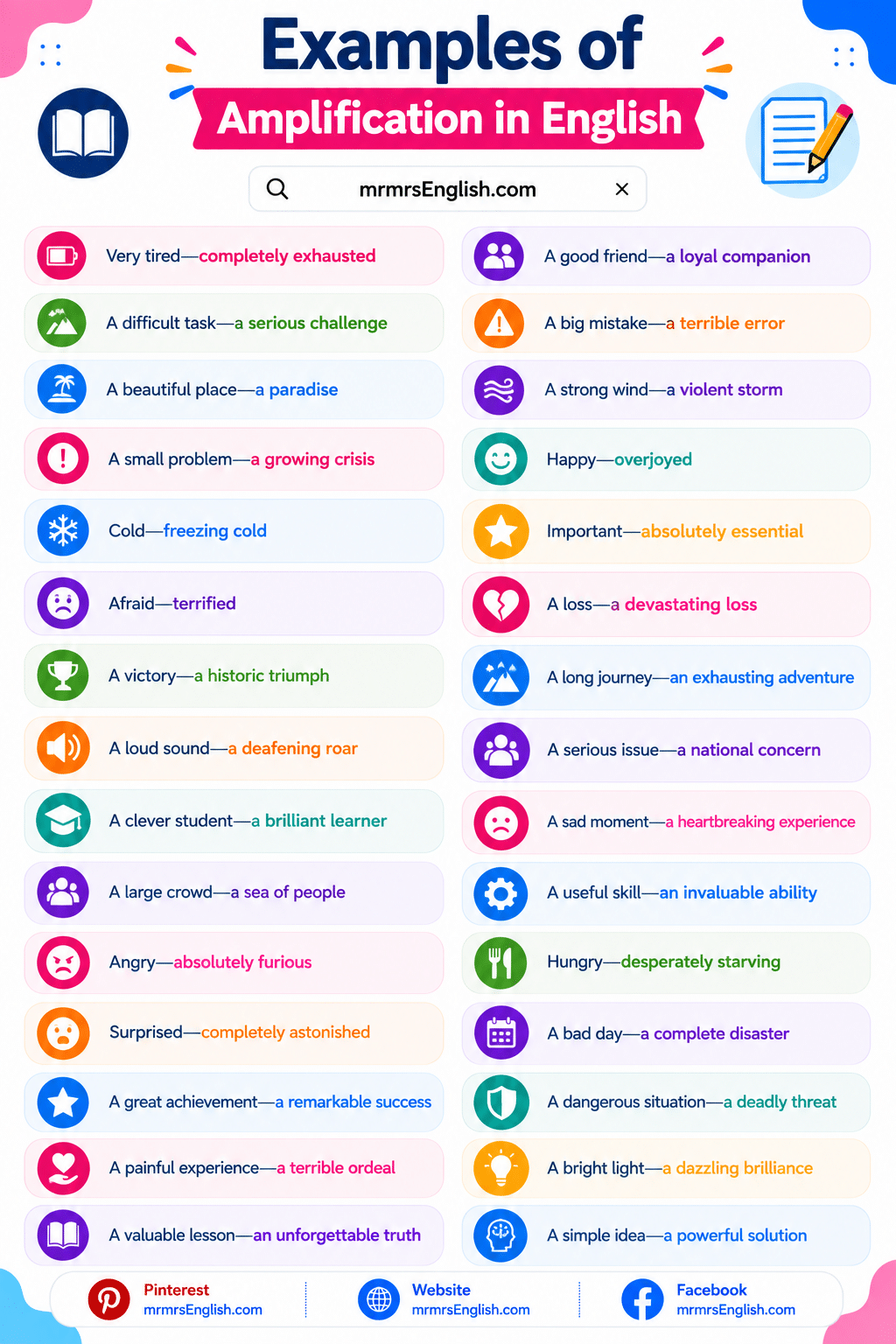
- Very tired—completely exhausted
- A good friend—a loyal companion
- A difficult task—a serious challenge
- A big mistake—a terrible error
- A beautiful place—a paradise
- A strong wind—a violent storm
- A small problem—a growing crisis
- Happy—overjoyed
- Cold—freezing cold
- Important—absolutely essential
- Afraid—terrified
- A loss—a devastating loss
- A victory—a historic triumph
- A long journey—an exhausting adventure
- A loud sound—a deafening roar
- A serious issue—a national concern
- A clever student—a brilliant learner
- A sad moment—a heartbreaking experience
- A large crowd—a sea of people
- A useful skill—an invaluable ability
- Angry—absolutely furious
- Hungry—desperately starving
- Surprised—completely astonished
- A bad day—a complete disaster
- A great achievement—a remarkable success
- A dangerous situation—a deadly threat
- A painful experience—a terrible ordeal
- A bright light—a dazzling brilliance
- A valuable lesson—an unforgettable truth
- A simple idea—a powerful solution
Examples of Amplification in English
Frequently Asked Questions About Amplification
What is amplification in English?
Amplification is a rhetorical device in which an idea is deliberately expanded with relevant details, explanation, description, illustration, or consequences to increase its clarity, emphasis, or rhetorical force. The expansion remains focused on the original thought rather than introducing an unrelated idea.
What is an example of amplification?
An example is “The road was dangerous—narrow, poorly lit, covered with ice, and bordered by steep cliffs.” The word dangerous presents the central judgment, while the additional details develop that judgment by showing the conditions that made the road dangerous.
Is amplification a figure of speech?
Yes. Amplification is commonly discussed as a rhetorical or stylistic figure, although it can operate across a phrase, sentence, paragraph, or longer passage. Its defining feature is the purposeful development of an existing idea to give it greater significance or emphasis.
Does amplification always involve repetition?
No. Repetition is only one possible method of amplification. An idea can also be amplified through explanation, specific details, enumeration, illustration, consequences, or progressive development. Repetition becomes amplification when it contributes to the further development of the idea rather than merely repeating the same language.
What is the main purpose of amplification?
The main purpose of amplification is to give an important idea greater clarity, depth, emphasis, or persuasive force. Depending on the context, it can also strengthen description, demonstrate the scale of an issue, intensify emotion, or reveal the broader significance of a statement.
What is the difference between amplification and repetition?
Repetition reproduces a word, phrase, structure, or idea, whereas amplification develops an existing idea with additional meaningful information. Repetition can form part of amplification, but the two are not synonymous. Amplification does not require exact repetition.
What is the difference between amplification and elaboration?
Elaboration is the general process of developing a subject by supplying additional information. Amplification has a more specific rhetorical purpose: it expands a particular idea in order to increase its importance, clarity, intensity, or effect. The two techniques can overlap, especially in explanatory and argumentative writing.
How can you identify amplification in a text?
Identify the central statement or idea and examine what follows it. If the writer remains focused on that idea and develops it through explanation, description, particulars, consequences, enumeration, or purposeful repetition, the passage may contain amplification. The key test is whether the additional material meaningfully enlarges the reader’s understanding of the original thought.
Conclusion
Amplification in English helps writers and speakers turn a simple statement into a clearer and more powerful expression. It works by expanding an important word, phrase, or idea through repetition, description, explanation, examples, reasons, or consequences. It is widely useful in literature, speeches, essays, persuasive writing, descriptive writing, and everyday communication. For ESL learners, the most important point is to remember that amplification does not mean adding unnecessary words. Effective amplification adds relevant details that clarify, emphasize, or strengthen the original idea.



Leave a Comment