
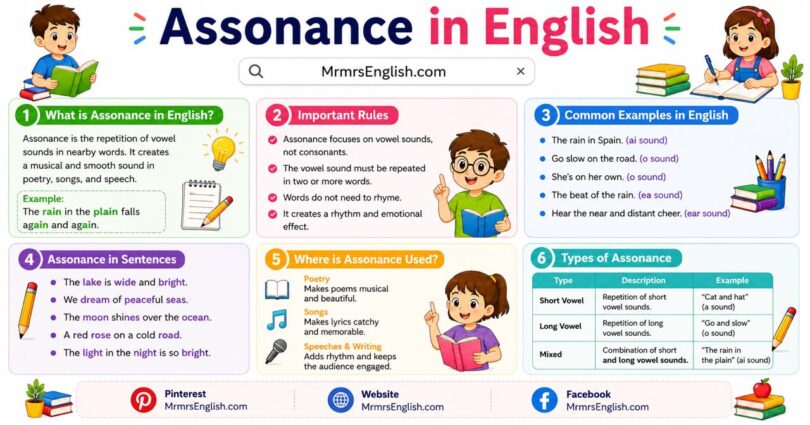
What Is Assonance in English?
Assonance happens when two or more nearby words repeat the same vowel sound inside the words.
It focuses on the sound of vowels such as:
a, e, i, o, u
The repeated vowel sound may appear in the middle or at the end of words.
Simple Examples:
- The rain in Spain
- Go and mow the lawn
- Try to light the fire
- Hear the mellow wedding bells
In these examples, the vowel sound repeats and creates a pleasant rhythm.
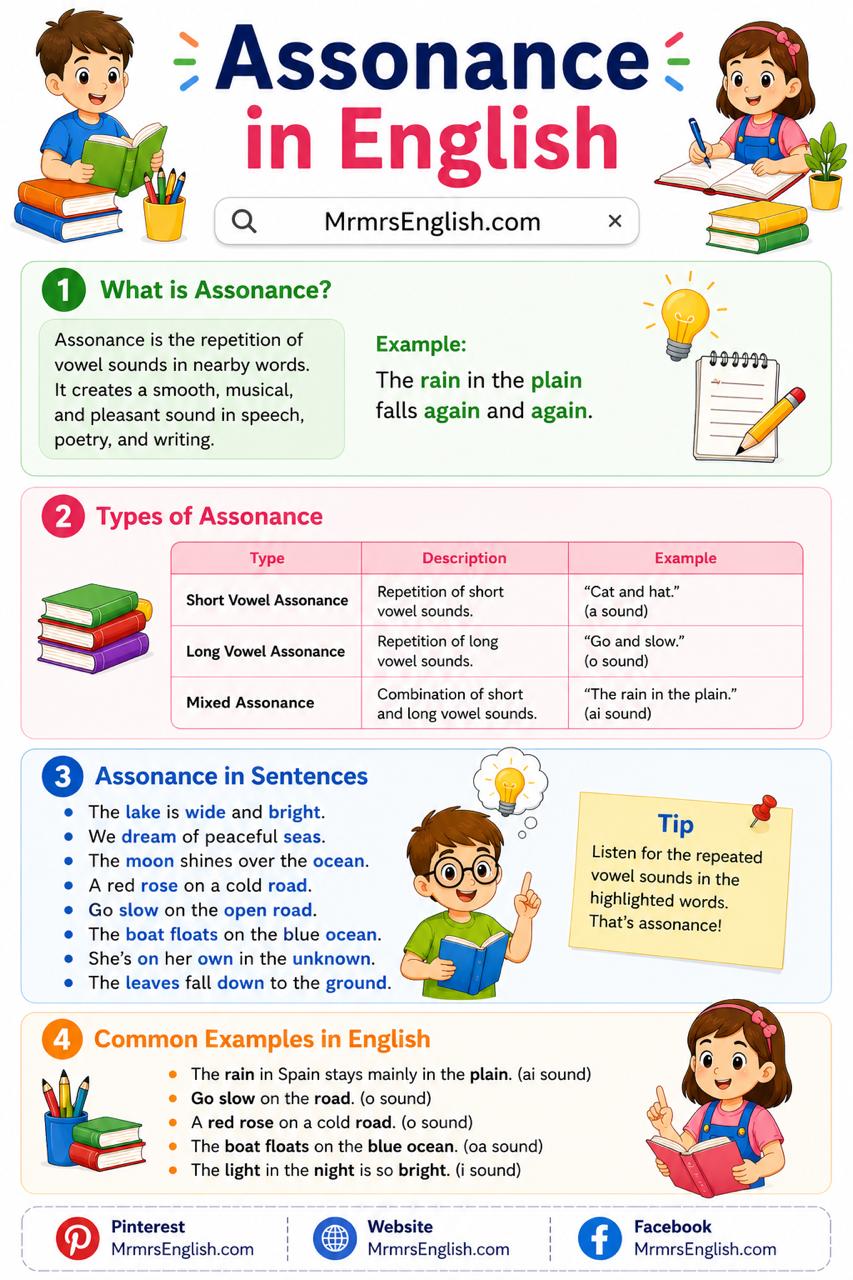
What Is Assonance in English with Examples
Easy Meaning of Assonance
Assonance means repeating similar vowel sounds in nearby words to make writing sound musical and smooth.
It is often used in:
- Poetry
- Songs
- Speeches
- Stories
- Advertising lines
- Creative writing
Important Rule of Assonance
Assonance depends on sound, not spelling.
Words may have different spellings but the same vowel sound.
Examples:
- lake / game / face → same long a sound
- light / sky / time → same long i sound
- moon / blue / truth → same long u sound
Basic Structure of Assonance
Pattern:
Nearby words with repeated vowel sounds
Examples:
| Phrase | Repeated Vowel Sound |
|---|---|
| Slow road home | O |
| Bright sky night | I |
| Sweet dream field | E |
| Cool moon blue | U |
Common Examples of Assonance in English
Everyday Examples
- No pain, no gain
- Go slow
- Time flies
- See me leave
Fun Examples
- The goat rode home alone
- Bright lights shine high
- Cool blue moon moved
Assonance in Sentences
| Sentence | Repeated Vowel Sound |
|---|---|
| The rain came today. | A |
| The light shined bright. | I |
| The cool moon moved slowly. | U |
| He spoke low in the hall. | O |
| She could see green leaves. | E |
Why Is Assonance Used?
Assonance improves the sound and beauty of language.
Main Benefits:
- Creates rhythm
- Makes sentences musical
- Adds emotion
- Makes writing memorable
- Strengthens poetry and songs
- Improves reading flow
Assonance in Poetry
Poets use assonance to create harmony and mood.
Example:
- The mellow wedding bells
Repeated e sound creates softness.
Example:
- Rise high in the bright sky
Repeated i sound creates energy.
Assonance in Songs
Many songs use repeated vowel sounds because they are pleasant to hear.
Example:
- Fly high tonight
Repeated i sound creates musical flow.
Types of Assonance
1. Short Vowel Assonance
Uses short vowel sounds.
Example:
- Men said yes
2. Long Vowel Assonance
Uses long vowel sounds.
Example:
- Blue moon moves soon
3. Mixed Assonance
Uses repeated vowel sounds across a sentence.
Example:
- The bright white kite flies high
Assonance vs Alliteration
| Assonance | Alliteration |
|---|---|
| Repetition of vowel sounds | Repetition of beginning consonant sounds |
| light sky time | big brown bear |
| Inside words | Usually start of words |
Assonance vs Consonance
| Assonance | Consonance |
|---|---|
| Repeated vowel sounds | Repeated consonant sounds |
| rain face day | blank think truck |
Assonance vs Rhyme
| Assonance | Rhyme |
|---|---|
| Similar vowel sounds | Same ending sounds |
| rise high light | light / night |
How to Create Assonance
Follow these steps:
- Choose a vowel sound.
- Think of words with the same sound.
- Put them near each other.
- Make a meaningful phrase.
Example:
Choose long O
Words: slow, road, home, stone
Sentence: The slow road led home.
Assonance for ESL Students
Assonance helps learners improve:
- Pronunciation
- Listening skills
- Vocabulary memory
- Reading fluency
- Poetry understanding
- Creative writing
It is useful in grammar and literature exams.
Examples from Basic to Advanced Level
Basic Examples
- Red pen bed
- Blue moon
- Bright light
Intermediate Examples
- The rain stayed all day.
- A slow boat moved alone.
Advanced Examples
- The pale rain faded across the gray plain.
- Bright fires climbed high in the silent night.
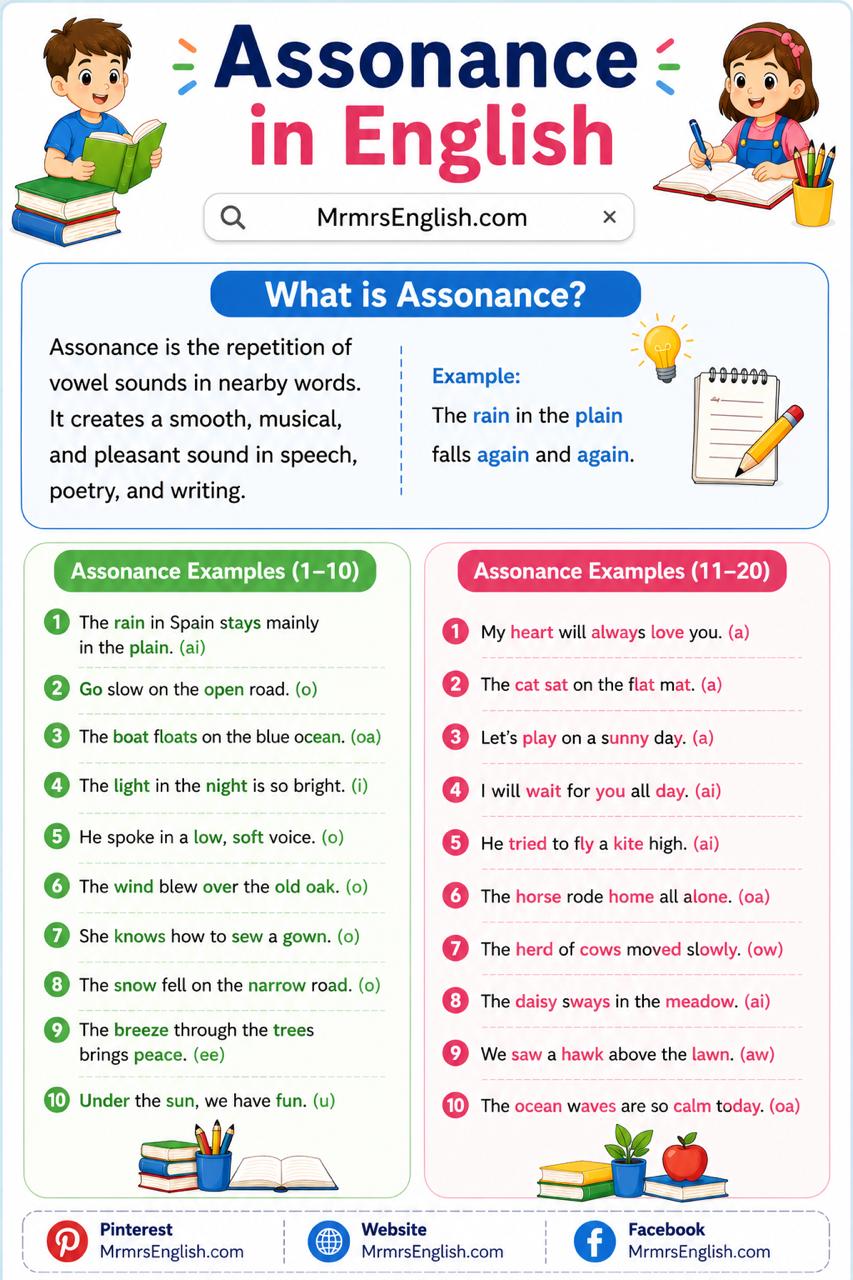
Assonance Example Sentences in English
Common Mistakes to Avoid
1. Looking Only at Spelling
❌ food / good (different sounds)
✔ blue / true (same sound)
2. Confusing with Alliteration
❌ big bear = assonance
✔ big bear = alliteration
3. Using Random Words
Use words that make sense together.
Practice Exercise
Find the repeated vowel sound:
- Bright light sky
- Cool blue moon
- Rain came late
- Deep green leaves
- Slow road home
Answers:
- I
- U
- A
- E
- O
Quick Revision Table
| Term | Meaning | Example |
|---|---|---|
| Assonance | Repeated vowel sounds | rain Spain |
| Sound-based | Based on pronunciation | blue true |
| Used in poetry | Adds beauty | bright sky |
| Used in songs | Creates rhythm | fly high |
Importance of Assonance in Exams
Students may be asked to:
- Identify assonance in lines
- Give examples
- Compare with alliteration
- Explain poetic effect
Example Question:
Find the assonance:
The light shines bright tonight.
Answer: Repeated long I sound.
Final Summary
Assonance is the repetition of similar vowel sounds in nearby words. It creates rhythm, smoothness, and musical beauty in English. It is widely used in poetry, songs, speeches, and creative writing.
By learning the Assonance definition in English, students can improve pronunciation, reading skills, and understanding of English literature.
FAQs
What is assonance in simple words?
It is the repetition of the same vowel sound in nearby words.
Give one example of assonance.
The rain in Spain.
Is assonance based on spelling?
No. It is based on sound.
Where is assonance used?
In poetry, songs, speeches, and creative writing.
Why is assonance important?
It makes language smoother, memorable, and more attractive.
Learn more helpful articles



Leave a Comment