
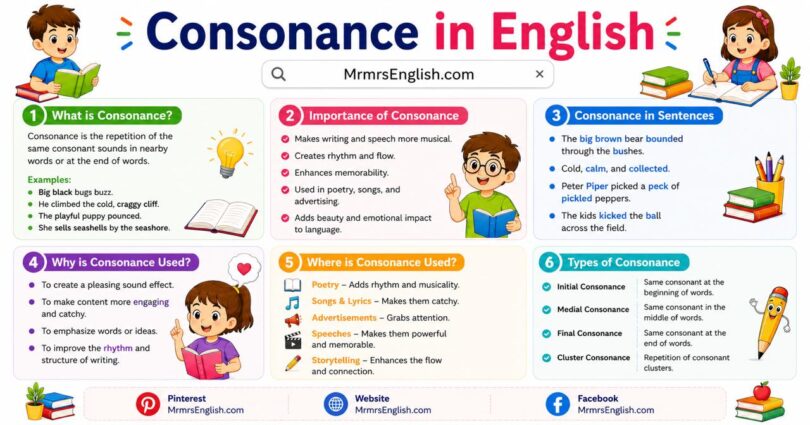
What Is Consonance in English?
Consonance happens when nearby words repeat the same consonant sound, especially in the middle or at the end of words.
It focuses on consonant sounds such as:
b, c, d, f, g, k, l, m, n, p, r, s, t, etc.
The repeated sound creates rhythm and harmony in writing.
Simple Examples:
- blank and think
- stroke of luck
- pitter patter
- bit and bet
In these examples, consonant sounds repeat.
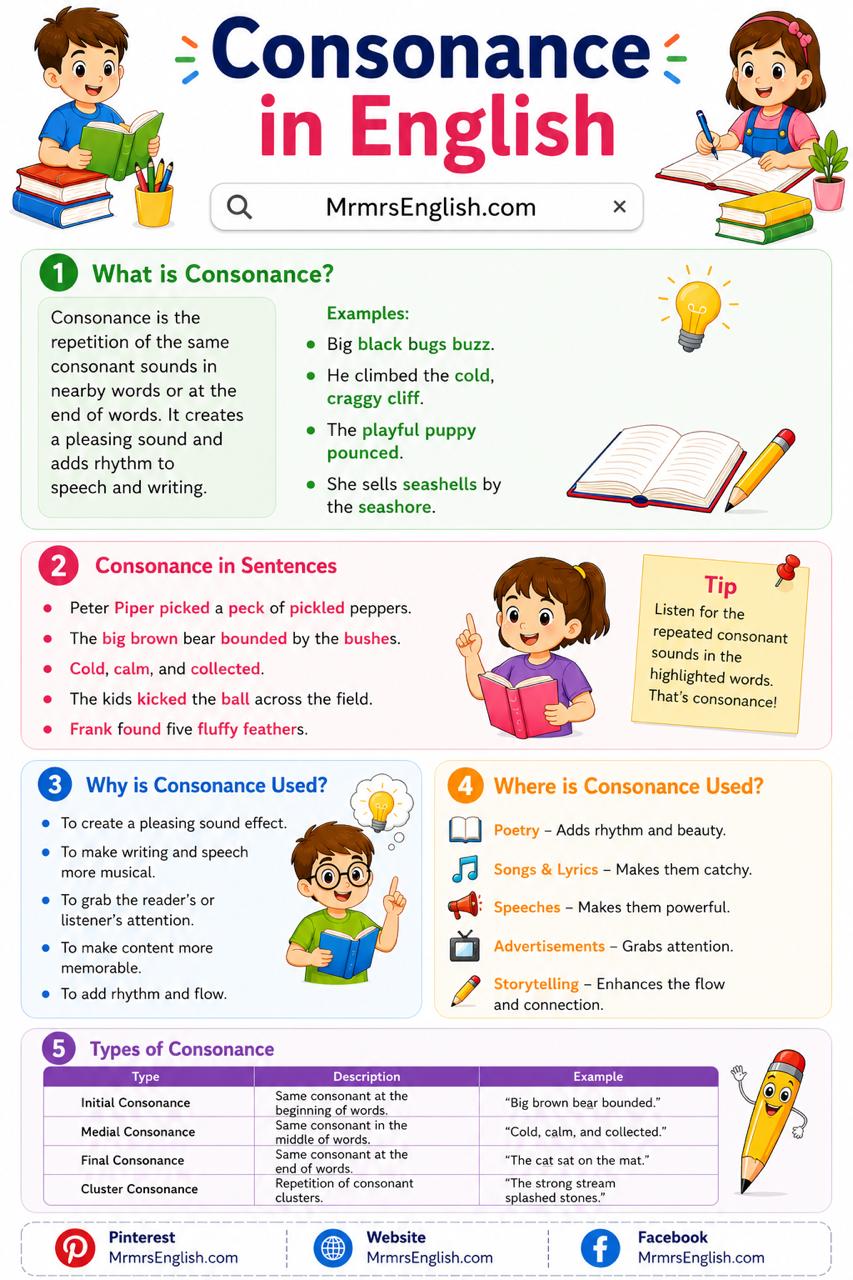
What Is Consonance in English with Examples
Easy Meaning of Consonance
Consonance means using similar consonant sounds in nearby words to make language smoother, stronger, and more musical.
It is often used in:
- Poetry
- Songs
- Speeches
- Stories
- Proverbs
- Creative writing
Important Rule of Consonance
Consonance depends on sound, not spelling.
Words may be spelled differently but still repeat the same consonant sound.
Examples:
- blank / think → repeated nk sound
- laugh / rough → repeated f sound
- stroke / luck → repeated k sound
Basic Structure of Consonance
Pattern:
Nearby words with repeated consonant sounds
Examples:
| Phrase | Repeated Consonant Sound |
|---|---|
| blank think | nk |
| stroke luck | k |
| pitter patter | t |
| mild world | ld |
Common Examples of Consonance in English
Everyday Examples
- pitter patter
- odds and ends
- stroke of luck
- best test
Fun Examples
- The black truck struck back
- Little bottle rattled softly
- Strong wings rang loudly
Why Is Consonance Used?
Consonance improves the sound and style of language.
Main Benefits:
- Creates rhythm
- Makes writing musical
- Adds emphasis
- Improves memory
- Strengthens poetry
- Makes speech attractive
Consonance in Poetry
Poets use consonance to create mood and sound patterns.
Example:
- The dark bark shook in the park
Repeated rk sound creates a strong effect.
Example:
- The silent bell fell well
Repeated ll sound gives softness.
Consonance in Songs
Songs often use consonance because repeated sounds are pleasant to hear.
Example:
- Heart beats bright nights
Repeated t sound creates rhythm.
Types of Consonance
1. Final Consonance
Repeated consonant sounds at the end of words.
Example:
- blank think
2. Middle Consonance
Repeated consonant sounds in the middle of words.
Example:
- little bottle
3. Full Sentence Consonance
Repeated sounds across many words.
Example:
- Black trucks struck thick rocks.
Consonance vs Alliteration
| Consonance | Alliteration |
|---|---|
| Repeated consonant sounds anywhere | Repeated beginning consonant sounds |
| blank think | big brown bear |
| Middle/end often common | Beginning of words |
Consonance vs Assonance
| Consonance | Assonance |
|---|---|
| Repeated consonant sounds | Repeated vowel sounds |
| best test | rain Spain |
Consonance vs Rhyme
| Consonance | Rhyme |
|---|---|
| Similar consonant sounds | Same ending sound pattern |
| blank think | light night |
How to Create Consonance
Follow these easy steps:
- Choose a consonant sound.
- Think of words containing that sound.
- Place them close together.
- Make a meaningful phrase.
Example:
Choose k
Words: black, truck, rock, back
Sentence: The black truck rolled back.
Consonance for ESL Students
Consonance helps learners improve:
- Pronunciation
- Listening skills
- Vocabulary memory
- Poetry understanding
- Speaking rhythm
- Creative writing
It is useful in grammar and literature exams.
Examples from Basic to Advanced Level
Basic Examples
- best test
- black clock
- cold world
Intermediate Examples
- The black truck stopped quickly.
- The best guest arrived late.
Advanced Examples
- The cracked rock shocked the dark dock.
- Silent bells rolled through the cold hall.
Consonance in Sentences in English
| Sentence | Repeated Sound |
|---|---|
| The blank thinker waited. | nk |
| The bitter wind hit the tree. | t |
| The black truck moved fast. | k |
| The best nest was empty. | st |
| The rolling bell rang. | l |
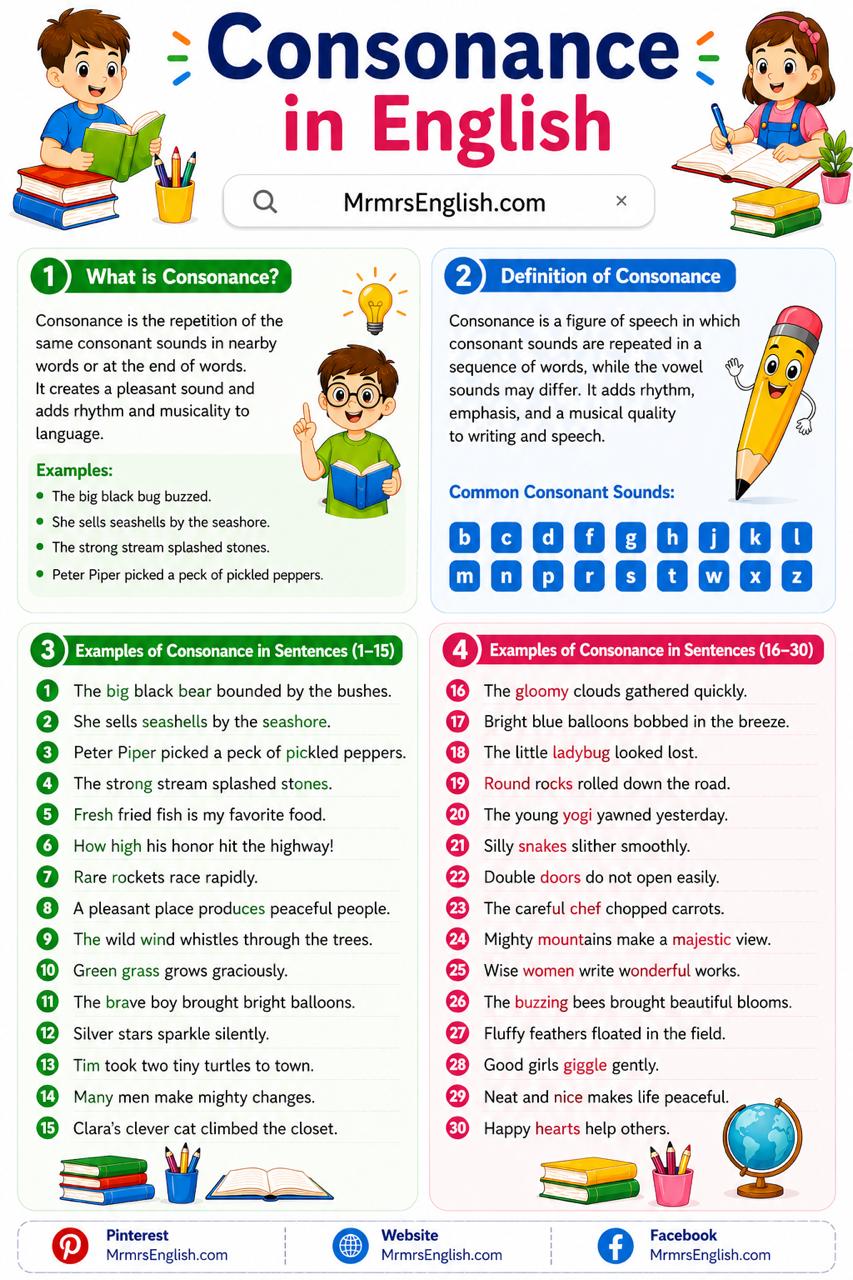
Consonance in Sentences in English
Common Mistakes to Avoid
1. Confusing with Alliteration
❌ Big bear = consonance only
✔ Big bear = mainly alliteration
2. Looking Only at Letters
Sound matters more than spelling.
3. Using Random Words
Use natural phrases with clear meaning.
Practice Exercise
Find the repeated consonant sound:
- Black truck
- Best test
- Pitter patter
- Blank think
- Mild world
Answers:
- k
- st
- t
- nk
- ld
Quick Revision Table
| Term | Meaning | Example |
|---|---|---|
| Consonance | Repeated consonant sounds | best test |
| Sound-based | Based on pronunciation | laugh rough |
| Used in poetry | Adds beauty | black truck |
| Used in songs | Creates rhythm | heart beats |
Importance of Consonance in Exams
Students may be asked to:
- Identify consonance in a line
- Give examples
- Compare with assonance
- Explain poetic effect
Example Question:
Find the consonance:
The black truck struck a rock.
Answer: Repeated k sound.
Learn more helpful articles




Leave a Comment