
Understanding the difference between concrete nouns and abstract nouns is an important part of learning English grammar. Concrete nouns refer to people, places, animals, or things that you can see, touch, hear, smell, or taste, while abstract nouns describe ideas, feelings, qualities, or states that cannot be experienced with the five senses. In this article, you will learn concrete and abstract nouns with simple definitions and easy examples, making it easier to identify and use them correctly in everyday speaking and writing. This guide is perfect for students, teachers, and English learners at every level.
What are Concrete and Abstract Nouns?
Both concrete and abstract nouns refer to things, but they differ in how we experience or perceive them. Let’s explore each type in detail.
Concrete Nouns
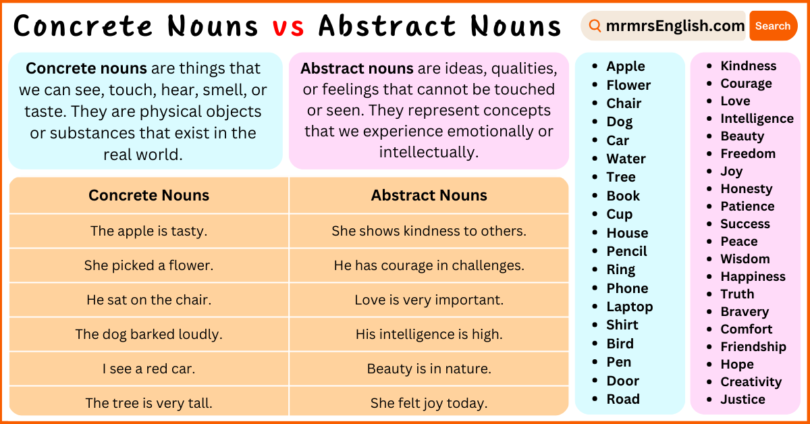
Concrete nouns are nouns that refer to things we can perceive with our five senses (sight, hearing, taste, touch, and smell). These are physical objects or things we can see or feel.
Examples of Concrete Nouns:
- Table
- Dog
- Flower
- Chocolate
- Ocean
Concrete nouns are tangible, meaning we can physically experience them. They include things like animals, objects, food, people, and places. For example, cat is a concrete noun because you can see and touch a cat.
Types of Concrete Nouns
Concrete nouns can be categorized into countable and uncountable nouns.
Countable Concrete Nouns
Countable nouns can be counted individually, like book, apple, or car.
Uncountable Concrete Nouns
Uncountable nouns cannot be separated into individual units, such as water, air, or sand.
Examples in Sentences
| Sentence | Concrete Noun Highlighted |
|---|---|
| I see the sun setting. | Sun |
| She petted her dog. | Dog |
| He bought a new phone. | Phone |
Abstract Nouns
Abstract nouns refer to things that cannot be experienced with the senses. They are ideas, qualities, emotions, or concepts that exist in our minds. You cannot see, touch, taste, smell, or hear an abstract noun.
Examples of Abstract Nouns:
- Happiness
- Wisdom
- Freedom
- Courage
- Love
These nouns represent feelings, emotions, qualities, or concepts rather than tangible objects. For instance, love is an abstract noun because you cannot see or touch love itself, even though you can experience it.
Types of Abstract Nouns
Abstract nouns can describe qualities, emotions, and states of being.
Quality-based Abstract Nouns
These nouns describe qualities, such as honesty, bravery, or intelligence.
Emotion-based Abstract Nouns
These nouns express emotions, like joy, anger, or fear.
Examples in Sentences
| Sentence | Abstract Noun Highlighted |
|---|---|
| She values honesty above all else. | Honesty |
| He showed great courage during the crisis. | Courage |
| Happiness is a key to a fulfilled life. | Happiness |

Concrete Nouns and Abstract Nouns definitions
Key Differences Between Concrete and Abstract Nouns
| Feature | Concrete Nouns | Abstract Nouns |
|---|---|---|
| Definition | Things you can perceive with senses | Ideas, feelings, and qualities |
| Examples | Table, dog, flower | Happiness, love, courage |
| Tangible or Intangible | Tangible | Intangible |
| Countable/Uncountable | Can be both countable and uncountable | Generally uncountable |
| Perception | Perceived physically | Exists mentally or emotionally |
Why Understanding Concrete and Abstract Nouns is Important
For ESL Students
For English learners, grasping the difference between concrete and abstract nouns can help clarify sentence meanings, enhance vocabulary, and improve comprehension in reading and writing.
Usage in Exams
Understanding these nouns is crucial for grammar exams, essays, and creative writing. Knowing the difference helps ESL students use the correct words to convey ideas effectively.
Concrete Nouns and Abstract Nouns Example Sentences
| Concrete Nouns | Abstract Nouns |
|---|---|
| The apple is tasty. | She shows kindness to others. |
| She picked a flower. | He has courage in challenges. |
| He sat on the chair. | Love is very important. |
| The dog barked loudly. | His intelligence is high. |
| I see a red car. | Beauty is in nature. |
| She drinks cold water. | Freedom makes people happy. |
| The tree is very tall. | She felt joy today. |
| He drives a fast car. | His honesty is strong. |
| This book is interesting. | She has patience always. |
| There’s a cup on the shelf. | Success comes with work. |
| Her house has a garden. | He finds peace there. |
| The pencil broke. | Her wisdom is helpful. |
| She wears a ring. | Happiness is the goal. |
| The phone is ringing. | Truth is powerful. |
| He has a laptop. | Bravery is needed in life. |
| His shirt is blue. | He finds comfort here. |
| I saw a bird flying. | Friendship brings joy. |
| There’s a pen on the desk. | Hope keeps us strong. |
| The door is open. | His creativity is endless. |
| The road is busy today. | Justice matters to all. |

Concrete Nouns and Abstract Nouns Example Sentences
Concrete Noun List:
- Apple
- Flower
- Chair
- Dog
- Car
- Water
- Tree
- Book
- Cup
- House
- Pencil
- Ring
- Phone
- Laptop
- Shirt
- Bird
- Pen
- Door
- Road
Abstract Noun List:
- Kindness
- Courage
- Love
- Intelligence
- Beauty
- Freedom
- Joy
- Honesty
- Patience
- Success
- Peace
- Wisdom
- Happiness
- Truth
- Bravery
- Comfort
- Friendship
- Hope
- Creativity
- Justice

Concrete Nouns and Abstract Nouns list
Tips for Identifying Concrete and Abstract Nouns
- Use Your Senses: If you can experience it through sight, touch, sound, taste, or smell, it’s a concrete noun.
- Consider Feelings and Concepts: If it describes a feeling, state of mind, or idea, it’s an abstract noun.
- Practice in Context: The best way to master nouns is to practice identifying them in sentences.
Exercises for Practice
Below are some exercises for practice to reinforce the concept:
Identify the Concrete and Abstract Nouns in Each Sentence:
- She felt immense joy after winning the award.
- The book on the table is hers.
- Wisdom comes with experience and age.
- The flowers in the garden are blooming.
Answers:
- Joy – Abstract
- Book, table – Concrete
- Wisdom, experience – Abstract
- Flowers, garden – Concrete
Frequently Asked Questions (FAQs)
Q1: Are all abstract nouns uncountable?
- Not all abstract nouns are uncountable. Some, like “ideas” or “thoughts,” can be plural and thus countable.
Q2: Can a noun be both concrete and abstract?
- No, nouns are typically one or the other, as they either refer to something tangible or an idea.
Q3: Is “music” a concrete or abstract noun?
- “Music” is considered a concrete noun because it can be heard, though some may view it as abstract due to its intangible nature.
Learn also:


Leave a Comment