
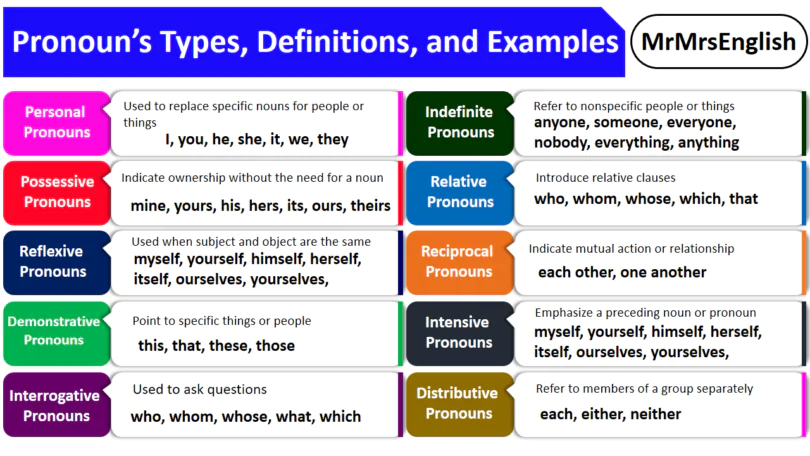
Pronouns are essential words in English grammar that replace nouns and help make sentences clearer, smoother, and less repetitive. Instead of repeating the same noun again and again, pronouns such as he, she, it, they, and we are used to make communication more natural and effective. Understanding pronouns is important for building correct sentences and improving both spoken and written English. In this article, you will learn about pronouns, their different types, definitions, and examples, helping you use them confidently in everyday communication and grammar exercises.
What Are Pronouns in English?
A pronoun is a word that is used in place of a noun. Instead of repeating the same noun again and again, we use a pronoun to make sentences shorter and easier to understand.
Examples
- Ali is a student. He studies English.
- Sara has a new book. She bought it yesterday.
- The children are playing. They look happy.
In these examples, he, she, and they replace nouns and help avoid repetition.
Why Are Pronouns Important?
Pronouns make communication more natural and effective.
Compare these sentences:
- Ahmed is my friend. Ahmed lives in Lahore. Ahmed works in a bank.
- Ahmed is my friend. He lives in Lahore. He works in a bank.
The second version sounds much better because pronouns reduce repetition.
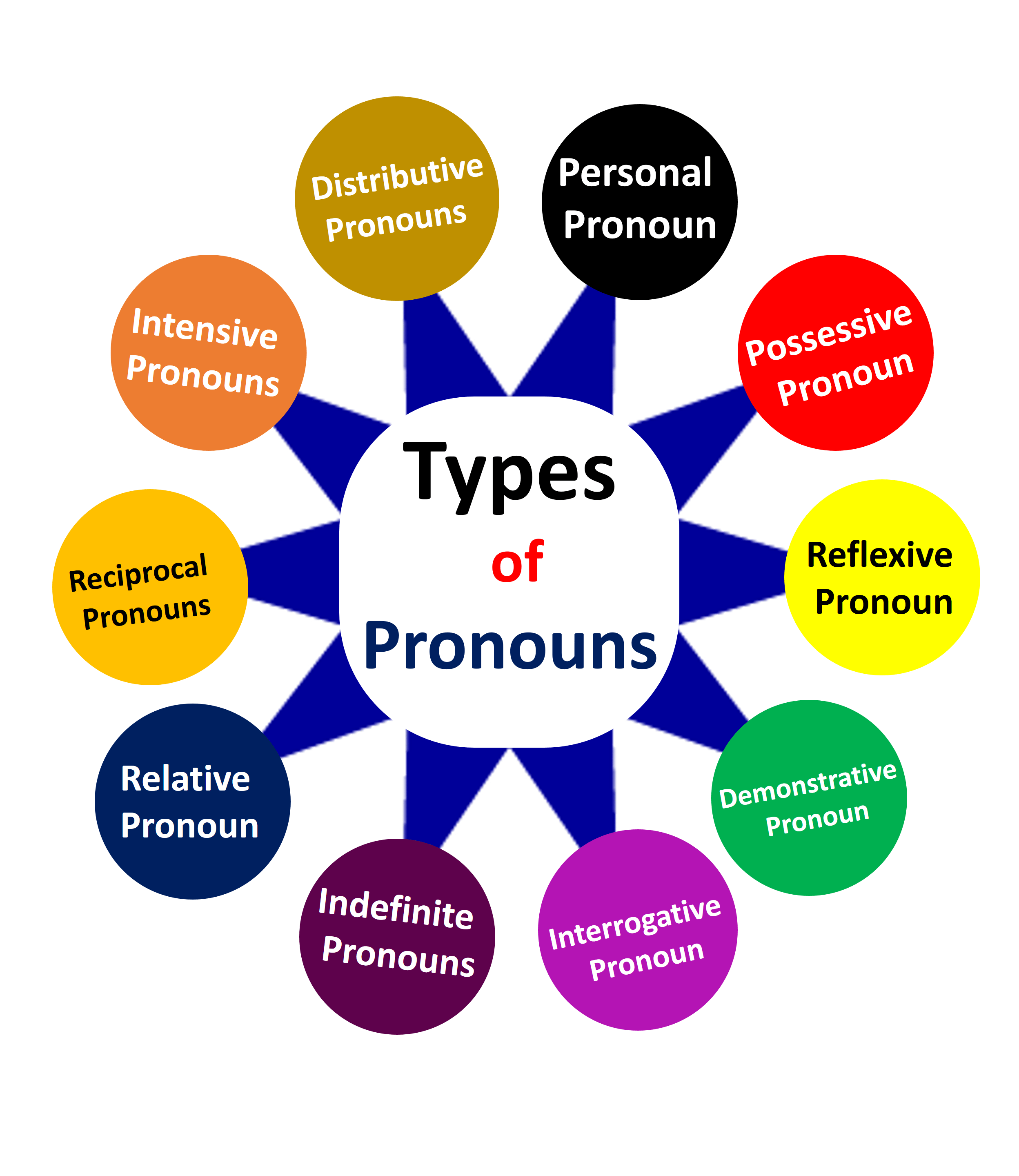
10 types of Pronouns
- Personal Pronouns
- Possessive Pronouns
- Reflexive Pronouns
- Demonstrative Pronouns
- Interrogative Pronouns
- Indefinite Pronouns
- Relative Pronouns
- Reciprocal Pronouns
- Intensive Pronouns
- Distributive Pronouns
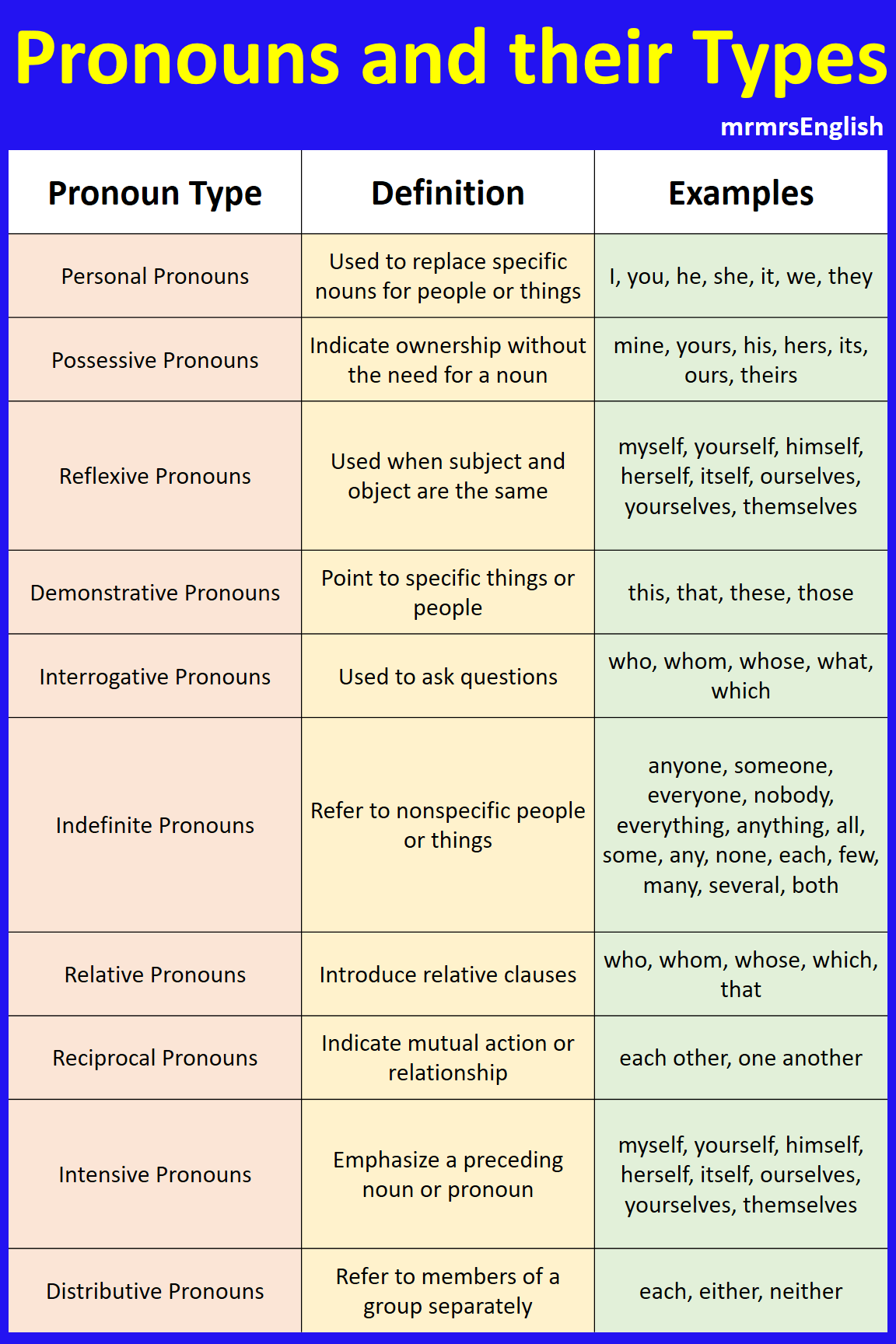
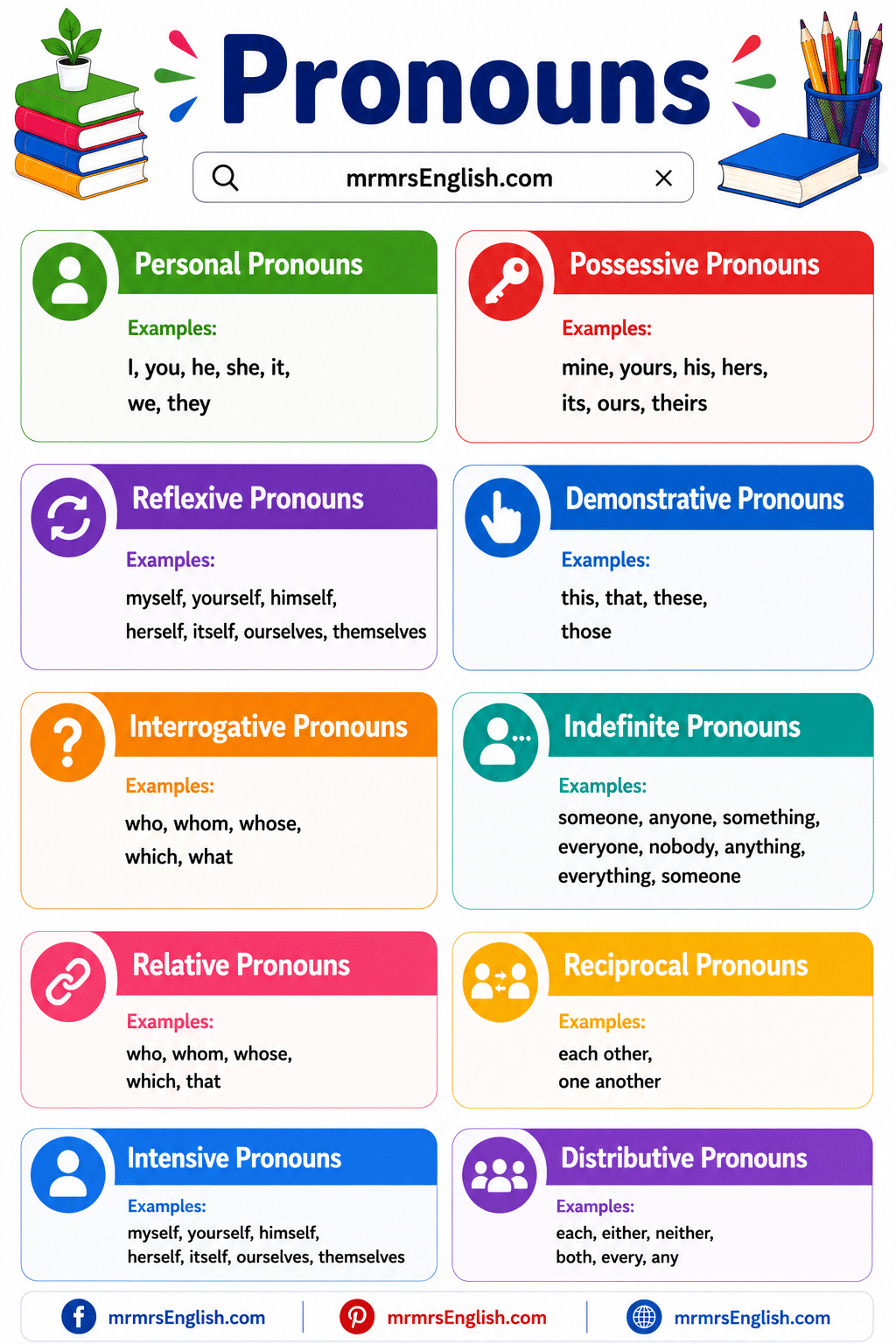
10 Pronouns and Their Types, Definitions, and Examples:
Personal Pronouns
- Definition: Personal pronouns are used to replace specific nouns referring to people or things.
- Examples: I, you, he, she, it, we, they
- Example sentences:
- She is going to the store.
- We are having dinner together.
Possessive Pronouns
- Definition: Possessive pronouns show ownership or possession without the need for a noun.
- Examples: mine, yours, his, hers, its, ours, theirs
- Example sentences:
- The book is mine.
- Is this pen yours?
Reflexive Pronouns
- Definition: Reflexive pronouns are used when the subject and the object of a sentence are the same.
- Examples: myself, yourself, himself, herself, itself, ourselves, yourselves, themselves
- Example sentences:
- She hurt herself while playing.
- We made the cake ourselves.
Demonstrative Pronouns
- Definition: Demonstrative pronouns point to specific things or people.
- Examples: this, that, these, those
- Example sentences:
- I want that one.
- These are the shoes I bought.
Interrogative Pronouns
- Definition: Interrogative pronouns are used to ask questions.
- Examples: who, whom, whose, what, which
- Example sentences:
- Who is coming to the party?
- What do you want for dinner?
Indefinite Pronouns
- Definition: Indefinite pronouns refer to nonspecific people or things.
- Examples: anyone, someone, everyone, nobody, everything, anything, all, some, any, none, each, few, many, several, both
- Example sentences:
- Everyone enjoyed the movie.
- Some of the cookies are gone.
Relative Pronouns
- Definition: Relative pronouns introduce relative clauses.
- Examples: who, whom, whose, which, that
- Example sentences:
- The person who called left a message.
- This is the book that I was talking about.
Reciprocal Pronouns
- Definition: Reciprocal pronouns indicate mutual action or relationship among individuals.
- Examples: each other, one another
- Example sentences:
- They love each other.
- The teams competed against one another.
Intensive Pronouns
- Definition: Intensive pronouns emphasize a preceding noun or pronoun.
- Examples: myself, yourself, himself, herself, itself, ourselves, yourselves, themselves
- Example sentences:
- I myself will take care of it.
- They did the work themselves.
Distributive Pronouns
- Definition: Distributive pronouns refer to members of a group separately.
- Examples: each, either, neither
- Example sentences:
- Each of the students received a certificate.
- You can choose either option.
Image of Pronouns and their Types:
Pronouns types
Pronoun Cases in English
Pronouns have different forms depending on their role in a sentence.
Subject Case
Used as the subject.
Examples:
- He is a doctor.
- They are playing.
Object Case
Used as the object.
Examples:
- I met him.
- She invited them.
Possessive Case
Shows ownership.
Examples:
- The book is mine.
- The house is ours.
Pronoun-Antecedent Agreement
A pronoun must agree with the noun it replaces in number and gender.
Correct Examples
- Ali lost his phone.
- The students submitted their assignments.
Incorrect Examples
- Ali lost their phone. ❌
- The students submitted his assignments. ❌
Common Pronoun Mistakes
1. Using the Wrong Pronoun
❌ Me and Sara went to school.
✅ Sara and I went to school.
2. Confusing Its and It’s
❌ The dog wagged it’s tail.
✅ The dog wagged its tail.
Its shows possession.
It’s means it is.
3. Using Reflexive Pronouns Incorrectly
❌ Please send the email to myself.
✅ Please send the email to me.
4. Pronoun Agreement Errors
❌ Every student should bring their book. (formal grammar issue in some exams)
✅ Every student should bring his or her book.
Modern English often accepts their as a singular pronoun, but some formal exams may prefer the traditional form.
Singular and Plural Pronouns
Singular Pronouns
| Pronoun |
| I |
| Me |
| He |
| Him |
| She |
| Her |
| It |
Plural Pronouns
| Pronoun |
| We |
| Us |
| They |
| Them |
Advanced Pronoun Usage
Generic “They”
Modern English often uses they to refer to a person whose gender is unknown.
Example:
- If someone calls, tell them I am busy.
This usage is widely accepted in modern English.
Pronouns in Formal Writing
In academic and formal writing:
- Use pronouns clearly.
- Avoid unclear references.
- Ensure agreement with antecedents.
Example:
❌ When John met Ali, he was tired.
The pronoun he is unclear.
✅ When John met Ali, John was tired.
How to Identify Pronouns in a Sentence
Ask yourself:
- Is this word replacing a noun?
- Is it showing ownership?
- Is it referring back to a person or thing already mentioned?
Examples
| Sentence | Pronoun |
| She is my friend. | She |
| This is amazing. | This |
| The car is theirs. | Theirs |
| Somebody called me. | Somebody, me |
Practice Exercise
Identify the pronouns in the following sentences.
- He plays cricket every weekend.
- This is my favorite book.
- Someone knocked on the door.
- They helped themselves.
- Which do you prefer?
Answers
| Sentence | Pronoun |
| 1 | He |
| 2 | This, my |
| 3 | Someone |
| 4 | They, themselves |
| 5 | Which, you |
Quick Summary Table
| Type of Pronoun | Purpose | Example |
| Personal | Refers to people or things | he, she |
| Possessive | Shows ownership | mine |
| Reflexive | Refers back to subject | myself |
| Demonstrative | Points out nouns | this |
| Interrogative | Asks questions | who |
| Relative | Connects clauses | which |
| Indefinite | Refers generally | someone |
| Reciprocal | Shows mutual action | each other |
| Intensive | Gives emphasis | himself |
| Distributive | Refers individually | each |
Pronouns Examples
Learn more helpful articles

Leave a Comment