
Climax is an important figure of speech that arranges words, phrases, or ideas in an order of increasing importance or intensity. It makes writing and speech more powerful, engaging, and memorable by building toward the strongest point. You can find climax in literature, speeches, poetry, advertisements, and everyday conversations. In this article, you will learn what climax is, its meaning, simple explanation, and clear examples in English. This guide is designed for students, teachers, ESL learners, and competitive exam preparation, helping you understand and use climax correctly with confidence.
What Is Climax in English?
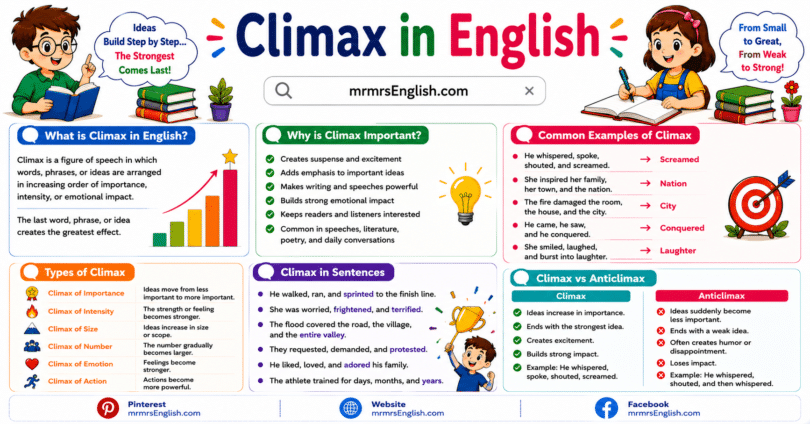
Climax is a figure of speech in which words, phrases, or ideas are arranged from the least important to the most important. The final word, phrase, or idea creates the greatest effect on the reader or listener.
It makes writing stronger, more dramatic, and more memorable.
Examples
- He whispered, spoke, shouted, and screamed.
- She inspired her family, her town, and the entire nation.
- The fire damaged the room, the house, and the whole neighborhood.
- He came, he saw, and he conquered.
In every example, the ideas gradually become stronger.
Easy Meaning of Climax
Climax means arranging ideas in ascending order, moving from small to large, weak to strong, or less important to more important.
Simple Examples
- She was worried, frightened, and terrified.
- The news shocked the students, the teachers, and the whole country.
- He lost his keys, his wallet, and his passport.
The strongest idea always comes at the end.
Origin of the Word Climax
The word Climax comes from the Greek word klimax, meaning “ladder” or “staircase.” Just as a staircase moves upward step by step, climax builds ideas gradually until reaching the highest point.
Characteristics of Climax
Climax has several important features:
- Ideas are arranged in increasing order.
- Each idea is stronger than the previous one.
- The final idea has the greatest impact.
- Creates suspense and excitement.
- Adds emphasis to writing and speeches.
- Makes ideas easier to remember.
- Common in literature, speeches, poetry, and advertising.
Types of Climax
1. Climax of Importance
Climax of Importance arranges ideas from less important to more important. Each stage carries greater value or significance than the previous one, making the final idea the most meaningful. This type is often used in speeches, essays, and literature to emphasize the highest level of importance and leave a lasting impression on the audience.
Examples
- He served his family, his community, and his country.
- The decision affected the students, the school, and the entire education system.
2. Climax of Intensity
Climax of Intensity presents feelings, actions, or situations in a gradually increasing level of strength. Every word or phrase is more powerful than the one before it, creating greater emotional impact. Writers use this type to build excitement, drama, and emphasis in both spoken and written English.
Examples
- She smiled, laughed, and burst into laughter.
- He disliked, hated, and completely despised dishonesty.
3. Climax of Size
Climax of Size arranges ideas from smaller to larger in terms of size, area, or scope. It helps readers clearly see how something grows or expands step by step. This type is commonly used in descriptive writing, storytelling, and news reports to create a stronger visual effect.
Examples
- The flood covered the street, the town, and the entire valley.
- The fire spread from a room to a building and then the whole block.
4. Climax of Number
Climax of Number shows a gradual increase in quantity or amount. It begins with a smaller number and moves toward a much larger one, making the final idea more impressive. This type is useful for showing growth, influence, participation, or scale in speeches, reports, and storytelling.
Examples
- One student complained, ten students protested, and the whole school joined.
- The speech influenced hundreds, thousands, and finally millions.
5. Climax of Emotion
Climax of Emotion arranges feelings from mild to very strong. Each emotion becomes more intense than the previous one, allowing readers or listeners to experience the emotional progression clearly. It is widely used in poetry, novels, speeches, and storytelling to create a powerful emotional response.
Examples
- She felt uneasy, worried, and terrified.
- He was happy, delighted, and overjoyed.
6. Climax of Action
Climax of Action presents actions in a sequence that becomes increasingly stronger or more significant. Every action adds greater force until the final action reaches the highest level of impact. This type is commonly found in narratives, speeches, and dramatic writing to build momentum and excitement.
Examples
- He walked, ran, and sprinted.
- They requested, demanded, and protested.

Types of Climax with Examples in English
How Climax Works
Climax works by arranging ideas so that every new word or phrase has greater force than the previous one.
For example:
- Small → Medium → Large
- Good → Better → Best
- Whisper → Speak → Shout → Scream
This gradual increase creates emphasis and keeps readers interested until the final point.
Rules for Using Climax
Arrange ideas in ascending order
Always move from weaker ideas to stronger ones.
✔ He was annoyed, angry, and furious.
Place the strongest idea last
The final word should create the greatest effect.
✔ She inspired her friends, her city, and her nation.
Use related ideas
All ideas should belong to the same category.
✔ Walked → Ran → Sprinted
Keep the order logical
The progression should feel natural and easy to understand.
Climax Examples in Sentences
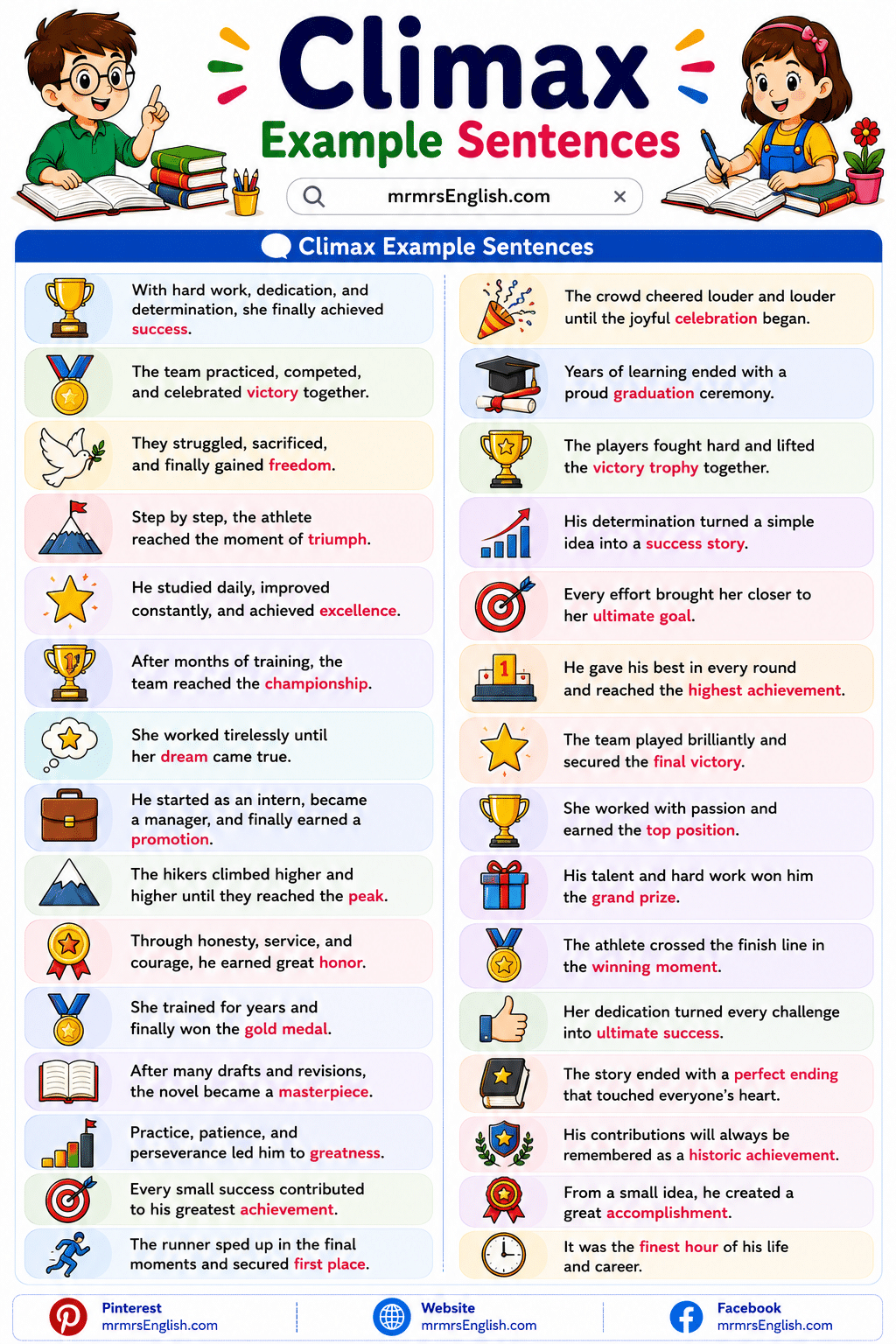
- He whispered, spoke, shouted, and screamed.
- She was nervous, worried, and terrified.
- The fire destroyed the room, the house, and the neighborhood.
- He helped his family, his village, and his country.
- The speech impressed the students, the teachers, and the principal.
- She walked, ran, and sprinted to the finish line.
- He liked, loved, and adored music.
- The storm damaged the trees, the buildings, and the entire city.
- The athlete trained for days, months, and years.
- The announcement surprised the class, the school, and the whole district.
- She became happy, excited, and overjoyed.
- He lost his phone, his wallet, and his passport.
- The disease affected a family, a town, and an entire country.
- They requested, demanded, and protested.
- The child murmured, cried, and screamed.
- He became a student, a teacher, and a respected professor.
- The invention changed the company, the industry, and the world.
- The flood covered the road, the village, and the valley.
- She studied, practiced, and mastered the language.
- They faced difficulty, danger, and disaster.
- He became famous in his school, his city, and his country.
- The audience watched, cheered, and applauded loudly.
- She gave her time, energy, and life to the cause.
- The disagreement became an argument, a conflict, and a war.
- He built a shop, a company, and a global business.
- The idea spread through the classroom, the school, and the nation.
- The students questioned, criticized, and challenged the decision.
- She felt sad, heartbroken, and devastated.
- The leader inspired children, adults, and future generations.
- The victory brought joy, pride, and unforgettable happiness.
Climax Examples in Sentences
Common Examples of Climax
| Expression | Ascending Order |
|---|---|
| Whispered → Spoke → Shouted → Screamed | Sound increases |
| Happy → Excited → Overjoyed | Emotion increases |
| Room → House → City | Size increases |
| Family → Community → Nation | Importance increases |
| Walked → Ran → Sprinted | Action increases |
| Days → Months → Years | Time increases |
| Good → Better → Best | Quality increases |
| Student → Teacher → Principal | Position increases |
| Concerned → Worried → Terrified | Fear increases |
| Seed → Plant → Tree | Growth increases |
Why Writers Use Climax
Writers use climax because it:
- Creates suspense.
- Adds emphasis.
- Makes speeches persuasive.
- Builds emotional impact.
- Keeps readers interested.
- Makes important ideas memorable.
- Improves storytelling.
Climax in Literature
Many famous writers use climax to create dramatic effects.
Examples
- “I came, I saw, I conquered.”
- “He lost his money, his home, and finally his hope.”
- “She fought for her family, her people, and her country.”
Each sentence ends with the strongest and most memorable idea.
Climax in Everyday English
People often use climax naturally in conversations.
Examples:
- I searched the room, the house, and the entire neighborhood.
- She is respected by her friends, coworkers, and everyone in town.
- He became interested, passionate, and completely devoted to the project.
Climax vs Anticlimax
| Climax | Anticlimax |
|---|---|
| Ideas increase in importance | Ideas suddenly become less important |
| Ends with the strongest idea | Ends with a weak or unexpected idea |
| Creates excitement | Often creates humor or disappointment |
| He whispered, spoke, shouted, screamed. | He whispered, shouted, and then whispered again. |
Climax vs Gradation
| Climax | Gradation |
|---|---|
| Reaches the highest point | General arrangement of ideas in order |
| Ends with the strongest idea | May increase or decrease |
| Strong emotional effect | Focuses on sequence |
Common Mistakes to Avoid
- Arranging ideas in the wrong order.
- Ending with a weaker idea.
- Mixing unrelated ideas.
- Using too many stages that confuse readers.
- Confusing climax with anticlimax.

Examples of Climax in English
Learn more helpful articles





Leave a Comment