
Metonymy is a commonly used figure of speech in English that adds variety and meaning to both spoken and written language. Instead of using the actual name of a person, place, object, or idea, it uses the name of something that is closely related to it. Learning metonymy in English with definition and example sentences helps students understand this concept more easily and use it correctly in everyday communication. In this article, you will learn the simple definition of metonymy, understand how it works, and explore easy example sentences to improve your English grammar and writing skills.
What Is Metonymy in English?
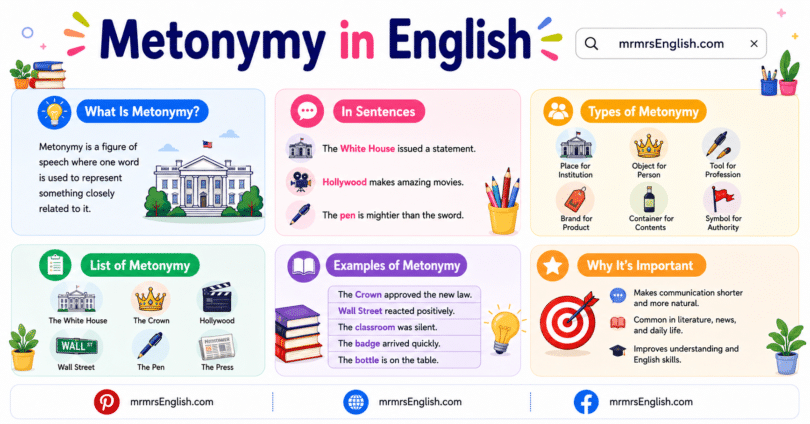
Metonymy is a figure of speech in which one word or phrase is used to represent another thing because they are closely connected in meaning. Instead of naming something directly, we use the name of something related to it.
For example:
- The White House announced a new policy.
- Here, The White House means the President or the U.S. government, not the building itself.
The relationship between the two words is based on a close connection, not similarity.
Why Is Metonymy Important?
Metonymy is useful because it:
- Makes communication shorter and more natural.
- Adds style to speaking and writing.
- Appears frequently in English books, news, and speeches.
- Helps students understand advanced English.
- Improves reading comprehension in exams.
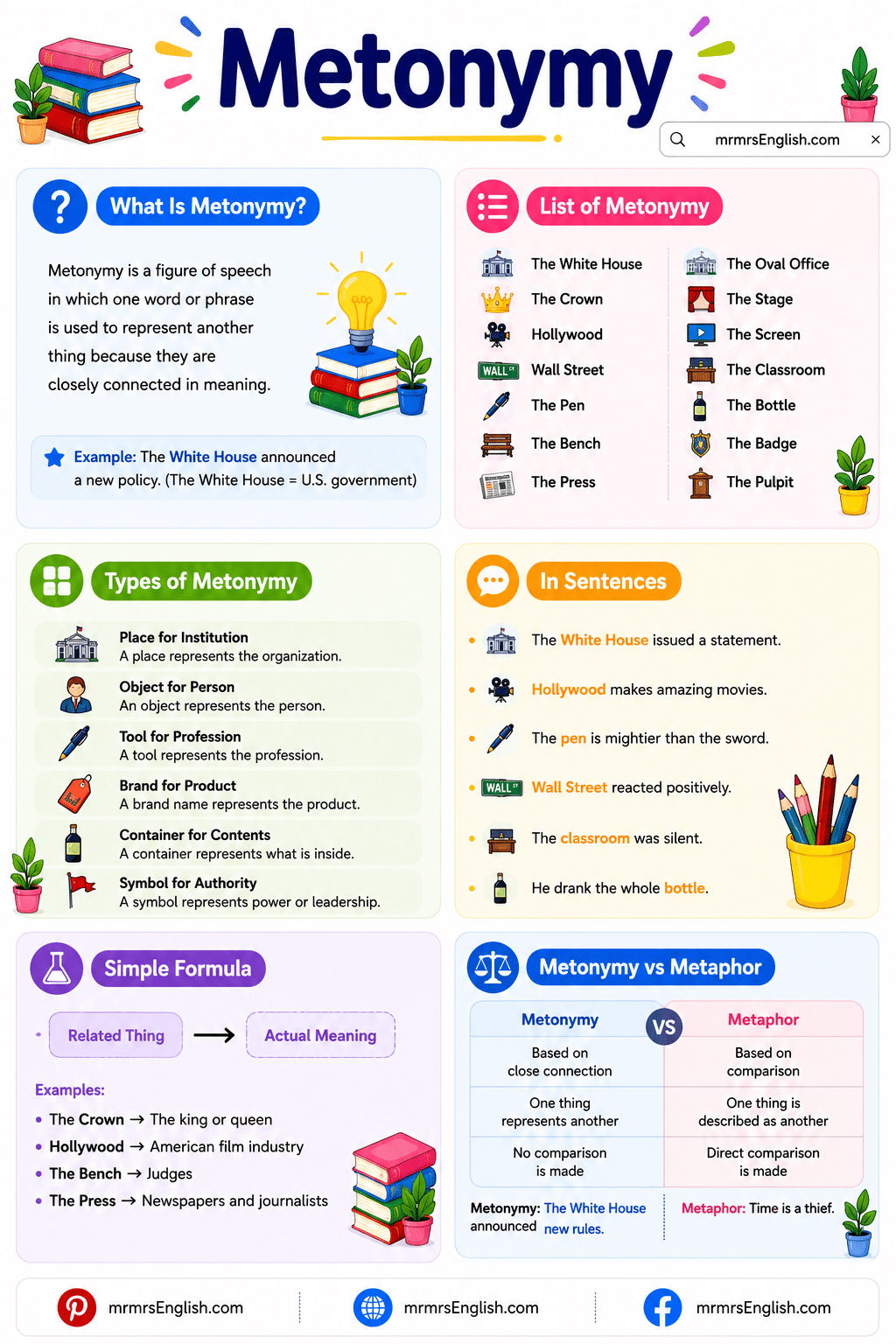
Simple Formula of Metonymy
Related Thing → Actual Meaning
Examples:
| Metonymy | Actual Meaning |
|---|---|
| The Crown | The king or queen |
| Hollywood | American film industry |
| The White House | U.S. government |
| The Bench | Judges |
| The Press | Newspapers and journalists |
How Does Metonymy Work?
Metonymy works by replacing something with another word that has a close relationship with it.
These relationships may include:
- Place for institution
- Object for person
- Tool for profession
- Symbol for authority
- Container for contents
- Brand for product
Easy Examples of Metonymy
| Sentence | Metonymy | Real Meaning |
|---|---|---|
| The White House issued a statement. | White House | U.S. government |
| Hollywood produces many movies. | Hollywood | Film industry |
| The Crown approved the decision. | Crown | Monarch |
| The pen is mightier than the sword. | Pen | Writing |
| The sword | Military power | |
| Wall Street reacted positively. | Wall Street | Financial markets |
| The classroom was silent. | Classroom | Students |
| Silicon Valley is growing rapidly. | Silicon Valley | Technology industry |
Metonymy in Everyday English
People use metonymy every day without realizing it.
Examples:
- She loves reading Shakespeare.
- (Books written by Shakespeare)
- He bought a new Ford.
- (A car made by Ford)
- The kitchen is busy tonight.
- (The cooks)
- Our company needs fresh hands.
- (Workers)
- The office approved your request.
- (Management)
Types of Metonymy
Place for Institution
A place represents the organization located there.
Examples:
- Washington announced new laws.
- Downing Street released a report.
- Buckingham Palace confirmed the news.
Object for Person
An object connected with someone represents that person.
Examples:
- The crown addressed the nation.
- The badge arrived quickly.
- The uniform entered the room.
Tool for Profession
A tool represents the person using it.
Examples:
- The pen changed history.
- The brush created a masterpiece.
- The camera captured every moment.
Brand for Product
Sometimes a brand name represents the product itself.
Examples:
- Pass me a Kleenex.
- I need a Band-Aid.
- She drives a Toyota.
Container for Contents
The container stands for what is inside it.
Examples:
- He drank the whole bottle.
- She finished the entire cup.
- The kettle is boiling.
Symbol for Authority
A symbol represents power or leadership.
Examples:
- The throne decided.
- The crown announced reforms.
- The flag represents the country.
Types of Metonymy with Examples
Metonymy in Literature
Many famous writers use metonymy to make their writing stronger.
Example:
“The pen is mightier than the sword.”
Here:
- Pen represents writing and knowledge.
- Sword represents war and violence.
The sentence means that ideas and words can be more powerful than force.
Metonymy in News Headlines
Journalists often use metonymy because it makes headlines short and clear.
Examples:
- White House Announces New Policy
- Wall Street Ends Higher
- Hollywood Celebrates Award Season
- Beijing Responds to Trade Talks
Metonymy in Advertising
Advertisers also use metonymy to make slogans memorable.
Examples:
- Taste the tradition.
- Drive luxury.
- Wear confidence.
- Experience excellence.
Metonymy vs Metaphor
Many learners confuse these two figures of speech.
| Metonymy | Metaphor |
|---|---|
| Based on close connection | Based on comparison |
| One thing represents another | One thing is described as another |
| No comparison is made | Direct comparison is made |
Examples
Metonymy:
- The White House announced new rules.
Metaphor:
- Time is a thief.
Metonymy vs Synecdoche
These two literary devices are also different.
| Metonymy | Synecdoche |
|---|---|
| Uses something closely related | Uses a part to represent the whole or the whole to represent a part |
| Relationship is association | Relationship is part and whole |
Examples:
Metonymy:
- Hollywood released many films.
Synecdoche:
- All hands on deck.
Here, hands means sailors.
List of Metonymy in English
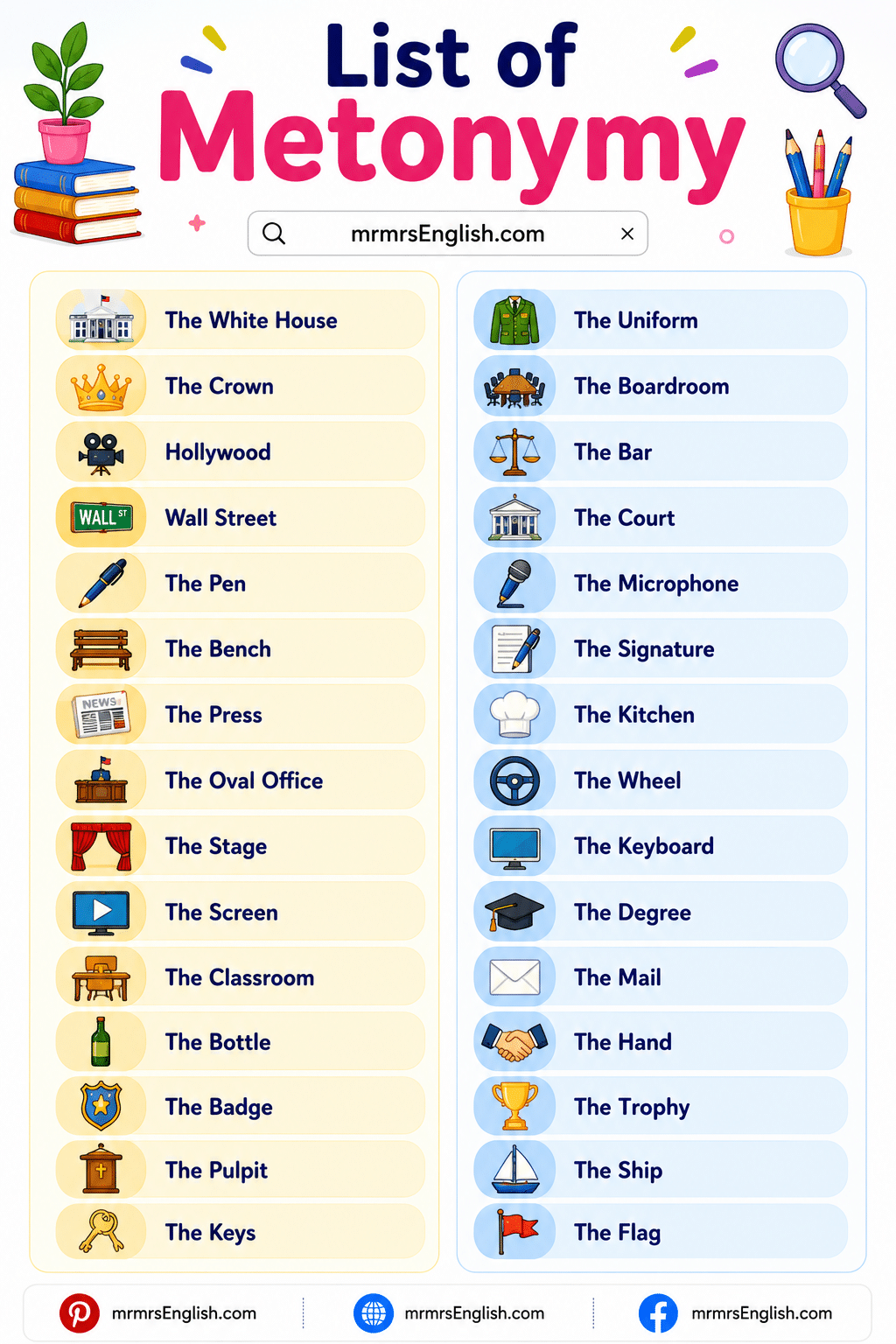
- The White House
- The Crown
- Hollywood
- Wall Street
- The Pen
- The Sword
- The Bench
- The Press
- The Oval Office
- The Stage
- The Screen
- The Classroom
- The Bottle
- The Badge
- The Pulpit
- The Keys
- The Uniform
- The Boardroom
- The Bar
- The Court
List of Metonymy in English
Examples of Metonymy in Sentences
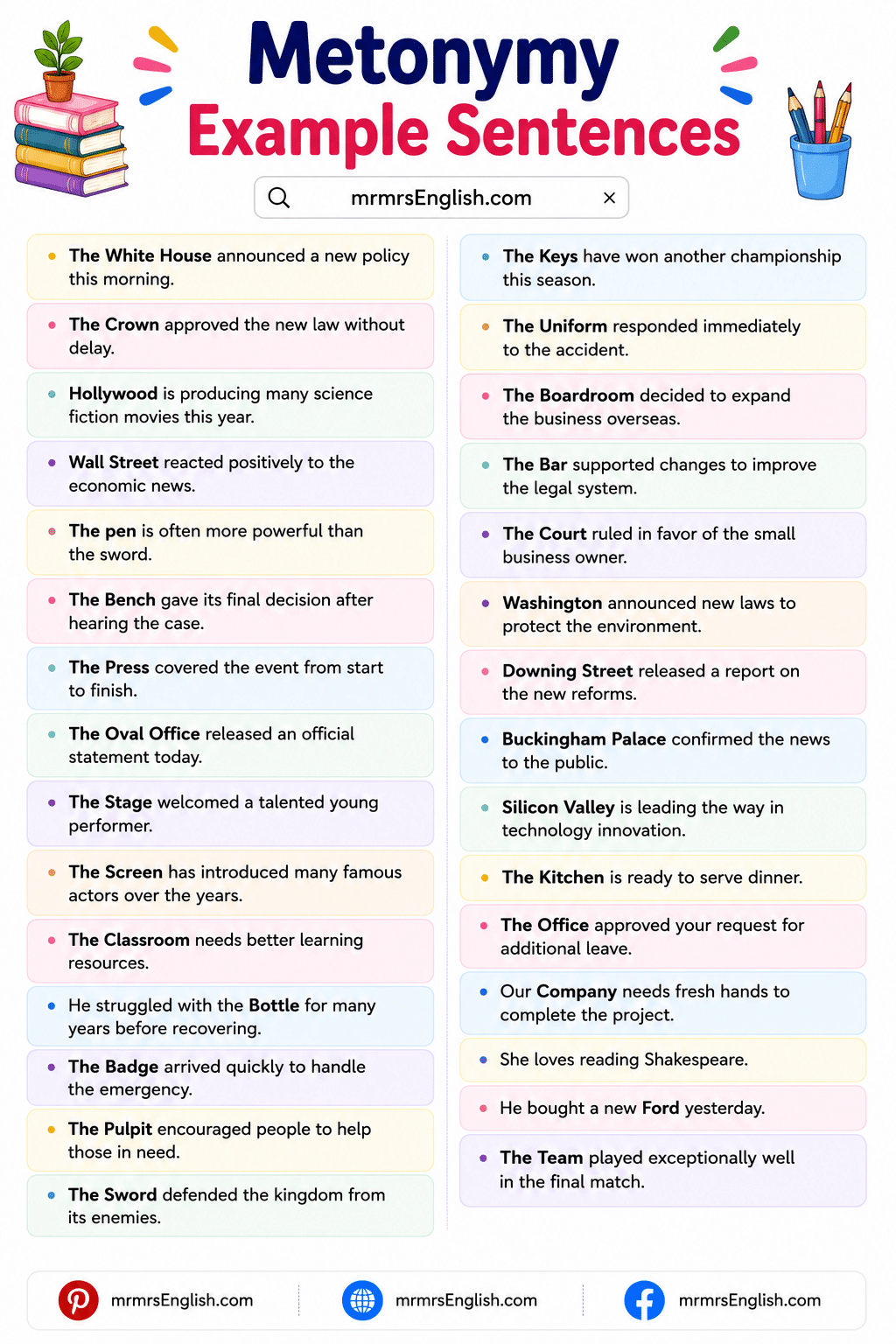
| Metonymy | Example Sentence |
|---|---|
| The White House | The White House announced a new policy this morning. |
| The Crown | The Crown approved the new law without delay. |
| Hollywood | Hollywood is producing many science fiction movies this year. |
| Wall Street | Wall Street reacted positively to the economic news. |
| The Pen | The pen is often more powerful than the sword. |
| The Bench | The bench gave its final decision after hearing the case. |
| The Press | The press covered the event from start to finish. |
| The Oval Office | The Oval Office released an official statement today. |
| The Stage | The stage welcomed a talented young performer. |
| The Screen | The screen has introduced many famous actors over the years. |
| The Classroom | The classroom needs better learning resources. |
| The Bottle | He struggled with the bottle for many years before recovering. |
| The Badge | The badge arrived quickly to handle the emergency. |
| The Pulpit | The pulpit encouraged people to help those in need. |
| The Sword | The sword defended the kingdom from its enemies. |
| The Keys | The keys have won another championship this season. |
| The Uniform | The uniform responded immediately to the accident. |
| The Boardroom | The boardroom decided to expand the business overseas. |
| The Bar | The bar supported changes to improve the legal system. |
| The Court | The court ruled in favor of the small business o |
Quick Summary
| Topic | Explanation |
|---|---|
| Meaning | Using one related word to represent another |
| Based On | Close association |
| Used In | Speaking, writing, literature, news, advertising |
| Purpose | Makes language shorter and more expressive |
| Different From | Metaphor and synecdoche |
Examples of Metonymy in Sentences
Learn more helpful articles

Leave a Comment