
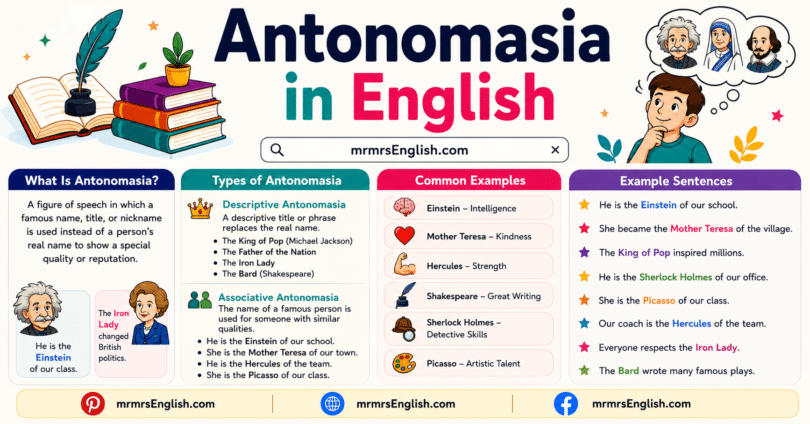
Antonomasia is a figure of speech in which a descriptive title, nickname, or well known name is used in place of a person’s real name, or a person’s name is used to describe someone with similar qualities. It is commonly used in literature, speeches, news, and everyday English to make language more expressive and memorable. Learning what antonomasia is, its meaning, and example sentences in English helps students and English learners understand this important literary device with ease. In this article, you will learn its simple meaning, learn how it is used, and study clear example sentences to improve your vocabulary and writing skills.
Table of Contents
ToggleWhat Is Antonomasia in English?
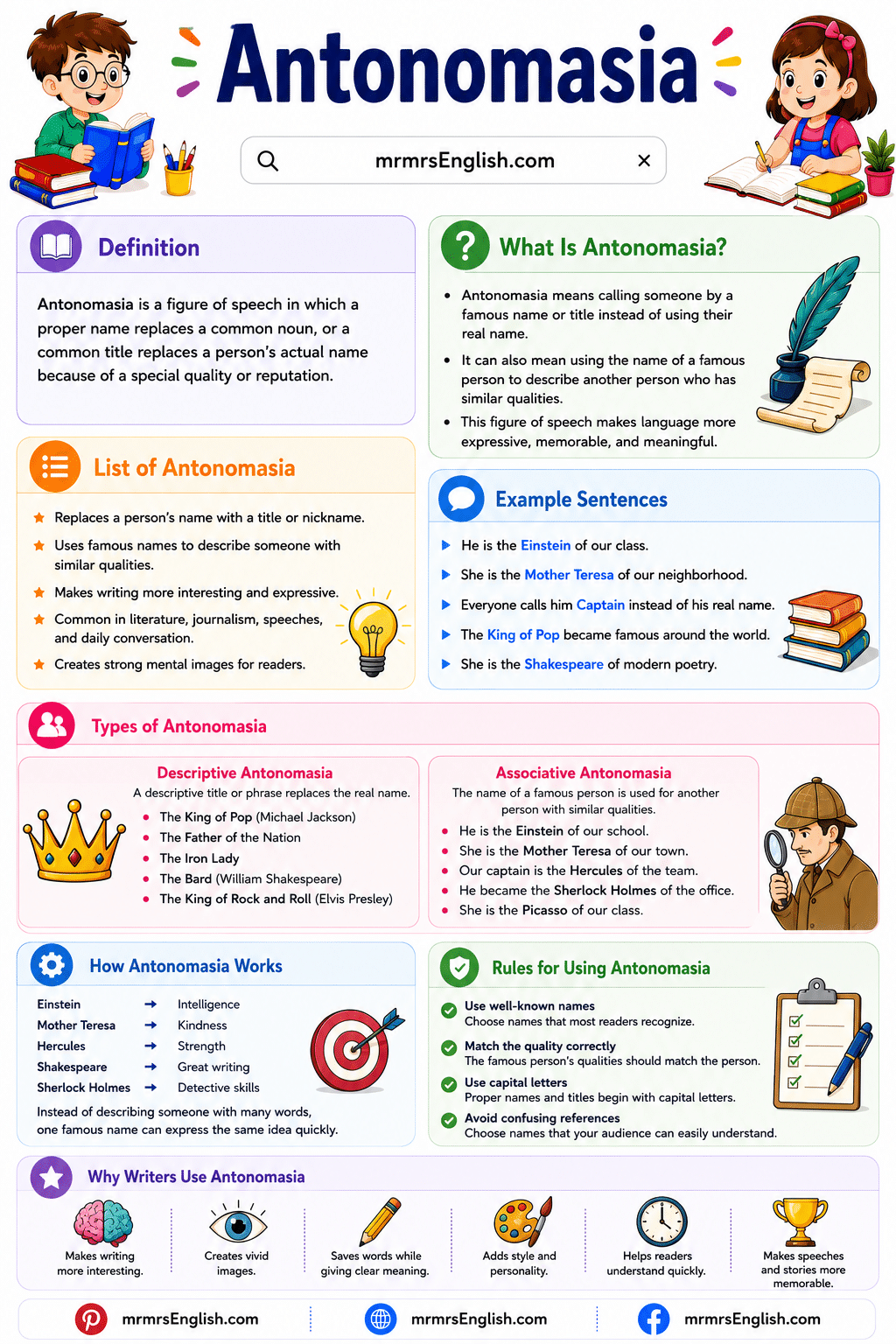
Antonomasia is a figure of speech in which a proper name replaces a common noun, or a common title replaces a person’s actual name because of a special quality or reputation.
For example:
- He is the Einstein of our class.
- The Iron Lady changed British politics.
In the first sentence, Einstein represents a very intelligent person. In the second sentence, The Iron Lady refers to Margaret Thatcher.
This figure of speech makes language more expressive, memorable, and meaningful.
Easy Meaning of Antonomasia
Antonomasia means calling someone by a famous name or title instead of using their real name.
It can also mean using the name of a famous person to describe another person who has similar qualities.
Examples
- She is the Mother Teresa of our neighborhood.
- He is the Shakespeare of modern poetry.
- Everyone calls him Captain instead of his real name.
- The King of Pop became famous around the world.
Origin of Antonomasia
The word Antonomasia comes from the Greek word antonomazein, which means “to call by another name.”
It has been used in literature and public speaking for centuries because it helps writers describe people in a powerful and memorable way.
Key Features of Antonomasia
- Replaces a person’s name with a title or nickname.
- Uses famous names to describe someone with similar qualities.
- Makes writing more interesting and expressive.
- Common in literature, journalism, speeches, and daily conversation.
- Creates strong mental images for readers.
Types of Antonomasia
Antonomasia can be divided into two main types.
1. Descriptive Antonomasia
A descriptive title or phrase replaces the real name.
Examples
- The King of Pop (Michael Jackson)
- The Father of the Nation
- The Iron Lady
- The Bard (William Shakespeare)
- The King of Rock and Roll (Elvis Presley)
2. Associative Antonomasia
The name of a famous person is used for another person with similar qualities.
Examples
- He is the Einstein of our school.
- She is the Mother Teresa of our town.
- Our captain is the Hercules of the team.
- He became the Sherlock Holmes of the office.
- She is the Picasso of our class.
Types of Antonomasia
How Antonomasia Works
Antonomasia works by connecting a person’s well-known quality with another person.
For example:
- Einstein → Intelligence
- Mother Teresa → Kindness
- Hercules → Strength
- Shakespeare → Great writing
- Sherlock Holmes → Excellent detective skills
Instead of describing someone with many words, one famous name can express the same idea quickly.
Rules for Using Antonomasia
Use well-known names
Choose names that most readers recognize.
✔ He is the Einstein of the team.
Match the quality correctly
The famous person’s qualities should match the person being described.
✔ She is the Mother Teresa of our village.
Use capital letters
Proper names and titles begin with capital letters.
✔ The Iron Lady
✔ The Bard
Avoid confusing references
Choose names that your audience can easily understand.
Examples of Antonomasia in Sentences
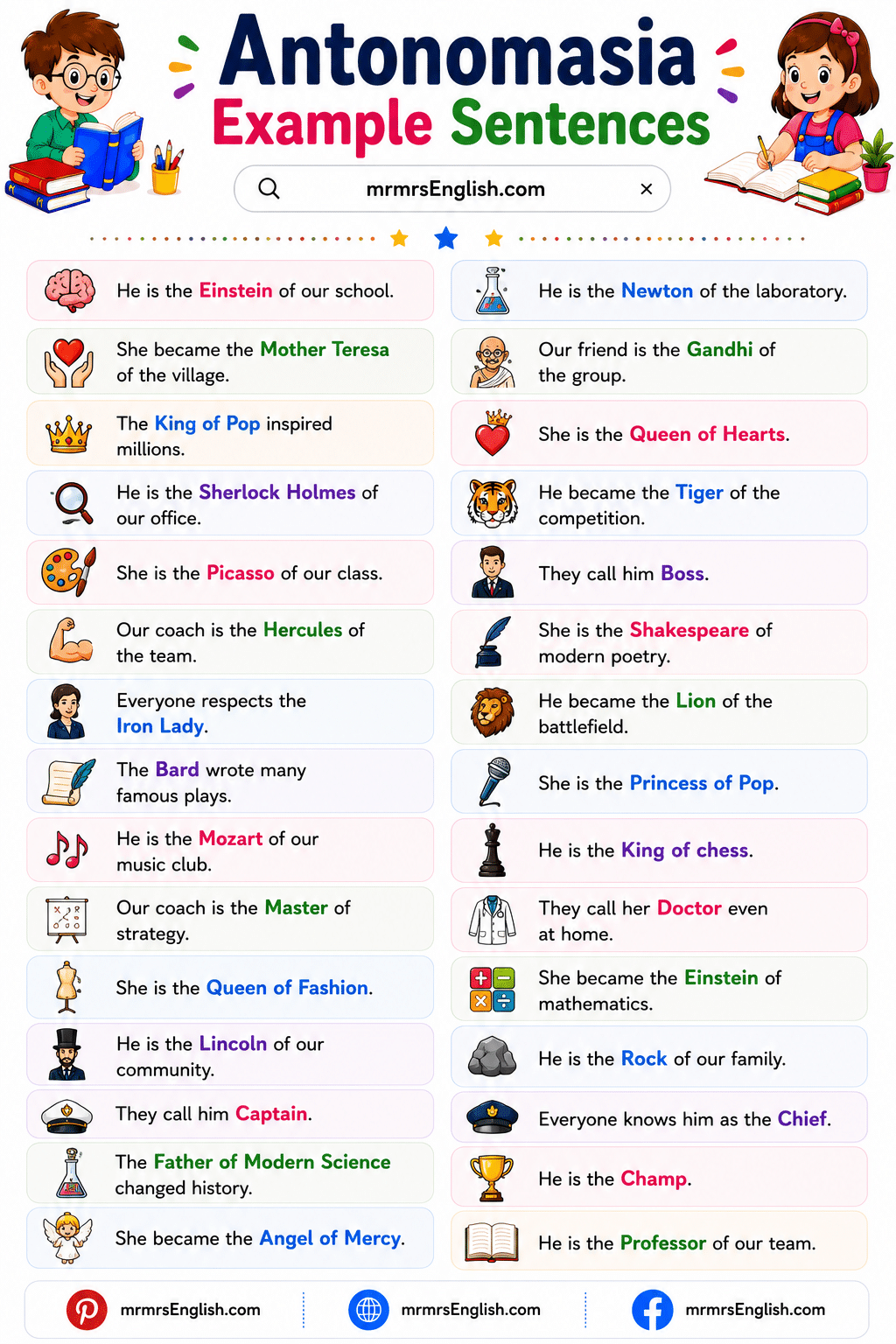
- He is the Einstein of our school.
- She became the Mother Teresa of the village.
- Our teacher calls him Professor.
- The King of Pop inspired millions.
- She is the Picasso of our class.
- He is the Sherlock Holmes of our office.
- Everyone respects the Iron Lady.
- He became the Hercules of the team.
- The Bard wrote many famous plays.
- She is the Florence Nightingale of the hospital.
- He is the Mozart of our music club.
- Our coach is the Master of strategy.
- She is the Queen of Fashion.
- He is the Lincoln of our community.
- They call him Captain.
- The Father of Modern Science changed history.
- She became the Angel of Mercy.
- He is the Newton of the laboratory.
- Our friend is the Gandhi of the group.
- She is the Queen of Hearts.
- He became the Tiger of the competition.
- They call him Boss.
- She is the Shakespeare of modern poetry.
- He became the Lion of the battlefield.
- She is the Princess of Pop.
- He is the King of chess.
- They call her Doctor even at home.
- She became the Einstein of mathematics.
- He is the Rock of our family.
- Everyone knows him as the Chief.
Examples of Antonomasia in Sentences
Common Titles Used in Antonomasia
| Title or Name | Represents |
|---|---|
| Einstein | Intelligence |
| Mother Teresa | Kindness |
| Hercules | Strength |
| Shakespeare | Great writing |
| Sherlock Holmes | Detective skills |
| Picasso | Artistic talent |
| Mozart | Musical genius |
| The Iron Lady | Strong leadership |
| The King of Pop | Michael Jackson |
| The Bard | William Shakespeare |
Antonomasia vs Metaphor
| Antonomasia | Metaphor |
|---|---|
| Replaces a name with another famous name or title | Compares two different things directly |
| Uses well-known people or titles | Uses symbolic comparison |
| He is the Einstein of the class. | He is a lion. |
| Based on reputation | Based on similarity |
Antonomasia vs Metonymy
| Antonomasia | Metonymy |
|---|---|
| Uses a famous name or title | Replaces something with a closely related word |
| He is the Einstein of the class. | The White House announced new policies. |
| Refers to personal reputation | Refers to association |
Antonomasia in Literature
Many famous authors use antonomasia to make characters more memorable.
Examples
- The Bard for William Shakespeare.
- The Lady with the Lamp for Florence Nightingale.
- The King of Pop for Michael Jackson.
- The Iron Lady for Margaret Thatcher.
These expressions help readers immediately understand the person’s importance.
Antonomasia in Everyday English
People use antonomasia more often than they realize.
Examples include:
- He’s the Einstein of our office.
- She’s the Mother Teresa of the neighborhood.
- Our son is the Sherlock Holmes of the family.
- Everyone calls him Coach.
Why Writers Use Antonomasia
Writers use antonomasia because it:
- Makes writing more interesting.
- Creates vivid images.
- Saves words while giving clear meaning.
- Adds style and personality.
- Helps readers understand quickly.
- Makes speeches and stories more memorable.
Common Mistakes to Avoid
- Using a famous name that readers may not recognize.
- Matching the wrong quality with the famous person.
- Forgetting to capitalize proper names.
- Overusing antonomasia in every sentence.
- Confusing antonomasia with metaphor or metonymy.
Antonomasia Examples in English
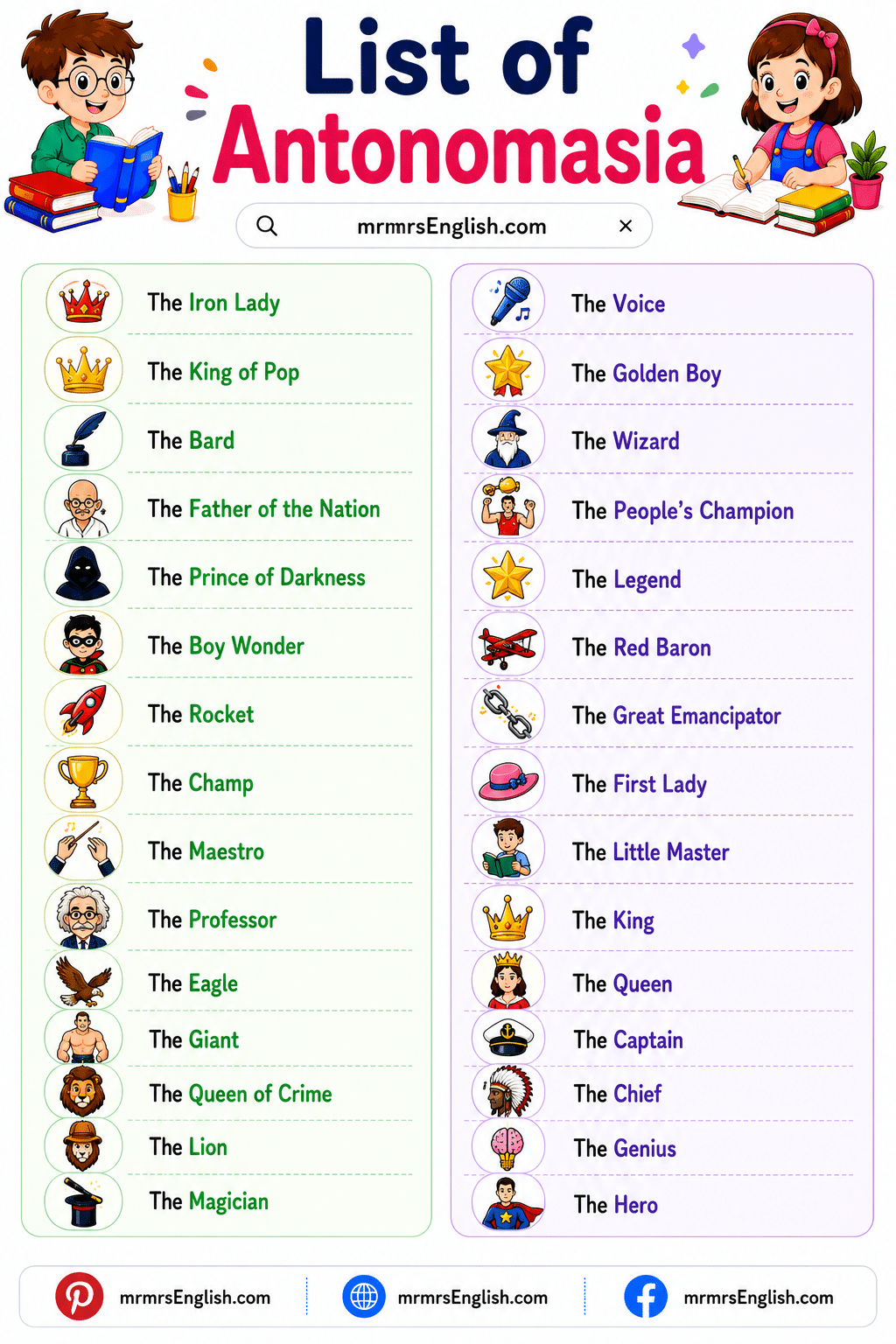
- The Iron Lady
- The King of Pop
- The Bard
- The Father of the Nation
- The Prince of Darkness
- The Boy Wonder
- The Rocket
- The Champ
- The Maestro
- The Professor
- The Eagle
- The Giant
- The Queen of Crime
- The Lion
- The Magician
- The Voice
- The Golden Boy
- The Wizard
- The People’s Champion
- The Legend
- The Red Baron
- The Great Emancipator
- The First Lady
- The Little Master
- The King
- The Queen
- The Captain
- The Chief
- The Genius
- The Hero
Antonomasia Examples in English
Learn more helpful articles

Leave a Comment