
Allegory is a literary device in which a story, character, or event represents a deeper meaning, often teaching a moral lesson or expressing an idea about life, society, or human nature. It is commonly used in literature, fables, religious texts, and creative writing to communicate important messages through symbols. Learning what allegory is, its meaning, definition, and examples in English helps students and English learners understand this important figure of speech and improve their reading and writing skills. In this article, you will learn a simple explanation, clear examples, and practical uses of allegory in easy to understand English.
What is an Allegory in English?
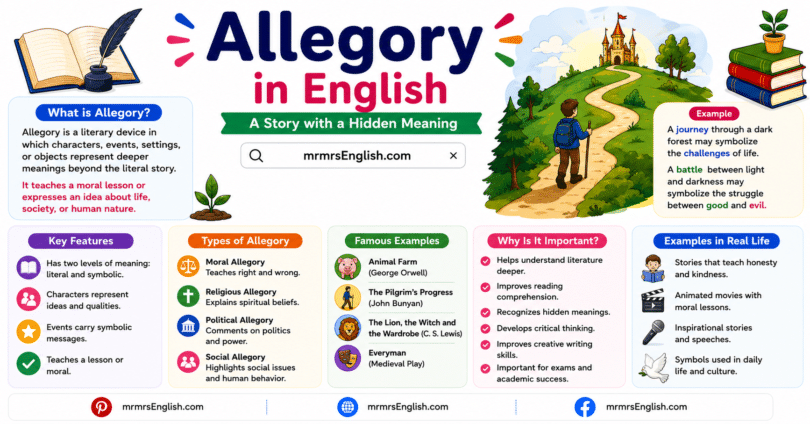
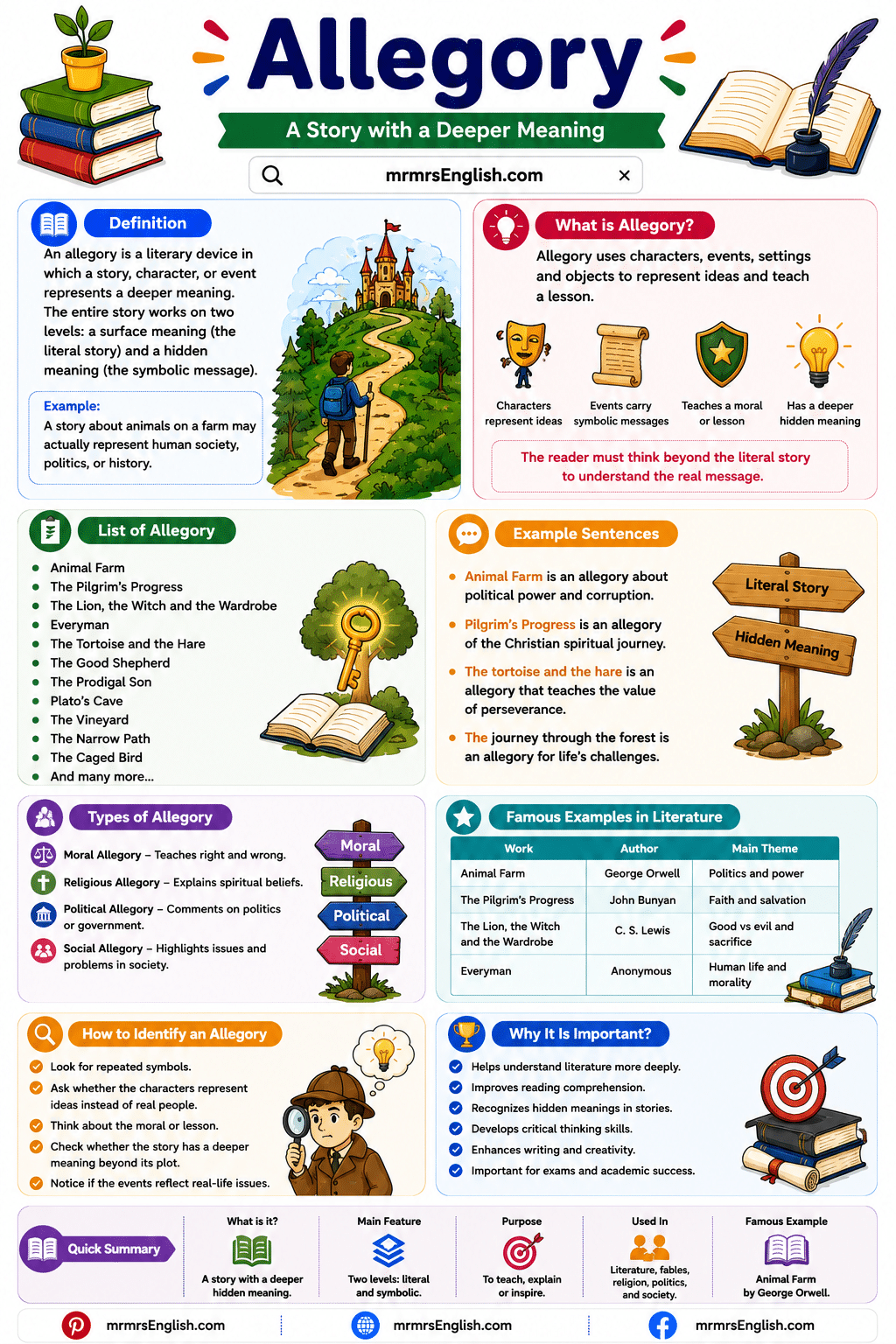
An allegory is a literary device in which the characters, events, settings, and objects represent deeper meanings beyond the literal story. The entire story works on two levels: one is the surface story, and the other is the hidden symbolic meaning. For example, a story about animals living on a farm may actually represent human society, politics, or history.
An allegory is often written to teach a lesson, share a moral, or express important ideas without stating them directly.
Why Is Allegory Important?
Learning an allegory helps you:
- Understand literature more deeply.
- Improve reading comprehension.
- Recognize hidden meanings in stories.
- Develop critical thinking skills.
- Write more creative essays and stories.
- Prepare for English literature exams.
How Does an Allegory Work?
An allegory tells a complete story while also communicating another message through symbolism.
For example:
- A journey through a dark forest may symbolize the challenges of life.
- A battle between light and darkness may symbolize the struggle between good and evil.
Every important part of an allegory usually has a symbolic meaning.
Main Characteristics of Allegory
An allegory has several unique features that make it different from ordinary stories.
It Has Two Meanings
Every allegory has:
- A literal meaning (the actual story).
- A symbolic meaning (the hidden message).
Characters Represent Ideas
Characters often symbolize qualities or ideas instead of just being ordinary people.
Examples:
- Wisdom
- Justice
- Greed
- Courage
- Freedom
Events Carry Symbolic Messages
The events in an allegory usually represent real-life situations or moral lessons.
For example, a difficult journey may represent personal growth.
It Teaches a Lesson
Many allegories are written to teach readers about:
- Honesty
- Kindness
- Responsibility
- Justice
- Faith
- Leadership
Types of Allegory in English
Moral Allegory
A moral allegory teaches readers about right and wrong.
Example:
A story where honesty is rewarded and dishonesty leads to failure.
Religious Allegory
A religious allegory explains spiritual beliefs and values through symbolic stories.
Example:
The Pilgrim’s Progress by John Bunyan.
Political Allegory
Political allegories use fictional stories to comment on governments, politics, or society.
Example:
Animal Farm by George Orwell.
The farm animals represent political leaders and historical events.
Social Allegory
A social allegory highlights problems within society, such as inequality, poverty, or injustice.
Many novels and plays use social allegories to encourage change.
Types of Allegory in English
Common Examples of Allegory
| Allegory | Hidden Meaning |
|---|---|
| Animal Farm | Political revolution and power |
| The Pilgrim’s Progress | Spiritual journey |
| The Lion, the Witch and the Wardrobe | Good versus evil and sacrifice |
| Everyman | Human life and morality |
| The Tortoise and the Hare | Patience and perseverance |
Allegory in Literature
Allegory has been used in literature for centuries because it allows writers to discuss serious topics creatively.
Some famous allegorical works include:
| Book | Author | Main Theme |
|---|---|---|
| Animal Farm | George Orwell | Politics and power |
| The Pilgrim’s Progress | John Bunyan | Faith and salvation |
| Everyman | Anonymous | Human morality |
| The Faerie Queene | Edmund Spenser | Virtue and honor |
These works entertain readers while encouraging them to think about deeper meanings.
Allegory in Everyday Life
Although allegories are most common in literature, symbolic stories also appear in daily life.
Examples include:
- Children’s stories that teach honesty.
- Animated movies with moral lessons.
- Short stories about teamwork and kindness.
- Inspirational videos with symbolic characters.
Allegory in Education
Teachers use allegories to help students understand difficult ideas.
For example:
A story about planting a seed may represent the importance of education and patience.
This method helps students connect abstract ideas with familiar experiences.
Difference Between Allegory and Symbolism
Many learners confuse allegory with symbolism.
| Allegory | Symbolism |
|---|---|
| The entire story has a hidden meaning. | A single object or image represents an idea. |
| Uses many symbols throughout the story. | Focuses on one or a few symbols. |
| Longer and more detailed. | Can appear in a sentence or paragraph. |
Example of Symbolism
- A dove represents peace.
Example of Allegory
- An entire story where every character and event symbolizes larger ideas.
Difference Between Allegory and Fable
Although both teach lessons, they are different.
| Allegory | Fable |
|---|---|
| Usually longer. | Usually short. |
| The entire story is symbolic. | Often features talking animals. |
| Can discuss politics, religion, or society. | Mainly teaches a simple moral lesson. |
Difference Between Allegory and Parable
| Allegory | Parable |
|---|---|
| Extended symbolic story. | Short story with a moral or spiritual lesson. |
| Every major element has a symbolic meaning. | Focuses mainly on one central lesson. |
Allegory Examples in Sentences
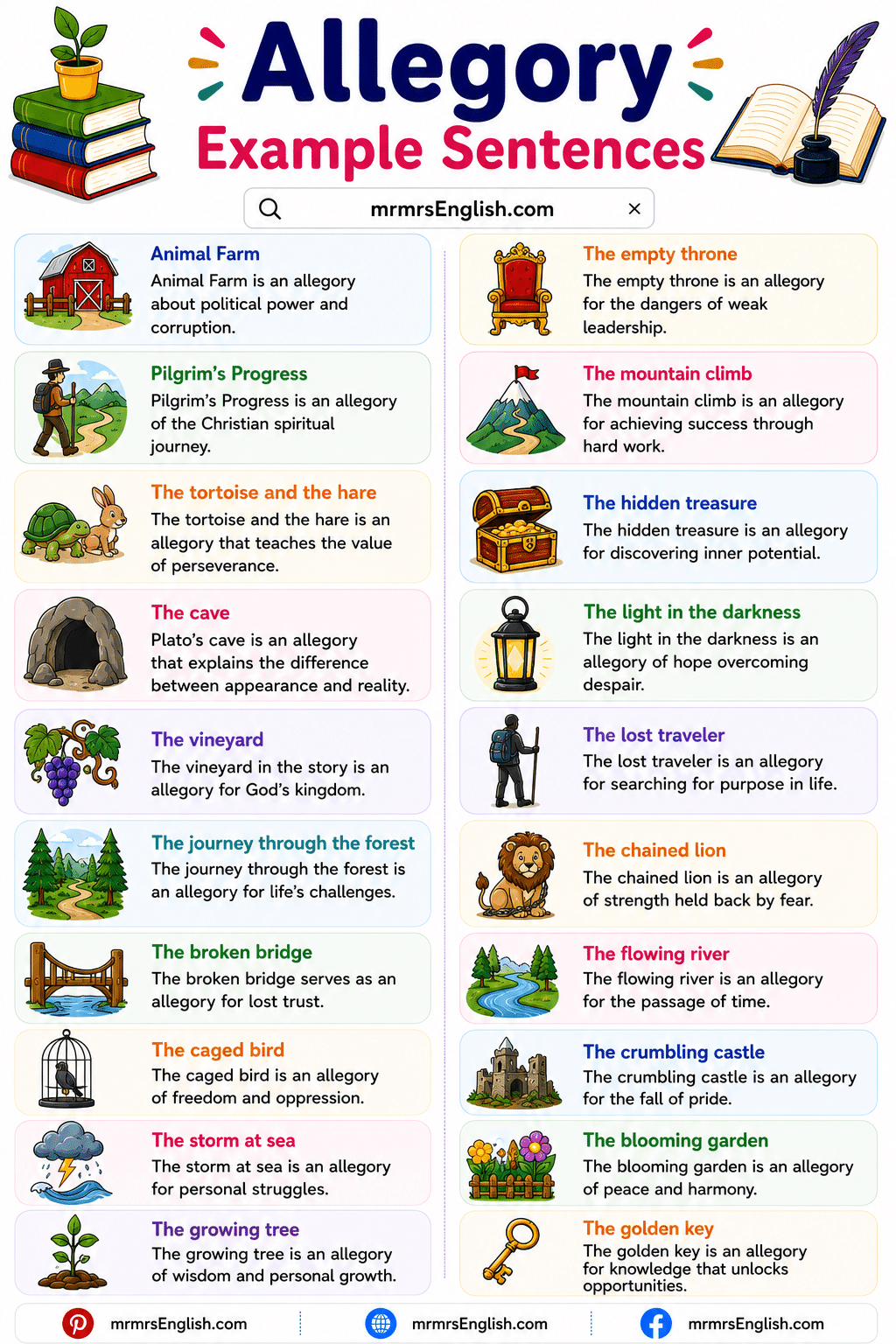
| Allegory | Example Sentence |
|---|---|
| The tortoise and the hare | The tortoise and the hare is an allegory that teaches the value of perseverance. |
| Animal Farm | Animal Farm is an allegory about political power and corruption. |
| Pilgrim’s Progress | Pilgrim’s Progress is an allegory of the Christian spiritual journey. |
| The cave | Plato’s cave is an allegory that explains the difference between appearance and reality. |
| The vineyard | The vineyard in the story is an allegory for God’s kingdom. |
| The journey through the forest | The journey through the forest is an allegory for life’s challenges. |
| The broken bridge | The broken bridge serves as an allegory for lost trust. |
| The caged bird | The caged bird is an allegory of freedom and oppression. |
| The storm at sea | The storm at sea is an allegory for personal struggles. |
| The growing tree | The growing tree is an allegory of wisdom and personal growth. |
| The empty throne | The empty throne is an allegory for the dangers of weak leadership. |
| The mountain climb | The mountain climb is an allegory for achieving success through hard work. |
| The hidden treasure | The hidden treasure is an allegory for discovering inner potential. |
| The light in the darkness | The light in the darkness is an allegory of hope overcoming despair. |
| The lost traveler | The lost traveler is an allegory for searching for purpose in life. |
| The chained lion | The chained lion is an allegory of strength held back by fear. |
| The flowing river | The flowing river is an allegory for the passage of time. |
| The crumbling castle | The crumbling castle is an allegory for the fall of pride. |
| The blooming garden | The blooming garden is an allegory of peace and harmony. |
| The golden key | The golden key is an allegory for knowledge that unlocks opportunities. |
Allegory Examples in Sentences
List of Allegory in English
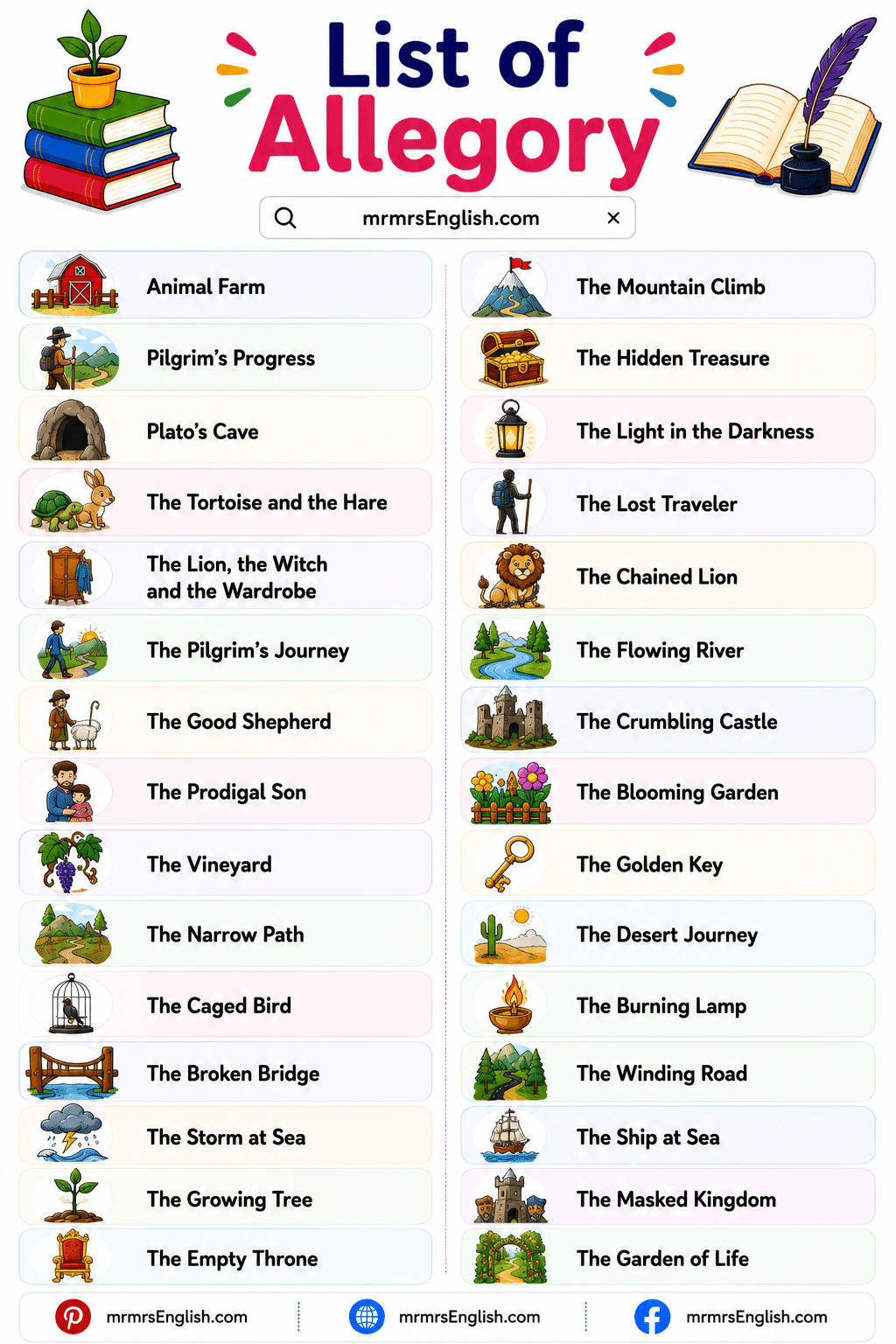
- Animal Farm
- Pilgrim’s Progress
- Plato’s Cave
- The Tortoise and the Hare
- The Lion, the Witch, and the Wardrobe
- The Pilgrim’s Journey
- The Good Shepherd
- The Prodigal Son
- The Vineyard
- The Narrow Path
- The Caged Bird
- The Broken Bridge
- The Storm at Sea
- The Growing Tree
- The Empty Throne
- The Mountain Climb
- The Hidden Treasure
- The Light in the Darkness
- The Lost Traveler
- The Chained Lion
- The Flowing River
- The Crumbling Castle
- The Blooming Garden
- The Golden Key
- The Desert Journey
- The Burning Lamp
- The Winding Road
- The Ship at Sea
- The Masked Kingdom
- The Garden of Life
List of Allegory in English
Tips for Identifying an Allegory
- Look for repeated symbols.
- Ask whether the characters represent ideas instead of real people.
- Think about the moral or lesson.
- Check whether the story has a deeper meaning beyond its plot.
- Notice if the events reflect real-life issues.
Quick Summary
| Topic | Explanation |
|---|---|
| Literary Device | Allegory |
| Purpose | To communicate deeper meanings through a symbolic story |
| Common Uses | Literature, education, speeches, and storytelling |
| Key Feature | Two levels of meaning: literal and symbolic |
| Famous Example | Animal Farm |
Learn more helpful articles

Leave a Comment