
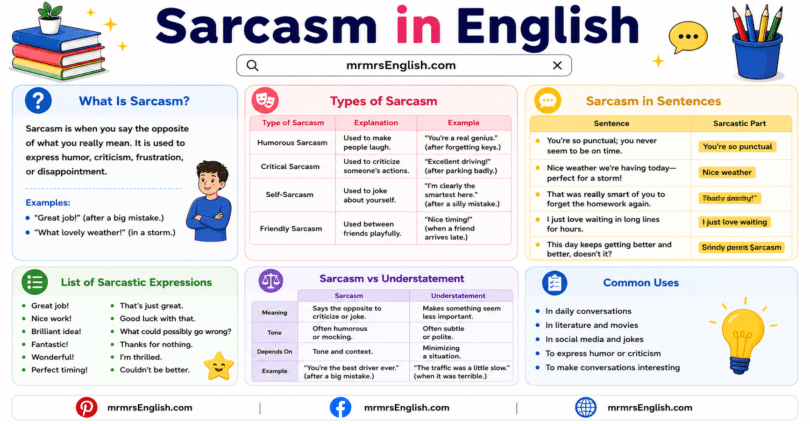
Sarcasm is a figure of speech in which someone says the opposite of what they really mean, usually to express humor, criticism, or frustration. It is commonly used in everyday conversations, movies, books, and social media, but understanding it depends on the situation and tone of voice. Learning sarcasm can improve your English vocabulary, listening skills, and understanding of real-life communication. In this article, you will learn sarcasm in English through a clear meaning and simple examples, helping students, teachers, and English learners recognize and use this figure of speech with confidence.
What Is Sarcasm in English?
Sarcasm is a way of speaking in which a person says something but actually means the opposite. It is usually used to express humor, criticism, annoyance, or disappointment. The real meaning is understood from the speaker’s tone of voice, facial expression, or the situation.
For example:
- “Great job!” (said after someone makes a big mistake.)
- “What lovely weather!” (during a heavy storm.)
The spoken words are positive, but the intended meaning is negative.
Simple Formula of Sarcasm
| Structure | Example |
|---|---|
| Positive Words + Negative Situation | “Fantastic!” after dropping your phone. |
| Praise + Obvious Failure | “You’re really organized.” after seeing a messy room. |
| Opposite Meaning + Context | “That was easy.” after an extremely difficult task. |
Why Do People Use Sarcasm?
People use sarcasm for different reasons.
- To make others laugh
- To express criticism indirectly
- To show frustration
- To add humor to conversations
- To point out mistakes
- To express disappointment
- To make conversations more interesting
Characteristics of Sarcasm
Sarcasm usually has these features:
- The words mean the opposite of the speaker’s intention.
- It often depends on tone of voice.
- It is commonly used in spoken English.
- It may express humor or criticism.
- The listener must understand the context.
- It can be playful or hurtful depending on how it is used.
Types of Sarcasm
Humorous Sarcasm
Used mainly to make people laugh without intending to hurt anyone.
Example:
- “You’re a real genius.” (after a friend forgets their keys.)
Critical Sarcasm
Used to criticize someone’s actions or behavior.
Example:
- “Excellent driving!” (after someone parks badly.)
Self-Sarcasm
People sometimes use sarcasm about themselves.
Example:
- “I’m clearly the smartest person here.” (after making a silly mistake.)
Friendly Sarcasm
Friends often use sarcasm jokingly without causing offense.
Example:
- “Nice timing!” (when a friend arrives very late.)
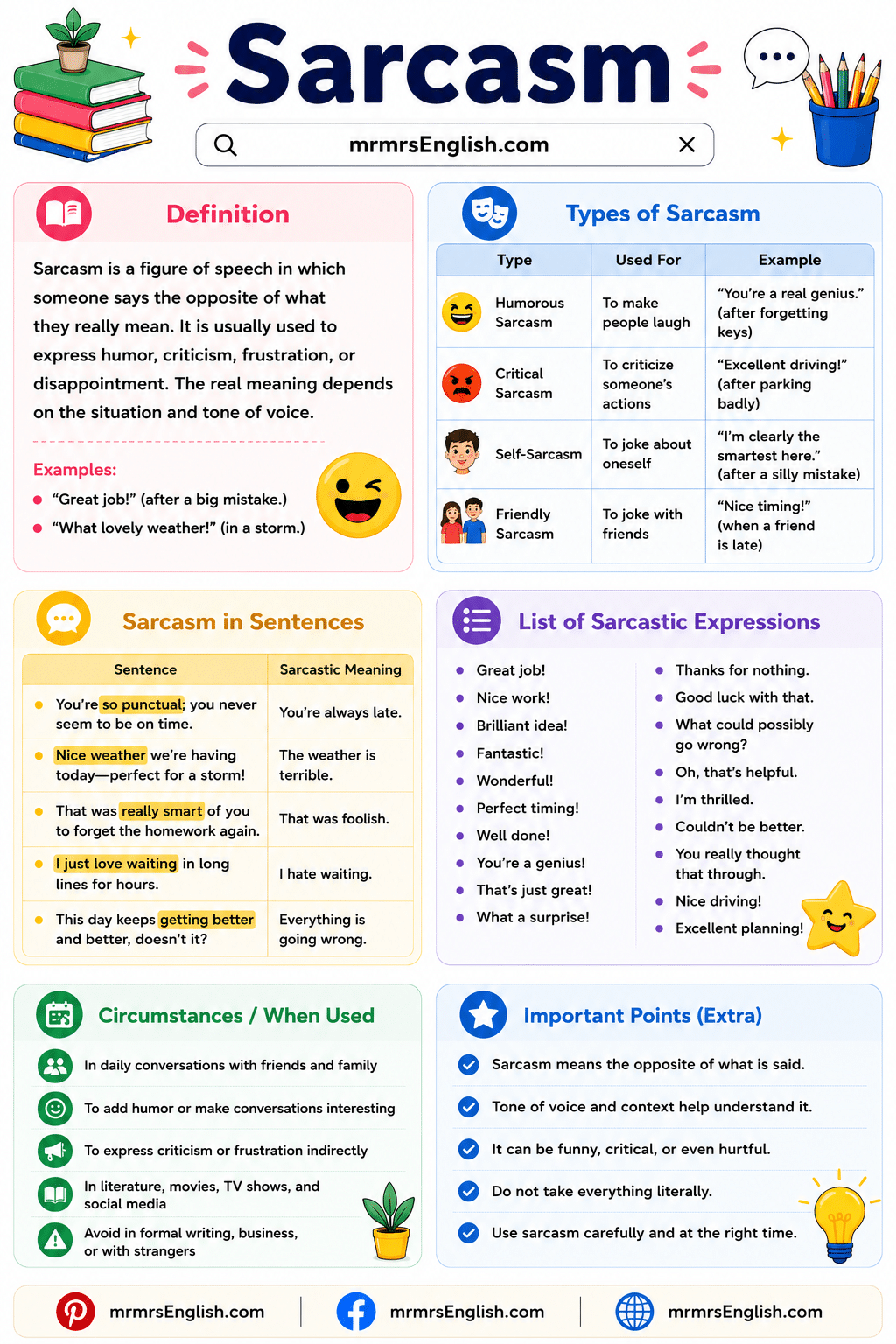
Types of Sarcasm with Examples and definition
Common Sarcastic Expressions
| Sarcastic Expression | Actual Meaning |
|---|---|
| Great job! | You did poorly. |
| Nice work! | That was a mistake. |
| Fantastic! | This is terrible. |
| Wonderful! | I’m unhappy about this. |
| Brilliant idea! | That was not a good idea. |
| Well done! | You should have done better. |
| Perfect timing! | Your timing was bad. |
| That’s helpful. | That wasn’t helpful at all. |
| Good luck with that. | It probably won’t work. |
| What could possibly go wrong? | Many things could go wrong. |
Sarcasm Examples in Everyday English
| Sentence | Real Meaning |
|---|---|
| Oh, that’s just perfect. | This is a problem. |
| You’re so punctual. (to someone who is late) | You’re always late. |
| Nice weather we’re having. (during heavy rain) | The weather is terrible. |
| That was really smart. | That was foolish. |
| I just love waiting in long lines. | I hate waiting. |
| This day keeps getting better. | Everything is going wrong. |
| You’re incredibly quiet today. (to someone talking nonstop) | You’re talking too much. |
| That was a smooth move. | That was clumsy. |
| Well, that solved everything. | It solved nothing. |
| You really thought that through. | You didn’t think carefully. |
Sarcasm in Literature
Writers use sarcasm to make dialogue more realistic, develop characters, or criticize people and situations.
Sarcasm can make readers laugh while also encouraging them to think about a deeper message.
Example: After failing the exam, he smiled and said, “Well, that went wonderfully.”
The sentence expresses disappointment by saying the opposite of what is true.
Sarcasm in Daily Conversation
Sarcasm is common in informal spoken English.
Examples include:
- “You’re early.” (to someone who arrives late.)
- “Nice mess!”
- “That couldn’t have gone any better.”
- “Sure, because that always works.”
- “Amazing choice.”
Native speakers often recognize sarcasm through facial expressions and tone of voice.
Sarcasm in Writing
Because readers cannot hear your voice, sarcasm may sometimes be misunderstood in writing.
Writers often use context or punctuation to make sarcastic meaning clear.
Sarcasm commonly appears in:
- Novels
- Comedy shows
- Movies
- Social media posts
- Opinion articles
- Humorous blogs
Difference Between Sarcasm and Irony
Many learners confuse sarcasm with irony.
| Sarcasm | Irony |
|---|---|
| Usually intended to criticize or mock | May simply show a contrast |
| Often uses a sharp or humorous tone | Does not always criticize |
| Common in spoken conversations | Common in stories and real-life situations |
| Speaker intentionally means the opposite | Meaning depends on unexpected contrast |
Example
Sarcasm
- “Fantastic driving!” (after someone causes an accident.)
Irony
- A firefighter’s house catches fire.
The second example is ironic but not sarcastic because no one is speaking.
Sarcasm vs Understatement
| Sarcasm | Understatement |
|---|---|
| Says the opposite to criticize or joke | Makes something seem less important than it really is |
| Often humorous or mocking | Often subtle or polite |
| Depends on tone | Depends on minimizing a situation |
Examples
Sarcasm
- “You’re the best driver ever.” (after a driving mistake.)
Understatement
- “The traffic was a little slow.” (when the traffic was extremely heavy.)
Sarcasm vs Hyperbole
| Sarcasm | Hyperbole |
|---|---|
| Opposite meaning | Deliberate exaggeration |
| Often expresses criticism | Makes something sound much bigger or smaller |
| Depends on context | Depends on exaggeration |
Common Words Used in Sarcasm
These words often appear in sarcastic expressions:
- Great
- Perfect
- Wonderful
- Fantastic
- Brilliant
- Amazing
- Excellent
- Nice
- Sure
- Obviously
How to Recognize Sarcasm
Ask yourself these questions:
- Does the situation match the words?
- Is the speaker smiling or using a special tone?
- Do the words seem opposite to reality?
- Is the sentence meant as humor or criticism?
If the answer is yes, the speaker is probably being sarcastic.
Tips for Using Sarcasm Correctly
- Use sarcasm carefully because not everyone understands it.
- Avoid sarcasm in formal writing.
- Consider the listener’s feelings.
- Use it mainly with people who know your sense of humor.
- Remember that tone of voice is very important.
Common Mistakes Students Make
Taking Sarcasm Literally
Many English learners think sarcastic statements are true because they focus only on the words instead of the context.
Confusing Sarcasm with Irony
Sarcasm is usually spoken and intentional, while irony can happen without anyone saying anything.
Using Sarcasm in Formal Situations
Sarcasm is generally inappropriate in business emails, academic writing, official letters, or professional communication.
Overusing Sarcasm
Using sarcasm too often can confuse people or make conversations sound negative.
Practice Exercise
Identify whether the following sentences are sarcastic.
| Sentence | Answer |
|---|---|
| Great job! (after spilling coffee) | Sarcasm |
| I really enjoy homework. (when complaining) | Sarcasm |
| The sun rises in the east. | Not sarcasm |
| Perfect timing! (after arriving an hour late) | Sarcasm |
| She passed the exam. | Not sarcasm |
List of Sarcasm in English
- Great job!
- Nice work!
- Brilliant idea!
- Fantastic!
- Wonderful!
- Perfect timing!
- You’re a genius.
- That’s just great.
- Well done!
- What a surprise!
- I just love this.
- That went well.
- You’re so organized.
- Nice driving!
- Amazing effort!
- You’re early.
- This is exactly what I needed.
- Thanks for nothing.
- What could possibly go wrong?
- Oh, that’s helpful.
- You’re so funny.
- That was smooth.
- Excellent planning.
- Good luck with that.
- You really thought that through.
- I’m thrilled.
- Couldn’t be better.
- What a masterpiece!
- That’s exactly how I wanted it.
- You’re making my day.
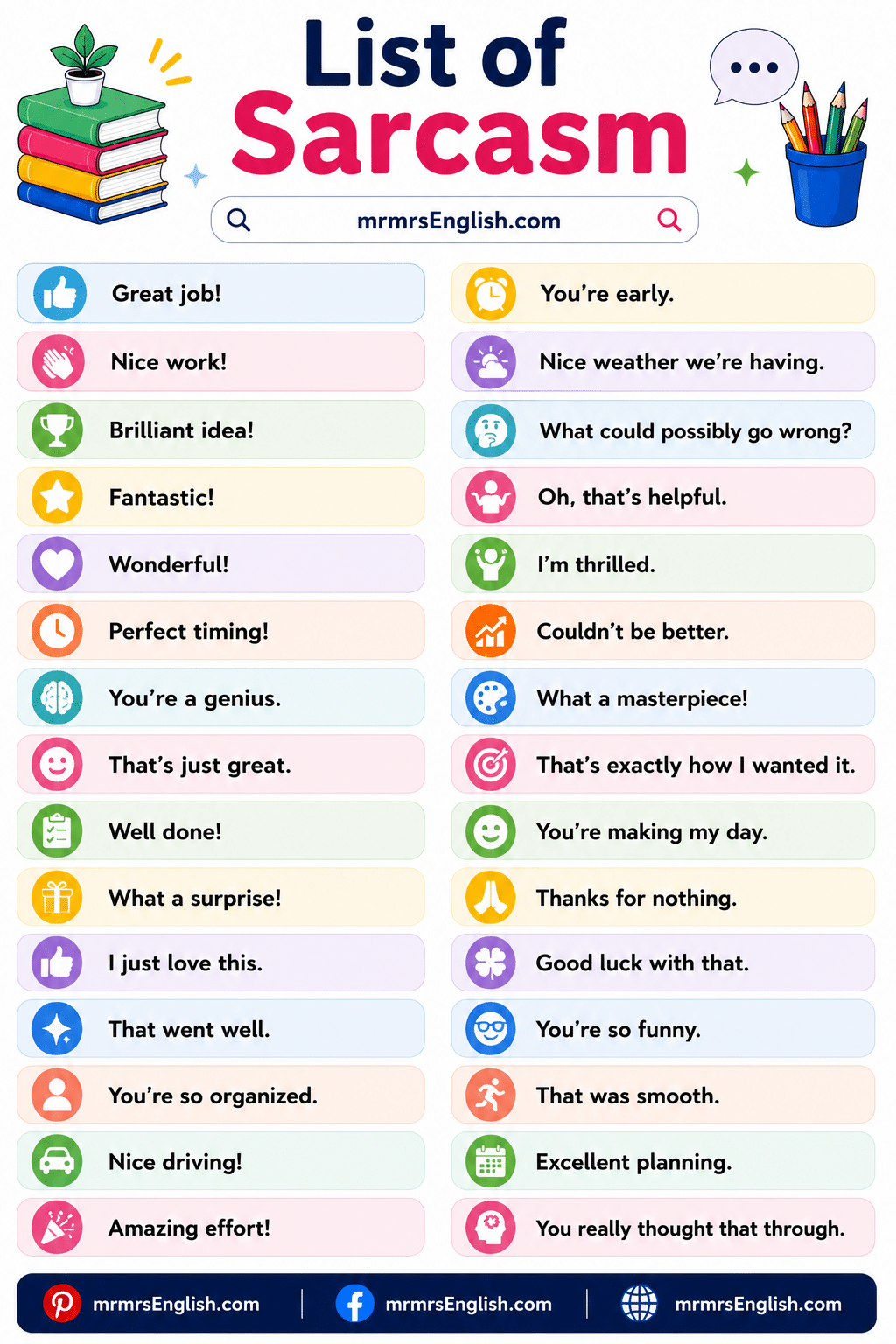
List of Sarcasm Examples in English
Sarcasm Example Sentences in English
| Sarcasm | Example Sentence |
|---|---|
| Great job! | Great job! You deleted the entire project by mistake. |
| Nice work! | Nice work! Now we’ll have to start all over again. |
| Brilliant idea! | Brilliant idea! Let’s forget our umbrellas during the storm. |
| Perfect timing! | Perfect timing! You arrived just as the meeting ended. |
| Wonderful! | Wonderful! My phone battery died when I needed it most. |
| Fantastic! | Fantastic! Another traffic jam on my way to work. |
| You’re a genius. | You’re a genius. You locked the keys inside the car. |
| That’s just great. | That’s just great. The printer stopped working before the deadline. |
| Excellent planning. | Excellent planning. We forgot to book the hotel. |
| You’re so organized. | You’re so organized. Your desk is covered with papers. |
| Nice driving! | Nice driving! You missed the parking space again. |
| What a surprise! | What a surprise! He’s late once again. |
| I’m thrilled. | I’m thrilled. We have another hour of homework tonight. |
| Couldn’t be better. | Couldn’t be better. It’s raining on our picnic day. |
| Good luck with that. | Good luck with that. Finishing the project in one hour won’t be easy. |
| That was smooth. | That was smooth. You dropped your coffee everywhere. |
| You’re early. | You’re early. We only waited for thirty minutes. |
| I just love waiting. | I just love waiting. We’ve been standing in line for two hours. |
| Thanks for nothing. | Thanks for nothing. Your advice made the problem worse. |
| You really thought that through. | You really thought that through. You forgot your passport before the flight. |
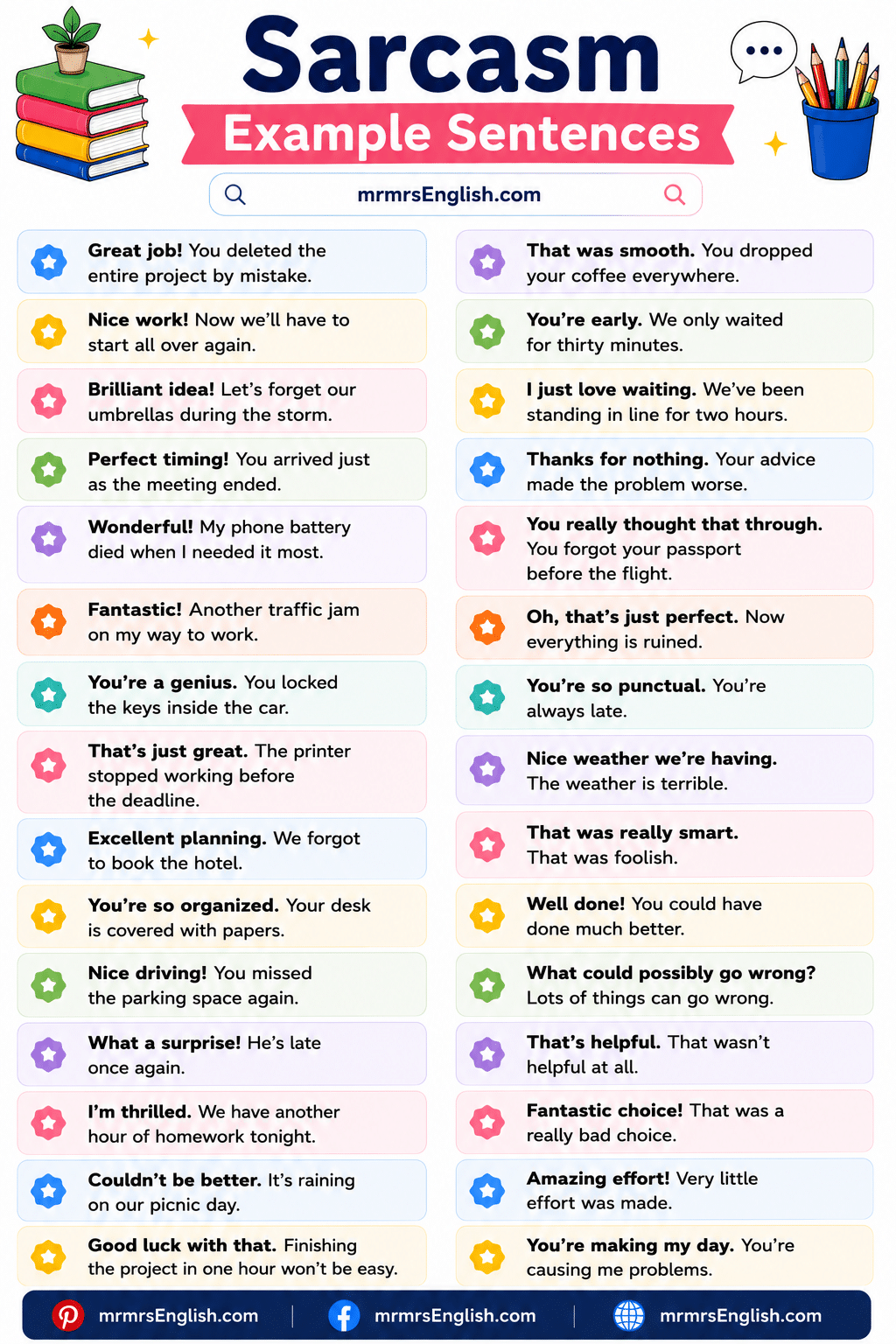
Examples of Sarcasm in Sentences in English
Learn more helpful articles



Leave a Comment