
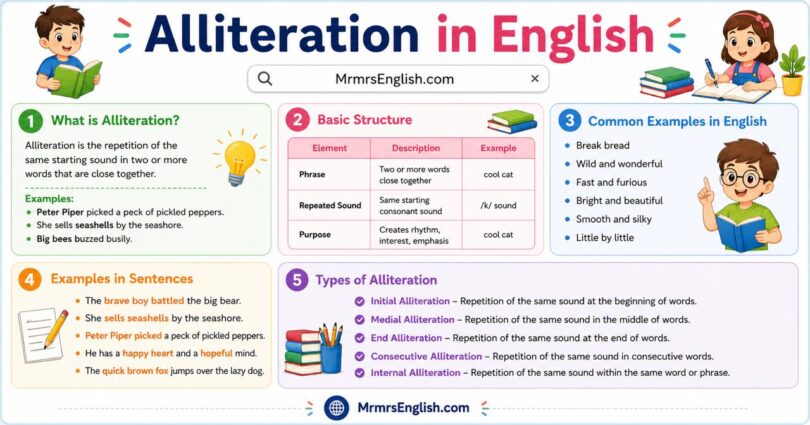
What Is Alliteration in English?
Alliteration happens when two or more nearby words begin with the same starting consonant sound.
It is based on sound, not only spelling. The repeated sound usually appears at the beginning of words placed close together.
Simple Examples:
- Peter Piper picked peppers
- Big black bear
- Sweet summer sun
- Wild windy weather
In these examples, the same beginning sound repeats and creates a musical effect.
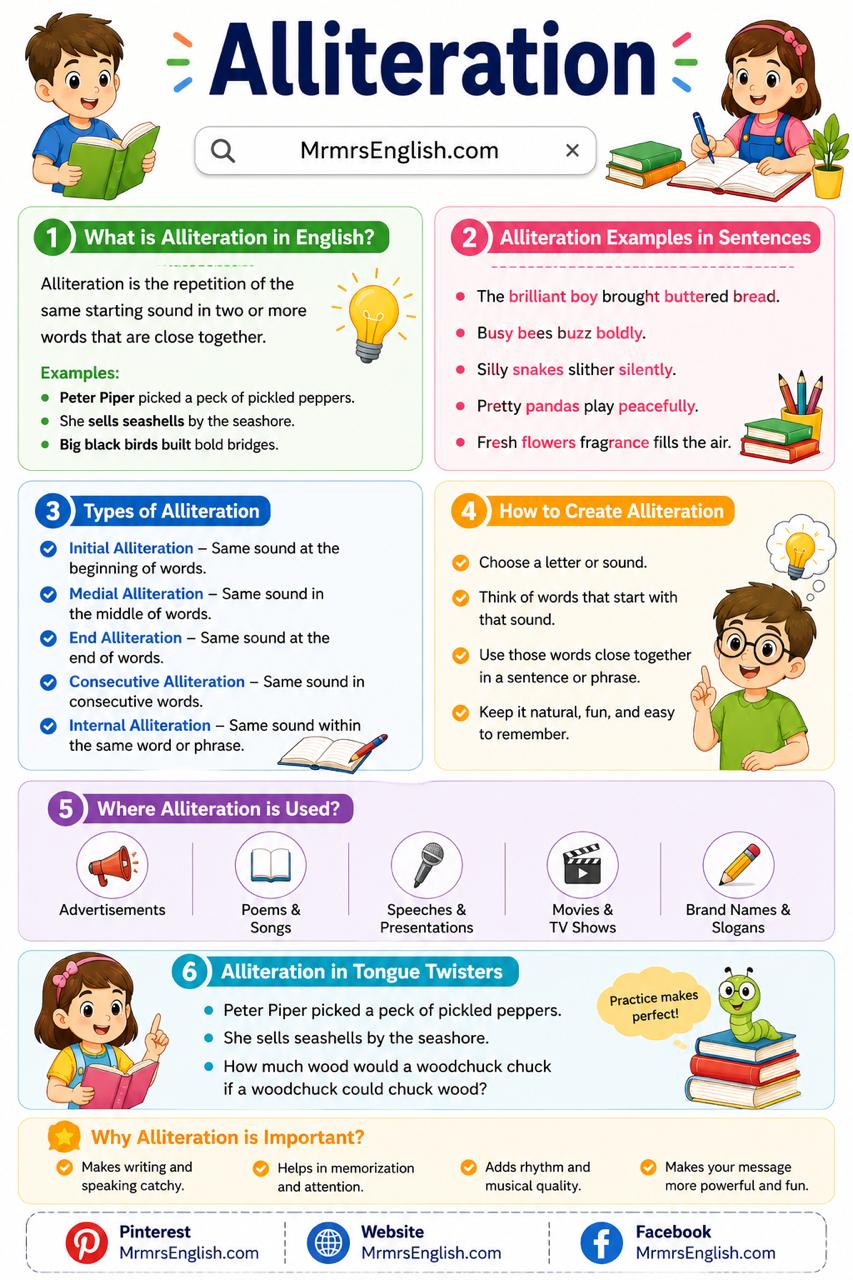
What Is Alliteration in English?
Easy Alliteration meaning in English
Alliteration means using the same first sound in nearby words to make language more interesting and easier to remember.
It is often used in:
- Poems
- Stories
- Speeches
- Brand names
- Slogans
- Tongue twisters
Basic Structure of Alliteration
Pattern:
Same beginning consonant sound + nearby words
Examples:
| Phrase | Repeated Sound |
|---|---|
| Silver silent sea | S |
| Busy buzzing bee | B |
| Clever curious cat | C |
| Funny flying fox | F |
Important Rule of Alliteration
Alliteration depends on sound, not just letters.
Example:
- City cycle = Yes (same s sound)
- Phone photo = Yes (same f sound)
- Ghost giant = No (different starting sounds)
This is why pronunciation matters.
Common Examples of Alliteration in English
Everyday Examples
- Safe and sound
- Time and tide
- Live and learn
- Dead as a doornail
Fun Examples
- Dancing dolphins dive deeply
- Brave boys build bridges
- Tiny turtles travel together
Why Is Alliteration Used?
Alliteration makes language stronger and more effective.
Main Benefits:
- Creates rhythm and musical sound
- Makes phrases easy to remember
- Adds beauty to writing
- Grabs attention
- Improves poetry and speeches
- Makes advertisements catchy
Alliteration in Literature
Writers often use alliteration in poems and stories.
Example:
- The golden grass glowed gently.
This creates a soft and pleasant sound.
Another Example:
- The dark dragon danced dangerously.
This creates energy and drama.
Alliteration in Advertisements
Many companies use alliteration because it is memorable.
Examples:
- Coca-Cola
- Best Buy
- PayPal
- Dunkin’ Donuts
These names are easier to remember because of repeated sounds.
Alliteration in Tongue Twisters
Tongue twisters often use alliteration for fun speaking practice.
Examples:
- She sells seashells by the seashore.
- Peter Piper picked a peck of pickled peppers.
- Big black bugs bleed blue black blood.
These are useful for pronunciation practice.
Types of Alliteration
1. Simple Alliteration
Repeated sound in two nearby words.
Example:
- Cold coffee
2. Multiple Alliteration
Repeated sound in many words.
Example:
- Silly snakes silently slithered south.
3. Continuous Alliteration
Repeated sound across a whole sentence.
Example:
- Brave Ben bought bright blue balloons.
Alliteration vs Repetition
| Alliteration | Repetition |
|---|---|
| Same beginning sound repeats | Same word or phrase repeats |
| Big brown bear | Run, run, run |
| Sound device | Word device |
Alliteration vs Rhyme
| Alliteration | Rhyme |
|---|---|
| Beginning sound repeats | Ending sound repeats |
| wild wind | light / night |
| near words | often line endings |
Alliteration in Poetry
Poets use alliteration to improve rhythm and beauty.
Example:
- Soft stars shone silently
This line sounds smooth and peaceful.
Example:
- Crashing clouds covered the sky
This sounds powerful and dramatic.
How to Create Alliteration
Follow these easy steps:
- Choose a consonant sound.
- Think of words starting with that sound.
- Place them close together.
- Make a meaningful phrase or sentence.
Example:
Choose B
Words: bright, blue, bird, beautiful
Sentence: The bright blue bird sang beautifully.
Alliteration for Students and ESL Learners
Alliteration helps learners improve:
- Pronunciation
- Vocabulary
- Memory
- Reading fluency
- Creative writing
- Speaking confidence
It is also useful in school exams and literature questions.
Examples from Basic to Advanced Level
Basic Examples
- Red rose
- Funny fish
- Happy home
Intermediate Examples
- The silver sun shone brightly.
- Busy birds built nests.
Advanced Examples
- Mighty mountains mirrored the morning mist.
- Gentle green gardens glowed in golden light.
Common Mistakes to Avoid
1. Focusing Only on Letters
❌ Cat city (different sounds: k / s)
✔ City cycle (same s sound)
2. Using Too Many Unclear Words
❌ Brave brown bright broad broken busy box…
✔ Brave brown bear walked slowly.
3. Ignoring Meaning
Alliteration should sound good and make sense.
Examples of Alliteration Sentences in English
| Sentence | Repeated Sound |
|---|---|
| The busy bee buzzed loudly. | B |
| A wild wind blew outside. | W |
| The happy horse ran fast. | H |
| Little Lucy laughed loudly. | L |
| The silent snake slid away. | S |
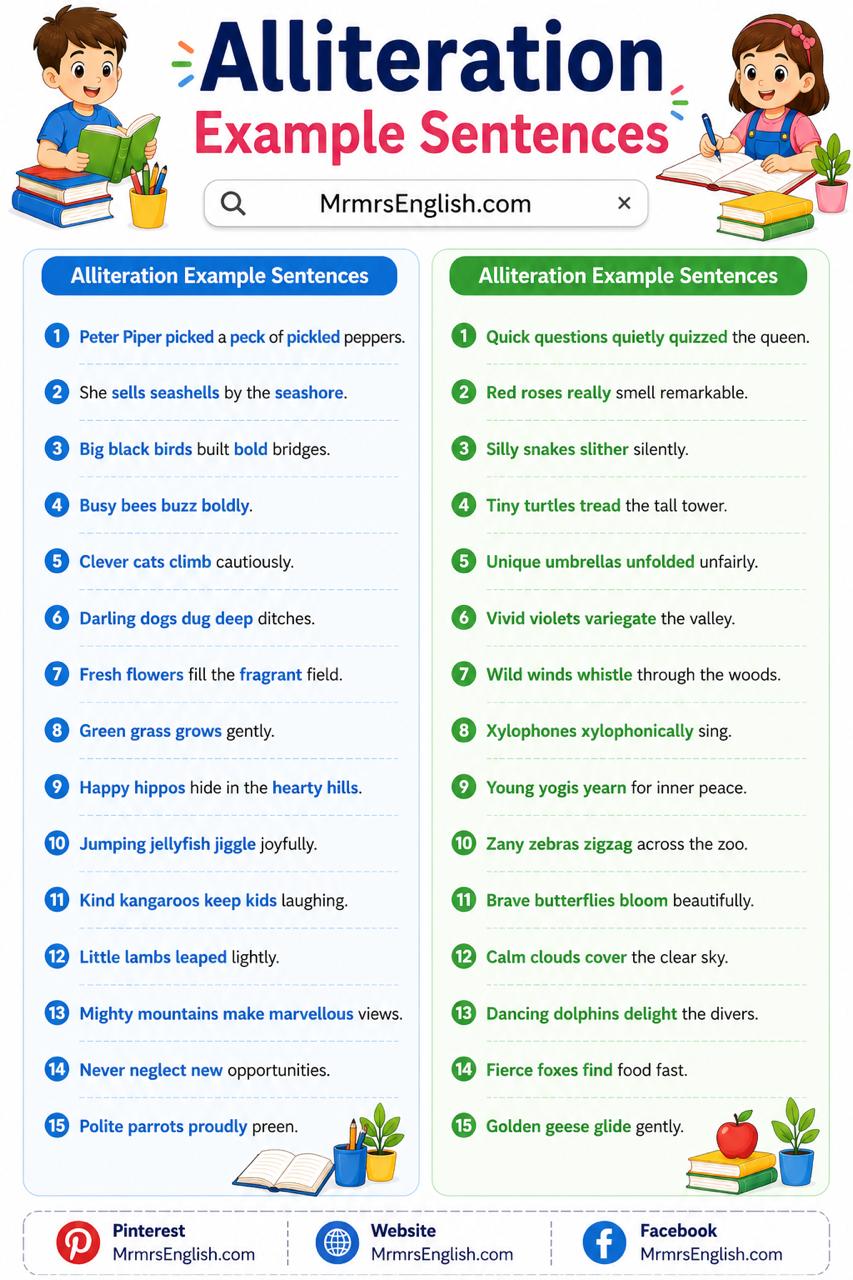
Examples of Alliteration Sentences in English
Practice Exercise
Find the repeated sound:
- Big blue balloon
- Sunny sky smiled
- Clever cats climbed carefully
- Wild wolves waited
- Pretty pink petals
Answers:
- B
- S
- C
- W
- P
Quick Revision Table
| Term | Meaning | Example |
|---|---|---|
| Alliteration | Same beginning sound in nearby words | big bear |
| Sound-based | Based on pronunciation | phone photo |
| Used in poetry | Adds beauty | soft stars |
| Used in ads | Easy memory | Coca-Cola |
Importance of Alliteration in Exams
Students may be asked to:
- Identify alliteration in a sentence
- Write examples
- Explain its effect in poetry
- Compare with rhyme or repetition
Example Question:
Identify the alliteration:
Silent snakes slither slowly.
Answer: Repeated S sound.
Final Summary
Alliteration is the repetition of the same beginning consonant sound in nearby words. It is used to create rhythm, beauty, and memorable expressions. It appears in poems, stories, speeches, and advertisements.
By learning alliteration, students can improve pronunciation, writing style, and understanding of English literature.
FAQs
What is alliteration in simple words?
It is when nearby words begin with the same sound.
Give one example of alliteration.
Busy bees buzzed.
Is alliteration based on letters or sounds?
It is based on sounds.
Why is alliteration important?
It makes language interesting, catchy, and easier to remember.
Is alliteration used in daily English?
Yes. Many common phrases and brand names use alliteration.
Learn more helpful articles

Leave a Comment