
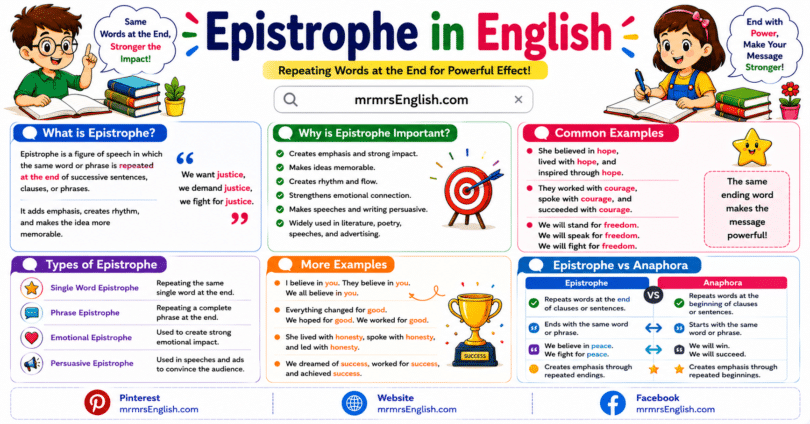
Epistrophe is a figure of speech in which the same word or phrase is repeated at the end of successive sentences, clauses, or phrases. This repetition adds emphasis, creates rhythm, and makes an idea more memorable for the reader or listener. Epistrophe is commonly used in literature, poetry, speeches, and persuasive writing to strengthen a message. In this article, you will learn what epistrophe is, its meaning, and simple examples in English to understand how it works. This guide will help students, teachers, writers, and English learners recognize epistrophe and use it correctly in their own writing and speech.
What Is Epistrophe in English?
Epistrophe is a figure of speech in which the same word or group of words is repeated at the end of two or more consecutive sentences, clauses, or phrases.
The repeated ending emphasizes an important idea and makes the sentence more powerful.
Examples
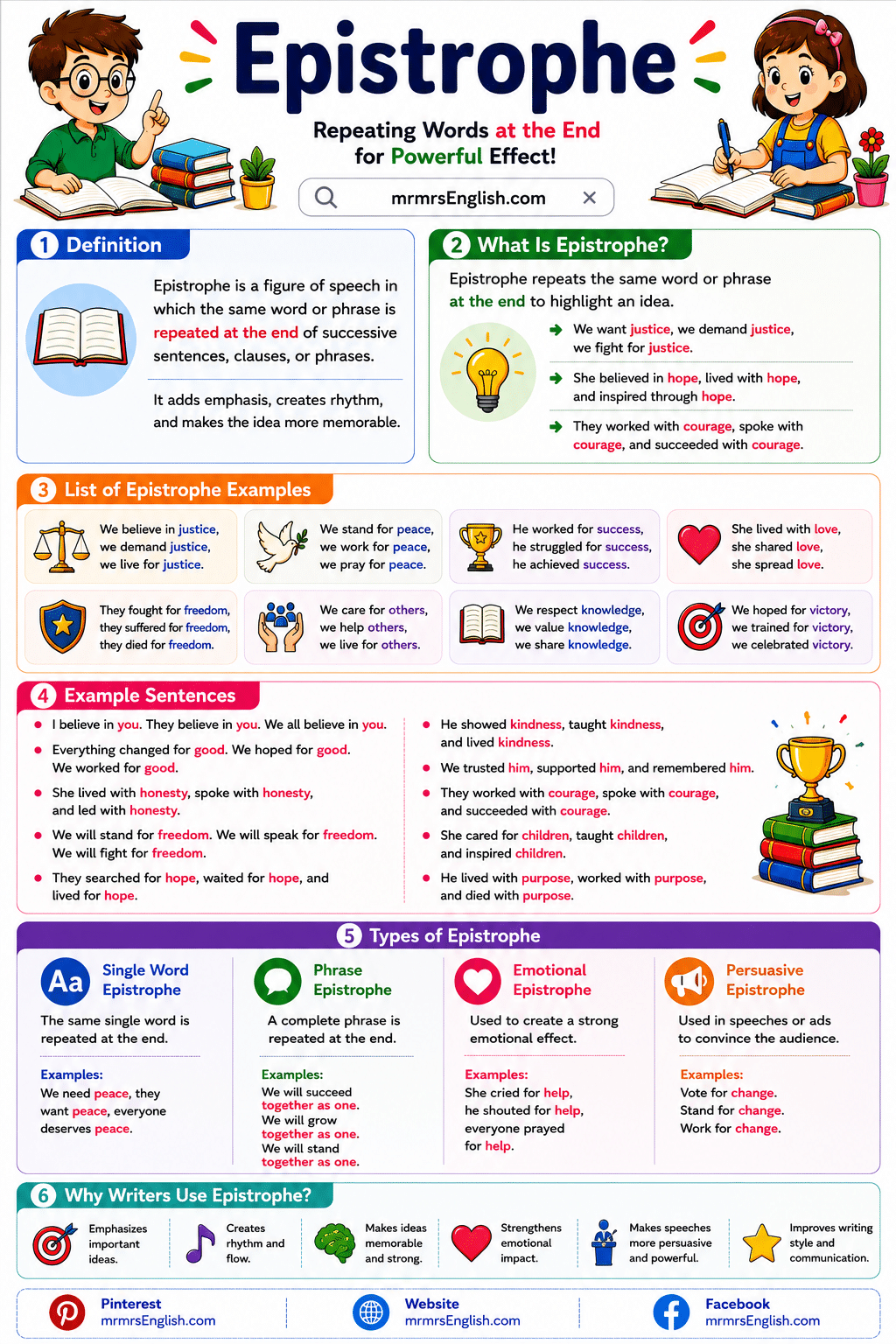
- We want justice, we demand justice, we fight for justice.
- She believed in hope, lived with hope, and inspired others through hope.
- They worked with courage, spoke with courage, and succeeded with courage.
In each example, the repeated word appears at the end.
Easy Meaning of Epistrophe
Epistrophe means repeating the same word or phrase at the end of nearby sentences or clauses to give extra emphasis.
Instead of repeating words at the beginning, epistrophe repeats them at the end.
Simple Examples
- I believe in you. They believe in you. We all believe in you.
- Everything changed for good. We hoped for good. We worked for good.
- She lived with honesty, spoke with honesty, and led with honesty.
Origin of the Word Epistrophe
The word Epistrophe comes from the Greek word epistrophē, which means “turning back” or “return.” It refers to the repeated return of the same word or phrase at the end of successive expressions.
Characteristics of Epistrophe
Epistrophe has several key features that make it easy to recognize.
- Repeats the same word or phrase at the end.
- Creates emphasis and rhythm.
- Makes ideas memorable.
- Strengthens emotional impact.
- Common in speeches, literature, poetry, and advertising.
- Improves persuasion and clarity.
How Epistrophe Works
Epistrophe works by ending consecutive clauses or sentences with the same word or phrase. The repeated ending naturally draws the reader’s attention and highlights the central message.
Example
- We will stand for freedom.
- We will speak for freedom.
- We will fight for freedom.
The repeated ending freedom makes the message stronger and easier to remember.
Types of Epistrophe
Although epistrophe follows one basic pattern, it can be used in different ways depending on the purpose.
1. Single Word Epistrophe
The same single word is repeated at the end.
Examples
- We need peace, they want peace, everyone deserves peace.
- He showed kindness, taught kindness, and lived kindness.
2. Phrase Epistrophe
A complete phrase is repeated at the end.
Examples
- We will succeed together as one.
- We will grow together as one.
- We will stand together as one.
3. Emotional Epistrophe
The repetition is used to create a strong emotional effect.
Examples
- She cried for help, he shouted for help, everyone prayed for help.
- They searched for hope, waited for hope, and lived for hope.
4. Persuasive Epistrophe
This type is used in speeches, debates, and advertisements to convince the audience.
Examples
- Vote for change.
- Stand for change.
- Work for change.
Types of Epistrophe with Examples
Rules for Using Epistrophe
Repeat the ending
The repeated word or phrase should always appear at the end.
✔ We believe in peace. We work for peace.
Use consecutive clauses or sentences
The repetition should occur in nearby clauses or sentences.
✔ She lived with hope, dreamed with hope, and succeeded with hope.
Choose meaningful repetition
Repeat important words that support the main message.
✔ They fought for freedom.
Avoid overusing it
Too much repetition can make writing sound unnatural.
Examples of Epistrophe in Sentences
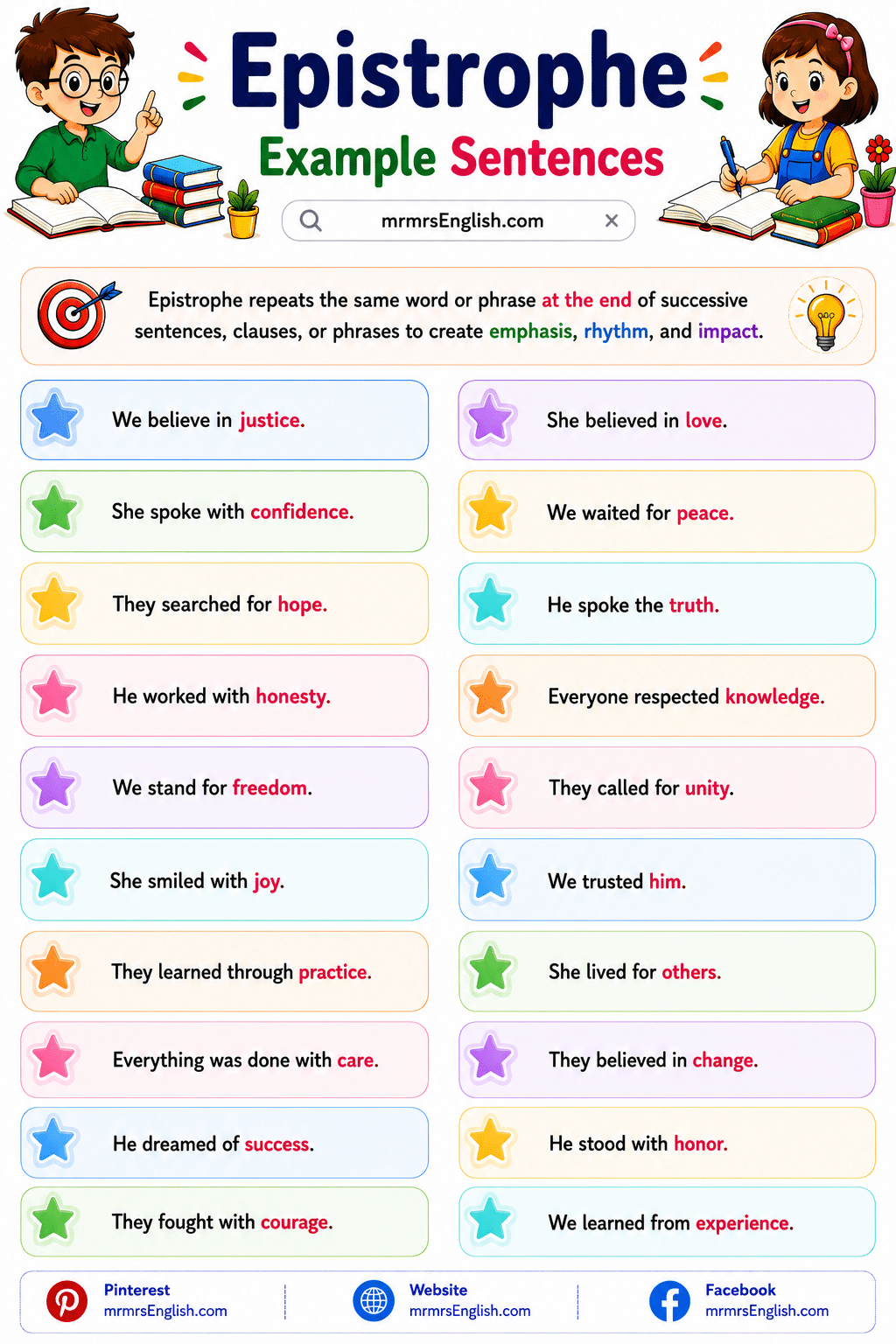
- We believe in justice, we fight for justice, we live for justice.
- She spoke with confidence, acted with confidence, and succeeded with confidence.
- They searched for hope, prayed for hope, and found hope.
- He worked with honesty, led with honesty, and retired with honesty.
- We stand for freedom, vote for freedom, and protect freedom.
- She smiled with joy, laughed with joy, and celebrated with joy.
- They learned through practice, improved through practice, and succeeded through practice.
- Everything was done with care.
- Every decision was made with care.
- Every result came from care.
- He dreamed of success, worked for success, and achieved success.
- They fought with courage, endured with courage, and won with courage.
- She believed in love, lived with love, and shared love.
- We waited for peace, hoped for peace, and celebrated peace.
- He spoke the truth, defended the truth, and lived the truth.
- Everyone respected knowledge, valued knowledge, and shared knowledge.
- They called for unity, worked for unity, and celebrated unity.
- We trusted him, supported him, and remembered him.
- She lived for others, worked for others, and sacrificed for others.
- They believed in change, voted for change, and achieved change.
- He stood with honor, served with honor, and retired with honor.
- We learned from experience, improved through experience, and succeeded because of experience.
- She cared for children, taught children, and inspired children.
- They prayed for rain, waited for rain, and celebrated rain.
- We remembered history, respected history, and learned from history.
- He searched for answers, waited for answers, and found answers.
- She believed in herself, trusted herself, and challenged herself.
- They fought against fear, rose above fear, and defeated fear.
- We hoped for victory, trained for victory, and celebrated victory.
- He lived with purpose, worked with purpose, and died with purpose.
Examples of Epistrophe in Sentences
Common Uses of Epistrophe
Epistrophe is widely used in:
- Literature
- Poetry
- Political speeches
- Religious speeches
- Advertisements
- Motivational writing
- Debates
- Everyday communication
Epistrophe in Literature
Writers use epistrophe to create rhythm, emphasize important ideas, and make passages more memorable. Repeating the same ending helps readers focus on the central theme and increases the emotional power of the writing.
Examples
- We remember with hope, we dream with hope, we live with hope.
- He fought for freedom, suffered for freedom, and died for freedom.
Epistrophe in Speeches
Public speakers often use epistrophe to persuade audiences and reinforce key messages.
Examples
- We will work for peace.
- We will sacrifice for peace.
- We will succeed through peace.
Epistrophe in Everyday English
People naturally use epistrophe in conversations when they want to stress an idea.
Examples
- I trust you. We all trust you.
- Everything depends on effort. Success comes from effort.
Epistrophe vs Anaphora
| Epistrophe | Anaphora |
|---|---|
| Repeats words at the end | Repeats words at the beginning |
| Ends with the same word or phrase | Starts with the same word or phrase |
| Creates emphasis through repeated endings | Creates emphasis through repeated beginnings |
| We believe in peace. We fight for peace. | We will win. We will succeed. |
Epistrophe vs Repetition
| Epistrophe | Repetition |
|---|---|
| Repetition only at the end of clauses or sentences | Repetition can appear anywhere |
| Follows a specific pattern | No fixed position |
| A figure of speech | A general writing technique |
Why Writers Use Epistrophe
Writers use epistrophe because it:
- Emphasizes important ideas.
- Creates rhythm and flow.
- Makes speeches more persuasive.
- Strengthens emotional impact.
- Helps readers remember key points.
- Improves literary style.
Common Mistakes to Avoid
- Repeating different words instead of the same one.
- Placing the repeated word in the middle instead of the end.
- Using too much repetition in one paragraph.
- Confusing epistrophe with anaphora.
- Repeating words that do not support the main idea.
Where is epistrophe commonly used?
It is commonly used in:
- Literature
- Poetry
- Speeches
- Advertisements
- Political debates
- Everyday conversations
What is the difference between epistrophe and anaphora?
Epistrophe repeats words at the end of clauses or sentences, while anaphora repeats words at the beginning.
Epistrophe Examples in English
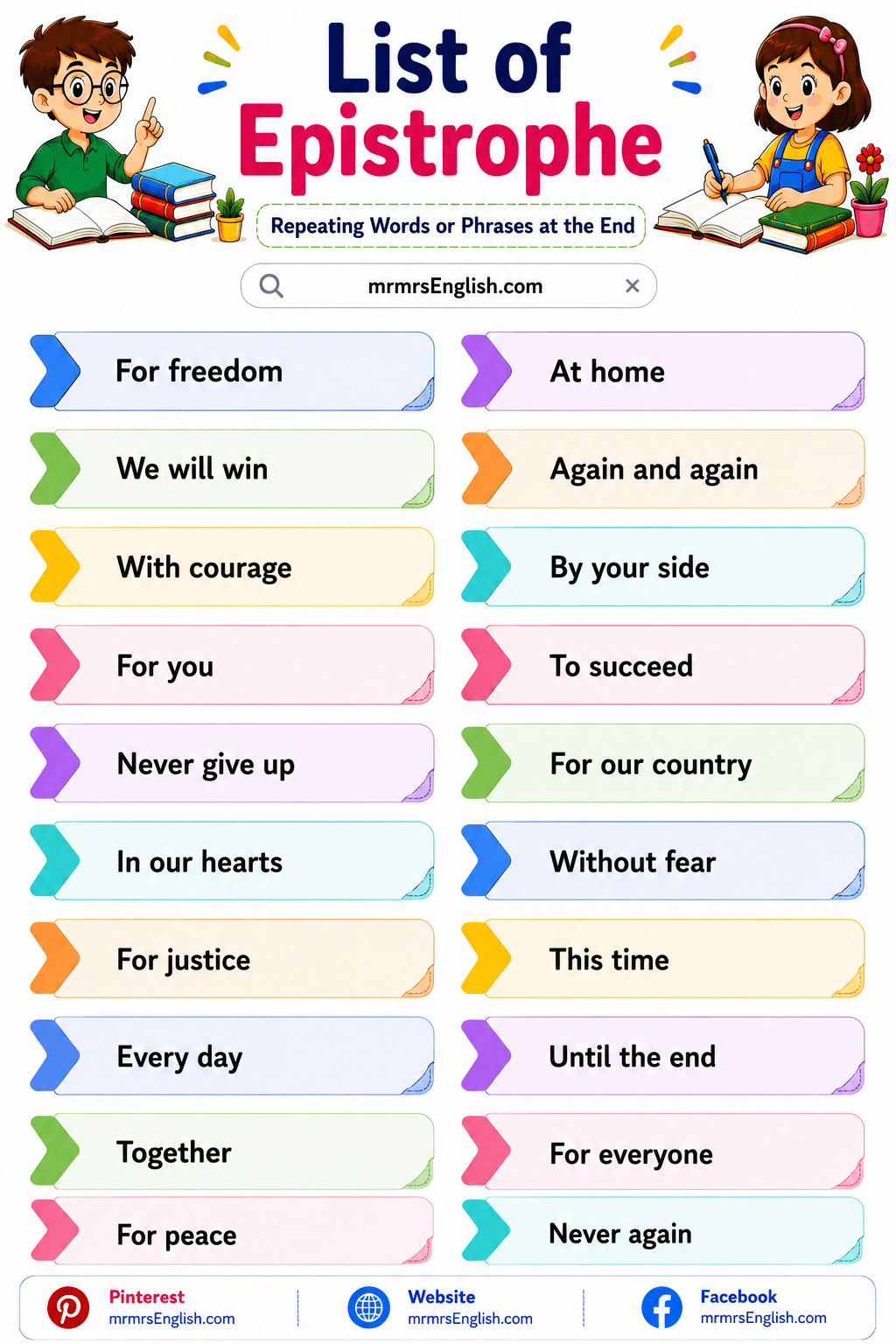
- For freedom
- We will win
- With courage
- For you
- Never give up
- In our hearts
- For justice
- Every day
- Together
- For peace
- At home
- Again and again
- By your side
- To succeed
- For our country
- Without fear
- This time
- Until the end
- For everyone
- Never again
- For love
- With hope
- For change
- All the way
- Everywhere
- Forever
- For the people
- Once again
- No matter what
- Until we win
Epistrophe Examples in English
Learn more helpful articles


Leave a Comment