
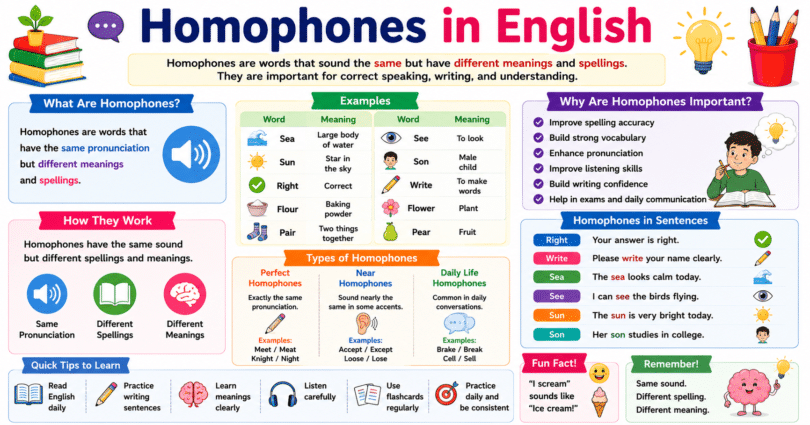
Homophones are words that sound the same when spoken but have different meanings and spellings. These words are very common in English and are often used in daily conversations, writing, and grammar lessons. Examples like “sea” and “see” or “flower” and “flour” can sometimes confuse English learners because they are pronounced alike but used in different situations. Learning homophones with meanings and examples helps students and English learners improve their vocabulary, spelling, pronunciation, and understanding of English grammar. In this article, you will learn what homophones are and explore simple examples to understand how they are used in sentences.
Table of Contents
ToggleWhat Are Homophones?
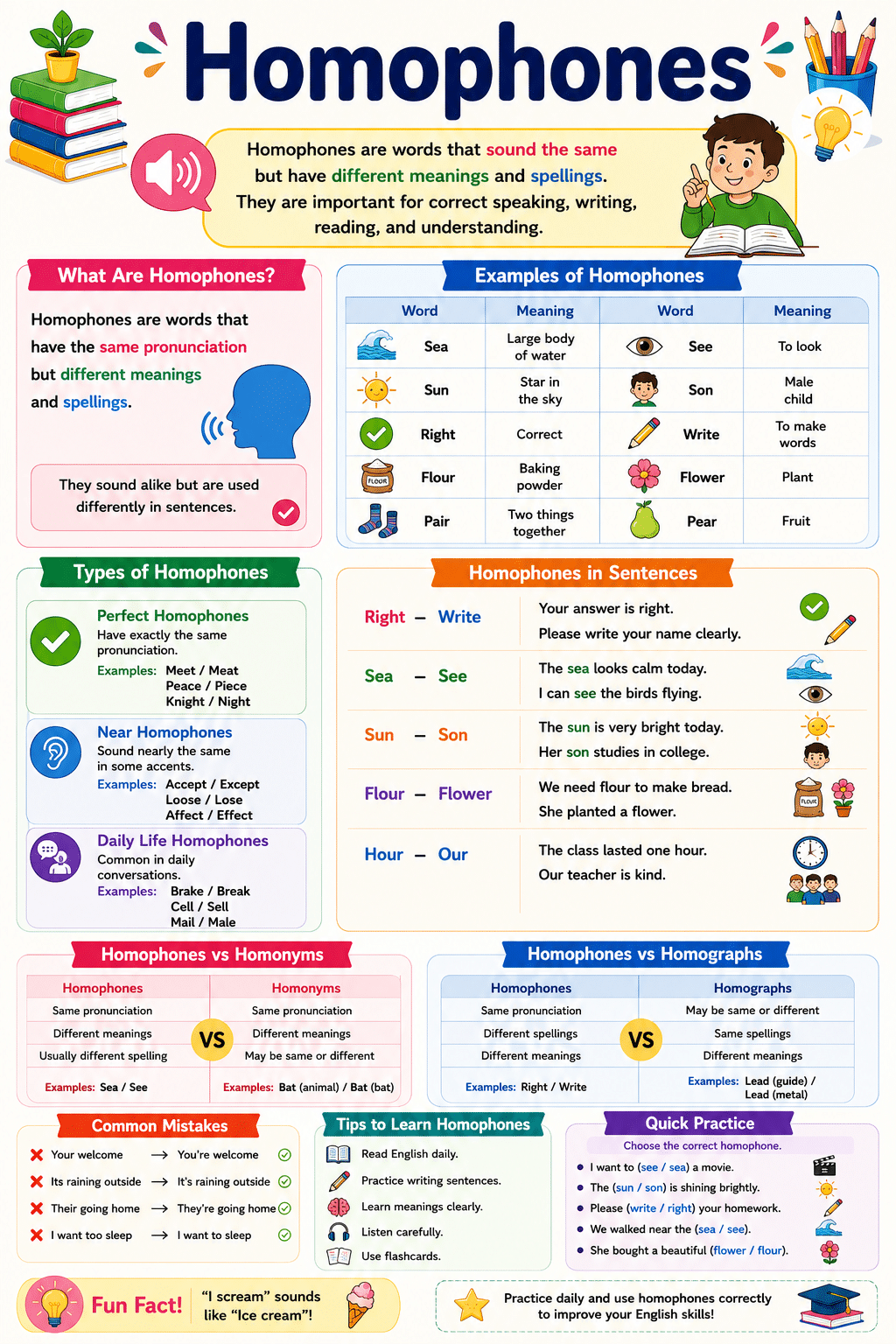
Homophones are words that have the same pronunciation but different meanings and spellings. Even though these words sound alike, they are used differently in sentences.
Examples of Homophones in English
| Homophone | Meaning | Homophone | Meaning |
|---|---|---|---|
| Sea | Large body of water | See | To look |
| Sun | Star in the sky | Son | Male child |
| Right | Correct | Write | To make words |
| Flour | Baking powder | Flower | Plant |
| Pair | Two things together | Pear | Fruit |
Why Are Homophones Important in English?
Homophones are important because they help learners improve:
- Spelling accuracy
- Vocabulary skills
- Pronunciation
- Listening ability
- Writing confidence
- Reading understanding
They are also useful in:
- School grammar exercises
- IELTS preparation
- TOEFL exams
- Essay writing
- Spoken English practice
- Competitive English tests
Main Features of Homophones
Homophones usually have three important features:
Same Pronunciation
Both words sound exactly the same when spoken.
Example
- Blue and Blew
Different Spellings
The spelling of each word is different.
Example
- Knight and Night
Different Meanings
Each word has its own meaning.
Example
- Mail means letters or parcels.
- Male means a boy or man.
Common Homophones in English
| Word | Word | Meaning |
|---|---|---|
| To | Too | Direction / Also |
| Two | Too | Number 2 / Also |
| Here | Hear | Place / Listen |
| No | Know | Negative / Understand |
| By | Buy | Near / Purchase |
| Be | Bee | Exist / Insect |
| One | Won | Number 1 / Victory |
| Weak | Week | Not strong / Seven days |
Homophones with Example Sentences
Right vs Write
| Word | Example Sentence |
|---|---|
| Right | Your answer is right. |
| Write | Please write your name clearly. |
Sea vs See
| Word | Example Sentence |
|---|---|
| Sea | The sea looks calm today. |
| See | I can see the birds flying. |
Sun vs Son
| Word | Example Sentence |
|---|---|
| Sun | The sun is very bright today. |
| Son | Her son studies in college. |
Flour vs Flower
| Word | Example Sentence |
|---|---|
| Flour | We need flour to make bread. |
| Flower | She planted a flower in the garden. |
Types of Homophones
Perfect Homophones
These homophones have exactly the same pronunciation.
Examples
- Meet / Meat
- Peace / Piece
- Knight / Night
- Whole / Hole
Near Homophones
These words sound nearly the same in some accents.
Examples
- Accept / Except
- Loose / Lose
- Affect / Effect
Daily Life Homophones
Many homophones are used in daily conversations and writing.
| Homophones | Example Sentences |
|---|---|
| Brake / Break | Use the brake carefully. / Do not break the glass. |
| Cell / Sell | He sat in a prison cell. / She wants to sell her phone. |
| Hour / Our | The class lasted one hour. / Our teacher is friendly. |
| Tail / Tale | The dog wagged its tail. / Grandpa told a funny tale. |
| Mail / Male | I received mail today. / The male lion is strong. |
Homophone Examples in English with meaning
Homophones for Students and ESL Learners
Homophones are commonly included in grammar tests and English exams. ESL learners should practice them regularly to avoid mistakes in writing and speaking.
Important Homophones for Exams
| Word | Word |
|---|---|
| Their | There |
| Hear | Here |
| Which | Witch |
| Peace | Piece |
| Principal | Principle |
| Stationary | Stationery |
Example Sentences
- Their house is beautiful.
- Put the bag over there.
- The witch flew on a broom.
- I want another piece of cake.
- Honesty is an important principle.
Difference Between Homophones and Homonyms
Many students confuse homophones with homonyms. Both are related to similar sounds, but they are slightly different.
| Feature | Homophones | Homonyms |
|---|---|---|
| Pronunciation | Same | Same |
| Meaning | Different | Different |
| Spelling | Usually different | May be same or different |
Example
- Sea and See are homophones.
- Bat (animal) and Bat (sports equipment) are homonyms.
Difference Between Homophones and Homographs
Homophones and homographs are also different grammar terms in English.
| Feature | Homophones | Homographs |
|---|---|---|
| Pronunciation | Same | May be same or different |
| Spelling | Different | Same |
| Meaning | Different | Different |
Example of Homographs
| Word | Meaning |
|---|---|
| Lead | To guide |
| Lead | A type of metal |
Advanced Homophones in English
Advanced-level homophones are important for academic writing and professional English.
| Word | Word |
|---|---|
| Complement | Compliment |
| Council | Counsel |
| Desert | Dessert |
| Allowed | Aloud |
| Affect | Effect |
Example Sentences
- Your shoes complement your dress.
- She gave me a nice compliment.
- Chocolate dessert tastes delicious.
- Camels live in the desert.
- Reading aloud improves pronunciation.
Common Mistakes with Homophones
English learners often confuse these homophones while writing.
| Incorrect Sentence | Correct Sentence |
|---|---|
| Your welcome | You’re welcome |
| Its raining outside | It’s raining outside |
| Their going home | They’re going home |
| I want too sleep | I want to sleep |
Tips to Learn Homophones Easily
Read English Daily
Reading English books, blogs, and newspapers helps learners recognize homophones naturally.
Practice Writing Sentences
Write separate sentences using each homophone correctly.
Learn Meanings Clearly
Understand the meaning before memorizing the spelling.
Listen Carefully
Listening to spoken English improves pronunciation understanding.
Use Flashcards
Flashcards help students remember meanings and spellings faster.
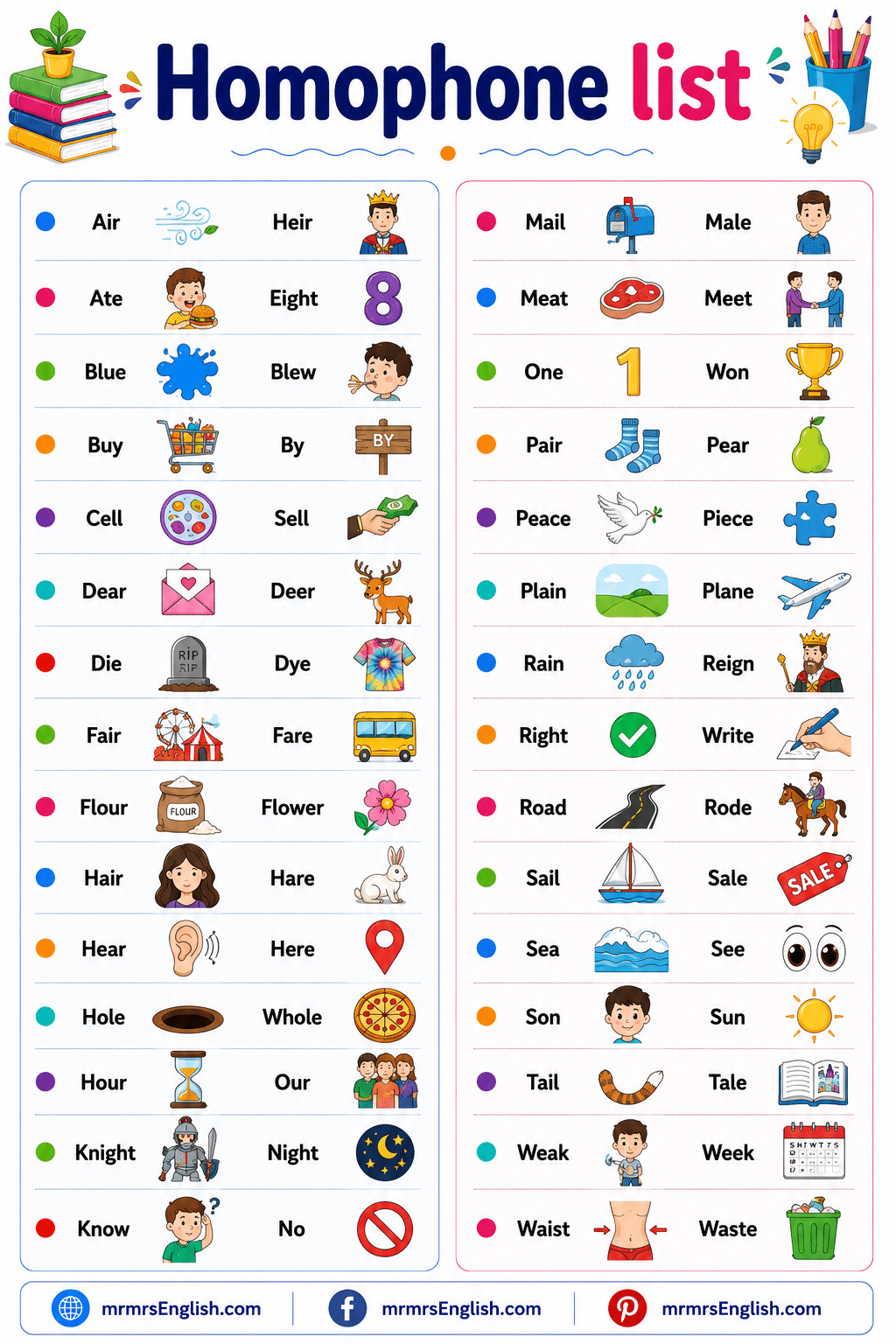
Homophones list in English
- Air — Heir
- Ate — Eight
- Blue — Blew
- Buy — By
- Cell — Sell
- Dear — Deer
- Die — Dye
- Fair — Fare
- Flour — Flower
- Hair — Hare
- Hear — Here
- Hole — Whole
- Hour — Our
- Knight — Night
- Know — No
- Mail — Male
- Meat — Meet
- One — Won
- Pair — Pear
- Peace — Piece
- Plain — Plane
- Rain — Reign
- Right — Write
- Road — Rode
- Sail — Sale
- Sea — See
- Son — Sun
- Tail — Tale
- Weak — Week
- Waist — Waste
Homophones list in English
Best Way to Master Homophones
The best way to master homophones is through regular reading, listening, and writing practice. Start with easy homophones like to, too, and two, then move toward advanced pairs. Practice daily sentences and learn meanings carefully. Over time, you will naturally understand the correct usage of each word.


Leave a Comment