
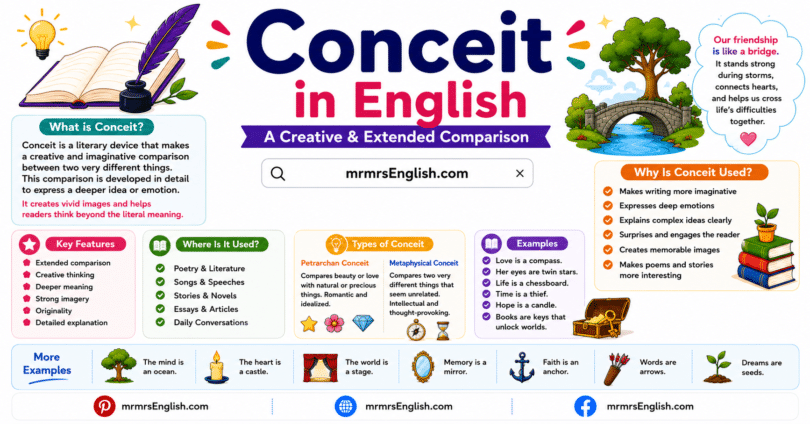
Conceit is a literary device that makes a creative and imaginative comparison between two very different things to express a deeper idea or emotion. It is commonly used in poetry and literature to create vivid images and encourage readers to think beyond the literal meaning. Learning Conceit in English with Meaning, Types, and Example Sentences helps students and English learners understand this important figure of speech while improving their reading, writing, and analytical skills. In this article, you will learn the meaning of conceit, explore its main types, and study simple example sentences that make this literary device easy to understand and use.
What Is Conceit in English?
A conceit is an extended and imaginative comparison between two completely different things. The comparison may seem unusual at first, but the writer explains it so well that it creates a deeper meaning and makes the reader think.
A conceit usually continues for several lines, paragraphs, or even throughout an entire poem instead of appearing in just one sentence.
Example:
Our friendship is like a bridge. It stands strong during storms, connects distant hearts, and helps us cross life’s difficulties together.
Here, friendship is compared to a bridge, and the comparison is developed through several related ideas. This makes it a conceit.
Simple Meaning of Conceit
In literature, a conceit is a long and creative comparison that connects two unlike things to express a deeper idea or emotion.
Easy Definition of Conceit
Conceit is a literary device in which a writer makes an extended comparison between two very different things to explain an idea, feeling, or experience in a creative and meaningful way.
This definition is suitable for ESL learners, school students, and English examinations.
Why Is Conceit Used?
Writers use conceit for many purposes.
- To make writing more imaginative
- To express deep emotions
- To explain complex ideas clearly
- To surprise the reader
- To create memorable images
- To make poems and stories more interesting
Main Characteristics of Conceit
A conceit usually has the following features:
| Feature | Explanation |
|---|---|
| Extended comparison | Continues over several lines or sentences |
| Creative thinking | Connects unrelated ideas |
| Deeper meaning | Gives symbolic or emotional value |
| Strong imagery | Helps readers imagine clearly |
| Originality | Uses unusual comparisons |
| Detailed explanation | Develops the comparison step by step |
Types of Conceit in English
There are two main types of conceit in English literature.
1. Petrarchan Conceit
This type became popular through the Italian poet Francesco Petrarch.
It compares a person’s beauty with objects from nature or precious materials.
Examples:
- Her eyes are brighter than the stars.
- His voice is sweeter than spring rain.
- Her smile shines like the morning sun.
These comparisons are beautiful, romantic, and idealized.
2. Metaphysical Conceit
This type became famous through poets like John Donne.
It compares two very different things that seem unrelated.
These comparisons are often intellectual and require careful thinking.
Example:
John Donne compares two lovers to the two legs of a compass.
Although the comparison seems unusual, he explains how the two legs always stay connected just like true lovers.
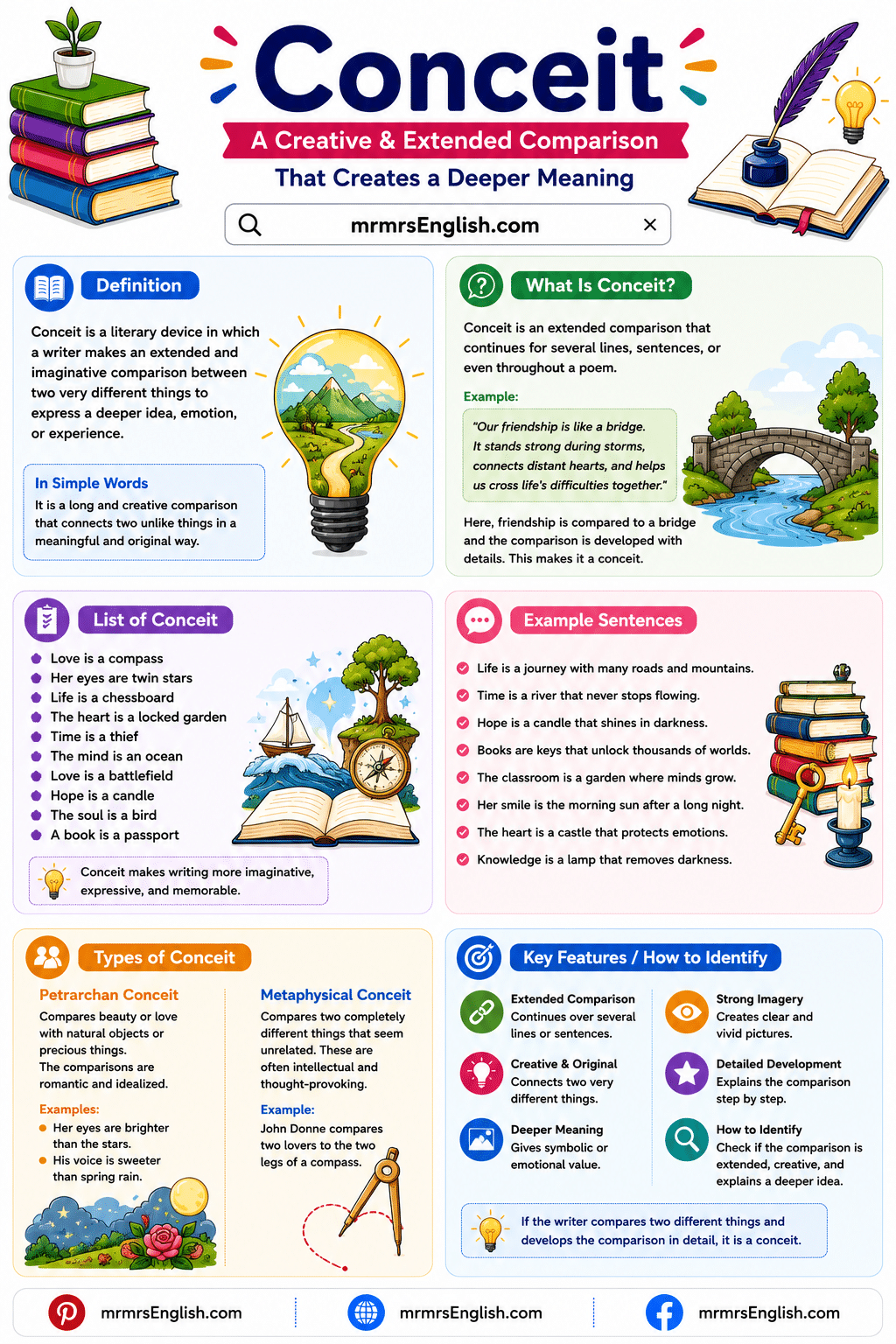
Types of Conceit in English
Examples of Conceit in English
Example 1
Life is a journey with many roads, unexpected turns, difficult mountains, and peaceful valleys.
The comparison between life and a journey continues throughout the sentence.
Example 2
The classroom became a garden where students were flowers growing with the sunlight of knowledge.
The writer develops the comparison between students and flowers.
Example 3
Time is a river that never stops flowing, carrying every memory away.
The comparison is explained through several connected ideas.
Example 4
Hope is a candle that continues burning even during the darkest night.
The image continues instead of ending after one comparison.
Example 5
Books are keys that unlock thousands of worlds waiting behind closed doors.
The writer develops the comparison between books and keys.
Conceit in Famous Literature
Many famous writers have used conceit.
| Writer | Example of Conceit |
|---|---|
| John Donne | Lovers compared to a compass |
| William Shakespeare | Extended comparisons in several sonnets |
| Francesco Petrarch | Beauty compared to stars, gold, and flowers |
| George Herbert | Spiritual ideas explained through everyday objects |
Conceit vs Metaphor
Many students confuse conceit with metaphor.
| Conceit | Metaphor |
|---|---|
| Extended comparison | Short comparison |
| Develops one idea in detail | Usually one sentence |
| Often unusual | Can be simple |
| Continues through several lines | Ends quickly |
| More detailed | More direct |
Example
Metaphor:
Knowledge is power.
Conceit:
Knowledge is a lamp that lights every dark path, removes fear, reveals truth, and guides us toward success.
Conceit vs Simile
| Conceit | Simile |
|---|---|
| Long comparison | Short comparison |
| Uses metaphor or simile repeatedly | Uses “like” or “as” once |
| Explains the comparison | Makes a quick comparison |
How to Identify a Conceit
Ask yourself these questions:
- Does the writer compare two different things?
- Is the comparison developed over several lines?
- Does the comparison explain a deeper idea?
- Does the writer continue adding details to support the comparison?
If the answer is yes, it is probably a conceit.
How to Use Conceit in Writing
You can write a conceit by following these steps.
Step 1
Choose an idea.
Example:
- Love
- Time
- Friendship
- Knowledge
- Hope
Step 2
Choose something completely different.
Example:
- Bridge
- River
- Tree
- Candle
- Compass
Step 3
Connect both ideas.
Step 4
Continue explaining the comparison with several details.
Conceit Example Sentences in English
| Conceit | Example Sentence |
|---|---|
| Love is a compass | The poet says love is a compass that always points the heart in the right direction. |
| Her eyes are twin stars | He describes her eyes as twin stars lighting the darkest night. |
| Life is a chessboard | The writer suggests life is a chessboard where every move matters. |
| The heart is a locked garden | The poem presents the heart as a locked garden waiting for true love. |
| Time is a thief | The poet builds the conceit that time is a thief stealing youth. |
| The mind is an ocean | She writes that the mind is an ocean full of hidden treasures. |
| Love is a battlefield | The poem compares love to a battlefield filled with victories and defeats. |
| Hope is a candle | The author says hope is a candle that never stops shining. |
| The soul is a bird | The poet imagines the soul as a bird flying toward freedom. |
| A book is a passport | He explains that a book is a passport to different worlds. |
| Dreams are seeds | The writer compares dreams to seeds that grow into reality. |
| Life is a river | The poem describes life as a river flowing toward the future. |
| Friendship is a bridge | The poet calls friendship a bridge connecting different hearts. |
| Knowledge is a lamp | The author says knowledge is a lamp that removes darkness. |
| The world is a stage | The writer develops the conceit that the world is a stage where everyone has a role. |
| Memory is a mirror | The poet describes memory as a mirror reflecting the past. |
| Faith is an anchor | The poem says faith is an anchor during life’s storms. |
| Words are arrows | The writer compares words to arrows that can heal or hurt. |
| Patience is a tree | The poet imagines patience as a tree that grows slowly but lasts long. |
| The heart is a castle | The poem presents the heart as a castle protecting precious emotions. |
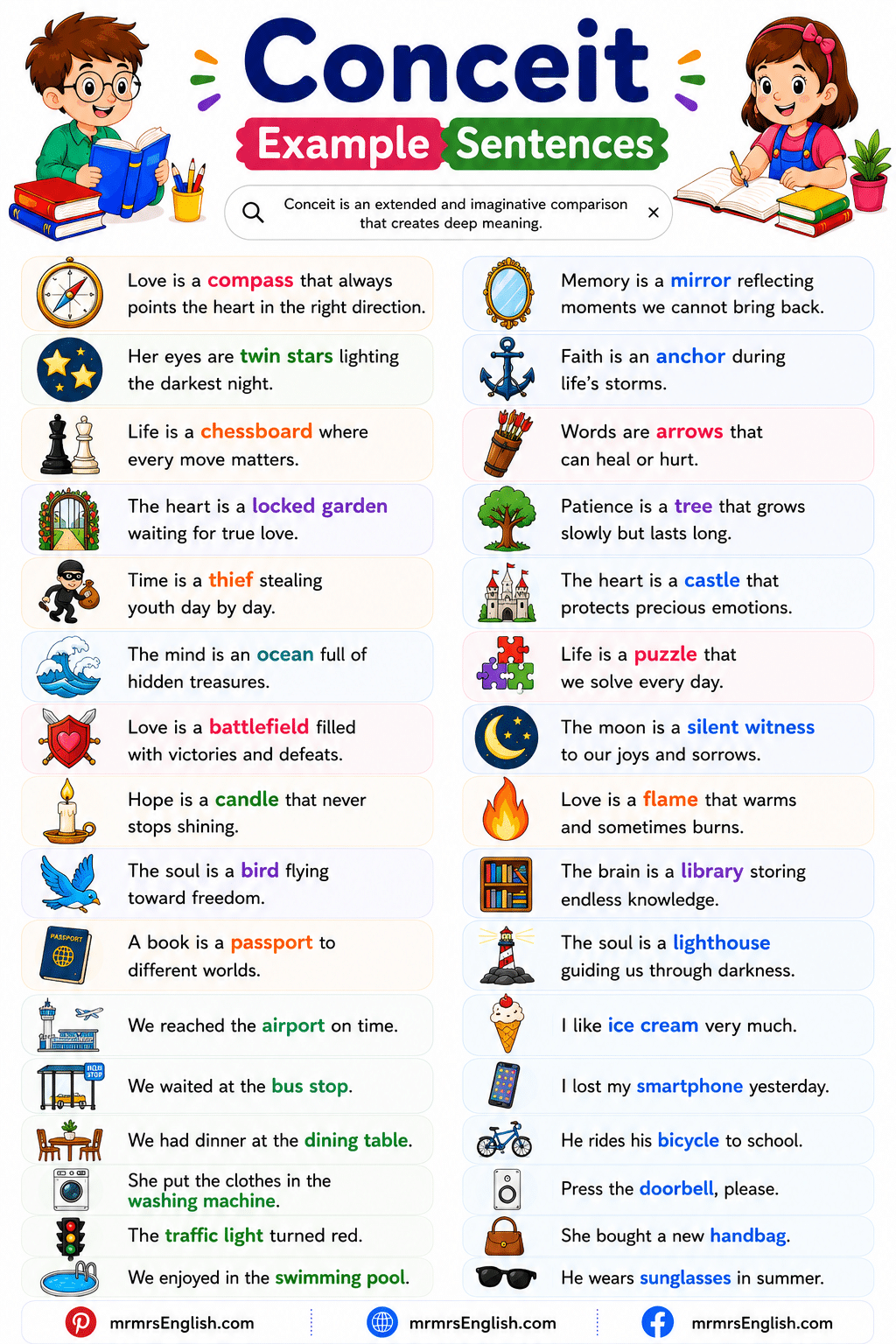
Conceit Example Sentences in English
Conceit Examples list
- Love is a compass
- Her eyes are twin stars
- Life is a chessboard
- The heart is a locked garden
- Time is a thief
- The mind is an ocean
- Love is a battlefield
- Hope is a candle
- The soul is a bird
- A book is a passport
- Dreams are seeds
- Life is a river
- Friendship is a bridge
- Knowledge is a lamp
- The world is a stage
- Memory is a mirror
- Faith is an anchor
- Words are arrows
- Patience is a tree
- The heart is a castle
- Life is a puzzle
- The moon is a silent witness
- Love is a flame
- The brain is a library
- The soul is a lighthouse
- Hope is a sunrise
- The future is an unwritten book
- The voice is music
- The heart is a battlefield
- Life is a tapestry
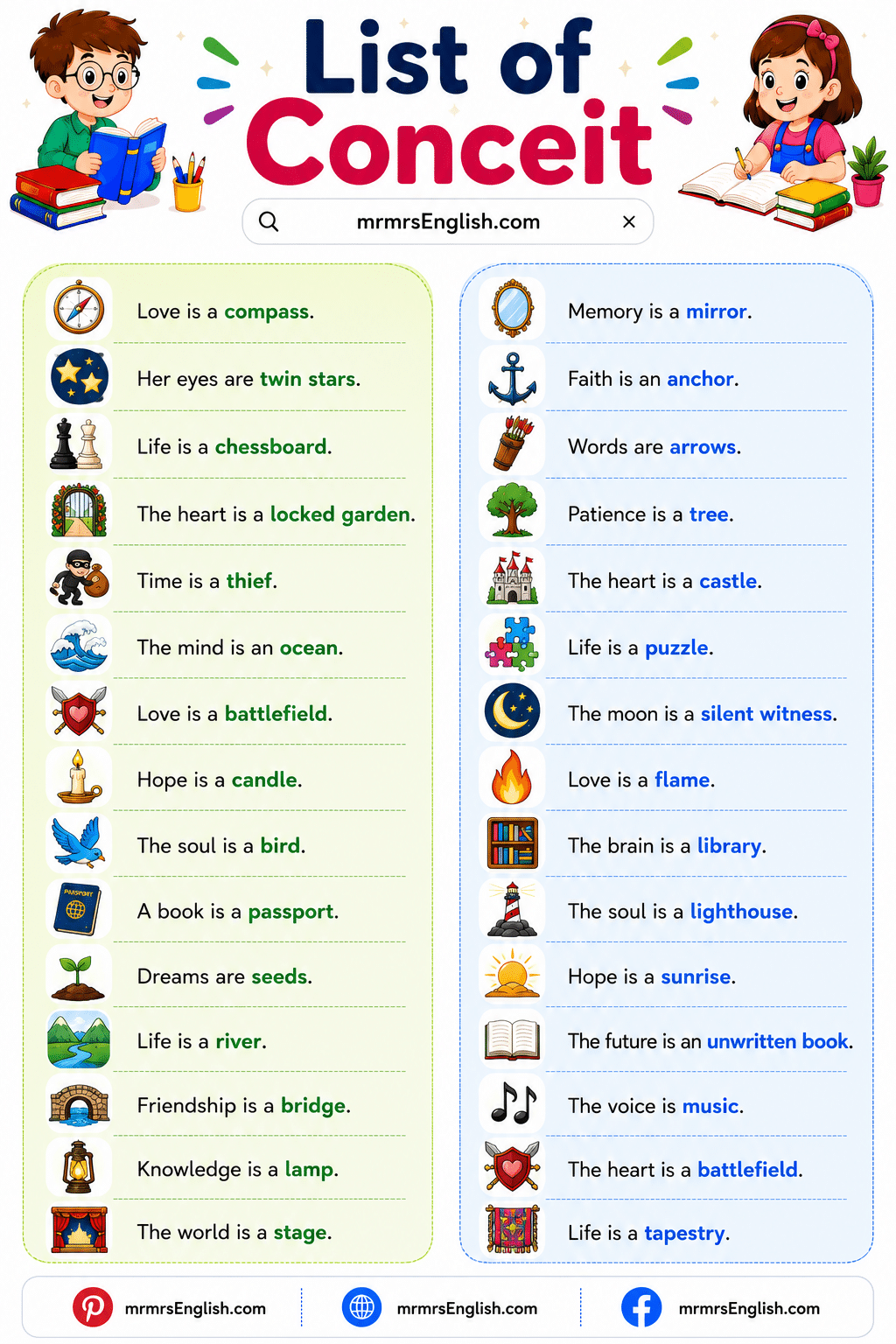
Conceit Examples list
Common Mistakes Students Make
Avoid these mistakes when learning conceit.
- Thinking every metaphor is a conceit.
- Writing only one comparison instead of developing it.
- Choosing comparisons without a meaningful connection.
- Confusing conceit with symbolism.
- Ending the comparison too quickly.
Practice Questions
Question 1
Is this a conceit?
Life is a race where every challenge is another mile to complete.
Answer: Yes.
Question 2
Is this a conceit?
He is a lion.
Answer: No. It is only a metaphor because the comparison is short.
Question 3
Complete the conceit.
Education is a __________ because…
Possible answers:
- bridge
- ladder
- light
- garden
- compass
Quick Revision Table
| Point | Summary |
|---|---|
| Literary device | Conceit |
| Main purpose | Extended comparison |
| Length | Several lines or more |
| Common in | Poetry and literature |
| Famous writer | John Donne |
| Main types | Petrarchan and Metaphysical |
| Similar to | Metaphor |
| Difference | More detailed and extended |
Learn more helpful articles

Leave a Comment