
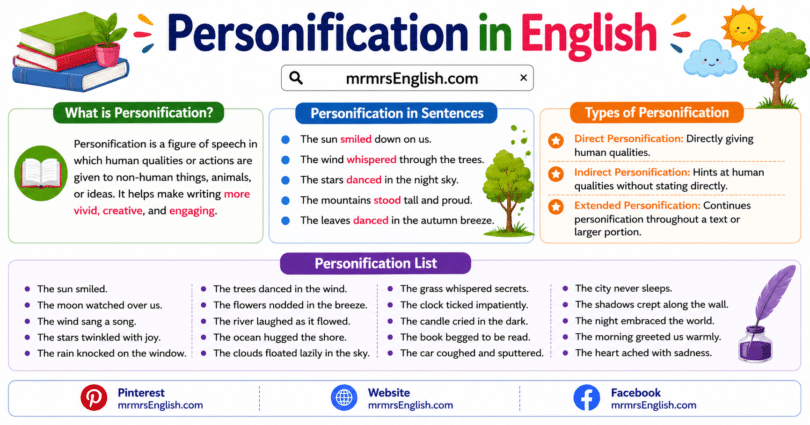
Personification is a figure of speech in which human qualities or actions are given to animals, objects, or ideas. It makes sentences more creative, lively, and easier to imagine by describing non-human things as if they were people. Personification is commonly used in English poetry, stories, and everyday writing to create stronger emotions and clearer descriptions. Learning personification meaning and examples helps students and English learners improve their vocabulary, writing, and literary understanding. In this article, you will learn the meaning of personification, explore easy examples, and get a helpful PDF for better practice and learning.
What Is Personification in English?
Personification is a figure of speech in which non-human things are described as if they have human abilities, feelings, or actions. Writers use personification to make descriptions more lively and easier to imagine.
Simple Examples
- The wind whispered through the trees.
- The sun smiled down on us.
- The flowers danced in the breeze.
- The alarm clock screamed at me.
The wind cannot really whisper, and the sun cannot actually smile. These human actions are given to non-human things.
Easy Meaning of Personification in English
Personification happens when an object, animal, idea, or force of nature is given human characteristics.
Why Is Personification Important in English?
Personification makes language more creative and expressive.
Main Benefits
- Makes writing vivid and interesting
- Helps readers imagine scenes clearly
- Creates emotional connections
- Improves storytelling
- Adds beauty to poetry
- Enhances descriptive writing
How Personification Works
Personification gives human actions or feelings to things that are not human.
Examples
| Non-Human Thing | Human Quality Given |
|---|---|
| Wind | Whispering |
| Sun | Smiling |
| Flowers | Dancing |
| Stars | Winking |
| Thunder | Growling |
Common Examples of Personification
| Personification | Meaning |
|---|---|
| The sun smiled. | The day was bright and pleasant. |
| The wind whispered. | The wind moved softly. |
| The stars winked. | The stars twinkled. |
| The flowers danced. | The flowers moved in the breeze. |
| Time flies. | Time passes quickly. |
Personification in Sentences
Basic Examples
- The moon smiled at the children.
- The leaves danced in the wind.
- The clock complained all night.
Intermediate Examples
- The rain tapped gently on the window.
- The river sang as it flowed through the valley.
- The thunder growled across the sky.
Advanced Examples
- The angry storm attacked the coastline.
- Opportunity knocked on his door.
- The city never sleeps.
Types of Personification in English
Human Actions
Non-human things perform human actions.
Examples
- The wind whispered.
- The flowers danced.
Human Emotions
Non-human things show human feelings.
Examples
- The sun smiled.
- The clouds looked sad.
Human Speech
Objects or ideas are described as speaking.
Examples
- The trees called to the travelers.
- The ocean roared with anger.
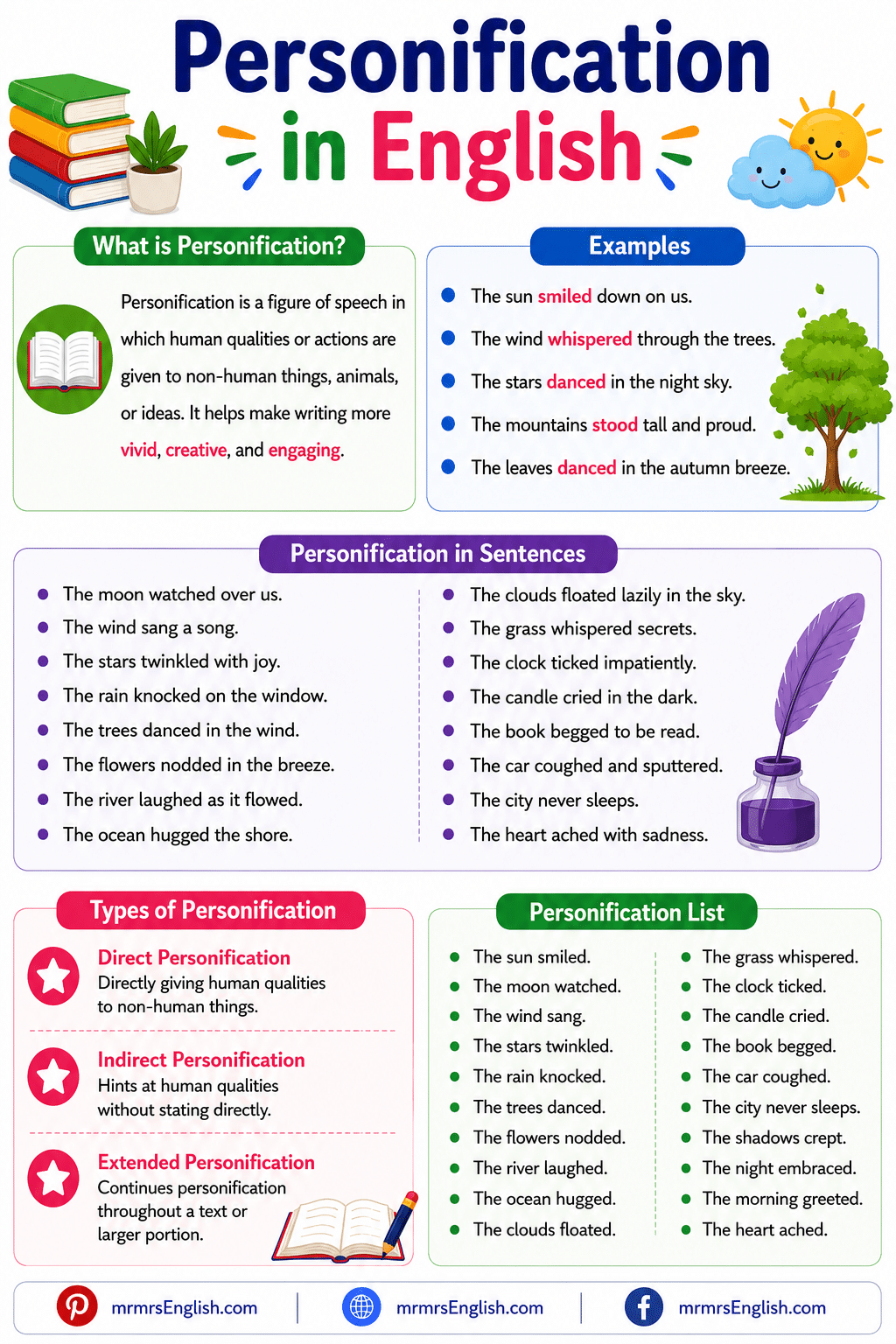
What is Personification with meaning and examples
Personification vs Simile
| Personification | Simile |
|---|---|
| Gives human qualities | Compares two things |
| The sun smiled. | The sun was like a smiling face. |
| The wind whispered. | The wind moved like a whisper. |
Personification vs Metaphor
| Personification | Metaphor |
|---|---|
| Gives human traits | Direct comparison |
| The stars danced. | The stars were diamonds. |
| The rain cried. | The rain was tears from the sky. |
Personification in Literature
Writers often use personification to bring scenes to life.
Example
- The wind danced through the forest.
This sentence helps readers imagine the movement of the wind more vividly.
Personification in Poetry
Poets frequently use personification because it creates strong imagery.
Example
- The moon watched over the sleeping village.
This makes the moon seem caring and alive.
Personification in Daily Life
Many common expressions use personification.
Examples
- Time flies.
- Opportunity knocks.
- The news hit me hard.
- The car refused to start.
These expressions make everyday language more colorful.
Personification for ESL Students
Learning personification helps students:
- Improve vocabulary
- Understand literature better
- Develop creative writing skills
- Make descriptions more interesting
- Improve reading comprehension
Common Personification Examples
| Personification | Meaning |
|---|---|
| The wind whispered. | Soft wind movement |
| The sun smiled. | Bright sunny day |
| The stars danced. | Stars twinkled |
| The flowers nodded. | Flowers moved in the breeze |
| The thunder growled. | Loud thunder sound |
| The river sang. | Flowing river sound |
| The moon watched. | Moon shining above |
| The clock complained. | Clock making noise |
Advanced Personification Examples in English
Nature
- The mountains stood proudly against the sky.
- The ocean welcomed the sailors home.
Weather
- The storm marched across the country.
- The rain kissed the earth.
Objects
- The old house groaned in the wind.
- The computer refused to cooperate.
Abstract Ideas
- Fear crept into his heart.
- Hope guided her through difficult times.
How to Create Personification in English
Follow these simple steps:
Step 1
Choose a non-human thing.
Step 2
Think of a human action, emotion, or behavior.
Step 3
Combine them in a sentence.
Example
Non-human thing: Wind
Human action: Whisper
Sentence:
- The wind whispered through the trees.
Common Mistakes to Avoid
1. Confusing Personification with Simile
❌ The moon is like a smiling face. (Simile)
✔ The moon smiled. (Personification)
2. Confusing Personification with Metaphor
❌ The moon is a silver lamp. (Metaphor)
✔ The moon watched us from above. (Personification)
3. Overusing Personification
Too much personification can make writing difficult to understand.
Use it where it adds meaning and imagery.
Practice Exercise
Identify the personification in each sentence.
- The wind whispered softly.
- The flowers danced in the garden.
- The thunder growled loudly.
- The stars winked at us.
- The sun smiled warmly.
Answers
- Wind whispered
- Flowers danced
- Thunder growled
- Stars winked
- Sun smiled
Quick Revision Table
| Personification | Human Quality |
|---|---|
| The sun smiled. | Smiling |
| The wind whispered. | Whispering |
| The flowers danced. | Dancing |
| The stars winked. | Winking |
| The thunder growled. | Growling |
Examples of Personification in Sentences in English
- The sun smiled down on us.
- The wind whispered through the trees.
- The flowers danced in the breeze.
- The moon watched over the village.
- The stars winked in the night sky.
- The rain tapped on the window.
- The thunder growled across the sky.
- The river sang as it flowed.
- The ocean roared with anger.
- The clouds cried all afternoon.
- The leaves danced in the autumn wind.
- The fire crackled with excitement.
- The alarm clock screamed at me.
- The old house groaned in the storm.
- The car complained as it climbed the hill.
- The trees waved their branches.
- The sun greeted us in the morning.
- The snow covered the earth with a warm blanket.
- The storm attacked the coastline.
- The fog crept through the streets.
- The wind howled during the night.
- The book called my name from the shelf.
- The chair welcomed me after a long day.
- The computer refused to work.
- The clock raced toward midnight.
- The opportunity knocked on his door.
- The fear grabbed his heart.
- The hope guided her through difficult times.
- The justice stood strong for the truth.
- The time flew during the holiday.
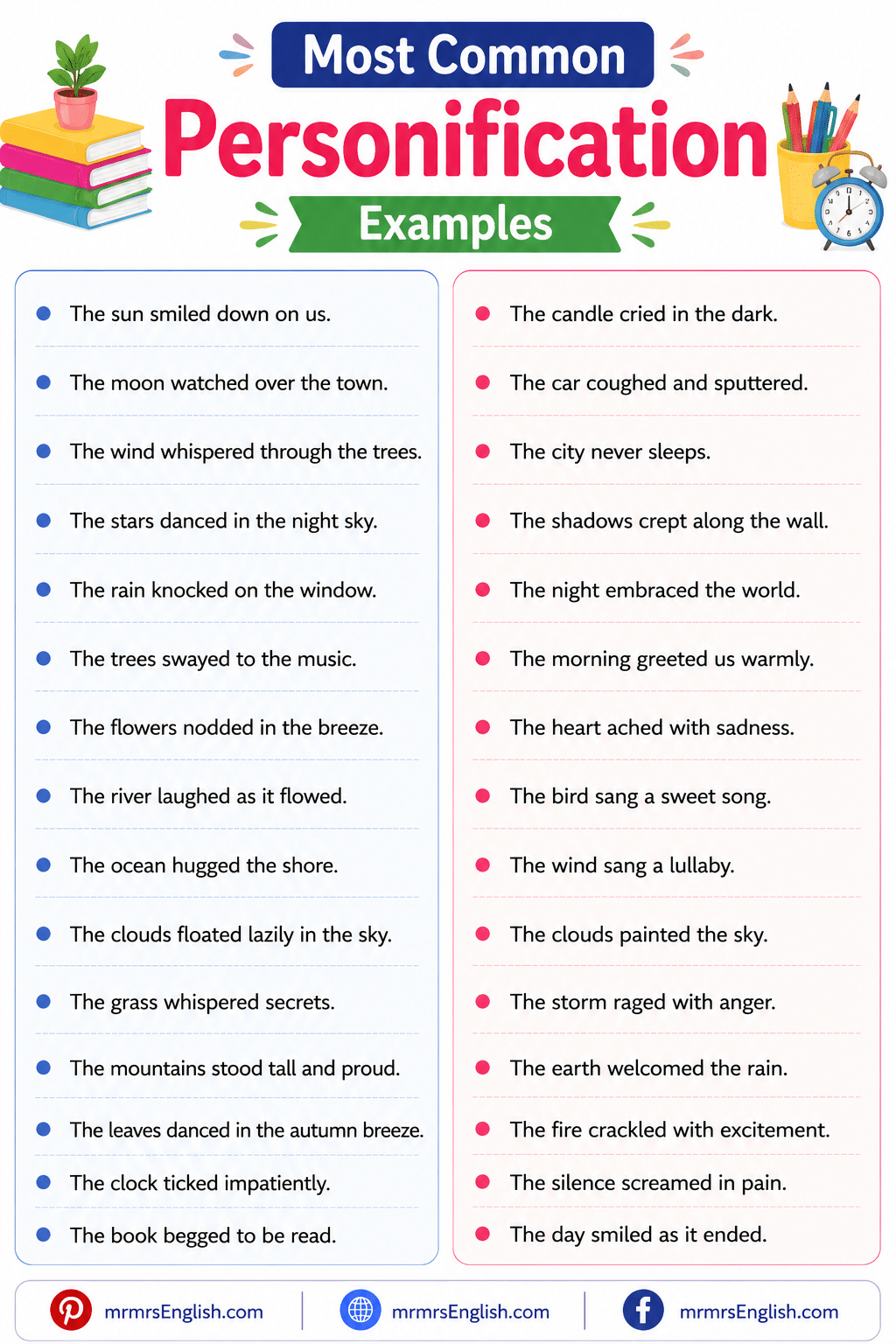
Examples of Personification in Sentences
Learn more helpful articles

Leave a Comment