
An apostrophe is a useful figure of speech often found in poetry, speeches, stories, and emotional writing. Understanding apostrophe meaning in English helps learners recognize when a speaker directly addresses an absent person, a dead person, an object, or an abstract idea as if it could listen or respond. For example, in “O Moon, guide me tonight,” the speaker talks directly to the moon. This literary device can express strong feelings and make writing more engaging. In this article, you will learn what apostrophe means, how it works, its main uses, and clear examples to help you identify it easily.
What Is Apostrophe in English?
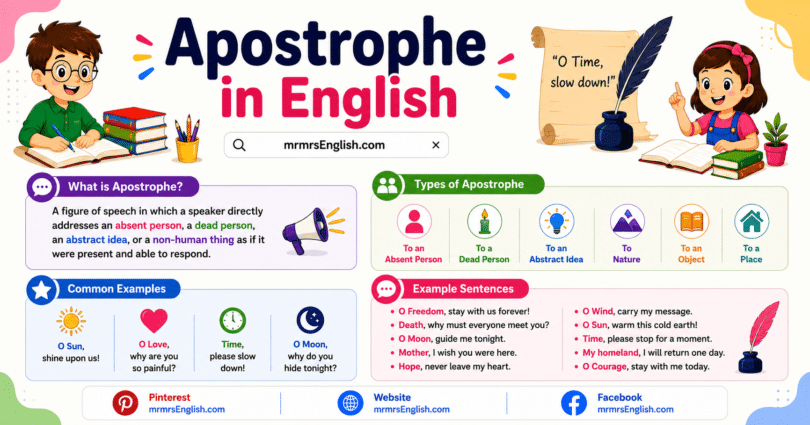
Apostrophe is a figure of speech in which a speaker directly addresses someone who is absent or dead, or speaks to an abstract idea, object, place, or natural force as though it were present and capable of hearing or responding.
For example: O Moon, why do you hide tonight?
The speaker addresses the moon directly, even though it cannot literally listen or answer.
Another example is: O Freedom, how precious you are!
Here, freedom is an abstract idea, but the speaker addresses it directly as if it were a person. The main feature of apostrophe is direct address to someone or something that cannot normally respond.
Easy Meaning of Apostrophe
In simple words, apostrophe means talking directly to someone or something that is not actually present or cannot answer you.
The speaker may address:
- An absent person
- A dead person
- An object
- An abstract idea
- Nature
- A place
- An emotion
Simple Examples
- O Sun, shine upon us!
- Death, why do you frighten us?
- O Love, why are you so painful?
- Time, please slow down!
- O Mother, I wish you were here.
The speaker behaves as though each subject can hear the words being spoken.
Origin of the Word Apostrophe
The word apostrophe comes from the Greek word apostrophē, meaning “a turning away.” In classical rhetoric, a speaker would turn away from the normal audience and suddenly address another person, object, or idea. This change in direction creates a dramatic effect and draws attention to the person or thing being addressed.
Apostrophe as a Figure of Speech
Apostrophe allows writers to express strong emotions in a direct and dramatic manner. Instead of simply describing feelings about something, the speaker talks directly to it.
Compare these sentences:
Ordinary statement:
The speaker wishes that time would move more slowly.
Apostrophe:
O Time, slow down!
The second expression sounds more emotional because Time is addressed directly.
Key Characteristics of Apostrophe
Apostrophe has several features that make it easier to identify:
- It involves direct address.
- The person being addressed may be absent or dead.
- The speaker may address a non-human object.
- Abstract ideas such as love, death, or freedom may be addressed.
- Nature and natural forces can be addressed directly.
- The addressed subject is treated as if it could hear or understand.
- It often expresses strong emotions.
- It is especially common in poetry, drama, and speeches.
How Does Apostrophe Work?
Apostrophe works by temporarily treating an absent, abstract, or non-human subject as a direct listener.
For example: O Death, where is your power?
Here:
- Death is an abstract concept.
- The speaker directly addresses Death.
- Death cannot literally listen or respond.
- The direct address creates emotional and dramatic force.
This structure helps readers experience the speaker’s feelings more strongly.
Common Structure of Apostrophe
Apostrophe often follows patterns such as:
O + person/object/idea + statement
or
Person/Object/Idea + direct statement
Examples
- O Love, why do you hurt so much?
- O Moon, guide me tonight.
- Time, please stop for a moment.
- Death, you cannot defeat my courage.
- My country, I will never forget you.
The word “O” is common in traditional poetry, but it is not required for apostrophe.
Types of Apostrophe in English
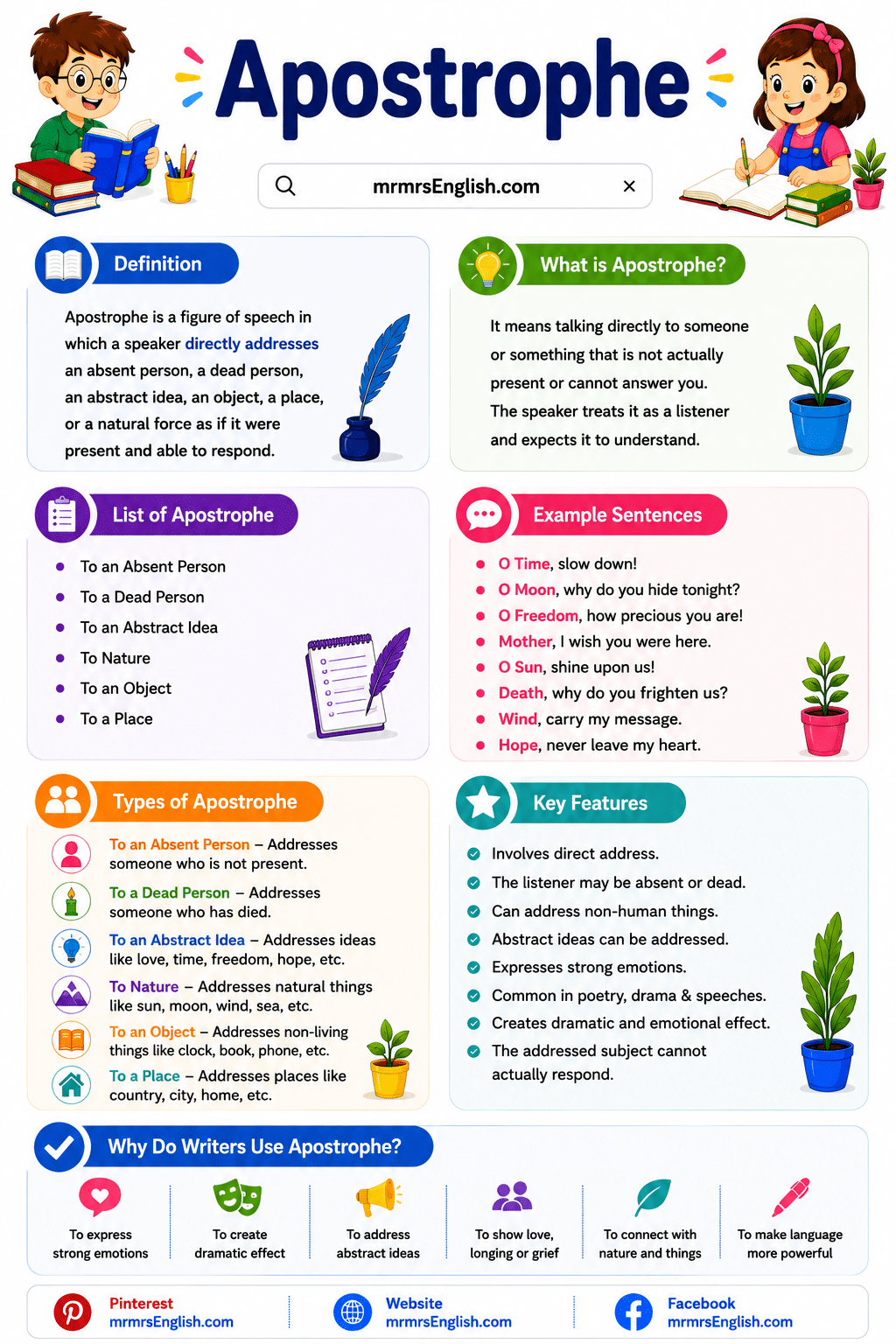
Apostrophe can be classified according to what the speaker directly addresses.
1. Apostrophe to an Absent Person
A speaker may directly address someone who is not physically present. The absent person is spoken to as though they were standing nearby and could hear every word. Writers often use this form to express love, longing, regret, loneliness, or emotional attachment.
Examples:
- O brother, I wish you were here.
- My friend, how I miss our conversations.
- Mother, I still remember your advice.
2. Apostrophe to a Dead Person
A speaker may address someone who has died as if that person were still alive and able to listen. This form is especially common in elegies, poems, memorial writing, and emotional speeches because it allows writers to express grief, respect, love, and remembrance directly.
Examples:
- O Father, I still follow your advice.
- Dear friend, your memory remains with us.
- Grandmother, I wish you could see us today.
3. Apostrophe to an Abstract Idea
Abstract ideas such as love, freedom, justice, hope, death, time, and fate can be directly addressed as if they were living beings. This technique gives invisible concepts a strong presence and allows writers to communicate complex emotions in a simple but dramatic way.
Examples:
- O Freedom, never leave us!
- Love, why are you so complicated?
- Time, please slow down.
- Hope, stay with me.
4. Apostrophe to Nature
Writers frequently address natural objects and forces such as the sun, moon, stars, wind, sea, rain, and mountains. Speaking directly to nature makes descriptions more emotional and helps establish a close connection between the speaker’s feelings and the surrounding natural world.
Examples:
- O Sun, warm this cold earth!
- Wind, carry my message home.
- O Moon, light my path tonight.
- Sea, calm your waves.
5. Apostrophe to an Object
An ordinary non-living object may also be addressed directly as though it could understand the speaker. This form can communicate affection, frustration, humor, sadness, or attachment, depending on the object and situation.
Examples:
- O Clock, why do you move so quickly?
- Dear book, you have taught me so much.
- Old house, I will always remember you.
- Phone, please work today!
6. Apostrophe to a Place
A country, city, home, or other location may be directly addressed as though it were a living listener. Writers commonly use this form to express patriotism, nostalgia, admiration, homesickness, or emotional attachment to a particular place.
Examples:
- O England, remember your history!
- My homeland, I will return one day.
- O city, how much you have changed!
- Home, I have missed you deeply.
Types of Apostrophe in English
Types of Apostrophe at a Glance
| Type | What Is Addressed? | Example |
|---|---|---|
| Absent Person | Someone not present | Friend, I wish you were here. |
| Dead Person | Someone who has died | Father, I still remember you. |
| Abstract Idea | Love, death, hope, time, etc. | O Time, slow down! |
| Nature | Sun, moon, wind, sea, etc. | O Moon, guide me! |
| Object | A non-living thing | Clock, stop moving so fast! |
| Place | Country, city, home, etc. | My homeland, I miss you. |
Examples of Apostrophe in Sentences
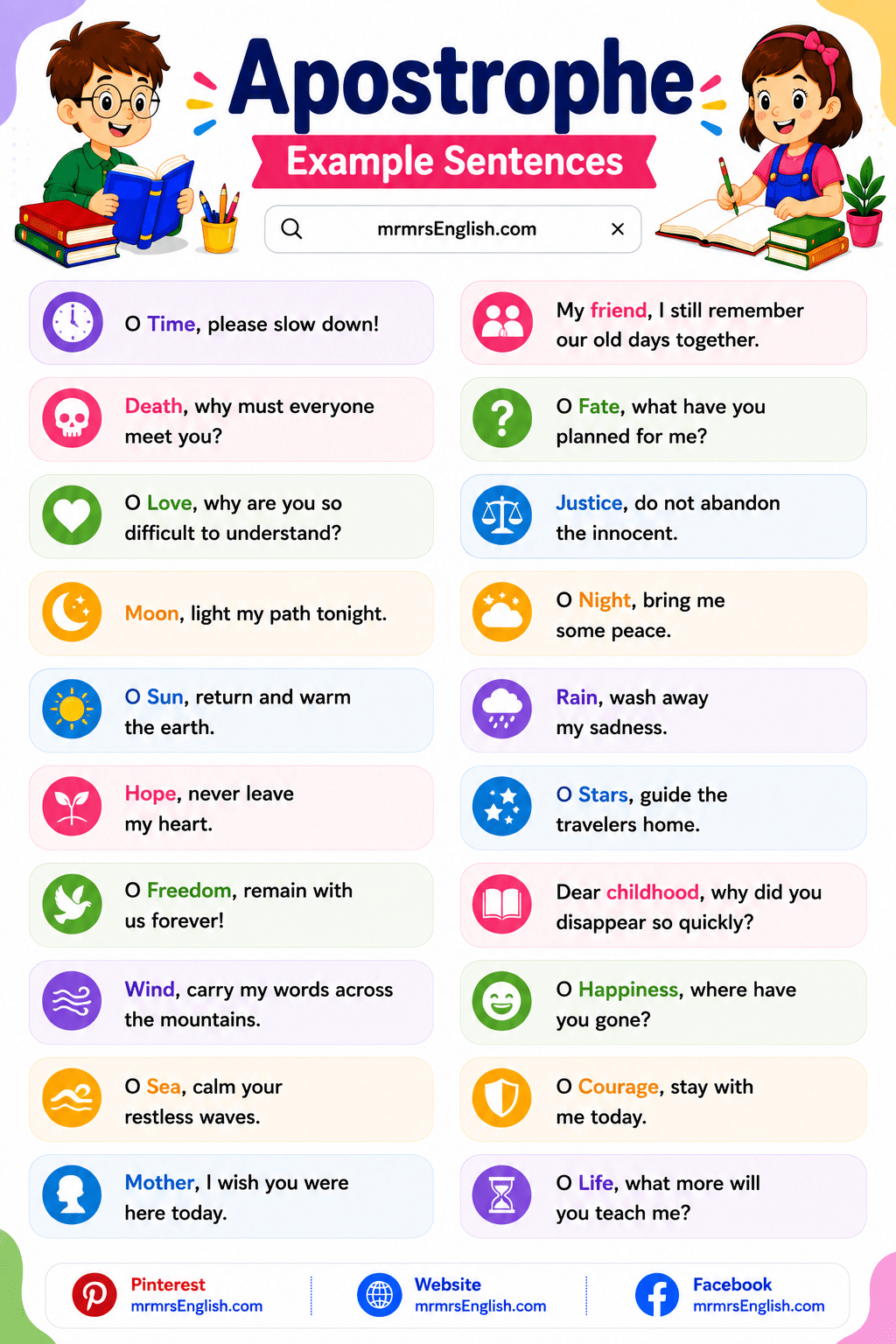
- O Time, please slow down!
- Death, why must everyone meet you?
- O Love, why are you so difficult to understand?
- Moon, light my path tonight.
- O Sun, return and warm the earth.
- Hope, never leave my heart.
- O Freedom, remain with us forever!
- Wind, carry my words across the mountains.
- O Sea, calm your restless waves.
- Mother, I wish you were here today.
- My friend, I still remember our old days together.
- O Fate, what have you planned for me?
- Justice, do not abandon the innocent.
- O Night, bring me some peace.
- Rain, wash away my sadness.
- O Stars, guide the travelers home.
- Dear childhood, why did you disappear so quickly?
- O Happiness, where have you gone?
- Fear, you will not control me anymore.
- O Earth, protect those who depend on you.
- Old house, you hold so many memories.
- O Clock, stop moving so quickly!
- Winter, leave us and let spring return.
- O Memory, why do you trouble me?
- My homeland, I will never forget you.
- O Courage, stay with me today.
- Sleep, why do you avoid me tonight?
- O Peace, return to our world.
- Fortune, smile upon us today.
- O Life, what more will you teach me?
Examples of Apostrophe in Sentences
Apostrophe Examples with Explanation
| Example | Addressed Subject | Why It Is Apostrophe |
|---|---|---|
| O Time, slow down! | Time | Time is directly addressed. |
| Death, leave me alone! | Death | An abstract concept is addressed. |
| O Moon, guide me tonight. | Moon | A natural object is treated as a listener. |
| Mother, I wish you were here. | Absent mother | Someone not present is directly addressed. |
| Hope, stay with me. | Hope | An abstract idea is spoken to directly. |
| Wind, carry my message. | Wind | A natural force is directly addressed. |
Apostrophe in Literature
Apostrophe is widely used in literature because it allows characters, narrators, and poets to express emotions directly. A writer may suddenly address death, love, nature, an absent person, or another subject that cannot respond.
Instead of simply describing sadness, for example, a character might say: O Death, why have you taken my friend?
This makes the emotion more immediate and dramatic for the reader.
Apostrophe in Poetry
Apostrophe is especially common in poetry, where direct address can create emotion, rhythm, and intimacy. Poets often speak to the moon, stars, wind, death, love, beauty, time, or people who are absent.
For example: O Moon, shine upon my lonely road.
The poet is not expecting the moon to answer. The direct address is used to express emotion and create poetic imagery.
Apostrophe in Speeches
Speakers may use apostrophe to address freedom, justice, history, a nation, past generations, or important people who are not present. It can make a speech sound more emotional and memorable.
For example: O Freedom, we will always defend you!
Here, freedom is treated as a listener, allowing the speaker to emphasize its importance.
Apostrophe in Everyday English
Although apostrophe is strongly associated with literature, similar expressions also appear in everyday conversations, especially when people are emotional, frustrated, or humorous.
Examples include:
- Come on, computer, work!
- Please, rain, stop!
- Time, slow down!
- Oh sleep, where are you?
- Monday, why are you here already?
The speaker knows that these things cannot respond but addresses them directly for expressive effect.
Why Do Writers Use Apostrophe?
Writers use apostrophe for several important purposes:
- To express strong emotions
- To create dramatic effect
- To address abstract ideas directly
- To communicate grief or longing
- To make poetry more expressive
- To create a connection with nature
- To emphasize an important idea
- To make language more memorable
- To reveal a character’s thoughts and feelings
Apostrophe can transform a simple statement into a much more emotional expression.
How to Identify Apostrophe
Apostrophe can be identified using a few simple steps.
Step 1: Look for Direct Address
Ask whether the speaker is directly talking to someone or something.
O Time, slow down!
The speaker is directly addressing Time.
Step 2: Identify the Listener
Determine who or what is being addressed.
Here, the listener is Time.
Step 3: Ask Whether It Can Actually Respond
Can time literally hear and answer?
No.
Therefore, the expression contains an apostrophe.
Apostrophe vs Personification
Apostrophe and personification are closely related, but they are not the same.
| Apostrophe | Personification |
|---|---|
| Directly addresses something | Gives human qualities or actions to something |
| Focus is on direct speech | Focus is on human characteristics |
| O Wind, listen to me! | The wind whispered through the trees. |
| Wind is directly addressed | Wind performs the human action of whispering |
Apostrophe may involve personification because the speaker often treats something as capable of listening. However, direct address is the essential feature of apostrophe.
Apostrophe vs Personification with Examples
Consider these two sentences:
Personification:
The sun smiled upon the village.
The sun is given the human ability to smile.
Apostrophe:
O Sun, smile upon our village!
The sun is directly addressed.
This distinction makes the two figures of speech easier to identify.
Apostrophe vs Exclamation
An exclamation expresses strong emotion, while apostrophe involves directly addressing someone or something.
Exclamation:
What a beautiful night!
Apostrophe:
O Night, how beautiful you are!
Not every emotional sentence is apostrophe. There must be some form of direct address.
Apostrophe vs Addressing a Present Person
Simply speaking directly to someone who is physically present is generally not rhetorical apostrophe.
For example: John, please close the door.
This is ordinary direct address because John is present and can respond.
However: John, wherever you are, I hope you remember me.
If John is absent, the sentence can function as an apostrophe because the speaker addresses him despite his absence.
Apostrophe as a Literary Device vs Apostrophe Punctuation
Students should not confuse apostrophe as a figure of speech with the punctuation mark (‘). They share the same name but have completely different functions.
| Apostrophe as a Figure of Speech | Apostrophe as Punctuation |
|---|---|
| A literary device | A punctuation mark |
| Involves direct address | Shows possession or omitted letters |
| O Time, slow down! | Sarah’s book |
| Used for emotional or rhetorical effect | Used in grammar and writing |
| Common in poetry and literature | Common in contractions and possessives |
Examples of the Punctuation Mark
- Sarah**’s** bag
- The teacher**’s** desk
- Don**’t**
- Can**’t**
- It**’s**
These examples have nothing to do with apostrophe as a figure of speech.
Common Mistakes to Avoid
A common mistake is assuming that every sentence beginning with “O” is automatically apostrophe. The important feature is not the word O itself but the direct address.
Another mistake is confusing apostrophe with personification. Remember:
Apostrophe = direct address
Personification = human qualities given to non-human things
Students should also avoid confusing literary apostrophe with the punctuation mark (‘).
Importance of Apostrophe in English
Understanding apostrophe helps students interpret poetry, drama, fiction, speeches, and other literary texts. It also teaches learners how writers communicate emotions indirectly through direct address.
For ESL students, recognizing apostrophe is particularly useful in:
- Figures of speech exercises
- Poetry analysis
- Literature exams
- Reading comprehension
- Creative writing
- Literary analysis
Practice Exercise
1. Which sentence contains an apostrophe?
A. The moon was bright.
B. O Moon, guide me home.
C. We watched the moon.
Answer: B. O Moon, guide me home.
2. What is being addressed in “O Time, slow down”?
A. A person
B. An abstract concept
C. An animal
Answer: B. An abstract concept
3. Which sentence is personification rather than apostrophe?
A. O Wind, carry my message.
B. The wind whispered through the trees.
C. Wind, listen to me.
Answer: B
4. Which is an example of apostrophe to an abstract idea?
A. O Freedom, stay with us!
B. The dog ran home.
C. The flowers were beautiful.
Answer: A
5. Is “John, pass me the book” normally an example of rhetorical apostrophe when John is present?
Answer: No. It is ordinary direct address.
Apostrophe Examples list
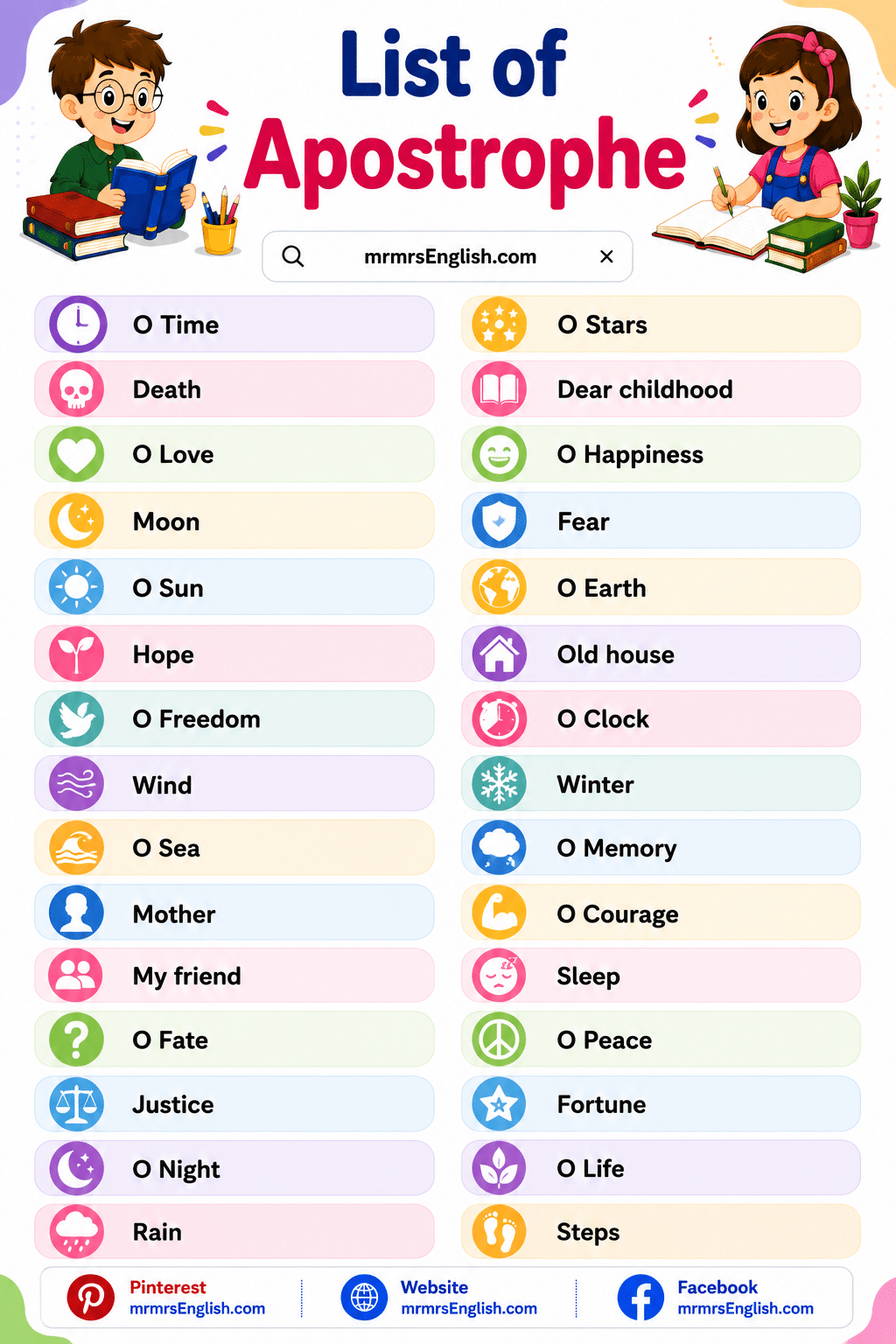
- O Time
- Death
- O Love
- Moon
- O Sun
- Hope
- O Freedom
- Wind
- O Sea
- Mother
- My friend
- O Fate
- Justice
- O Night
- Rain
- O Stars
- Dear childhood
- O Happiness
- Fear
- O Earth
Apostrophe Examples list
Learn more helpful articles





Leave a Comment