
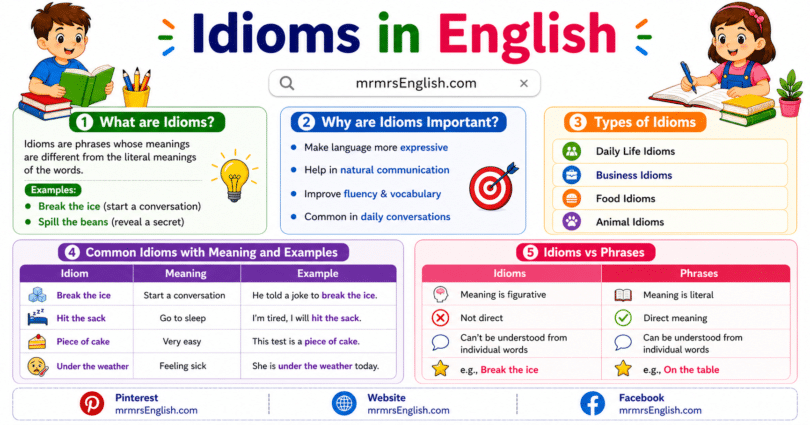
Idioms are an important part of everyday English, helping speakers express ideas, feelings, and situations in a more natural and interesting way. These expressions usually have meanings that cannot be understood simply by translating each word separately. Common examples include a piece of cake, break the ice, spill the beans, and once in a blue moon. Learning idioms in English is a useful way to improve vocabulary, reading comprehension, and communication skills. In this article, you will learn English idioms with meanings and examples through simple explanations, helping students, teachers, beginners, and English learners understand, remember, and use common idiomatic expressions correctly and confidently.
Table of Contents
ToggleWhat Are Idioms in English?
An idiom is a fixed or commonly used expression with a meaning that cannot always be understood by translating each word separately. For example, “break the ice” does not mean to break actual ice. It means to make people feel more comfortable in a new or uncomfortable situation.
Idioms are an important part of English because native speakers often use them naturally in conversations. However, their meanings can be difficult for learners because the words may suggest something completely different from the intended idea.
For example:
- Break the ice → Start a friendly conversation.
- Hit the nail on the head → Say or do something exactly right.
- A piece of cake → Something very easy.
- Under the weather → Feeling unwell.
Understanding the meaning and context of an idiom is more useful than simply memorizing its words.
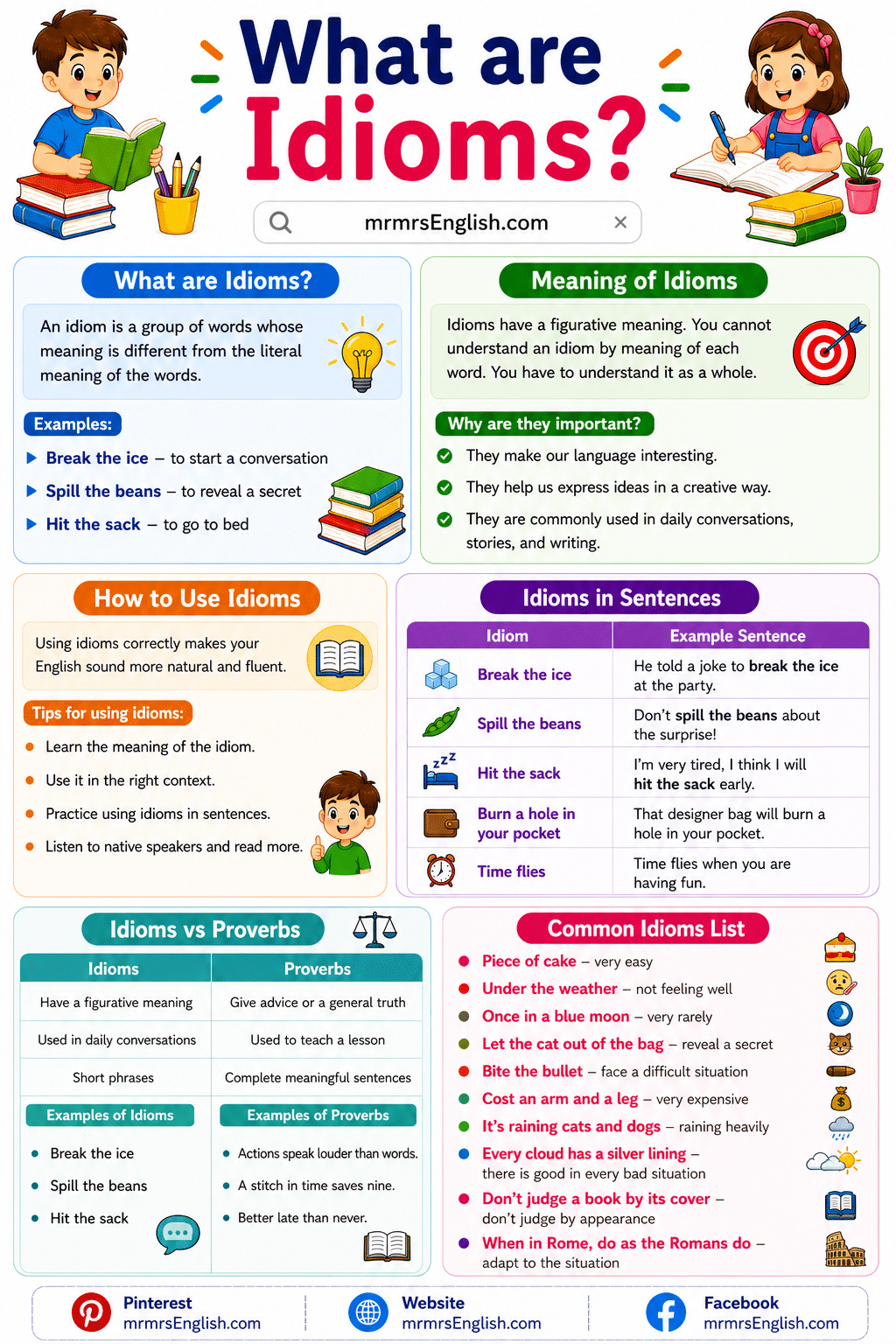
What Are Idioms in English with Examples
Why Are English Idioms Important?
Idioms make English communication more natural and expressive. They allow speakers to communicate ideas, feelings, situations, and experiences in a short and memorable way.
For ESL students, idioms are also useful for reading comprehension, speaking, writing, listening, and English examinations. When students understand common idiomatic expressions, they can better understand passages, conversations, stories, and questions.
Idioms can also make writing more interesting, but they should be used carefully. A learner should choose an idiom that fits the situation instead of adding one simply to make a sentence sound advanced.
Common Idioms in English with Meanings and Examples
Common English idioms are frequently used in everyday conversations and writing to express ideas naturally. Learning their meanings with simple examples helps learners understand these expressions and use them correctly in different situations.
| Idiom | Meaning | Example Sentence |
|---|---|---|
| A piece of cake | Something very easy | The test was a piece of cake. |
| Break the ice | Start a friendly conversation | He told a joke to break the ice. |
| Hit the nail on the head | Say exactly the right thing | You hit the nail on the head. |
| Once in a blue moon | Very rarely | She visits us once in a blue moon. |
| Under the weather | Feeling ill | I am feeling under the weather today. |
| Cost an arm and a leg | Be very expensive | That car cost an arm and a leg. |
| Spill the beans | Reveal a secret | Who spilled the beans about the party? |
| Let the cat out of the bag | Reveal a secret accidentally | Tom let the cat out of the bag. |
| Beat around the bush | Avoid saying something directly | Please stop beating around the bush. |
| Call it a day | Stop working for the day | We have finished enough, so let’s call it a day. |
| In hot water | In trouble | He is in hot water with his teacher. |
| On cloud nine | Extremely happy | She was on cloud nine after winning. |
| Bite the bullet | Face something difficult bravely | I decided to bite the bullet and apologize. |
| Kill two birds with one stone | Achieve two things with one action | I walked to work to kill two birds with one stone. |
| The ball is in your court | It is your turn to act | I have made my offer; the ball is in your court. |
| Better late than never | Doing something late is better than not doing it | He finally apologized. Better late than never. |
| Actions speak louder than words | Actions show intentions better than words | She helped me when I needed her. Actions speak louder than words. |
| Practice makes perfect | Practice improves ability | Keep practicing because practice makes perfect. |
| A blessing in disguise | Something that seems bad but has a good result | Missing that bus was a blessing in disguise. |
| Every cloud has a silver lining | There is something positive in a difficult situation | Losing that job helped her find a better one. Every cloud has a silver lining. |
Idioms for Daily Conversation
Many English idioms are frequently used in everyday conversations. Learning these expressions can help students understand informal English and communicate more naturally.
1. Hang in ThereMeaning: Remain patient and do not give up during a difficult situation.
Example: Hang in there; things will get better.
2. No Big DealMeaning: Something is not important or serious.
Example: Don’t worry about the mistake. It is no big deal.
3. So Far, So GoodMeaning: Everything has been satisfactory until now.
Example: How is your new job? So far, so good.
4. Take It EasyMeaning: Relax or avoid working too hard.
Example: You look tired, so take it easy today.
5. Keep an Eye onMeaning: Watch or look after someone or something carefully.
Example: Please keep an eye on my bag.
6. Give Me a HandMeaning: Help me.
Example: Can you give me a hand with this box?
7. Hang OutMeaning: Spend time relaxing or socializing.
Example: We usually hang out after school.
8. Get the Hang of ItMeaning: Learn how to do something through practice.
Example: I am slowly getting the hang of it.
9. In a HurryMeaning: Needing to do something quickly.
Example: I cannot talk now because I am in a hurry.
10. Out of the BlueMeaning: Suddenly and unexpectedly.
Example: She called me out of the blue.
Idioms About Success and Failure
English speakers use many idioms to describe success, failure, progress, and achievement.
| Idiom | Meaning | Example |
|---|---|---|
| Go the extra mile | Make more effort than expected | She always goes the extra mile for her students. |
| Learn the ropes | Learn how to do a job or activity | It took me a week to learn the ropes. |
| Rise to the occasion | Successfully deal with a difficult situation | He rose to the occasion during the final match. |
| Get the ball rolling | Start an activity or process | Let’s get the ball rolling on the new project. |
| Back to square one | Return to the beginning after failure | The plan failed, so we are back to square one. |
| Miss the boat | Miss an opportunity | I applied too late and missed the boat. |
| Pull it off | Successfully achieve something difficult | I cannot believe you pulled it off! |
| Come a long way | Make a lot of progress | Her English has come a long way. |
| Turn the tables | Change a situation so that the advantage changes sides | Our team turned the tables in the second half. |
| Go from strength to strength | Continue becoming more successful | The business has gone from strength to strength. |
Idioms About Money
Money-related idioms are common in both spoken and written English.
Break the BankMeaning: Cost more money than someone can reasonably afford.
Example: This phone is good, but it won’t break the bank.
Make Ends MeetMeaning: Have enough money to pay for basic needs.
Example: It is difficult to make ends meet on a low salary.
Save for a Rainy DayMeaning: Save money for a future time when it may be needed.
Example: I save part of my salary for a rainy day.
Tighten Your BeltMeaning: Spend less money because of financial difficulty.
Example: We need to tighten our belts this month.
Money to BurnMeaning: Have plenty of money to spend.
Example: He seems to have money to burn.
Pay Through the NoseMeaning: Pay an excessively high price.
Example: We paid through the nose for the hotel room.
Common Idioms About Feelings and Emotions
Idioms can describe happiness, sadness, anger, fear, surprise, and other emotions in an expressive way.
| Idiom | Meaning | Example |
|---|---|---|
| Over the moon | Extremely happy | She was over the moon about her result. |
| Down in the dumps | Very sad or unhappy | He has been down in the dumps lately. |
| Green with envy | Very jealous | She was green with envy when she saw his new car. |
| See red | Become very angry | His rude comment made me see red. |
| Have butterflies in your stomach | Feel nervous or excited | I had butterflies in my stomach before the speech. |
| Lose your temper | Become angry | Try not to lose your temper. |
| Keep your cool | Remain calm | She kept her cool during the argument. |
| On edge | Nervous or worried | Everyone was on edge before the announcement. |
| In high spirits | Very cheerful | The children were in high spirits. |
| Heartbroken | Extremely sad, especially because of a loss or disappointment | He was heartbroken after the failure. |
Idioms About Time
Time-related idioms are useful in conversations, stories, and written English.
In the Nick of TimeMeaning: Just before it is too late.
Example: We arrived in the nick of time.
At the Eleventh HourMeaning: At the last possible moment.
Example: He submitted the application at the eleventh hour.
Once in a Blue MoonMeaning: Very rarely.
Example: We eat at that restaurant once in a blue moon.
Around the Clock
Meaning: All day and all night.
Example: The hospital provides care around the clock.
In No TimeMeaning: Very quickly or after a short period.
Example: You will finish the work in no time.
From Time to TimeMeaning: Occasionally.
Example: I still visit my old school from time to time.
Learn Idioms About Work and Effort
Idioms related to work can help learners understand workplace conversations and general English.
| Idiom | Meaning | Example |
|---|---|---|
| Work your fingers to the bone | Work extremely hard | She worked her fingers to the bone to finish the project. |
| Pull your weight | Do your fair share of work | Everyone must pull their weight. |
| Learn the ropes | Learn how something is done | The new employee is learning the ropes. |
| Go the extra mile | Make additional effort | He always goes the extra mile for his customers. |
| Burn the midnight oil | Work or study late at night | I had to burn the midnight oil before the exam. |
| Put your nose to the grindstone | Work hard and continuously | She put her nose to the grindstone and completed the task. |
| Get down to business | Start focusing seriously on work | Let’s get down to business. |
| Call it a day | Stop working for the day | We have finished our tasks, so let’s call it a day. |
Idioms About Problems and Difficult Situations
These Idioms can also describe problems, risks, and difficult circumstances.
A Tough Nut to CrackMeaning: A person, problem, or situation that is difficult to understand or solve.
Example: This mathematics problem is a tough nut to crack.
In Deep WaterMeaning: In serious trouble or difficulty.
Example: He is in deep water because he missed the deadline.
Between a Rock and a Hard PlaceMeaning: Facing two difficult choices or situations.
Example: I was between a rock and a hard place when both companies offered different deadlines.
Add Fuel to the FireMeaning: Make an already difficult or angry situation worse.
Example: His angry reply only added fuel to the fire.
A Storm in a TeacupMeaning: A lot of anger or worry about a small problem.
Example: Their argument was just a storm in a teacup.
Weather the StormMeaning: Survive and deal with a difficult period.
Example: The company managed to weather the storm.
Idioms About Knowledge and Understanding
Some idioms describe learning, understanding, and discovering information.
| Idiom | Meaning | Example |
|---|---|---|
| Know the ropes | Know how something works | She knows the ropes after years of experience. |
| Get the picture | Understand the situation | Now I get the picture. |
| Put two and two together | Understand something from available facts | I put two and two together and understood what happened. |
| Read between the lines | Find an implied meaning | You need to read between the lines to understand the message. |
| Food for thought | Something that encourages careful thinking | His speech gave me food for thought. |
| Learn something the hard way | Learn through an unpleasant experience | I learned the hard way not to trust unknown websites. |
| A quick study | A person who learns quickly | She is a quick study. |
| Know something inside out | Know something extremely well | He knows the subject inside out. |
Idioms About Communication
Communication idioms are useful when discussing conversations, secrets, opinions, and explanations.
Get Straight to the PointMeaning: Talk about the main subject without unnecessary details.
Example: Please get straight to the point.
Speak Your MindMeaning: Say what you honestly think or feel.
Example: She is not afraid to speak her mind.
Beat Around the BushMeaning: Avoid discussing the main subject directly.
Example: Stop beating around the bush and tell me what happened.
Get Your Point AcrossMeaning: Communicate an idea successfully.
Example: The teacher used an example to get her point across.
Keep Someone in the LoopMeaning: Keep someone informed about what is happening.
Example: Please keep me in the loop about the project.
Hear It Through the GrapevineMeaning: Hear information from another person rather than from an official source.
Example: I heard it through the grapevine that the office will move.
Idioms About Relationships
English has many idiomatic expressions for friendship, cooperation, disagreement, and relationships.
| Idiom | Meaning | Example |
|---|---|---|
| Get along with | Have a friendly relationship | I get along with my classmates. |
| See eye to eye | Agree completely or generally | We do not always see eye to eye. |
| Give someone the cold shoulder | Deliberately ignore someone | She gave me the cold shoulder. |
| Patch things up | Repair a damaged relationship | They decided to patch things up. |
| A shoulder to cry on | Someone who provides emotional support | My sister is always a shoulder to cry on. |
| Hit it off | Develop a good relationship quickly | We hit it off at the meeting. |
| Rub someone the wrong way | Annoy someone | His attitude rubbed me the wrong way. |
| Through thick and thin | During both good and difficult times | They stayed together through thick and thin. |
Advanced English Idioms
Advanced idioms are often found in newspapers, literature, discussions, interviews, and formal or semi-formal communication. They can be useful for higher-level ESL learners, but their meaning and context should be understood before using them.
A Double-Edged SwordMeaning: Something that has both advantages and disadvantages.
Example: Social media can be a double-edged sword for young people.
The Tip of the IcebergMeaning: A small visible part of a much larger problem or situation.
Example: These complaints are only the tip of the iceberg.
A Grey AreaMeaning: A situation that is not clearly defined or does not have an obvious answer.
Example: The new rule creates a grey area for small businesses.
A Far Cry FromMeaning: Very different from something.
Example: The new building is a far cry from the old one.
At the End of the DayMeaning: When all relevant facts or circumstances are considered.
Example: At the end of the day, everyone wants to feel respected.
By the Same TokenMeaning: In the same way or for the same reason.
Example: We should respect their opinion and, by the same token, expect them to respect ours.
Go Against the GrainMeaning: Act or behave differently from what is usual or expected.
Example: His decision to work alone went against the grain.
Leave No Stone UnturnedMeaning: Make every possible effort to find or achieve something.
Example: The investigators left no stone unturned.
Read the Writing on the WallMeaning: Recognize signs that something is likely to happen.
Example: The falling sales were a sign, and management read the writing on the wall.
The Last StrawMeaning: The final problem or event that makes a difficult situation impossible to accept.
Example: The missed deadline was the last straw for the manager.
Idioms Commonly Used in Exams
Students may encounter idioms in English grammar tests, vocabulary questions, comprehension passages, competitive examinations, and school examinations. In these questions, the correct answer usually depends on understanding the figurative meaning rather than the literal meaning.
For example:
“The new student broke the ice.”
The correct meaning is:
Started a friendly conversation or made people feel comfortable.
It does not mean that the student physically broke ice.
Another example is:
“The examination was a piece of cake.”
The intended meaning is:
The examination was very easy.
How to Answer Idiom QuestionsWhen an idiom appears in an examination, first read the complete sentence. The surrounding words often provide clues about its meaning. Do not translate every word separately because idioms normally have a figurative meaning.
For example: Ali was feeling under the weather, so he stayed home.
The phrase under the weather means feeling ill. The rest of the sentence supports this meaning because Ali stayed home.
Literal Meaning vs. Idiomatic Meaning
One of the greatest difficulties for English learners is the difference between literal and figurative meanings.
| Expression | Literal Idea | Idiomatic Meaning |
|---|---|---|
| Break the ice | Break frozen water | Start a friendly interaction |
| Spill the beans | Drop beans | Reveal a secret |
| Hit the nail on the head | Strike a nail correctly | Say something exactly right |
| Piece of cake | A piece of a cake | Something very easy |
| Cost an arm and a leg | Lose body parts | Be extremely expensive |
| Let the cat out of the bag | Release a cat | Reveal a secret |
| Bite the bullet | Bite a bullet | Face something difficult bravely |
| Under the weather | Below the weather | Feel ill |
This difference is why idioms should usually be learned as complete expressions, rather than as separate words.
How to Learn English Idioms Easily
Learning a large number of idioms at once can be difficult. A better approach is to learn a small group of useful expressions and understand how they work in real sentences.
Learn Idioms in ContextDo not memorize only the meaning. Learn the idiom together with an example sentence.
For example:
Idiom: Call it a day
Meaning: Stop working for the day.
Example: We have finished the main task, so let’s call it a day.
This makes the expression easier to remember and use correctly.
Learn the Correct FormSome idioms have a fixed structure. Changing their words may make the expression sound unnatural or change its meaning.
For example:
Correct: He hit the nail on the head.
Learners should remember the complete expression instead of changing it to hit the nail on the top.
Use Idioms According to ContextNot every idiom is suitable for every situation. Some are very informal, while others are more common in general or semi-formal English.
For example, “What’s up?” is a casual expression, while “leave no stone unturned” can appear in more serious discussions and written contexts.
Keep a Personal Idiom ListStudents can maintain a notebook with four simple columns:
| Idiom | Meaning | Example | Situation |
|---|---|---|---|
| Break the ice | Start a friendly conversation | He told a joke to break the ice. | Social situation |
| Call it a day | Stop working | Let’s call it a day. | Work |
| Once in a blue moon | Very rarely | I eat fast food once in a blue moon. | Daily life |
Difference Between Idioms and Proverbs
Idioms and proverbs are related but they are not the same. An idiom is a fixed expression whose overall meaning is usually different from the literal meaning of its words.
Example: Break the ice.
A proverb is a short traditional saying that expresses a general truth, lesson, or piece of advice.
Example: Actions speak louder than words.
The main difference is that an idiom functions as part of a sentence, while a proverb usually communicates a general lesson or observation.
Difference Between Idioms and Phrasal Verbs
Idioms should also be distinguished from phrasal verbs. A phrasal verb combines a verb with a particle, such as an adverb or preposition, to create a particular meaning.
Examples:
- Give up → Stop trying.
- Look after → Take care of.
- Turn down → Reject or refuse.
An idiom is generally a fixed expression with a figurative meaning.
Example:
- A piece of cake → Something very easy.
Some expressions can be difficult to classify neatly, and everyday English contains many expressions that share features of both categories.
Benefits of Learning Idioms
Learning idioms can provide several benefits for English learners:
- It improves reading comprehension.
- It helps learners understand native and natural English.
- It increases useful vocabulary.
- It supports better listening comprehension.
- It makes everyday speaking more expressive.
- It helps students understand English examinations.
- It improves understanding of movies, books, interviews, and conversations.
- It helps learners recognize figurative language.
However, idioms should be learned alongside ordinary vocabulary and grammar. Knowing idioms alone does not guarantee fluent English.
Idioms and their meanings in English
- Break the ice – to start a friendly conversation
- Hit the nail on the head – to say something exactly right
- Piece of cake – something very easy
- Under the weather – feeling sick or unwell
- Once in a blue moon – something that happens rarely
- Spill the beans – to reveal a secret
- Let the cat out of the bag – to share a secret by mistake
- A blessing in disguise – something good that first seemed bad
- Burn the midnight oil – to work late at night
- Bite the bullet – to face a difficult situation bravely
- Call it a day – to stop working for the day
- Cut corners – to do something in a cheap or easy way
- Hit the sack – to go to bed
- In hot water – in trouble
- On cloud nine – very happy
- Miss the boat – to miss a good chance
- Pull someone’s leg – to joke with someone
- Sit on the fence – to not take a side
- The ball is in your court – it is your turn to decide
- Through thick and thin – in good and bad times
- Time flies – time passes quickly
- Cost an arm and a leg – very expensive
- Cry over spilled milk – to be upset about something already done
- Face the music – to accept the results of your actions
- Get out of hand – become difficult to control
- Give it a shot – to try something
- Keep an eye on – to watch carefully
- Make up your mind – to decide something
- On the same page – to agree with others
- Take it easy – to relax or stay calm
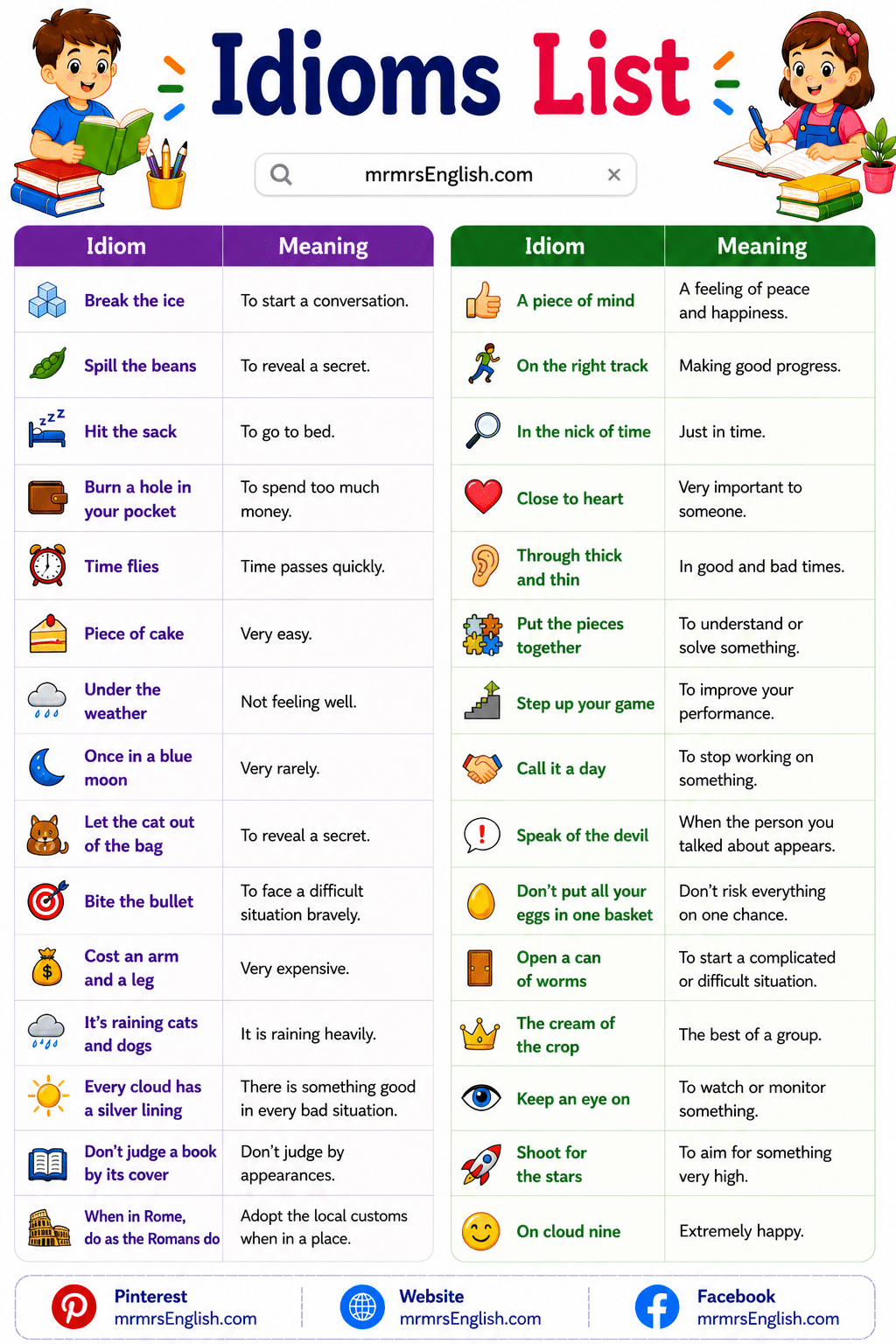
List of Idioms with their meanings
Learn more helpful articles

Leave a Comment