
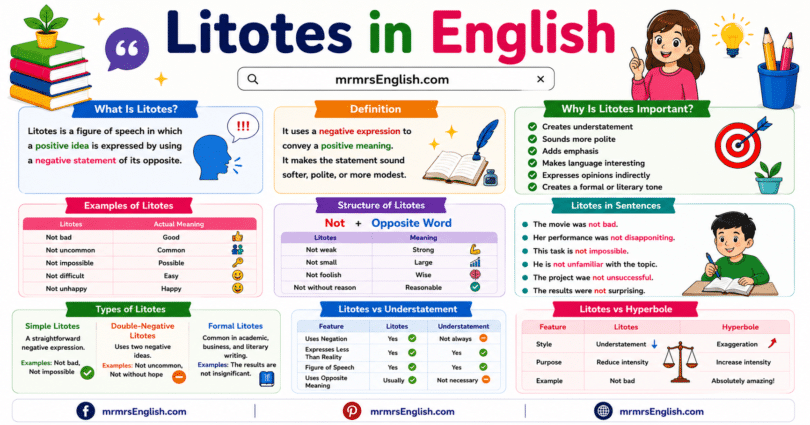
Litotes is a figure of speech in which a positive idea is expressed by using a negative statement, often by denying the opposite. It is commonly used in English to make expressions sound softer, more polite, or more interesting. For example, saying “not bad” instead of “good” or “not uncommon” instead of “common” are examples of litotes. Learning litotes with meaning and easy examples helps students and English learners understand figurative language and improve their speaking and writing skills. In this article, you will learn what litotes is, how it is used, and explore simple examples to understand it more easily.
What Is Litotes in English?
Litotes is a figure of speech in which a positive idea is expressed by using a negative statement of its opposite. Instead of saying something directly, the speaker uses a negative expression to create emphasis, politeness, or understatement.
Simple Examples of Litotes
| Litotes | Actual Meaning |
|---|---|
| Not bad | Good |
| Not uncommon | Common |
| Not impossible | Possible |
| Not difficult | Easy |
| Not unhappy | Happy |
In these examples, the speaker avoids using the direct positive word and instead uses a negative form to express the same idea.
Why Is Litotes Used?
Writers and speakers use litotes for several reasons:
- To create understatement
- To sound more polite
- To add emphasis
- To make language more interesting
- To express opinions indirectly
- To create a formal or literary tone
Example
Direct Statement: The movie was excellent.
Litotes: The movie was not bad at all.
Both sentences are positive, but the second one uses understatement.
Main Features of Litotes
Litotes has several important characteristics.
Uses a Negative Expression
A negative word such as not, never, or no is commonly used.
Expresses a Positive Meaning
Although the sentence contains a negative word, the intended meaning is usually positive.
Creates Understatement
Litotes often makes a statement sound less strong than it actually is.
Adds Style to Writing
Writers use litotes to make their language more engaging and effective.
Structure of Litotes
The most common pattern of litotes is:
Not + Opposite Word
Examples
| Litotes Structure | Meaning |
|---|---|
| Not bad | Good |
| Not weak | Strong |
| Not small | Large |
| Not foolish | Wise |
| Not impossible | Possible |
Common Examples of Litotes in English
The following examples are frequently used in daily conversations.
| Litotes | Meaning |
|---|---|
| Not bad | Good |
| Not uncommon | Common |
| Not impossible | Possible |
| Not unusual | Normal |
| Not wrong | Correct |
| Not unhappy | Happy |
| Not insignificant | Important |
| Not without reason | Reasonable |
Litotes in Sentences
Understanding litotes becomes easier when seen in complete sentences.
Examples
- The food was not bad.
- Her performance was not disappointing.
- This task is not impossible.
- He is not unfamiliar with the topic.
- The project was not unsuccessful.
- The teacher’s explanation was not unclear.
- The results were not surprising.
- She is not lacking confidence.
In all these sentences, a negative expression conveys a positive or moderate meaning.
Litotes in Everyday Conversation
Native English speakers often use litotes in daily speech.
Examples
| Sentence | Intended Meaning |
|---|---|
| That was not bad. | That was good. |
| He is not stupid. | He is intelligent. |
| The test was not difficult. | The test was easy. |
| She is not unfriendly. | She is friendly. |
| It is not a small problem. | It is a serious problem. |
Litotes in Literature
Many authors use litotes to create emphasis and subtle meaning.
Examples
- He was not unaware of the danger.
- The achievement was not insignificant.
- She was not without talent.
These examples sound more sophisticated than direct statements and often add depth to literary writing.
Types of Litotes
Although litotes generally follows the same principle, it can appear in different forms.
Simple Litotes
A straightforward negative expression used to convey a positive meaning.
Examples
- Not bad
- Not impossible
- Not weak
Double-Negative Litotes
Uses two negative ideas to express a positive thought.
Examples
- Not uncommon
- Not without hope
- Not incapable
Formal Litotes
Commonly found in academic, business, and literary writing.
Examples
- The proposal is not unreasonable.
- The findings are not insignificant.
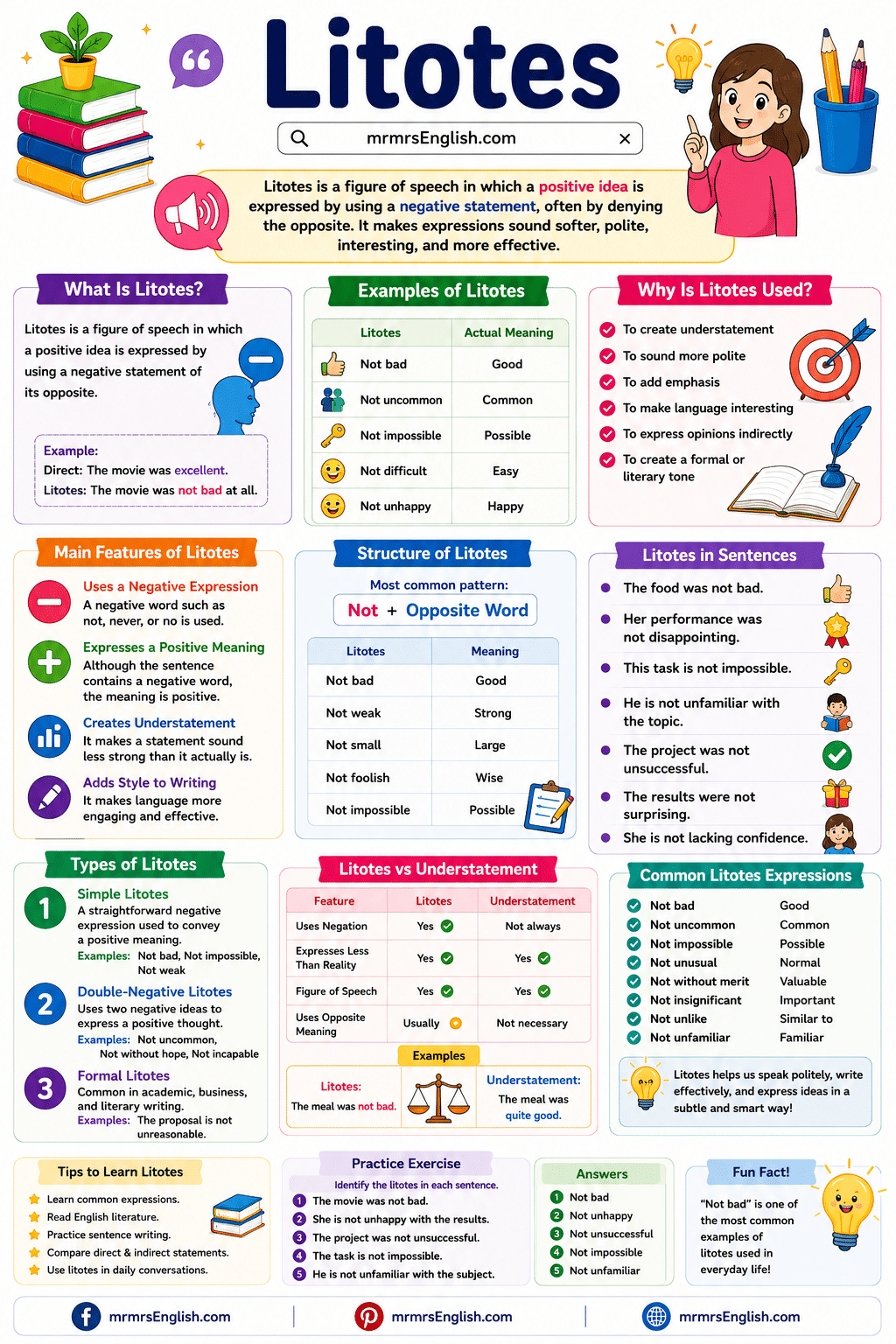
Litotes definition in English with Meaning and Example Sentences
Litotes vs Understatement
Many students think litotes and understatement are the same, but there is a slight difference.
| Feature | Litotes | Understatement |
|---|---|---|
| Uses Negation | Yes | Not always |
| Expresses Less Than Reality | Yes | Yes |
| Figure of Speech | Yes | Yes |
| Uses Opposite Meaning | Usually | Not necessary |
Examples
Litotes: The meal was not bad.
Understatement: The meal was quite good.
Both reduce the force of the statement, but litotes specifically uses negation.
Litotes vs Hyperbole
Litotes and hyperbole are opposite literary devices.
| Feature | Litotes | Hyperbole |
|---|---|---|
| Style | Understatement | Exaggeration |
| Purpose | Reduce intensity | Increase intensity |
| Example | Not bad | Absolutely amazing |
Example Comparison
Litotes: The performance was not bad.
Hyperbole: The performance was the best thing ever.
Litotes vs Irony
Litotes and irony can sometimes appear similar, but they are different.
| Feature | Litotes | Irony |
|---|---|---|
| Uses Negation | Usually | Not necessary |
| Meaning | Generally positive | Often opposite |
| Purpose | Understatement | Contrast or humor |
Example
Litotes: The exam was not difficult.
Irony: Saying “What a beautiful day!” during a storm.
Common Litotes Expressions
Many litotes expressions are regularly used in English.
| Expression | Meaning |
|---|---|
| Not bad | Good |
| Not uncommon | Common |
| Not impossible | Possible |
| Not unusual | Normal |
| Not without merit | Valuable |
| Not insignificant | Important |
| Not unlike | Similar to |
| Not unfamiliar | Familiar |
Litotes in Academic Writing
Litotes is often used in formal and academic writing because it sounds balanced and careful.
Examples
- The evidence is not insignificant.
- The results are not unexpected.
- The findings are not without importance.
Academic writers use litotes to avoid making statements that sound too strong or absolute.
Advantages of Using Litotes
Creates Politeness
Litotes helps speakers sound less direct.
Adds Emphasis
Indirect wording can sometimes make a statement more powerful.
Improves Writing Style
It makes writing more sophisticated and engaging.
Creates Subtle Meaning
Litotes allows writers to express opinions carefully.
Common Mistakes When Using Litotes
Students often make these mistakes:
Confusing Litotes with Simple Negatives
Not every negative sentence is litotes.
Example:
- I am not going. ❌ (Not litotes)
- I am not unhappy. ✔ (Litotes)
Using Too Many Negatives
Too many negatives can make a sentence confusing.
Ignoring the Positive Meaning
Remember that litotes usually conveys a positive or softened meaning.
Tips for Learning Litotes
Learn Common Expressions
Start with phrases like:
- Not bad
- Not uncommon
- Not impossible
Read English Literature
Many authors use litotes in stories, novels, and essays.
Practice Sentence Writing
Create your own litotes sentences daily.
Compare Direct and Indirect Statements
This helps you understand how litotes changes tone.
Practice Exercise on Litotes
Identify the litotes in each sentence.
- The movie was not bad.
- She is not unhappy with the results.
- The project was not unsuccessful.
- The task is not impossible.
- He is not unfamiliar with the subject.
Answers
- Not bad
- Not unhappy
- Not unsuccessful
- Not impossible
- Not unfamiliar
Frequently Asked Questions About Litotes
Is litotes a figure of speech?
- Yes, litotes is a figure of speech that expresses a positive idea through the negation of its opposite.
Is “not bad” a litotes?
- Yes. “Not bad” is one of the most common examples of litotes.
Why do writers use litotes?
- Writers use litotes to create understatement, emphasis, politeness, and a more sophisticated style.
Can litotes be used in everyday conversation?
- Yes. Native English speakers frequently use litotes in daily communication.
Litotes Examples with Meanings and Sentences
| Litotes | Meaning | Example Sentence |
|---|---|---|
| Not bad | Good | Your presentation was not bad at all. |
| Not uncommon | Common | It is not uncommon to see birds here. |
| Not impossible | Possible | Winning the match is not impossible. |
| Not small | Large | They live in a not small house. |
| Not unhappy | Happy | She seemed not unhappy with the result. |
| Not difficult | Easy | This exercise is not difficult to solve. |
| Not weak | Strong | He is not weak after months of training. |
| Not ugly | Attractive | The painting is not ugly at all. |
| Not insignificant | Important | Her contribution was not insignificant. |
| Not poor | Wealthy | They are not poor compared to others. |
| Not rare | Frequent | Such mistakes are not rare among beginners. |
| Not foolish | Wise | Choosing that option was not foolish. |
| Not boring | Interesting | The movie was not boring for the audience. |
| Not impossible to understand | Understandable | The lesson is not impossible to understand. |
| Not without talent | Talented | The young singer is not without talent. |
| Not lacking confidence | Confident | She spoke while not lacking confidence. |
| Not the worst | Fairly good | This restaurant is not the worst in town. |
| Not unaware | Aware | He was not unaware of the problem. |
| Not unkind | Kind | The teacher was not unkind to the students. |
| Not a little | Very much | We were not a little surprised by the news. |
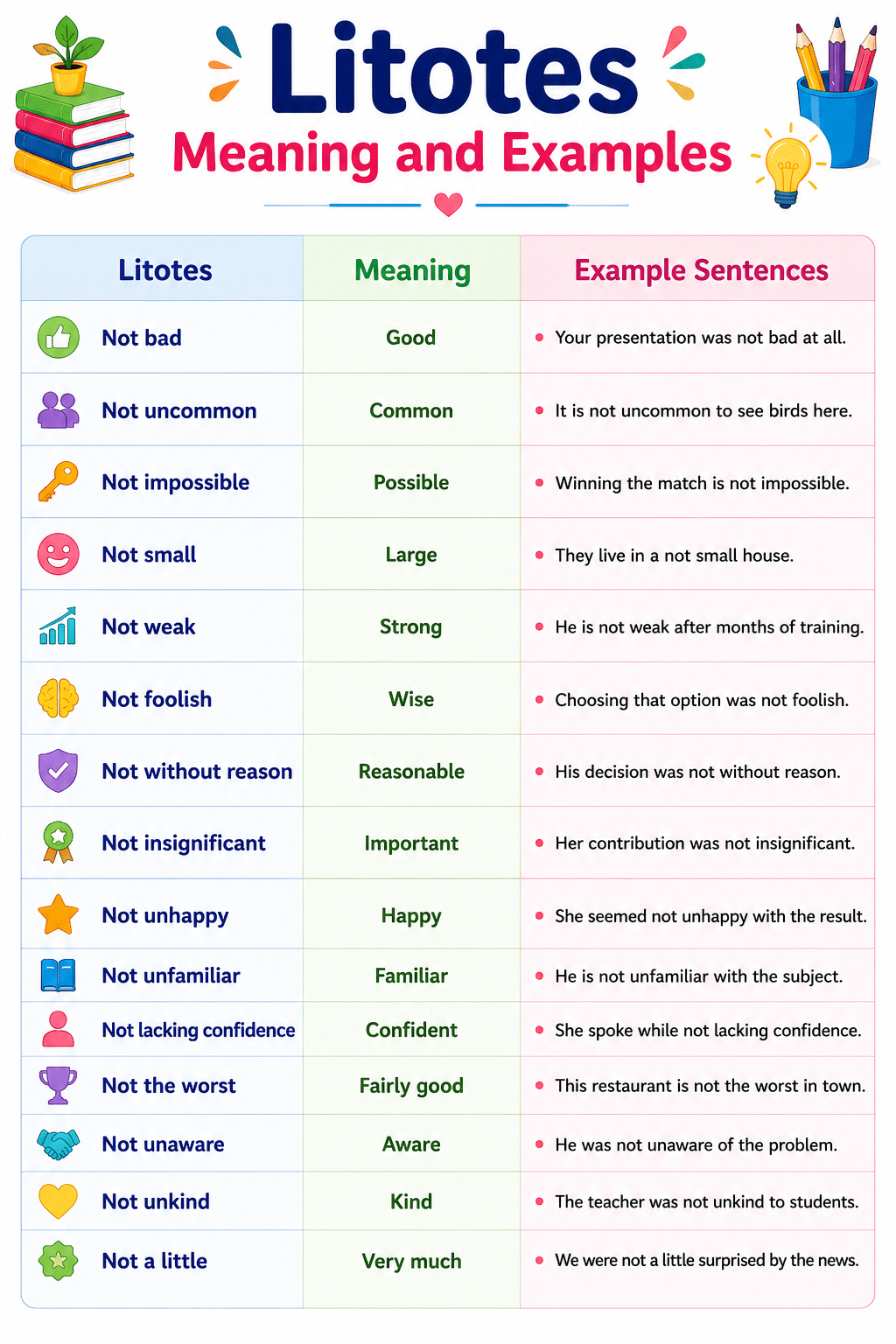
Litotes meaning with Example Sentences
List of Litotes in English
- Not bad
- Not unhappy
- Not uncommon
- Not impossible
- Not difficult
- Not small
- Not weak
- Not ugly
- Not insignificant
- Not poor
- Not rare
- Not foolish
- Not boring
- Not without talent
- Not without merit
- Not lacking confidence
- Not the worst
- Not unaware
- Not unkind
- Not a little
- No small feat
- No easy task
- No mean achievement
- No ordinary person
- No stranger to hard work
- Not entirely wrong
- Not too shabby
- Not incapable
- Not displeased
- Not unfamiliar
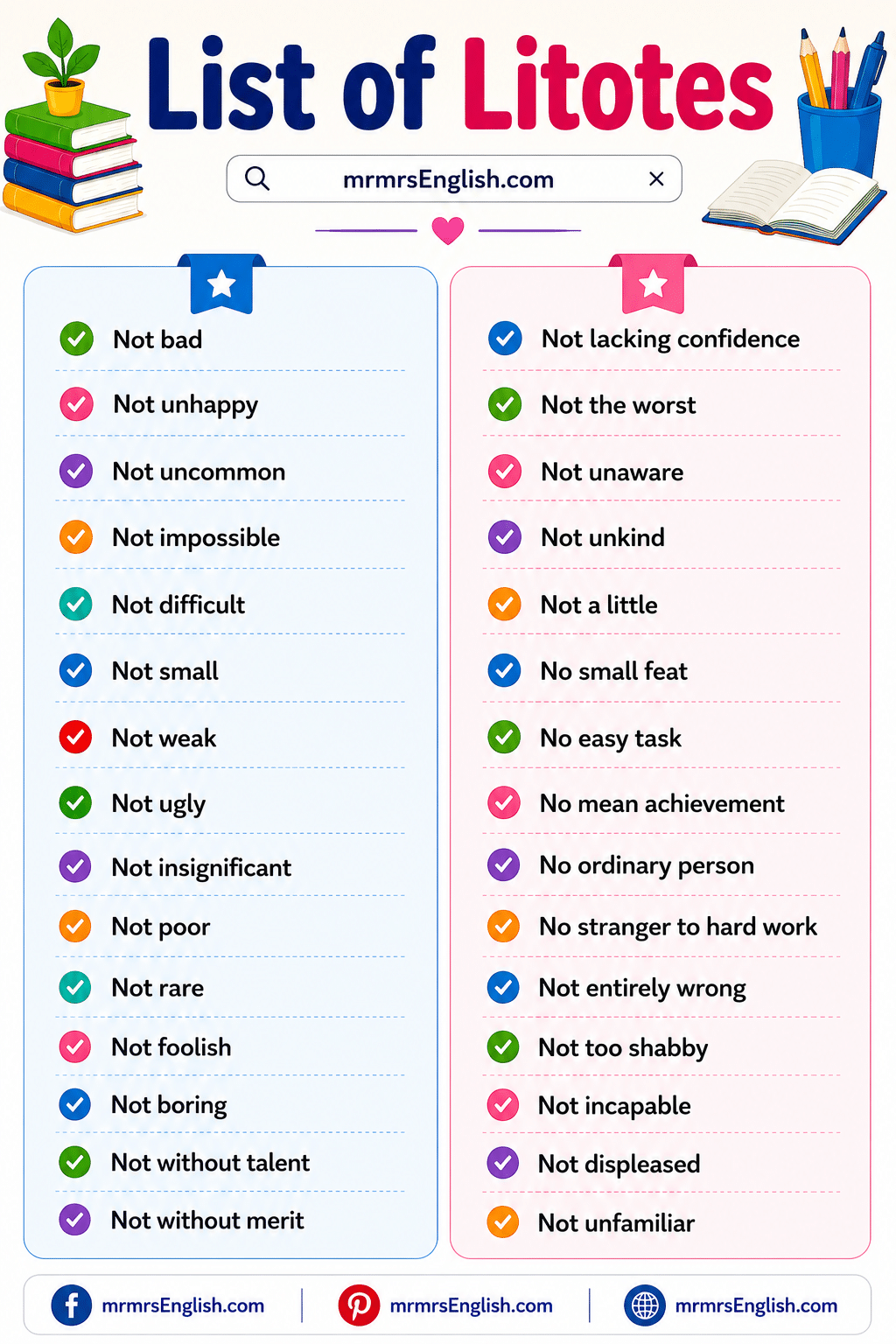
List of Litotes in English
Learn more helpful articles






Leave a Comment