Antithesis in English
Antithesis is one of the most important figures of speech in English grammar and literature. It is commonly used in speeches, essays, poems, advertisements, and everyday communication to create contrast between two opposite ideas. By placing contrasting thoughts close together, antithesis makes writing more powerful, memorable, and effective.
For ESL learners, understanding antithesis is important because it frequently appears in English exams, literary texts, academic writing, and competitive tests. Learning this literary device can improve reading comprehension, writing skills, vocabulary, and understanding of figurative language.
In this complete guide, you will learn antithesis in English from basic to advanced level, including its meaning, structure, characteristics, examples, types, uses, and differences from related literary devices.
What Is Antithesis in English?
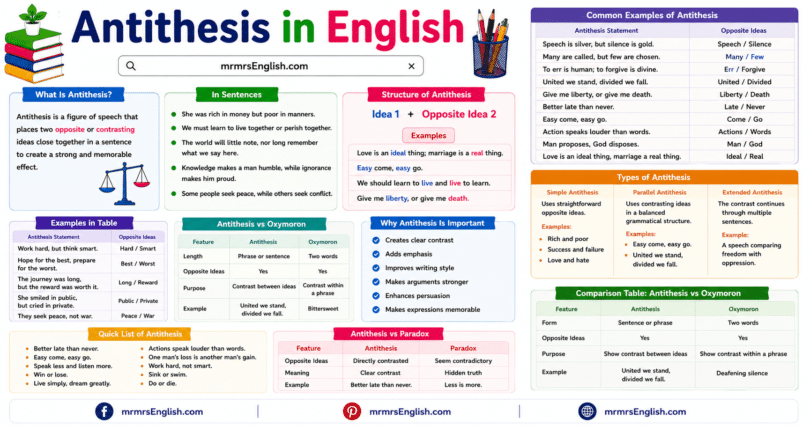
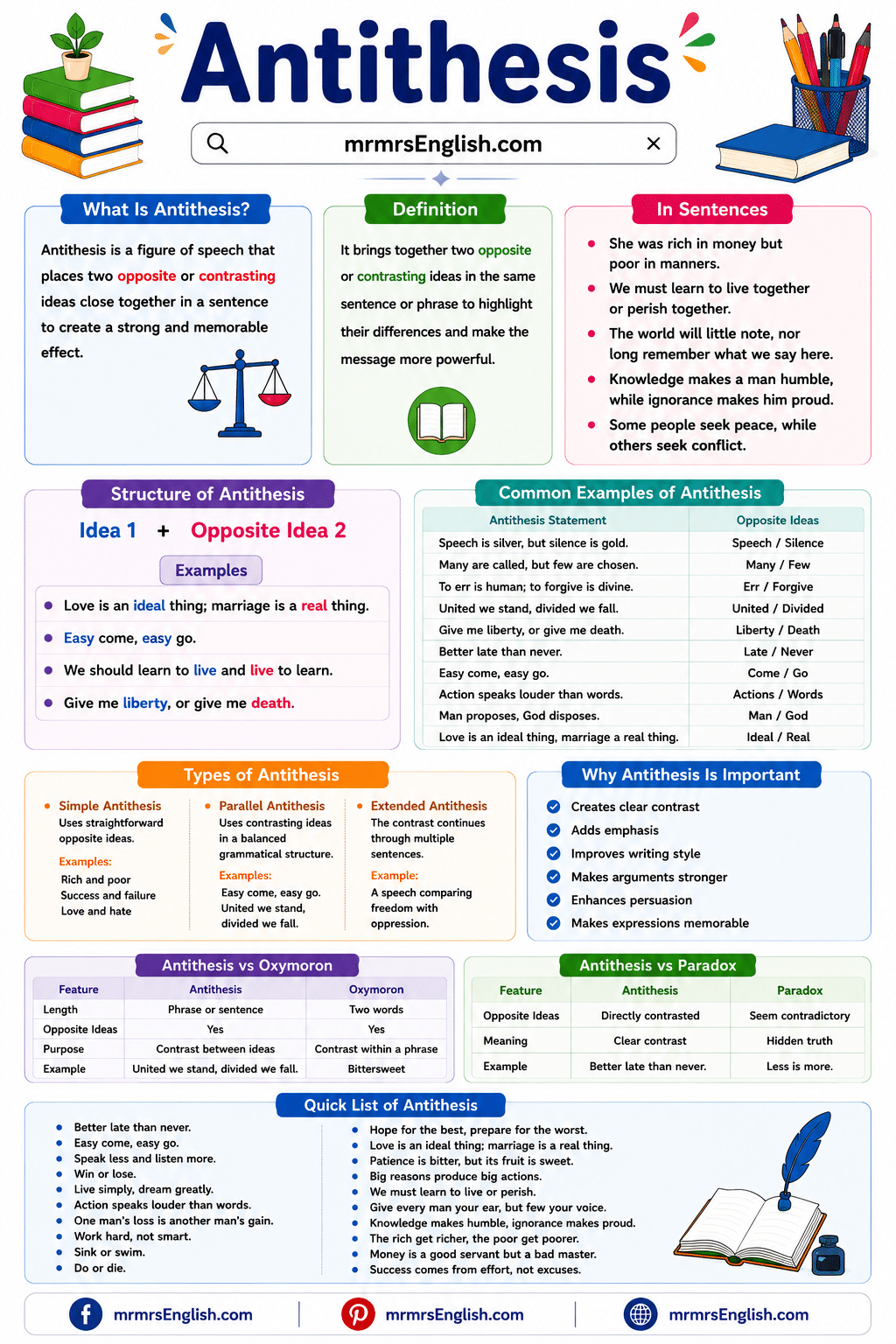
Antithesis is a figure of speech that brings together two opposite or contrasting ideas in the same sentence or phrase to create a strong effect.
The purpose of antithesis is to highlight the difference between two ideas and make the message more memorable.
Simple Examples of Antithesis
| Antithesis Statement | Opposite Ideas |
|---|
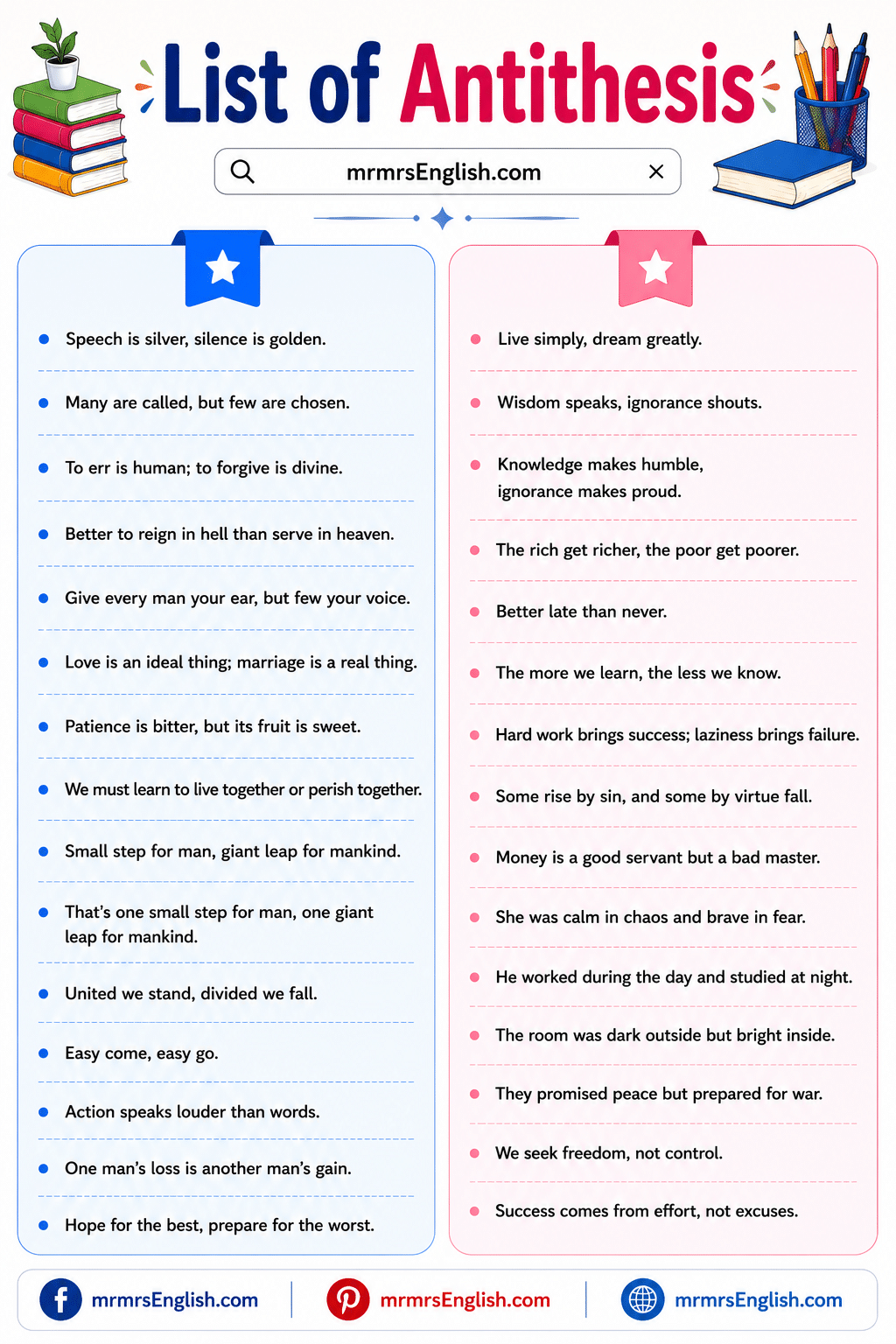
| Speech is silver, but silence is gold. | Speech / Silence |
| Many are called, but few are chosen. | Many / Few |
| To err is human; to forgive is divine. | Err / Forgive |
| United we stand, divided we fall. | United / Divided |
| Give me liberty, or give me death. | Liberty / Death |
In each example, contrasting ideas are placed together to create emphasis.
Why Is Antithesis Used?
Writers and speakers use antithesis for several reasons.
To Create Contrast
It clearly shows the difference between two opposing ideas.
To Add Emphasis
The contrast makes the message stronger and easier to remember.
To Improve Writing Style
Antithesis makes sentences more elegant and powerful.
To Persuade Readers
Many speakers use antithesis in speeches to influence audiences.
To Create Balance
Antithetical sentences often have a balanced grammatical structure that sounds pleasing.
Main Features of Antithesis
Antithesis has several characteristics that help identify it.
Opposite Ideas
The sentence contains two contrasting thoughts.
Parallel Structure
The contrasting ideas often follow a similar grammatical pattern.
Strong Emphasis
The contrast highlights the main point.
Memorable Expression
Antithesis creates sentences that are easy to remember.
Structure of Antithesis
Antithesis commonly follows a balanced structure where opposite ideas appear in parallel form.
Common Pattern
Idea 1 + Opposite Idea 2
Examples
| Structure | Example |
|---|
| Opposite nouns | Love is an ideal thing; marriage is a real thing. |
| Opposite adjectives | Small steps lead to great success. |
| Opposite verbs | We should learn to live and live to learn. |
| Opposite phrases | Easy come, easy go. |
Common Examples of Antithesis
The following examples are frequently used in English.
| Sentence | Opposing Ideas |
|---|
| Actions speak louder than words. | Actions / Words |
| Better late than never. | Late / Never |
| Easy come, easy go. | Come / Go |
| Man proposes, God disposes. | Man / God |
| Love is an ideal thing, marriage a real thing. | Ideal / Real |
Antithesis in Sentences
Understanding antithesis becomes easier when seen in complete sentences.
Examples
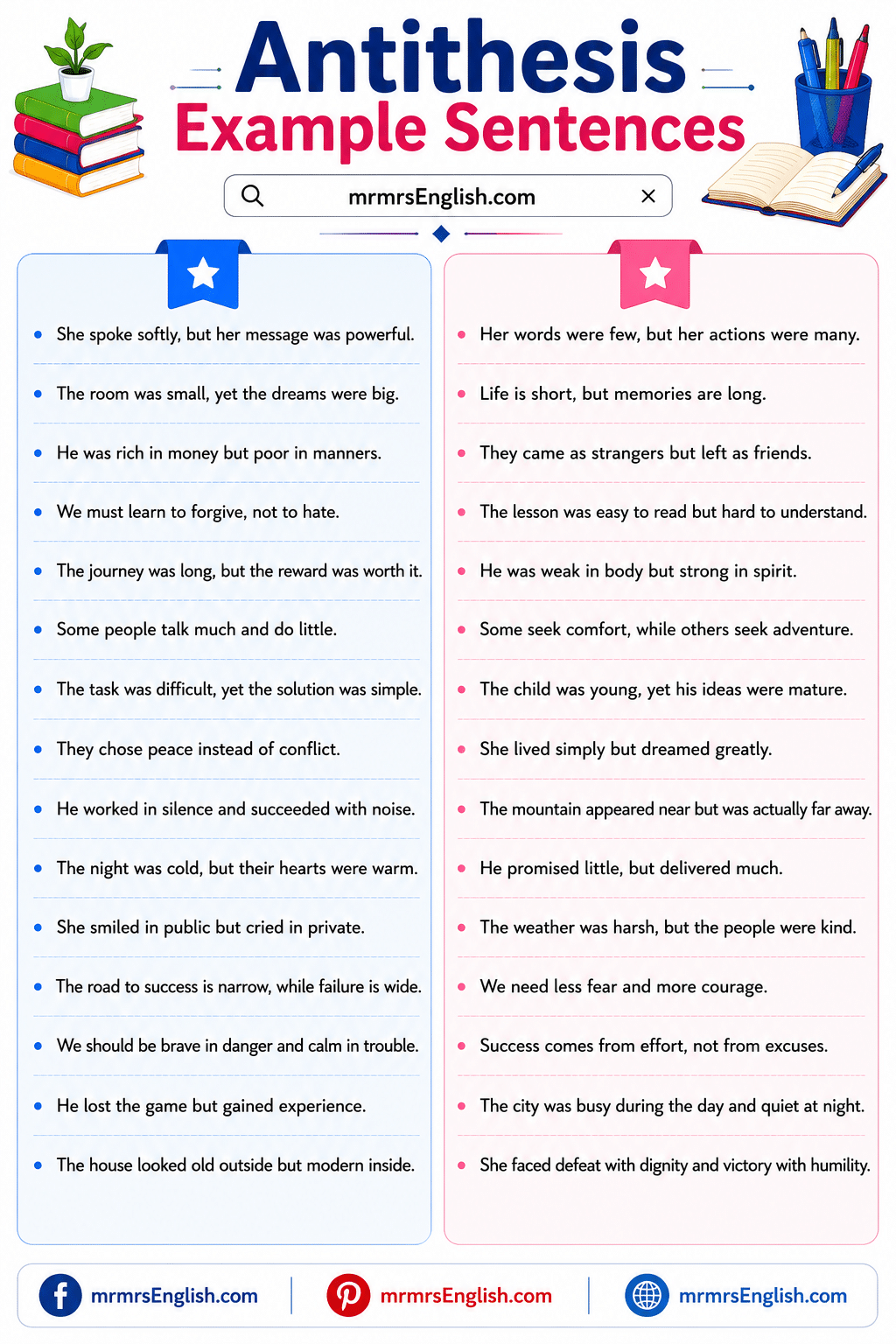
- She was rich in possessions but poor in spirit.
- We must learn to live together or perish together.
- The world will little note, nor long remember what we say here.
- Knowledge makes a man humble, while ignorance makes him proud.
- Some people seek peace, while others seek conflict.
In these examples, opposite ideas are placed side by side to create a stronger message.
Antithesis in Everyday Conversation
Although antithesis is often associated with literature, it also appears in daily communication.
Examples
| Sentence | Contrasting Ideas |
|---|
| Work hard, not smart. | Hard / Smart |
| Better to give than to receive. | Give / Receive |
| Speak less and listen more. | Speak / Listen |
| We win some and lose some. | Win / Lose |
| Hope for the best, prepare for the worst. | Best / Worst |

Antithesis meaning types and Examples in English
Antithesis in Literature
Many famous authors use antithesis to make their writing more impactful.
Examples
- “It was the best of times, it was the worst of times.”
- “To be, or not to be.”
- “Give every man thy ear, but few thy voice.”
These examples remain memorable because the opposing ideas create dramatic contrast.
Antithesis in Speeches
Antithesis is one of the most common rhetorical devices used in speeches.
Examples
| Statement | Contrasting Ideas |
|---|
| Ask not what your country can do for you; ask what you can do for your country. | Country / You |
| We must learn to live together as brothers or perish together as fools. | Live / Perish |
| United we stand, divided we fall. | United / Divided |
Speakers use antithesis because it makes arguments stronger and easier to remember.
Types of Antithesis
Simple Antithesis
Uses straightforward opposite ideas.
Examples
- Rich and poor
- Success and failure
- Love and hate
Parallel Antithesis
Uses contrasting ideas in a balanced grammatical structure.
Examples
- Easy come, easy go.
- United we stand, divided we fall.
Extended Antithesis
The contrast continues through multiple sentences or paragraphs.
Example
A speech comparing freedom with oppression over several lines.
Antithesis vs Oxymoron
Many students confuse antithesis with oxymoron.
| Feature | Antithesis | Oxymoron |
|---|
| Length | Usually a phrase or sentence | Usually two words |
| Opposite Ideas | Yes | Yes |
| Purpose | Contrast between ideas | Contrast within a phrase |
| Example | United we stand, divided we fall. | Bittersweet |
Examples
Antithesis: United we stand, divided we fall.
Oxymoron: Deafening silence.
Antithesis vs Paradox
Antithesis and paradox both involve contrast, but they are different.
| Feature | Antithesis | Paradox |
|---|
| Opposite Ideas | Directly contrasted | Seem contradictory |
| Meaning | Clear contrast | Hidden truth |
| Example | Better late than never. | Less is more. |
Examples
Antithesis: Better late than never.
Paradox: The only constant is change.
Antithesis vs Juxtaposition
These literary devices are related but not identical.
| Feature | Antithesis | Juxtaposition |
|---|
| Opposite Ideas | Required | Not always required |
| Contrast | Strong and direct | May simply compare |
| Structure | Usually parallel | Any structure |
Example
Antithesis: Many are called, but few are chosen.
Juxtaposition: A poor village beside a luxurious city.
Common Antithesis Expressions
Many antithetical expressions are widely used in English.
| Expression | Opposite Ideas |
|---|
| Better late than never | Late / Never |
| Easy come, easy go | Come / Go |
| Give and take | Give / Take |
| Sink or swim | Sink / Swim |
| Win or lose | Win / Lose |
| Black and white | Black / White |
| Life and death | Life / Death |
Importance of Antithesis in Writing
Makes Writing Memorable
Readers remember contrasting ideas more easily.
Strengthens Arguments
Antithesis helps emphasize key points.
Improves Style
It adds elegance and rhythm to writing.
Enhances Persuasion
Many speeches and advertisements use antithesis to influence audiences.
Common Mistakes When Identifying Antithesis
Assuming Any Contrast Is Antithesis
Not every contrasting sentence is antithesis. The contrast should be deliberate and meaningful.
Ignoring Parallel Structure
Many examples of antithesis use balanced grammar.
Confusing It with Oxymoron
Antithesis compares opposite ideas in a sentence, while oxymoron combines opposite words in a phrase.
Tips for Learning Antithesis
Learn Common Opposites
Practice words such as:
- Good / Bad
- Rich / Poor
- Success / Failure
- Life / Death
Read Literature
Literary works contain many examples of antithesis.
Analyze Famous Quotes
Many famous quotations use antithesis effectively.
Practice Writing
Create your own sentences using contrasting ideas.
Practice Exercise on Antithesis
Identify the contrasting ideas in the following sentences.
- United we stand, divided we fall.
- Better late than never.
- Speech is silver, but silence is gold.
- Many are called, but few are chosen.
- To err is human; to forgive is divine.
Answers
| Sentence | Opposite Ideas |
|---|
| United we stand, divided we fall. | United / Divided |
| Better late than never. | Late / Never |
| Speech is silver, but silence is gold. | Speech / Silence |
| Many are called, but few are chosen. | Many / Few |
| To err is human; to forgive is divine. | Err / Forgive |
Frequently Asked Questions About Antithesis
Is antithesis a figure of speech?
Yes. Antithesis is a figure of speech that places contrasting ideas together for emphasis.
What is the purpose of antithesis?
Its purpose is to highlight differences, create emphasis, and make writing more memorable.
Is antithesis used in everyday English?
Yes. Many common sayings and expressions use antithesis.
Why is antithesis important in literature?
It helps authors create contrast, improve style, and communicate ideas more effectively.
Antithesis Examples Sentences in English


Leave a Comment