
Adjectives are important words that describe or give more information about nouns and pronouns. They help us explain a person’s appearance, an object’s size, a place, a feeling, or a quality, making our sentences clearer and more interesting. In this article, you will learn adjectives and their types, definitions, and examples in simple and easy language. With clear explanations and practical example sentences, this guide will help students, teachers, and English learners understand how adjectives work and use them correctly in everyday speaking and writing.
What Are Adjectives in English?
An adjective is a word that describes or gives more information about a noun or pronoun. It tells us about the quality, quantity, size, shape, color, age, number, or condition of a person, place, thing, or idea.
Examples
- She has a beautiful dress.
- It is a large building.
- They bought three books.
- The sky looks blue today.
In these sentences, the highlighted words describe nouns, making the meaning more specific and clear.
Why Are Adjectives Important?
Adjectives make communication more detailed and effective.
Compare these sentences:
- I saw a car.
- I saw a red sports car.
The second sentence gives a much clearer picture because the adjectives provide additional details.
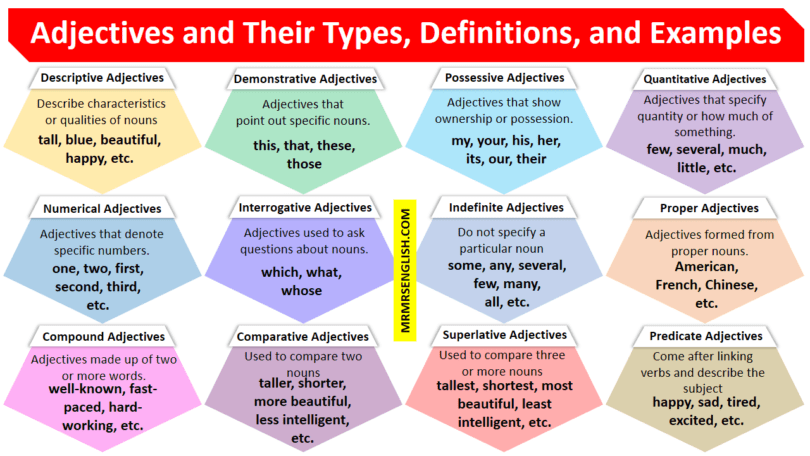
12 Adjectives and Their Types:
- Descriptive adjectives
- Demonstrative adjectives
- Possessive adjectives
- Quantitative adjectives
- Numerical adjectives
- Interrogative adjectives
- Indefinite adjectives
- Proper adjectives
- Compound adjectives
- Comparative adjectives
- Superlative adjectives
- Predicate adjectives
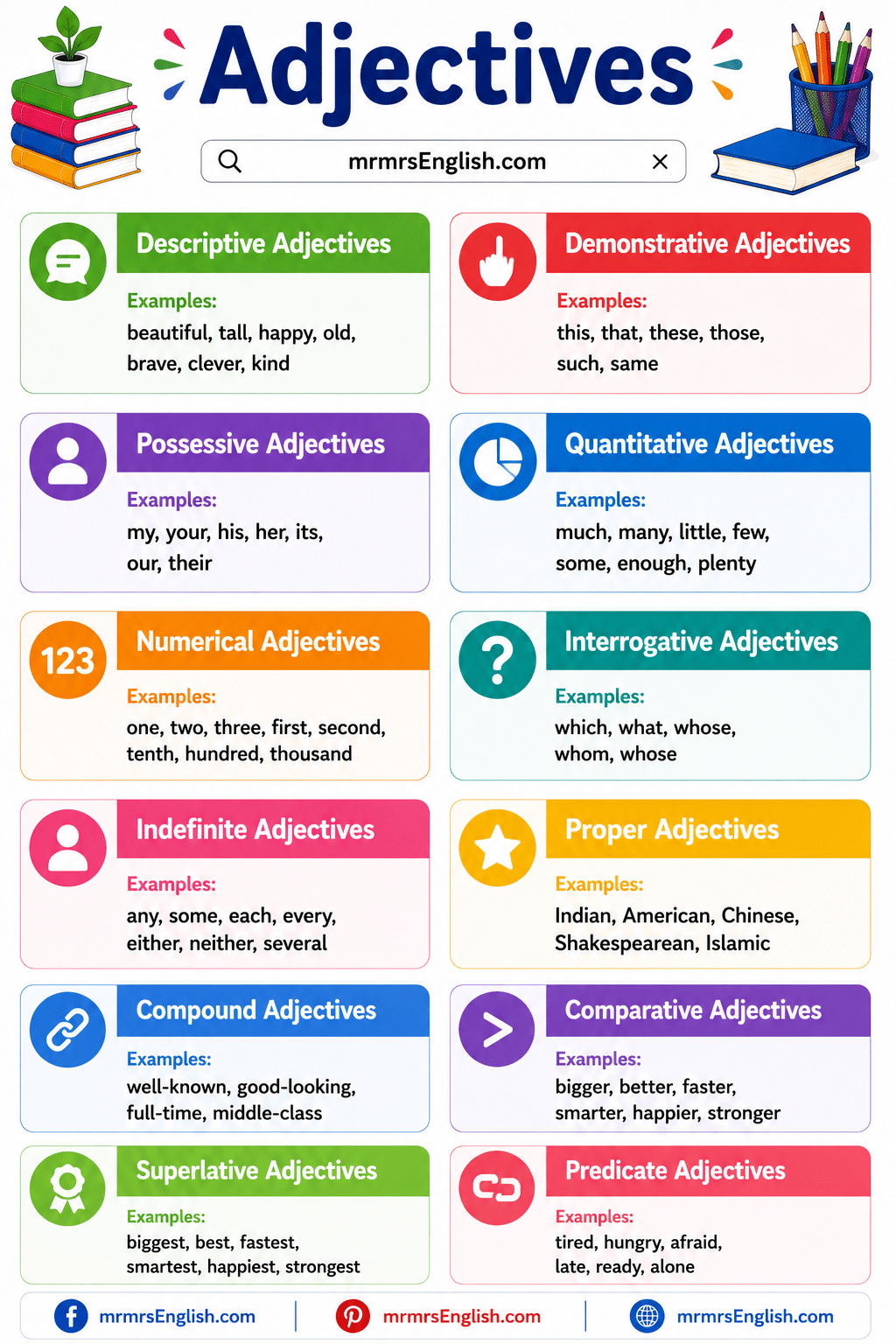
Types of Adjectives in English
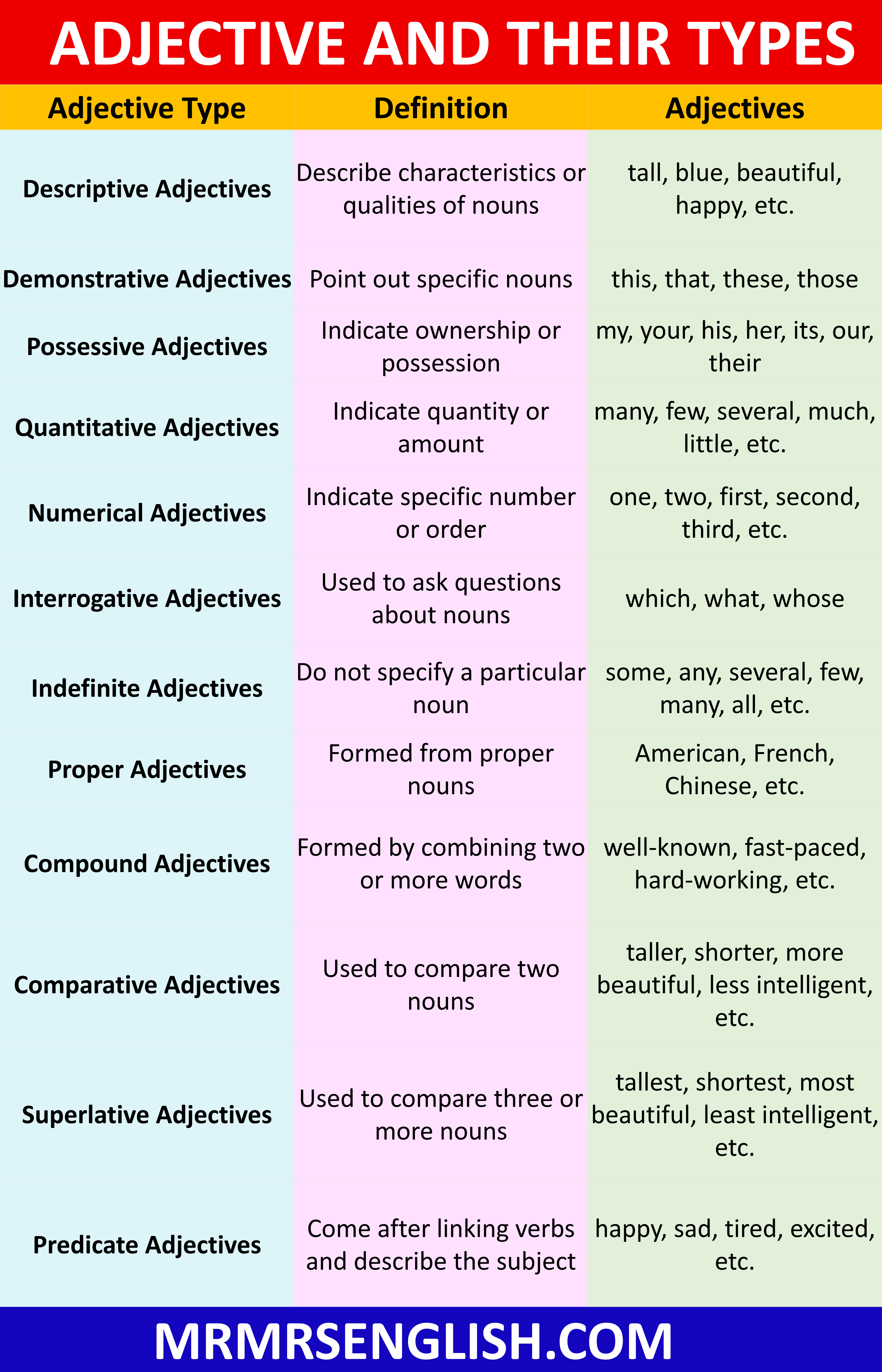
Adjectives and Their Types, Definitions, and Examples:
Descriptive Adjectives:
- Definition: Adjectives that describe the characteristics or qualities of nouns.
- Adjectives: tall, blue, beautiful, happy, etc.
- Example sentences:
- The tall tree stood majestically in the park.
- She wore a blue dress to the party.
- He admired the beautiful sunset.
Demonstrative Adjectives:
- Definition: Adjectives used to point out specific nouns.
- Adjectives: this, that, these, those
- Example sentences:
- This book belongs to me.
- I prefer those shoes over these.
- That house across the street is for sale.
Possessive Adjectives:
- Definition: Adjectives that indicate ownership or possession.
- Adjectives: my, your, his, her, its, our, their
- Example sentences:
- My car is parked outside.
- Their dog is very friendly.
- She forgot her keys at home.
Quantitative Adjectives:
- Definition: Adjectives that indicate the quantity or amount of a noun.
- Adjectives: many, few, several, much, little, etc.
- Example sentences:
- There are many books on the shelf.
- She has few friends in this city.
- He doesn’t have much time to spare.
Numerical Adjectives:
- Definition: Adjectives that indicate a specific number or order of a noun.
- Adjectives: one, two, first, second, third, etc.
- Example sentences:
- He was the first person to arrive at the party.
- There are three apples on the table.
- She lives on the fourth floor of the building.
Interrogative Adjectives:
- Definition: Adjectives used to ask questions about nouns.
- Adjectives: which, what, whose
- Example sentences:
- Which book do you prefer?
- What color is your car?
- Whose pen is this?
Indefinite Adjectives:
- Definition: Adjectives that do not specify a particular noun.
- Adjectives: some, any, several, few, many, all, etc.
- Example sentences:
- She bought some flowers for the vase.
- Do you have any plans for the weekend?
- Several people attended the meeting.
Proper Adjectives:
- Definition: Adjectives formed from proper nouns.
- Adjectives: American, French, Chinese, etc.
- Example sentences:
- He enjoys American cuisine.
- She studies French literature.
- They visited the Chinese restaurant last night.
Compound Adjectives:
- Definition: Adjectives formed by combining two or more words.
- Adjectives: well-known, fast-paced, hard-working, etc.
- Example sentences:
- She lives in a well-known neighborhood.
- The movie had a fast-paced plot.
- He is a hard-working student.
Comparative Adjectives:
- Definition: Adjectives used to compare two nouns.
- Adjectives: taller, shorter, more beautiful, less intelligent, etc.
- Example sentences:
- She is taller than her sister.
- This book is more interesting than the one I read yesterday.
- He is less patient than his brother.
Superlative Adjectives:
- Definition: Adjectives used to compare three or more nouns.
- Adjectives: tallest, shortest, most beautiful, least intelligent, etc.
- Example sentences:
- Mount Everest is the tallest mountain in the world.
- She is the most talented musician in the band.
- This is the least expensive option available.
Predicate Adjectives:
- Definition: Adjectives that come after linking verbs and describe the subject.
- Adjectives: happy, sad, tired, excited, etc.
- Example sentences:
- She feels happy about her promotion.
- He seems tired after a long day at work.
- They are excited about their upcoming vacation.
Adjectives
Position of Adjectives in Sentences
Adjectives can appear in different positions.
Before the Noun
This is the most common position.
Examples:
- A beautiful garden
- A small house
- A bright light
After Linking Verbs
Adjectives can also appear after linking verbs such as:
- Be
- Seem
- Become
- Feel
- Look
Examples:
- The sky is blue.
- She seems happy.
- The food tastes delicious.
Order of Adjectives in English
When multiple adjectives describe the same noun, they usually follow a specific order.
Standard Order
| Order | Type |
|---|---|
| 1 | Opinion |
| 2 | Size |
| 3 | Age |
| 4 | Shape |
| 5 | Color |
| 6 | Origin |
| 7 | Material |
| 8 | Purpose |
Example
- A beautiful large old round brown Italian wooden dining table
Although this seems long, native speakers naturally follow this order.
Comparative and Superlative Adjectives
Adjectives can compare people, places, or things.
Comparative Adjectives
Used to compare two things.
Examples
- Ali is taller than Ahmed.
- This book is better than that one.
Superlative Adjectives
Used to compare three or more things.
Examples
- Sara is the tallest student.
- This is the best restaurant in town.
Comparison Table
| Positive | Comparative | Superlative |
|---|---|---|
| Tall | Taller | Tallest |
| Small | Smaller | Smallest |
| Fast | Faster | Fastest |
| Good | Better | Best |
| Bad | Worse | Worst |
Degrees of Adjectives
There are three degrees of comparison.
| Degree | Example |
|---|---|
| Positive | Smart |
| Comparative | Smarter |
| Superlative | Smartest |
Example Sentence
- John is smart.
- John is smarter than Mike.
- John is the smartest student in the class.
Adjectives Ending in -ed and -ing
Many learners find these confusing.
-ed Adjectives
These describe feelings.
Examples
- I am interested in science.
- She felt excited.
-ing Adjectives
These describe the thing causing the feeling.
Examples
- Science is interesting.
- The movie was exciting.
Compare
| -ed | -ing |
|---|---|
| Interested | Interesting |
| Excited | Exciting |
| Bored | Boring |
| Tired | Tiring |
Adjectives and Pronouns
Adjectives can modify pronouns after linking verbs.
Examples
- He is kind.
- They seem ready.
- She looks beautiful.
Advanced Uses of Adjectives
Compound Adjectives
Two or more words joined together to describe a noun.
Examples
- A well-known author
- A five-star hotel
- A part-time job
- A high-quality product
Participial Adjectives
These are formed from verbs.
Examples
- A broken chair
- A running machine
- A sleeping baby
Predicate Adjectives
These appear after linking verbs.
Examples
- The weather is pleasant.
- The students are ready.
Quick Summary Table
| Type of Adjective | Function | Example |
|---|---|---|
| Descriptive | Describes quality | beautiful |
| Quantitative | Shows amount | some |
| Numerical | Shows number | three |
| Demonstrative | Points out nouns | this |
| Possessive | Shows ownership | my |
| Interrogative | Asks questions | which |
| Distributive | Refers individually | each |
| Proper | Derived from proper nouns | Pakistani |
Learn more helpful articles

Leave a Comment