
Adverbs are an important part of English grammar, adding more detail to verbs, adjectives, other adverbs, and complete sentences. They come in many types, including adverbs of manner, time, place, frequency, degree, and reason, each performing a specific function in communication. Learning adverbs and their types is a useful way to improve your English grammar while making sentences clearer and more meaningful. In this article, you will learn adverb definitions and examples with simple explanations, helping kids, students, teachers, beginners, and English learners identify different types of adverbs, understand their uses, and use them correctly and confidently in everyday English.
What Are Adverbs in English?
An adverb is a word that gives more information about a verb, an adjective, another adverb, or even an entire sentence.
Adverbs help answer questions such as:
- How?
- When?
- Where?
- How often?
- To what extent?
Examples
| Sentence | Adverb | Function |
|---|---|---|
| She speaks clearly. | clearly | How she speaks |
| We arrived yesterday. | yesterday | When we arrived |
| They looked everywhere. | everywhere | Where they looked |
| He always studies. | always | How often he studies |
| The water is very cold. | very | Degree of coldness |
Why Are Adverbs Important?
Adverbs make sentences more detailed and meaningful.
Compare these sentences:
- She sings.
- She sings beautifully.
The second sentence gives more information and creates a clearer picture.
Types of Adverbs in English Grammar:
- Adverbs of manner
- Adverbs of place
- Adverbs of time
- Adverbs of frequency
- Adverbs of degree
- Adverbs of certainty
- Adverbs of negation
- Adverbs of affirmation
- Adverbs of comparison
- Adverbs of duration
- Adverbs of frequency and repetition
- Adverbs of sequence
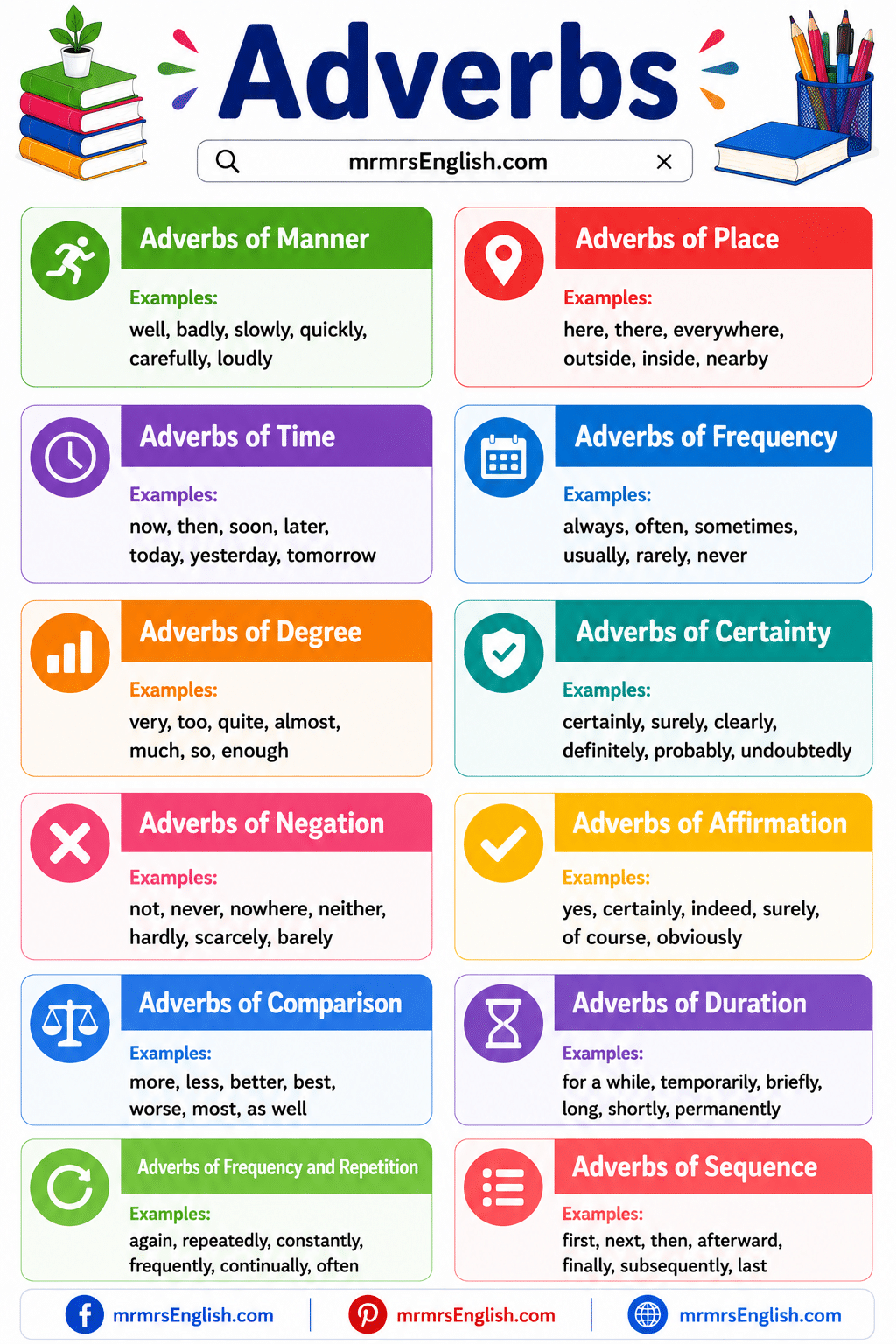
Adverbs
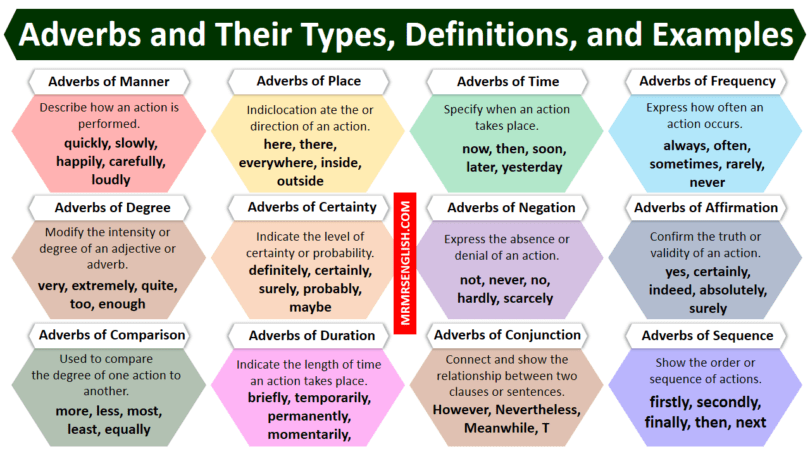
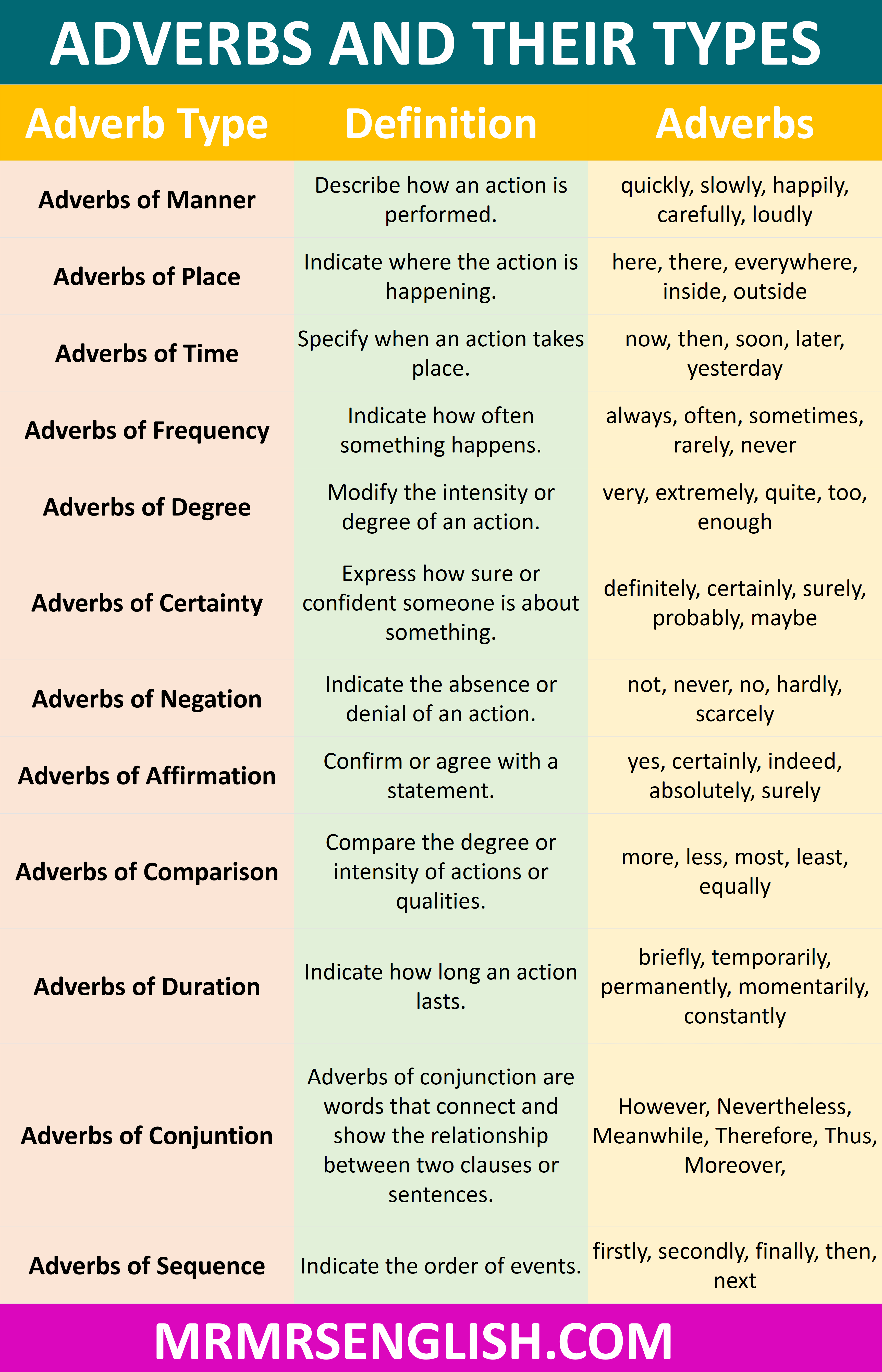
12 Adverbs and Their Types, Definitions, and Examples:
Adverbs of Manner
- Definition: Adverbs of manner describe how an action is performed.
- Adverbs: quickly, slowly, happily, carefully, loudly
- Examples:
- She danced happily at the party.
- The cat walked slowly across the room.
- He completed the puzzle carefully.
Adverbs of Place
- Definition: Adverbs of place indicate where the action is happening.
- Adverbs: here, there, everywhere, inside, outside
- Examples:
- The keys are lying there on the table.
- They went inside the house to escape the rain.
- Birds were flying everywhere in the sky.
Adverbs of Time
- Definition: Adverbs of time specify when an action takes place.
- Adverbs: now, then, soon, later, yesterday
- Examples:
- We should start our homework now.
- He will arrive soon at the airport.
- She visited her grandmother yesterday.
Adverbs of Frequency
- Definition: Adverbs of frequency indicate how often something happens.
- Adverbs: always, often, sometimes, rarely, never
- Examples:
- He brushes his teeth always before bed.
- They go to the movies rarely.
- She eats seafood never.
Adverbs of Degree
- Definition: Adverbs of degree modify the intensity or degree of an action.
- Adverbs: very, extremely, quite, too, enough
- Examples:
- She was very tired after the long journey.
- The movie was extremely boring.
- He is quite tall for his age.
Adverbs of Certainty
- Definition: Adverbs of certainty express how sure or confident someone is about something.
- Adverbs: definitely, certainly, surely, probably, maybe
- Examples:
- She will definitely attend the meeting.
- He is probably going to be late.
- They will surely win the game.
Adverbs of Negation
- Definition: Adverbs of negation indicate the absence or denial of an action.
- Adverbs: not, never, no, hardly, scarcely
- Examples:
- He is not interested in watching the movie.
- She never eats fast food.
- There is no milk left in the fridge.
Adverbs of Affirmation
- Definition: Adverbs of affirmation confirm or agree with a statement.
- Adverbs: yes, certainly, indeed, absolutely, surely
- Examples:
- Yes, I will help you with your homework.
- He will certainly attend the party.
- She is indeed a talented musician.
Adverbs of Comparison
- Definition: Adverbs of comparison compare the degree or intensity of actions or qualities.
- Adverbs: more, less, most, least, equally
- Examples:
- She sings more beautifully than her sister.
- He runs less quickly than his brother.
- This book is equally interesting as the one you read before.
Adverbs of Duration
- Definition: Adverbs of duration indicate how long an action lasts.
- Adverbs: briefly, temporarily, permanently, momentarily, constantly
- Examples:
- He paused briefly before answering the question.
- The exhibit will be open temporarily for two weeks.
- They lived in the city permanently after retirement.
Adverbs of Conjunction:
- Definition: Adverbs of conjunction are words that connect and show the relationship between two clauses or sentences.
- Adverbs: However, Nevertheless, Meanwhile, Therefore, Thus, Moreover, Furthermore, Nonetheless, Consequently, Hence, Additionally, Likewise, Accordingly, Similarly, Nonetheless, In contrast,
- Examples:
- However, she completed the project on time.
- Meanwhile, they were working on another task.
- Therefore, we decided to go out.
Adverbs of Sequence
- Definition: Adverbs of sequence indicate the order of events.
- Adverbs: firstly, secondly, finally, then, next
- Examples:
- Firstly, we need to gather all the materials.
- She prepared the salad next.
- Finally, we served the main course.
Adverbs
Advanced Use of Adverbs
Sentence Adverbs
These adverbs comment on the whole sentence.
Examples
- Fortunately, nobody was injured.
- Honestly, I don’t agree.
- Unfortunately, the event was canceled.
Common Sentence Adverbs
| Adverb |
|---|
| Fortunately |
| Unfortunately |
| Honestly |
| Frankly |
| Clearly |
| Luckily |
Adverb vs Adjective
Many learners confuse adverbs with adjectives.
| Adjective | Adverb |
|---|---|
| Beautiful | Beautifully |
| Quick | Quickly |
| Happy | Happily |
| Careful | Carefully |
Compare
- She is a beautiful girl. (adjective)
- She sings beautifully. (adverb)
Practice Sentences
Identify the adverbs:
- She speaks softly.
- We arrived yesterday.
- They often visit us.
- He lives nearby.
- The test was extremely difficult.
Answers
| Sentence | Adverb |
|---|---|
| 1 | softly |
| 2 | yesterday |
| 3 | often |
| 4 | nearby |
| 5 | extremely |
Quick Summary Table
| Type | Purpose | Example |
|---|---|---|
| Manner | How? | quickly |
| Time | When? | yesterday |
| Place | Where? | here |
| Frequency | How often? | always |
| Degree | To what extent? | very |
| Certainty | How sure? | definitely |
| Interrogative | Asking questions | where |
| Relative | Connecting clauses | when |
Learn more helpful articles

Leave a Comment