
English Speaking Course Lesson 6 by Structures is designed to help you speak English more clearly by learning simple and practical sentence patterns. These structures make it easier to form correct sentences without depending on difficult grammar rules. The lesson includes easy examples that you can use in everyday conversations, helping you build confidence step by step. Whether you are a beginner or improving your communication skills, this lesson will make spoken English easier to understand, practice, and use in real-life situations.
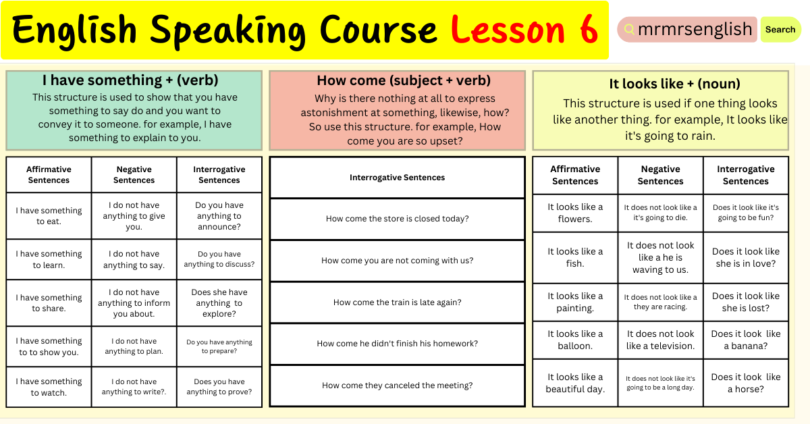
I have something + (verb)
This structure is used to show that you have something to say and you want to convey it to someone. for example, I have something to explain to you.
Formulas
- Affirmative Sentences: I + have/has + something to (verb).
- Negative Sentences: I + do/does + not have + anything to (verb).
- Interrogative Sentences: Do/Does +you/she + have + anything to (verb)?
| Affirmative Sentences | Negative Sentences | Interrogative Sentences |
| I have something to eat. | I do not have anything to give you. | Do you have anything to announce? |
| I have something to learn. | I do not have anything to say. | Do you have anything to discuss? |
| I have something to share. | I do not have anything to inform you about. | Does she have anything to explore? |
| I have something to show you. | I do not have anything to plan. | Do you have anything to prepare? |
| I have something to watch. | I do not have anything to write. | Do you have anything to prove? |

How come (subject + verb)
Why is there nothing at all to express astonishment at something, likewise, how? So use this structure. for example, How come you are so upset?
Formulas
- Interrogative Sentences: How come + subject + verb
| Interrogative Sentences |
| How come the store is closed today? |
| How come you are not coming with us? |
| How come the train is late again? |
| How come he didn’t finish his homework? |
| How come they canceled the meeting? |

It looks like + (noun):
This structure is used if one thing looks like another thing. for example, It looks like it’s going to rain.
Formulas
- Affirmative Sentences: It looks like + a + (noun).
- Negative Sentences: It does not + look like + (a/an) + (noun).
- Interrogative Sentences: Does + it look like + (a/an) + (noun)?
| Affirmative Sentences | Negative Sentences | Interrogative Sentences |
| It looks like flowers. | It does not look like it’s going to die. | Does it look like it’s going to be fun? |
| It looks like a fish. | It does not look like he is waving to us. | Does it look like she is in love? |
| It looks like a painting. | It does not look like they are racing. | Does it look like she is lost? |
| It looks like a balloon. | It does not look like a television. | Does it look like a banana? |
| It looks like a beautiful day. | It does not look like it’s going to be a long day. | Does it look like a horse? |

Read Also:

Leave a Comment