

English Speaking Course Lesson 7 by Structures helps you improve your spoken English by teaching useful sentence patterns that are easy to understand and use in daily conversations. Instead of memorizing long grammar rules, you will learn practical structures that make speaking more natural and confident. This lesson includes simple examples that are perfect for beginners and anyone who wants to communicate more effectively in English. By practicing these structures regularly, you can build better speaking skills and express your thoughts with greater ease.
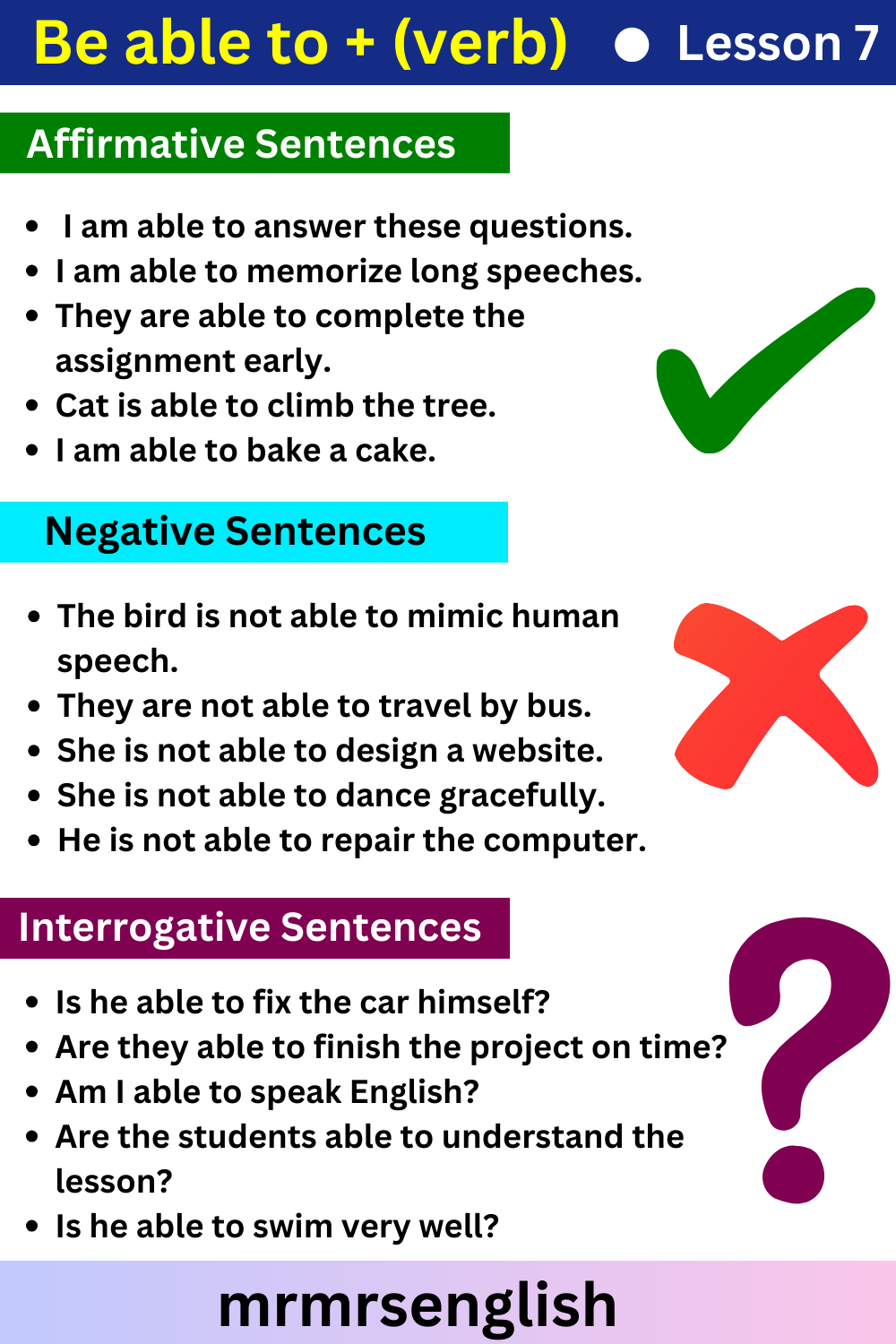
Be able to + (verb):
This structure is used to describe someone’s ability. For example, she is able to run fast. I am able to memorize long. They are able to complete the assignment early.
Formulas
- Affirmative Sentences: I/he/we/they + am/is/are + able to + (verb).
- Negative Sentences: I/he/we/they + am/is/are + not + able to + (verb).
- Interrogative Sentences: Am/Is/Are +I/he/we/they + able to + (verb)?
| Affirmative Sentences | Negative Sentences | Interrogative Sentences |
| I am able to answer these questions. | The bird is not able to mimic human speech. | Is he able to fix the car himself? |
| I am able to memorize long speeches. | They are not able to travel by bus. | Are they able to finish the project on time? |
| They are able to complete the assignment early. | She is not able to design a website. | Am I able to speak English? |
| Cat is able to climb the tree. | She is not able to dance gracefully. | Are the students able to understand the lesson? |
| I am able to bake a cake. | He is not able to repair the computer. | Is he able to swim very well? |
English Speaking Course Lesson 7 by Structures
Would rather + (verb):
This structure is used to refer one object to other objects or to another object. For example, I would rather work from home.
- Affirmative Sentences: I/he/we/they + would rather + (first form of the verb).
| Affirmative Sentences |
| I would rather stay home. |
| She would rather read a book. |
| He would rather play soccer. |
| They would rather travel by car. |
| I would rather drink coffee. |

English Speaking Course Lesson 7 by Structures
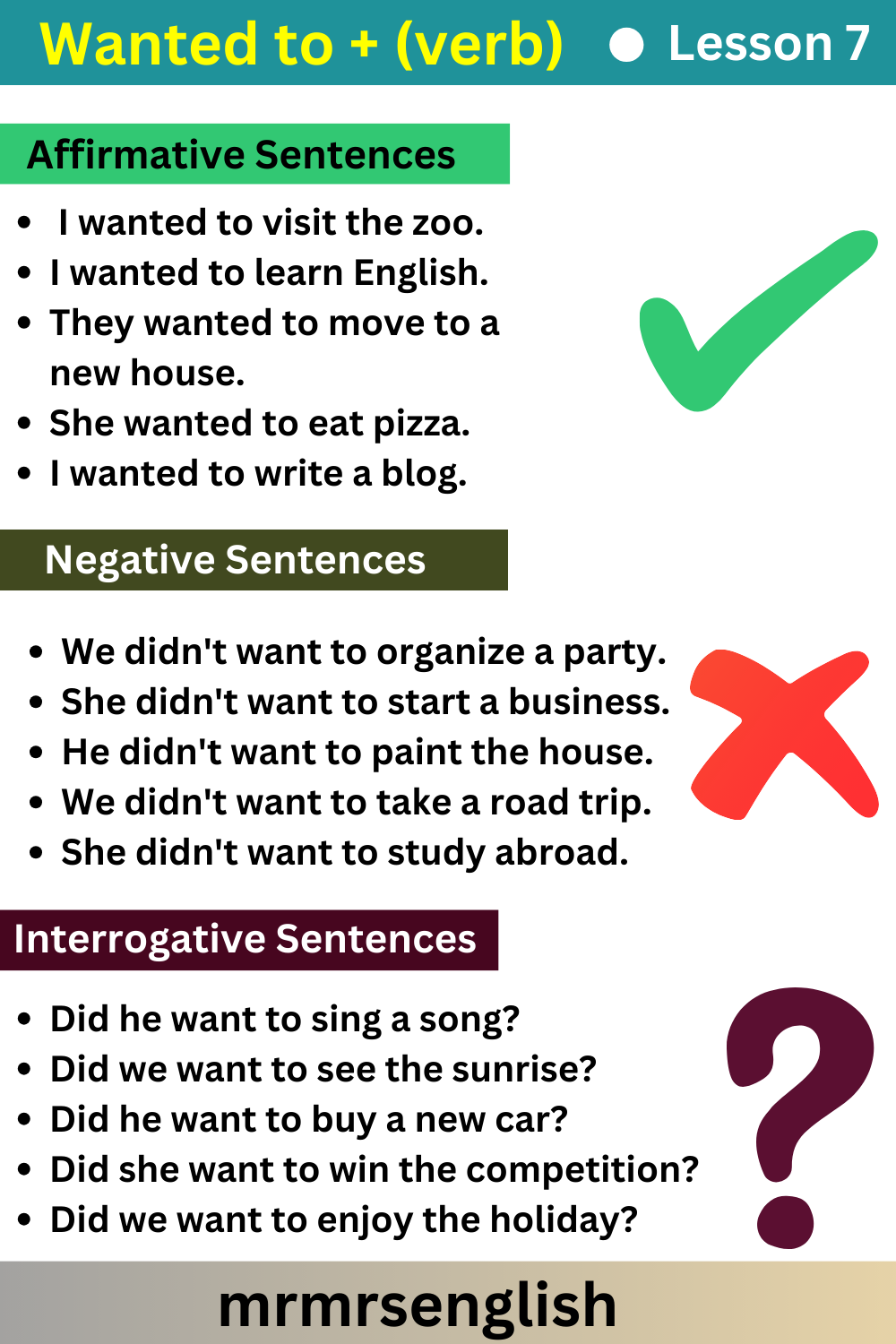
Wanted to + (verb):
This structure is used when someone wants to do something in the past. For example, we wanted to make a difference.
Formulas
- Affirmative Sentences: I/he/we/they + wanted to + (first form of the verb).
- Negative Sentences: I/he/we/they + did not want to + (first form of the verb).
- Interrogative Sentences: Did + I/he/we + want to + (first form of the verb)?
| Affirmative Sentences | Negative Sentences | Interrogative Sentences |
| I wanted to visit the zoo. | We didn’t want to organize a party. | Did he want to sing a song? |
| I wanted to learn English. | She didn’t want to start a business. | Did we want to see the sunrise? |
| They wanted to move to a new house. | He didn’t want to paint the house. | Did he want to buy a new car? |
| She wanted to eat pizza. | We didn’t want to take a road trip. | Did she want to win the competition? |
| I wanted to write a blog. | She didn’t want to study abroad. | Did we want to enjoy the holiday? |
Learn more helpful articles

Leave a Comment