
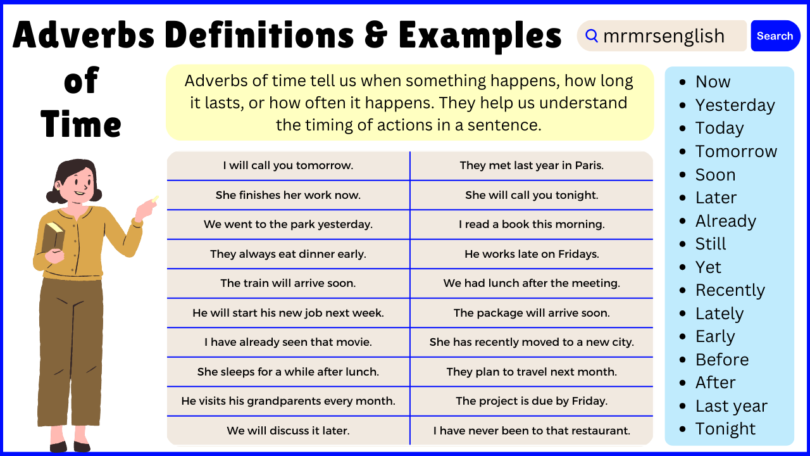
Adverbs of time are words that tell us when an action happens, how often it occurs, or for how long it continues. They help make sentences more clear, natural, and meaningful in everyday English. Common adverbs of time include today, yesterday, now, soon, always, and never. Understanding how to use them correctly is essential for improving both speaking and writing skills. In this article, you will learn adverbs of time through simple definitions and easy example sentences, making the topic easy to understand for students, teachers, and English learners.
What Are Adverbs of Time?
Adverbs of time are words or phrases that provide information about when an action happens, how long it lasts, or how often it occurs. They are used to modify verbs and can be placed in different positions within a sentence, typically at the beginning or end.
Adverbs of Time with Examples Sentences
| Adverb of Time | Example Sentence |
|---|---|
| Now | I am reading the book now. |
| Yesterday | She went shopping yesterday. |
| Today | We will meet today at noon. |
| Tomorrow | I will start my project tomorrow. |
| Soon | They will arrive soon. |
| Later | I will finish the task later. |
| Already | He has already finished the homework. |
| Still | Are you still working on that? |
| Yet | Have you eaten yet? |
| Ago | She moved here five years ago. |

Adverbs of Time with Examples Sentences
Types of Adverbs of Time with Example
1. Adverbs of Frequency
These adverbs tell us how often an action occurs.
- Always: I always drink coffee in the morning.
- Sometimes: He sometimes walks to work.
- Never: She has never been to Paris.
2. Adverbs of Duration
These adverbs explain how long an action takes place.
- For a while: I will stay for a while.
- All day: They worked all day to finish the project.
- Since: We have lived here since 2015.
3. Adverb of Time in Relation to the Present
These adverbs refer to actions happening now, in the past, or in the future.
- Now: She is now a doctor.
- Yesterday: They celebrated his birthday yesterday.
- Tomorrow: We will go to the beach tomorrow.
Placement of Adverbs of Time
The position of an adverb of time in a sentence can change based on emphasis. Here are the most common positions:
1. At the Beginning of a Sentence
When the time reference is crucial, we place the adverb at the beginning:
- Yesterday, I visited my grandparents.
- Today, we will go for a walk.
2. At the End of a Sentence
Most commonly, adverbs of time are placed at the end of a sentence:
- She is going to the gym tomorrow.
- They watched a movie yesterday.
3. In the Middle of a Sentence
For some adverbs like “always,” “never,” and “already,” we place them in the middle of the sentence:
- I have already eaten.
- He is still waiting for a reply.
Advanced Use of Adverbs of Time
For advanced learners, adverbs of time can be used in more complex ways to give specific details about actions. Below are a few advanced concepts:
1. Combining Multiple Adverb of Time
In some cases, you might want to provide more detailed information by using multiple adverbs of time in one sentence.
- I met her yesterday at 5 pm.
- She is coming tomorrow morning.
2. Using Phrases as Adverb of Time
Sometimes, adverbial phrases (groups of words that function as adverbs) are used to express time.
- By next week, I will finish the report.
- They have lived in this city for three years.
3. Formal vs. Informal Use of Adverb of Time
Some adverbs of time may be more formal than others. For example, instead of using “soon” in formal writing, you might say in the near future. Similarly, “right now” can be replaced by at this very moment in a more formal context.
Table of Time-Related Phrases
| Adverbial Phrase | Meaning | Example |
|---|---|---|
| In the near future | Very soon | We will implement the changes in the near future. |
| At the moment | Right now | I am busy at the moment. |
| In the past | A time that has already happened | She used to live here in the past. |
| For the time being | Temporarily | He is staying here for the time being. |
| Up to now | Until now | Up to now, everything has been fine. |
Read Also:
- Adjectives and Their Types, Definitions, and Examples
- Helping Verbs with Definition, Examples, Types, and Worksheet
- Homes Names of Animals and Their Images in English
- Phrasal Verbs in English Grammar With Example Sentences
- Present Perfect Continuous Tense Examples Sentences
- Musical Instruments Names in English




Leave a Comment