
What Are Euphemisms?
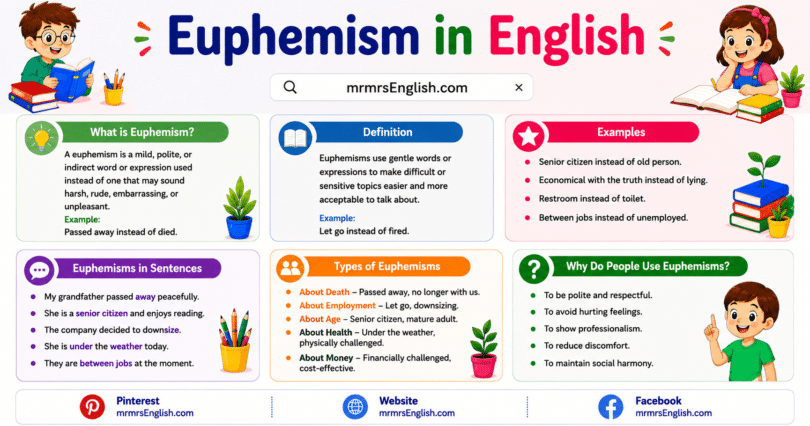
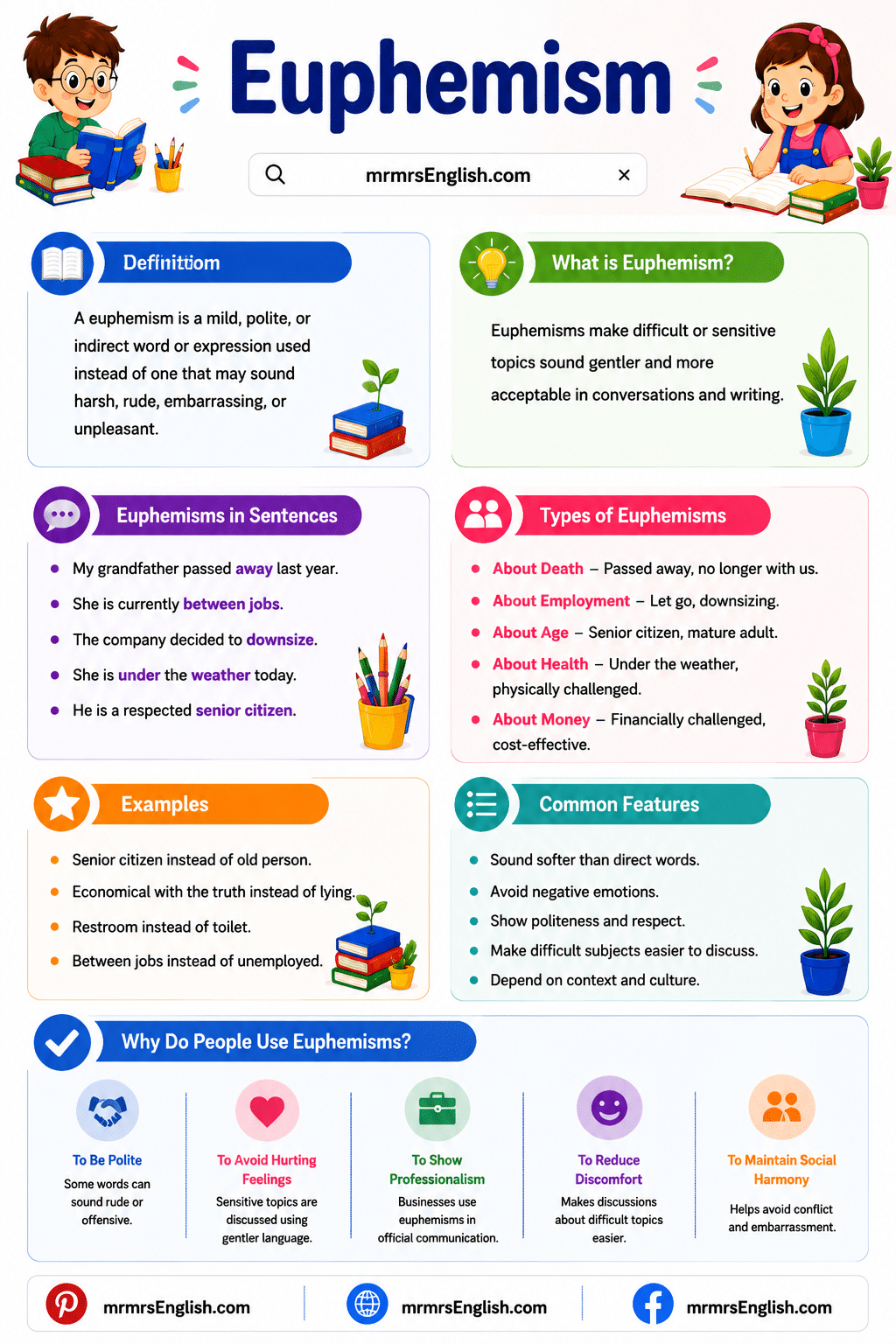
A euphemism is a mild, polite, or indirect word or expression used instead of one that may sound harsh, rude, embarrassing, or unpleasant. In simple words, euphemisms make difficult topics sound gentler and more acceptable.
Examples
- Passed away instead of died
- Senior citizen instead of old person
- Let go instead of fired
- Economical with the truth instead of lying
In each example, the euphemism sounds softer than the direct expression.
Why Do People Use Euphemisms?
People use euphemisms for many reasons.
To Be Polite
Some words can sound rude or offensive. Euphemisms help make conversations more respectful.
To Avoid Hurting Feelings
Sensitive topics such as age, illness, and death are often discussed using gentler language.
To Show Professionalism
Businesses and organizations frequently use euphemisms in official communication.
To Reduce Discomfort
Topics related to death, money, health, and personal problems can make people uncomfortable. Euphemisms make these discussions easier.
Common Features of Euphemisms
Euphemisms usually:
- Sound softer than direct words.
- Avoid negative emotions.
- Show politeness and respect.
- Make difficult subjects easier to discuss.
- Depend on context and culture.
Common Euphemisms and Their Meanings
| Euphemism | Direct Meaning |
|---|---|
| Passed away | Died |
| Let go | Fired from a job |
| Senior citizen | Old person |
| Between jobs | Unemployed |
| Correctional facility | Prison |
| Economical with the truth | Lying |
| Physically challenged | Disabled |
| Restroom | Toilet |
| Sleep with | Have sexual relations |
| Downsizing | Reducing employees |
Types of Euphemisms
Euphemisms About Death
Death is one of the most common topics where euphemisms are used.
Examples
- Passed away
- No longer with us
- At rest
- Departed
- Gone to a better place
Example Sentence:
- My grandfather passed away peacefully last year.
Euphemisms About Employment
Companies often use softer terms when discussing jobs and employment.
Examples
- Let go
- Downsizing
- Career transition
- Workforce reduction
- Seeking new opportunities
Example Sentence:
- Several employees were let go during the restructuring process.
Euphemisms meaning in English with Examples
Euphemisms About Age
People often use polite expressions when talking about age.
Examples
- Senior citizen
- Golden-aged
- Mature adult
- Older adult
Example Sentence:
- The museum offers discounts for senior citizens.
Euphemisms About Health
Health-related topics can be sensitive, so euphemisms are commonly used.
Examples
- Under the weather
- Not feeling well
- Special needs
- Physically challenged
Example Sentence:
- She is feeling under the weather today.
Euphemisms About Money
Financial difficulties are often described using indirect language.
Examples
- Financially challenged
- Tight budget
- Economic hardship
- Cost-effective
Example Sentence:
- The family is currently facing economic hardship.
Euphemisms in Everyday English
Many people use euphemisms without realizing it.
Daily Examples
| Euphemism | Meaning |
|---|---|
| Restroom | Toilet |
| Put to sleep | Euthanized |
| Full-figured | Overweight |
| Housekeeper | Cleaner |
| Sanitation worker | Garbage collector |
| Correctional officer | Prison guard |
| Domestic engineer | Homemaker |
| Between jobs | Unemployed |
These expressions often sound more respectful and socially acceptable.
Euphemisms in Literature
Writers use euphemisms to:
- Create a polite tone.
- Avoid offensive language.
- Discuss sensitive topics carefully.
- Improve the flow of writing.
- Reflect cultural values.
In novels, poems, and stories, euphemisms help authors communicate difficult ideas without sounding harsh.
Euphemisms in Business English
Business communication frequently contains euphemisms.
Common Business Euphemisms
| Euphemism | Meaning |
|---|---|
| Downsizing | Reducing staff |
| Rightsizing | Cutting jobs |
| Restructuring | Organizational changes |
| Revenue enhancement | Price increase |
| Negative cash flow | Financial loss |
Example
Instead of saying:
- “The company fired 100 workers.”
A company may say:
- “The company is undergoing a workforce restructuring.”
Euphemisms vs Direct Language
| Euphemism | Direct Language |
|---|---|
| Passed away | Died |
| Let go | Fired |
| Senior citizen | Old person |
| Restroom | Toilet |
| Economical with the truth | Lie |
| Between jobs | Unemployed |
Direct language is clearer, while euphemisms are often more polite and less emotional.
Advantages of Using Euphemisms
Politeness
They help people communicate respectfully.
Professional Communication
They are useful in workplaces and formal situations.
Emotional Sensitivity
They reduce the emotional impact of difficult topics.
Social Harmony
They help avoid conflict and embarrassment.
Disadvantages of Euphemisms
Can Be Confusing
Some people may not understand the real meaning.
May Hide the Truth
Overusing euphemisms can make information unclear.
Can Sound Misleading
In politics and business, euphemisms are sometimes used to make negative situations sound better.
How to Identify Euphemisms
Ask yourself these questions:
- Does the phrase sound softer than the actual meaning?
- Is it replacing a harsh or uncomfortable word?
- Is it being used to show politeness?
- Is the speaker avoiding direct language?
If the answer is yes, the expression is likely a euphemism.
Examples of Euphemisms in Sentences
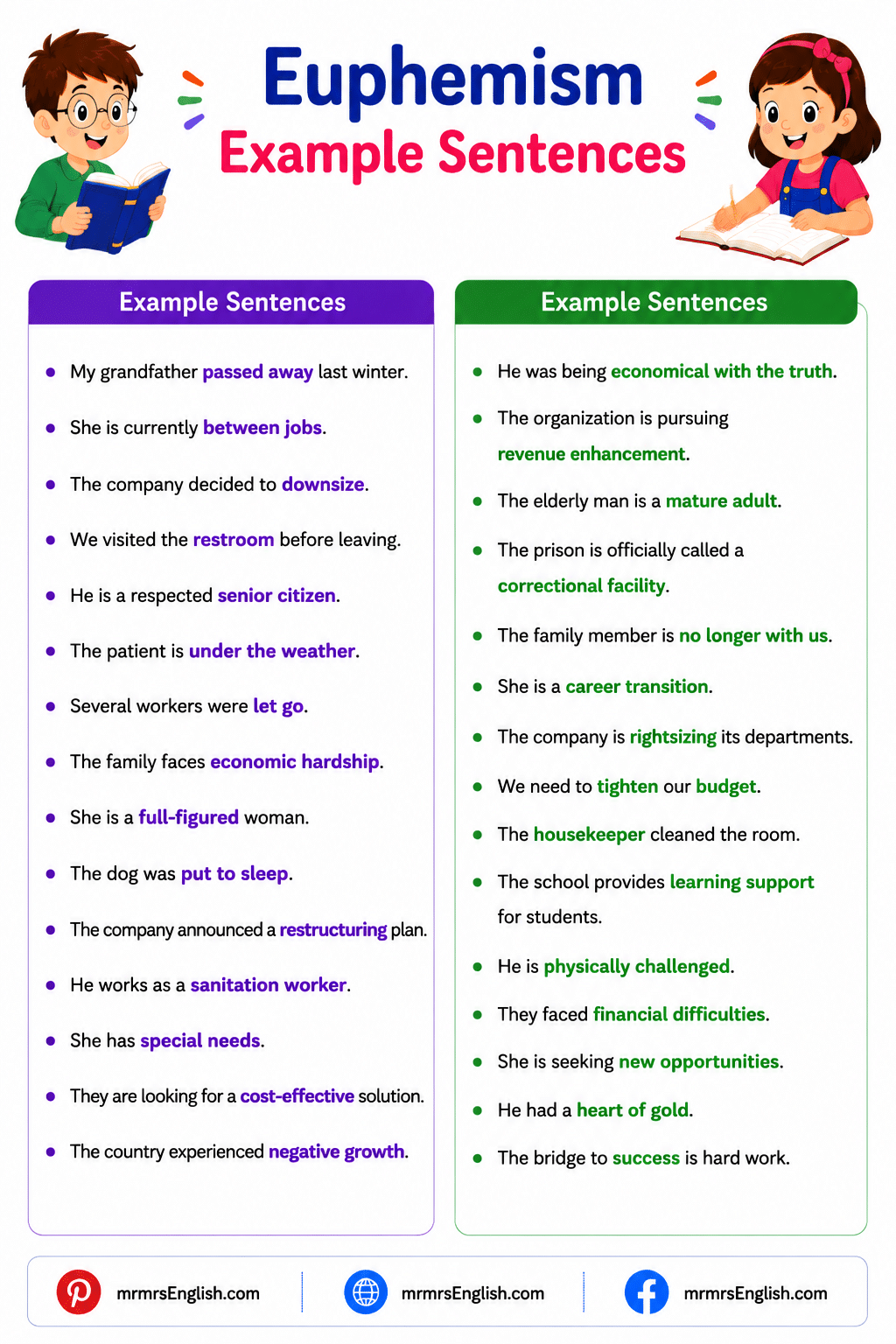
- My grandfather passed away last winter.
- She is currently between jobs.
- The company decided to downsize.
- We visited the restroom before leaving.
- He is a respected senior citizen.
- The patient is under the weather.
- Several workers were let go.
- The family faces economic hardship.
- She is a full-figured woman.
- The dog was put to sleep.
- The company announced a restructuring plan.
- He works as a sanitation worker.
- She has special needs.
- They are looking for a cost-effective solution.
- The country experienced negative growth.
- He was being economical with the truth.
- The organization is pursuing revenue enhancement.
- The elderly man is a mature adult.
- The prison is officially called a correctional facility.
- The family member is no longer with us.
Examples of Euphemisms in Sentences in English
Common Mistakes Students Make
Confusing Euphemisms with Idioms
Not all euphemisms are idioms. A euphemism specifically softens an unpleasant idea.
Using Euphemisms in Every Situation
Direct language is sometimes more appropriate, especially in academic and factual writing.
Misunderstanding Context
Some euphemisms are suitable only in formal situations, while others are used in casual conversation.






Leave a Comment