
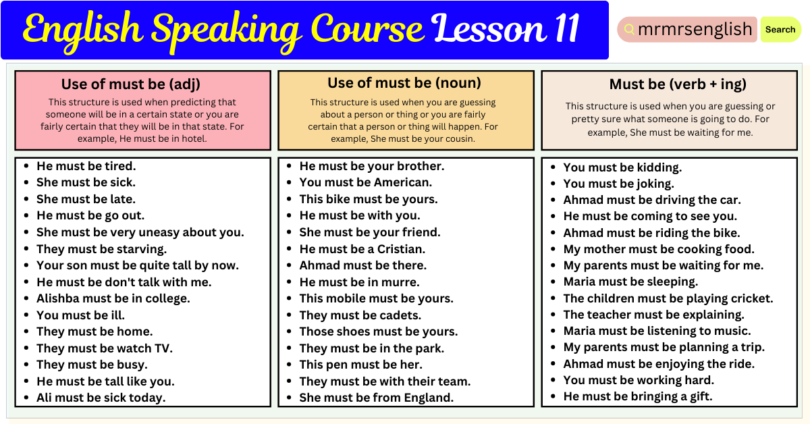
Learning English through sentence structures is one of the easiest ways to develop strong speaking skills and communicate with confidence. Sentence patterns teach learners how to build correct and meaningful sentences that can be used in real-life situations. By practicing these structures regularly, you can improve your grammar, expand your vocabulary, and speak more naturally in everyday conversations. Each lesson introduces practical patterns that make learning simple and organized. In this Lesson 11 of the English Speaking Course by Structures, you will learn useful sentence structures and examples that will help you improve your fluency and communicate more effectively in English.
Use of must be (adj)
This structure is used when predicting that someone will be in a certain state or you are fairly certain that they will be in that state. For example, He must be in hotel.
Structure: [Subject] + must be + [adjective/noun/present participle]
- He must be tired.
- She must be sick.
- She must be late.
- He must be go out.
- She must be very uneasy about you.
- They must be starving.
- Your son must be quite tall by now.
- He must be don’t talk with me.
- Alishba must be in college.
- You must be ill.
- They must be home.
- They must be watch TV.
- They must be busy.
- He must be tall like you.
- Ali must be sick today.

English Speaking Course Lesson 11 by Structures
Use of must be (noun)
This structure is used when you are guessing about a person or thing or you are fairly certain that a person or thing will happen. For example, She must be your cousin.
Structure: [Subject] + must be + [noun/adjective]
- He must be your brother.
- You must be American.
- This bike must be yours.
- He must be with you.
- She must be your friend.
- He must be a Cristian.
- Ahmad must be there.
- He must be in murre.
- This mobile must be yours.
- They must be cadets.
- Those shoes must be yours.
- They must be in the park.
- This pen must be her.
- They must be with their team.
- She must be from England.

English Speaking Course Lesson 11 by Structures
Must be (verb + ing)
This structure is used when you are guessing or pretty sure what someone is going to do. For example, She must be waiting for me.
Structure: [Subject] + must be + ing + [present participle]
- You must be kidding.
- You must be joking.
- Ahmad must be driving the car.
- He must be coming to see you.
- Ahmad must be riding the bike.
- My mother must be cooking food.
- My parents must be waiting for me.
- Maria must be sleeping.
- The children must be playing cricket.
- The teacher must be explaining.
- Maria must be listening to music.
- My parents must be planning a trip.
- Ahmad must be enjoying the ride.
- You must be working hard.
- He must be bringing a gift.

English Speaking Course Lesson 11 by Structures
Read Also:

Leave a Comment