
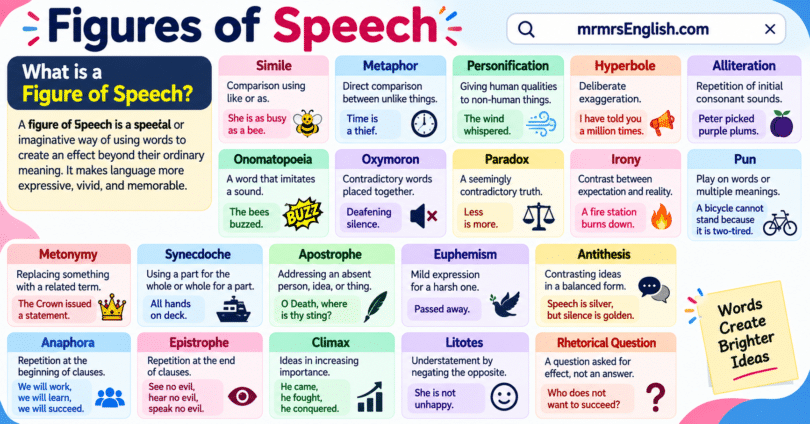
Figures of speech are an important part of English because they make ordinary sentences more expressive, imaginative, and meaningful. Instead of using every word in its literal sense, a speaker or writer can use comparison, exaggeration, contrast, repetition, or association to communicate an idea more effectively. Learning the types of figures of speech with examples helps students understand poetry, stories, speeches, and everyday conversations. It also improves reading comprehension and creative writing. In this article, you will learn what a figure of speech is, its major types, their functions, and clear examples from basic to advanced levels.
What Is a Figure of Speech?
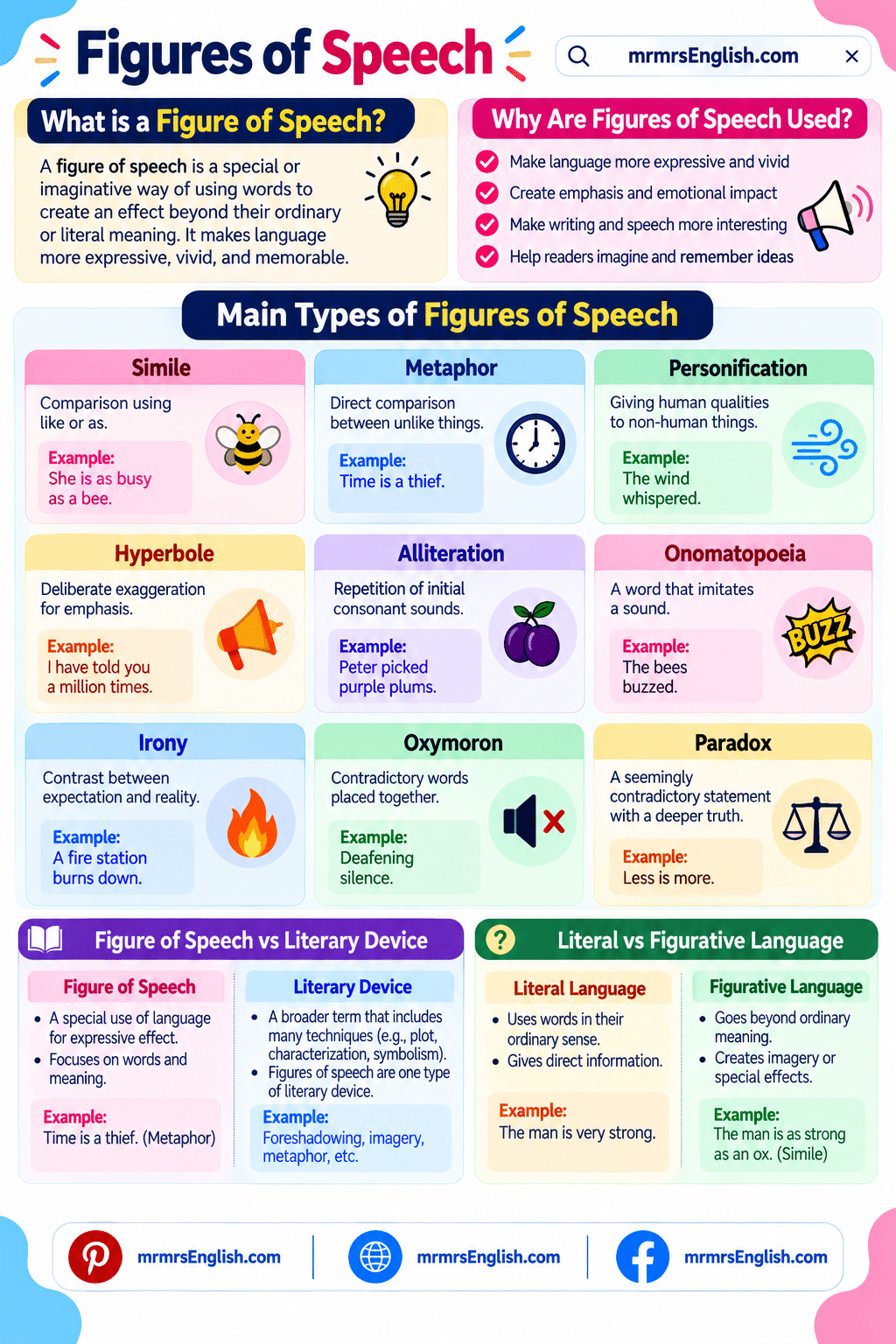
A figure of speech is a special or imaginative way of using words to create an effect beyond their ordinary or literal meaning. It may be used to compare ideas, create emphasis, describe something vividly, express emotion, or make language more memorable.
For example:
- Literal: The classroom was very noisy.
- Figurative: The classroom was a zoo.
The classroom is not actually a zoo. The word zoo is used to suggest that the classroom was noisy, wild, or disorderly. Figures of speech are commonly used in poetry, literature, speeches, songs, advertisements, stories, and everyday English.
Why Are Figures of Speech Used?
Figures of speech are not used only for decoration. They can perform important functions in both spoken and written English. Writers and speakers use them to:
- make descriptions more vivid and interesting
- explain difficult ideas through familiar comparisons
- emphasize important words or ideas
- express strong feelings and emotions
- create humor, surprise, or dramatic effect
- make language more memorable
- give deeper meanings to simple statements
- create rhythm and sound effects
- help readers imagine a person, place, object, or situation
For example, saying “He was very brave” gives direct information. Saying “He was a lion on the battlefield” creates a much stronger image of courage.
Main Types of Figures of Speech in English
There are many figures of speech in English. Some are based on comparison, while others depend on exaggeration, repetition, contrast, sound, association, substitution, or unusual sentence structure.
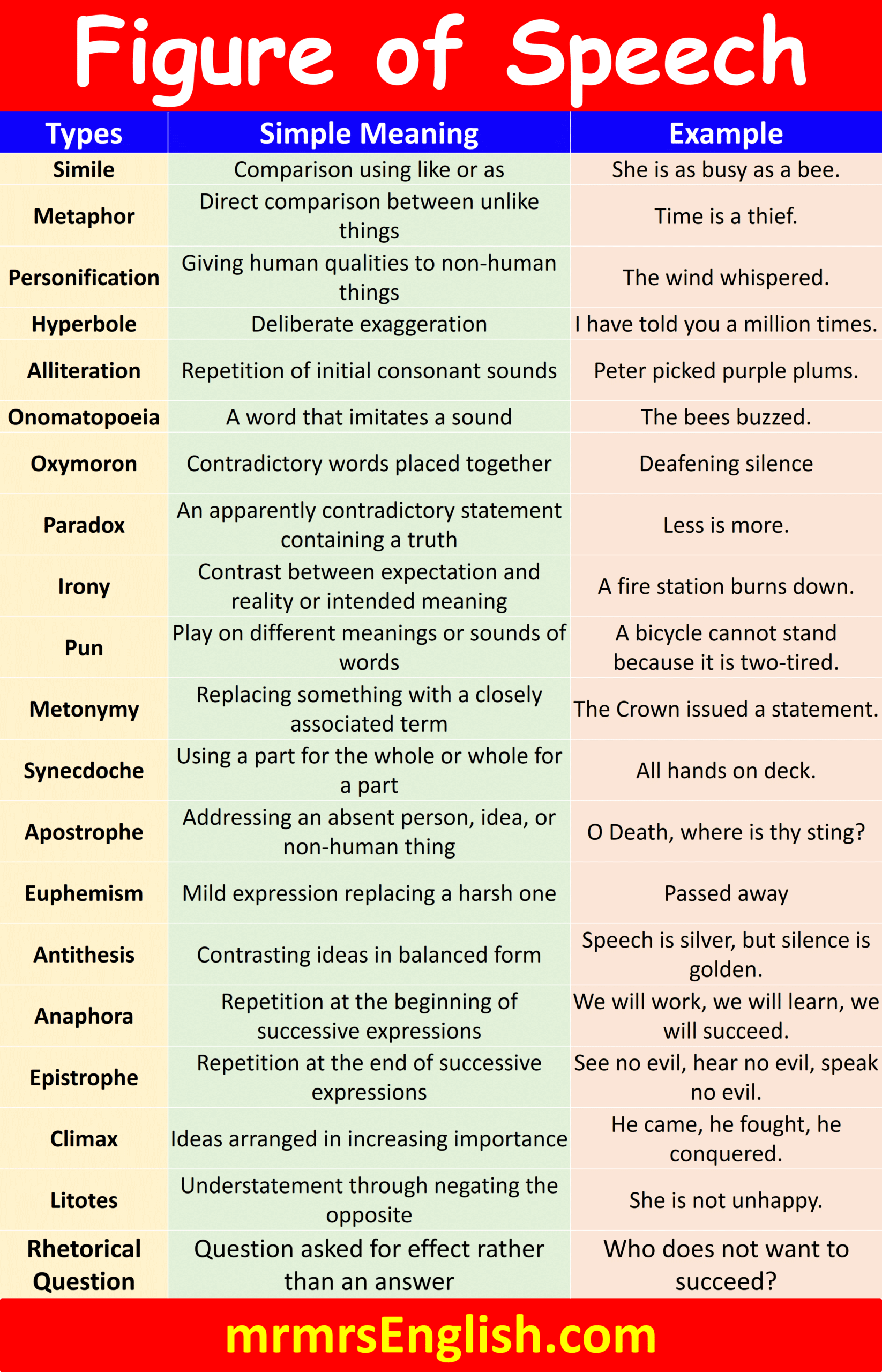
| Figure of Speech | Simple Meaning | Example |
|---|---|---|
| Simile | Comparison using like or as | She is as busy as a bee. |
| Metaphor | Direct comparison between unlike things | Time is a thief. |
| Personification | Giving human qualities to non-human things | The wind whispered. |
| Hyperbole | Deliberate exaggeration | I have told you a million times. |
| Alliteration | Repetition of initial consonant sounds | Peter picked purple plums. |
| Onomatopoeia | A word that imitates a sound | The bees buzzed. |
| Oxymoron | Contradictory words placed together | Deafening silence |
| Paradox | An apparently contradictory statement containing a truth | Less is more. |
| Irony | Contrast between expectation and reality or intended meaning | A fire station burns down. |
| Pun | Play on different meanings or sounds of words | A bicycle cannot stand because it is two-tired. |
| Metonymy | Replacing something with a closely associated term | The Crown issued a statement. |
| Synecdoche | Using a part for the whole or whole for a part | All hands on deck. |
| Apostrophe | Addressing an absent person, idea, or non-human thing | O Death, where is thy sting? |
| Euphemism | Mild expression replacing a harsh one | Passed away |
| Antithesis | Contrasting ideas in balanced form | Speech is silver, but silence is golden. |
| Anaphora | Repetition at the beginning of successive expressions | We will work, we will learn, we will succeed. |
| Epistrophe | Repetition at the end of successive expressions | See no evil, hear no evil, speak no evil. |
| Climax | Ideas arranged in increasing importance | He came, he fought, he conquered. |
| Litotes | Understatement through negating the opposite | She is not unhappy. |
| Rhetorical Question | Question asked for effect rather than an answer | Who does not want to succeed? |
20 Figures of Speech types with meaning and Examples in English
Simile
A simile is a figure of speech that directly compares two different things using words such as “like” or “as.” It helps make descriptions clearer, more vivid, and easier for readers to imagine.
Examples:
- She is as gentle as a lamb.
- His face was like the moon.
- The water was as clear as glass.
- He runs like the wind.
- The baby slept like a log.
In “The water was as clear as glass,” water and glass are different things, but they are compared because both can be clear.
How to Identify a Simile
Look for a comparison between two unlike things, especially when the sentence contains like or as. However, every sentence containing like or as is not automatically a simile. There must be a meaningful comparison.
Metaphor
A metaphor is a figure of speech that directly describes one thing as another to show a shared quality, without using “like” or “as.” It makes ideas more vivid, expressive, and meaningful.
Examples:
- Time is a thief.
- Life is a journey.
- Her voice was music to my ears.
- The world is a stage.
- He has a heart of stone.
In “Time is a thief,” time is not literally a thief. The metaphor suggests that time gradually takes moments, opportunities, or experiences away from us.
Simile vs Metaphor
| Simile | Metaphor |
|---|---|
| Makes an explicit comparison | Makes a direct or implied comparison |
| Commonly uses like or as | Usually does not use like or as |
| She is like a star. | She is a star. |
| His heart is as cold as ice. | He has a heart of ice. |
Personification
Personification is a figure of speech in which human qualities, feelings, or actions are given to non-human things, such as animals, objects, or nature. It makes descriptions more vivid, imaginative, and engaging.
Examples:
- The wind whispered through the trees.
- The sun smiled at us.
- The flowers danced in the breeze.
- Opportunity knocked at his door.
- The old house groaned in the storm.
The wind cannot literally whisper. The human action whispered makes the description more vivid.
Hyperbole
Hyperbole is a figure of speech that uses deliberate exaggeration for emphasis or effect rather than literal truth. It makes an idea, feeling, action, or situation seem stronger, larger, smaller, or more dramatic.
Examples:
- I have told you a million times.
- This bag weighs a ton.
- I am dying of hunger.
- She cried a river of tears.
- I waited forever for the bus.
When someone says “I waited forever,” the person does not mean an infinite amount of time. The exaggeration shows that the wait felt extremely long.
Alliteration
Alliteration is a figure of speech in which the same initial consonant sound is repeated in nearby words. It creates rhythm, adds emphasis, and makes phrases, poems, speeches, and sentences more memorable.
Examples:
- Peter picked purple plums.
- Big bears bake bread.
- Silly snakes slide slowly.
- Wild winds whistled.
- Friendly frogs found food.
Alliteration is frequently used in poetry, slogans, advertisements, tongue twisters, and brand names because repeated sounds can make language memorable.
Onomatopoeia
Onomatopoeia is a figure of speech in which a word imitates or suggests the sound it describes, such as buzz, hiss, bang, or splash. It makes writing more vivid, expressive, and engaging.
Common examples include:
- buzz
- hiss
- bang
- crash
- tick-tock
- splash
- click
- boom
Examples in sentences:
- The bees buzzed around the flowers.
- The balloon went bang.
- Water splashed onto the floor.
- The snake hissed at us.
- Thunder went boom across the sky.
These words help readers imagine not only an action but also its sound.
Oxymoron
An oxymoron is a figure of speech that combines two apparently contradictory or opposite words to create a meaningful expression. Examples include deafening silence, bittersweet, and living dead. It adds emphasis and creative effect.
Examples:
- deafening silence
- bittersweet
- open secret
- living dead
- seriously funny
- clearly confused
For example, “deafening silence” combines two opposite ideas. Silence produces no sound, but deafening emphasizes how powerful or uncomfortable that silence feels.
Paradox
A paradox is a figure of speech that presents a seemingly contradictory or illogical statement that may reveal a deeper meaning or truth. It encourages readers to think carefully about the idea being expressed.
Examples:
- Less is more.
- The more you learn, the more you realize how little you know.
- The only constant is change.
- I must be cruel only to be kind.
- The beginning of the end.
A paradox is usually broader than an oxymoron. An oxymoron often places contradictory words together, whereas a paradox generally presents an apparently contradictory idea or statement.
Oxymoron vs Paradox
| Oxymoron | Paradox |
|---|---|
| Usually combines contradictory words | Usually involves a contradictory statement or idea |
| Often short | Can form a complete sentence |
| Deafening silence | Less is more. |
| Creates a striking expression | Often reveals a deeper meaning |
Irony
Irony is a figure of speech in which the intended meaning differs from the literal meaning of the words, often creating emphasis, humor, or criticism. It commonly depends on a contrast between appearance and reality.
Examples:
- A fire station catches fire.
- A traffic officer receives a parking ticket.
- Someone looks outside during heavy rain and says, “What beautiful weather!”
Irony can create humor, criticism, surprise, or dramatic effect.
Common Types of Irony
Irony is commonly divided into verbal, situational, and dramatic irony. Verbal irony contrasts words with intended meaning, situational irony involves unexpected outcomes, and dramatic irony occurs when the audience knows more than the characters.
Verbal irony occurs when someone says something but intends a contrasting meaning.
Example:
“Wonderful!” she said after dropping her phone.
Situational irony occurs when the result of a situation is significantly different from what is expected.
Example:
A swimming instructor is afraid of water.
Dramatic irony occurs when the audience knows something important that a character does not know.
This form is particularly common in plays, films, and stories.
Pun
A pun is a figure of speech that creates humor or emphasis by using words with multiple meanings or words that sound alike but have different meanings. It is commonly used for clever wordplay.
Examples:
- The bicycle could not stand because it was two-tired.
- The math teacher has too many problems.
- A boiled egg is hard to beat.
- The calendar’s days are numbered.
Puns depend heavily on understanding the different meanings or sounds involved.
Metonymy
Metonymy is a figure of speech in which the name of one thing is replaced by the name of something closely associated with it. It makes expressions shorter, more vivid, and more meaningful.
Examples:
- The Crown issued a statement.
- The White House announced the decision.
- She enjoys reading Shakespeare.
- The suits entered the meeting room.
- The press surrounded the actor.
In “She enjoys reading Shakespeare,” Shakespeare refers to the works written by Shakespeare, rather than the person himself.
Synecdoche
Synecdoche is a figure of speech in which a part represents the whole, the whole represents a part, or a related part-whole relationship is used.
Examples:
- We need more hands to finish the work.
- There are many new faces in the class.
- He bought a new set of wheels.
- England won the match.
In “We need more hands,” hands represents complete people or workers.
Metonymy vs Synecdoche
| Metonymy | Synecdoche |
|---|---|
| Based on association | Based mainly on a part-whole relationship |
| The Crown = monarchy | Hands = workers |
| The substitute is closely related to the thing | The substitute is a part or whole of the thing represented |
Apostrophe
In figures of speech, apostrophe occurs when a speaker directly addresses an absent person, dead person, abstract idea, object, or non-human thing as though it could hear or respond.
Examples:
- O Death, where is thy sting?
- O Moon, guide me tonight.
- Time, please slow down.
- Love, why are you so difficult?
- O Freedom, how precious you are!
Apostrophe is especially common in poetry and emotional speeches. It should not be confused with the punctuation mark apostrophe (‘) used in contractions and possessive forms.
Euphemism
A euphemism is a mild, polite, or indirect expression used instead of one that may sound harsh, unpleasant, embarrassing, or offensive.
| Euphemism | More Direct Expression |
|---|---|
| Passed away | Died |
| Let go | Fired |
| Senior citizen | Old person |
| Between jobs | Unemployed |
| Correctional facility | Prison |
For example, people commonly say “He passed away” instead of “He died” when they want to speak more gently.
Antithesis
Antithesis is a figure of speech that places contrasting or opposite ideas close together, often in a balanced grammatical structure. It emphasizes differences, strengthens meaning, and makes an expression more striking and memorable.
Examples:
- Speech is silver, but silence is golden.
- To err is human; to forgive, divine.
- Many are called, but few are chosen.
- We must learn to live together, not die alone.
The contrast makes both ideas clearer and often gives the sentence a memorable rhythm.
Anaphora
Anaphora is the deliberate repetition of a word or group of words at the beginning of successive clauses, sentences, or lines.
Example:
We will work for success.
We will work for change.
We will work for a better future.
Another example:
Every day I learn.
Every day I improve.
Every day I move forward.
Anaphora creates emphasis, rhythm, emotional force, and unity.
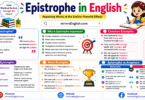
Epistrophe
Epistrophe is the repetition of the same word or expression at the end of successive clauses, sentences, or lines.
Example:
We want justice.
They demand justice.
Everyone deserves justice.
Anaphora repeats words at the beginning, while epistrophe repeats them at the end.
Repetition
Repetition is the intentional use of the same word, phrase, sound, or idea more than once to create emphasis, rhythm, clarity, or emotional force.
Examples:
- Run, run, run as fast as you can.
- It was a long, long journey.
- Never, never, never give up.
- The rain continued day after day after day.
Repetition is a broad technique. Anaphora and epistrophe are specific forms of repetition based on where the repeated expression appears.
Climax
Climax, as a figure of speech, arranges words, ideas, or events in an order of increasing importance, intensity, or force.
Examples:
- He whispered, spoke, and shouted.
- She studied, graduated, and became a doctor.
- He came, he saw, he conquered.
- The incident affected the village, the city, and the entire country.
Each idea becomes stronger or more important than the previous one.
Anticlimax
Anticlimax occurs when a sequence moves from something serious, important, or powerful to something unexpectedly trivial or less important. For example, he lost his family, his fortune, and his favorite hat. The first two losses are serious, while the final item is comparatively unimportant. This sudden drop can create a humorous or disappointing effect.
Litotes
Litotes expresses an idea through understatement, commonly by denying its opposite.
Examples:
- She is not unhappy.
- He is not a bad singer.
- The test was no easy task.
- That is not impossible.
- It was not an ordinary performance.
For example, “He is not a bad singer” can indirectly suggest that he is actually a good singer.
Understatement
Understatement deliberately presents something as less important, serious, large, or intense than it actually is.
Examples:
- After a terrible storm: “The weather was a little rough.”
- After winning a major competition: “I did fairly well.”
- Looking at a badly damaged car: “It has a small scratch.”
Understatement can be used for humor, politeness, irony, or controlled emotional effect.
Rhetorical Question
A rhetorical question is asked to create emphasis or make the audience think rather than to receive an actual answer.
Examples:
- Who does not want to be successful?
- Is money everything in life?
- How could I ever forget that day?
- Why waste your valuable time?
- Can anyone live forever?
The expected answer is usually obvious or unnecessary.
Allusion
An allusion is a brief and indirect reference to a well-known person, event, place, story, historical event, myth, or literary work. The writer expects the reader to recognize the reference.
Examples:
- He met his Waterloo in the final competition.
- She has the patience of Job.
- Opening that box was like opening Pandora’s box.
- He acts like Romeo whenever he falls in love.
An allusion can communicate a large idea using only a few words because it relies on the reader’s existing knowledge.
Allegory
An allegory is an extended narrative or representation in which characters, events, places, or objects can represent deeper moral, social, political, or abstract ideas. For example, a story about animals ruling a farm may also represent ideas about power, leadership, or society.
Unlike a simple metaphor, an allegory can continue through an entire story, poem, painting, or other work.
Analogy
An analogy explains an idea by showing a meaningful similarity or relationship between two things. It is particularly useful for making a difficult idea easier to understand.
Examples:
- The heart works like a pump, moving blood around the body.
- Learning a language is like building a house; a strong foundation makes later progress easier.
- Just as a key opens a lock, knowledge can open opportunities.
An analogy is usually more explanatory than a simple simile.
Antonomasia
Antonomasia substitutes a descriptive title or characteristic expression for a person’s proper name, or sometimes uses a famous proper name to describe someone with similar qualities.
Examples:
- The Bard for William Shakespeare
- The King of Pop for Michael Jackson
- He is an Einstein in mathematics.
- She thinks she is Cinderella.
Antonomasia helps emphasize the identity, reputation, or characteristic quality associated with a person.
Periphrasis
Periphrasis uses a longer or indirect expression instead of a shorter and more direct word or phrase.
Examples:
- The king of the jungle instead of lion
- The city that never sleeps instead of New York City
- The heavenly body that lights our day instead of the sun
It can make language more descriptive, indirect, elegant, or expressive.
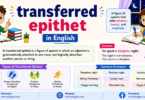
Transferred Epithet
A transferred epithet occurs when an adjective is grammatically attached to one noun even though the quality logically belongs more directly to another person or thing connected with it.
Examples:
- a sleepless night
- an anxious hour
- a weary road
- a restless night
- a happy morning
In “a sleepless night,” the night itself does not sleep. The person experiencing the night is sleepless.
Catachresis
Catachresis is an unusual, strained, or deliberately unconventional use of a word or expression, often created by applying language in a way that does not logically or literally fit.
Examples may include expressions such as:
- the mouth of a river
- the leg of a table
- the arms of a chair
In traditional rhetoric, catachresis can also involve a mixed, stretched, or seemingly improper metaphor used for expressive effect.
It is an advanced literary device and should be distinguished from an ordinary error in word choice.
Conceit
A conceit is an extended, imaginative, and often surprising comparison between two things that may initially appear very different. For example, a poet may compare two lovers to the two legs of a compass, developing the comparison through several related ideas. A conceit is generally more elaborate and intellectually developed than an ordinary metaphor.
Amplification
Amplification expands an idea by adding details, explanations, descriptions, examples, or repeated information to increase its importance or make its meaning clearer.
Example:
The storm was dangerous—dangerous enough to destroy homes, uproot trees, block roads, and leave thousands of people without electricity.
The central idea “The storm was dangerous” is expanded with additional details to strengthen its effect.
Assonance
Assonance is the repetition of similar vowel sounds in nearby words.
Examples:
- The light of the fire is bright.
- Go and mow the lawn.
- The mellow wedding bells.
Assonance is particularly common in poetry because it can create rhythm, musicality, and mood.
Consonance
Consonance is the repetition of consonant sounds in nearby words, especially in positions other than only the beginning.
Examples:
- blank and think
- luck and lock
- pitter-patter
The main difference is that alliteration usually emphasizes beginning consonant sounds, while consonance can occur at different positions within words.
types of figure of speech
Anaphora vs Epistrophe vs Repetition
These devices are related but differ in how repetition is arranged.
| Device | Where Repetition Occurs | Example |
|---|---|---|
| Anaphora | Beginning | We need hope. We need courage. |
| Epistrophe | End | We want peace. They deserve peace. |
| Repetition | Anywhere | Never, never, never quit. |
Major Categories of Figures of Speech
Figures of speech can also be understood according to the technique they use. The exact classification can vary among grammar and rhetoric textbooks, but the following grouping is useful for learners.
Figures Based on Comparison
These devices establish similarities or imaginative relationships between things.
- Simile
- Metaphor
- Analogy
- Conceit
- Personification
Figures Based on Contrast
These devices gain their effect from opposing or apparently contradictory ideas.
Examples include:
- Antithesis
- Oxymoron
- Paradox
- Irony
Figures Based on Association or Substitution
These figures replace or represent one thing through another connected expression.
Examples include:
- Metonymy
- Synecdoche
- Antonomasia
- Periphrasis
Figures Based on Emphasis
These figures strengthen, reduce, expand, or intensify an idea.
Examples include:
- Hyperbole
- Litotes
- Understatement
- Amplification
- Climax
- Anticlimax
Figures Based on Repetition
These devices repeat sounds, words, or structures to create emphasis and rhythm.
Examples include:
- Repetition
- Anaphora
- Epistrophe
- Alliteration
- Assonance
- Consonance
Figures Based on Sound
These devices produce their effect mainly through sound patterns.
Examples include:
- Alliteration
- Assonance
- Consonance
- Onomatopoeia
Figure of Speech vs Literal Language
Understanding the difference between literal and figurative language is essential for identifying figures of speech.
| Literal Language | Figurative Language |
|---|---|
| Uses words in their ordinary sense | May go beyond ordinary word meanings |
| Gives direct information | Often creates imagery or special effects |
| The man is very strong. | The man is as strong as an ox. |
| She runs quickly. | She runs like the wind. |
| It is very cold. | It is freezing me to death. |
Literal language tells us directly what something is, while figurative language often helps us imagine what something feels, looks, sounds, or seems like.
Figure of Speech vs Literary Device
The terms figure of speech and literary device are related, but they are not always identical. figure of speech generally concerns a special use or arrangement of language, such as metaphor, simile, hyperbole, or personification.
A literary device is a broader term covering techniques writers use to construct meaning and effect. Literary devices can include symbolism, foreshadowing, flashback, imagery, irony, characterization, and figures of speech.
Therefore, figures of speech can be considered an important group within the broader range of literary and rhetorical devices.
How to Identify a Figure of Speech
Students can identify figures of speech more accurately by following a few steps.
Look Beyond the Literal Meaning
First, ask whether the sentence makes complete sense when interpreted literally.
For example: The stars danced in the sky.
Stars cannot literally dance. This suggests figurative language.
Look for Comparison
If two different things are compared, check whether the sentence contains a simile, metaphor, analogy, or conceit.
Her eyes were like stars.
The use of like indicates a simile.
Look for Human Qualities
If an object, animal, idea, or natural force performs a distinctly human action, it may be personification.
The wind whispered my name.
The wind receives the human action whispered.
Look for Exaggeration
Ask whether the statement is intentionally impossible or extremely exaggerated.
I have waited for a thousand years.
This is hyperbole.
Look for Repeated Sounds or Words
Repeated beginning sounds can suggest alliteration, while repeated words may indicate repetition, anaphora, or epistrophe depending on their position.
Look for Opposite Ideas
Expressions containing strong contradictions or contrasts may involve oxymoron, paradox, antithesis, or irony. The context and structure of the sentence help determine which one is being used.
Examples of Figures of Speech in Sentences
| Sentence | Figure of Speech |
|---|---|
| Her smile was like sunshine. | Simile |
| Knowledge is power. | Metaphor |
| The leaves danced in the wind. | Personification |
| I am so hungry I could eat a horse. | Hyperbole |
| Busy bees buzzed by. | Alliteration |
| The bacon sizzled in the pan. | Onomatopoeia |
| It was a deafening silence. | Oxymoron |
| Less is more. | Paradox |
| All hands were needed on deck. | Synecdoche |
| The White House made an announcement. | Metonymy |
| O Time, slow down! | Apostrophe |
| He passed away last night. | Euphemism |
| We will learn, we will grow, we will succeed. | Anaphora |
| They wanted freedom, fought for freedom, and died for freedom. | Epistrophe |
| Who does not want happiness? | Rhetorical Question |
| The test was no easy task. | Litotes |
| He whispered, spoke, and finally shouted. | Climax |
| The King of Pop became famous worldwide. | Antonomasia |
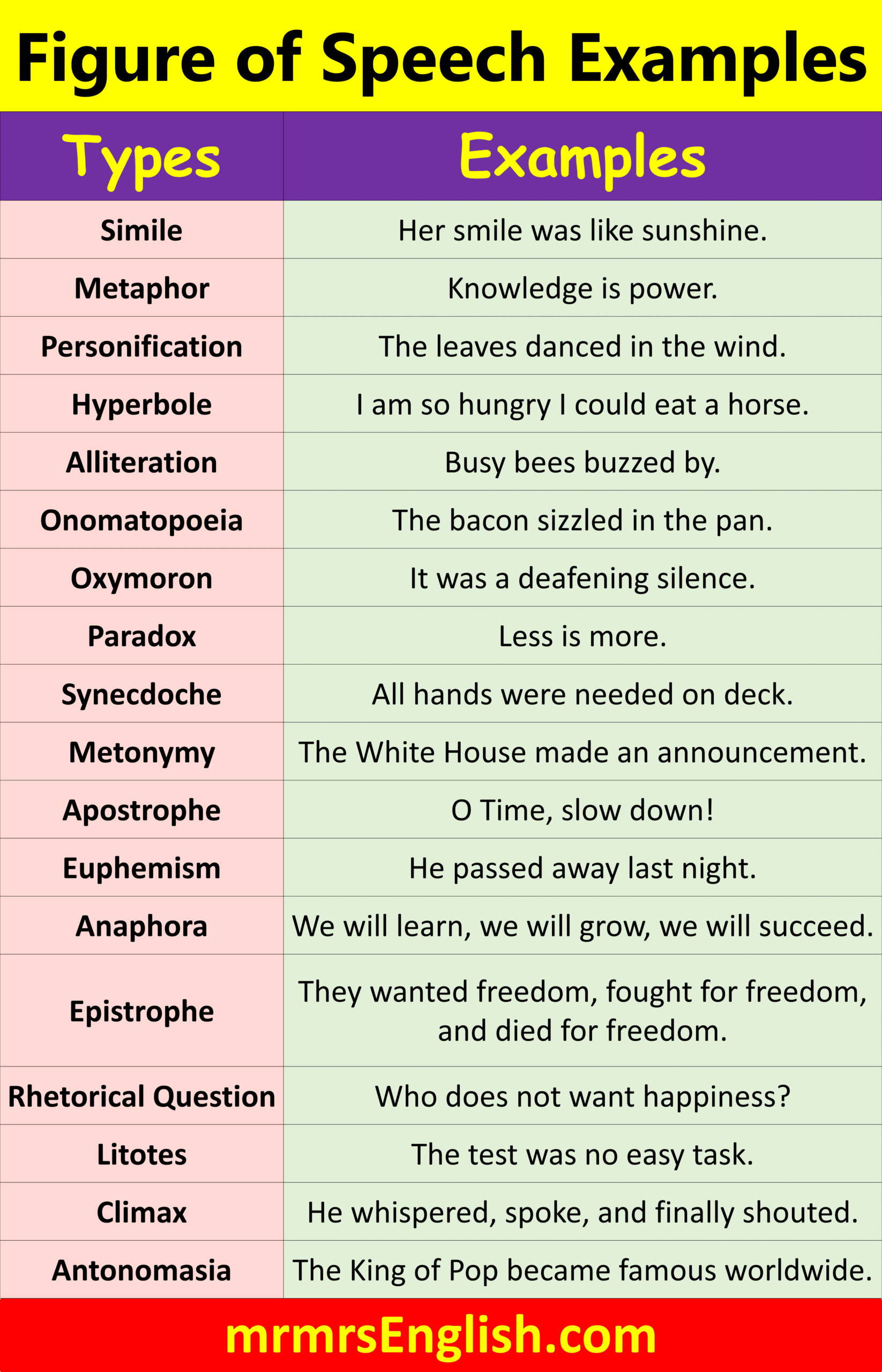
Figure of speech with examples
Importance of Figures of Speech in English
Figures of speech play an important role in both language learning and literary study. They allow writers to communicate more than the dictionary meanings of individual words.
For ESL students, understanding them is especially useful because figurative expressions frequently appear in poems, stories, novels, speeches, reading-comprehension passages, examinations, and everyday conversations.
They also help learners understand why a sentence such as “My brother is a night owl” should not be interpreted literally. The speaker means that the brother tends to remain awake or active late at night.
Common Mistakes When Learning Figures of Speech
Students often confuse figures of speech because several devices can appear similar.
One common mistake is treating every comparison as a simile. Remember that a simile usually makes an explicit comparison, commonly using like or as, while a metaphor identifies or describes one thing in terms of another.
Another common problem is confusing metonymy and synecdoche. Metonymy depends mainly on association, whereas synecdoche typically involves a part-whole relationship.
Students may also confuse oxymoron and paradox. An oxymoron usually combines contradictory words, while a paradox presents a broader statement or idea that appears contradictory but may contain truth.
Finally, figurative language should always be interpreted in context. The same word or expression can perform different functions depending on how it is used.
How to Use Figures of Speech in Writing
Figures of speech can make writing stronger when they are used naturally and purposefully.
For example, instead of writing:
The road was very busy.
You might write:
The road was a river of cars.
Instead of:
The wind was strong.
You could write:
The wind roared through the streets.
However, using too many figures of speech in every sentence can make writing difficult to understand. A good writer uses them where they add meaning, imagery, emphasis, rhythm, or emotion.
Frequently Asked Questions
What is a figure of speech in simple words?
A figure of speech is a special way of using words to make language more expressive or meaningful. It often goes beyond the ordinary literal meaning of the words.
What are the most common types of figures of speech?
Some of the most common types are simile, metaphor, personification, hyperbole, alliteration, onomatopoeia, irony, oxymoron, paradox, metonymy, and synecdoche.
What is the difference between simile and metaphor?
A simile makes an explicit comparison, usually with words such as like or as, while a metaphor directly describes one thing in terms of another.
For example:
- Simile: He fights like a lion.
- Metaphor: He is a lion in battle.
Is personification a figure of speech?
Yes. Personification is a figure of speech that gives human characteristics, emotions, or actions to animals, objects, ideas, or natural forces.
Example: The sun smiled at us.
Is hyperbole meant to be true?
No. Hyperbole is a deliberate exaggeration and is not intended to be interpreted literally.
For example, “I have called you a hundred times” may simply mean that the speaker has called many times.
What is the difference between metonymy and synecdoche?
Metonymy replaces something with a term closely associated with it, while synecdoche generally uses a part to represent a whole or a whole to represent a part.
For example:
- Metonymy: The Crown for the monarchy
- Synecdoche: hands for workers
Why are figures of speech important for students?
They help students understand figurative meanings, poetry, literature, reading passages, speeches, and everyday expressions. They can also improve descriptive and creative writing.
Can one sentence contain more than one figure of speech?
Yes. A sentence can contain multiple figures of speech. For example, it may use personification together with alliteration or combine metaphor with hyperbole. The exact interpretation depends on the language and context.
Figures of Speech PDF
Learn more helpful articles

Leave a Comment